Crochet Tutorials

Ready for a new crochet stitch, technique, or pattern? You’re in the right place! Browse all the crochet tutorials, or select a category from the dropdown menu. What will you learn today?


Double crochet 3 together dc3tog tutorial
Turn 3 stitches into 1 with the Double Crochet 3 Together (dc3tog) decrease! This standard double decrease starts with 3 ...More
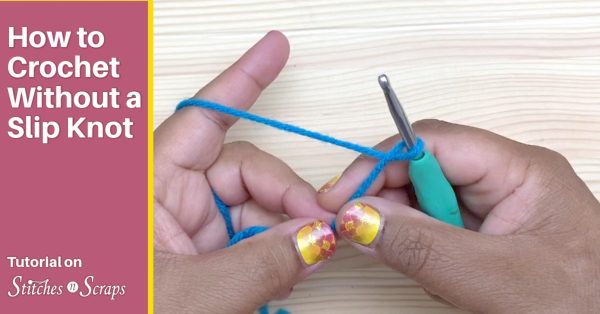
How to Crochet without a slip knot
Most of us learned to start our crochet by making a slip knot. It's so annoying to squish some soft, ...More
Swatch showing my way of doing hdc decreases
The traditional half double crochet 2 together (hdc2tog) decrease can be bulky, particularly at the edges of the fabric. This ...More
Tub of yarn scraps - StitchesNScraps.com

Tutorial – Combining scraps

If you’re like me, you have a LOT of little bits of leftover yarn. They’re too small to make much of anything with, and too big to just throw away or cut up for stuffing. This particular box is mostly Red Heart Super Saver, with some other worsted weight yarns well, such as Red Heart Kids (discontinued), and Red Heart Soft.

Tub of yarn scraps - StitchesNScraps.com

Many scrap projects rely on using small sections or motifs in each yarn, but that usually also means weaving in dozens of ends. So how can we work these up into something fun, without a nightmare finishing task? One way is by combining scraps together to make a jumbo yarn.

Basically, you work with multiple strands at the same time, replacing each strand as it runs out, one at a time. Here I have grabbed 5 random scraps of different lengths from my bin. It’s important to keep the lengths different as you will soon see. Holding them together, and using a large hook (I’m using a P/11.5 mm in this picture), I started crocheting as normal.

5 colors combined - StitchesNScraps.com  Starting chain - combining yarn scraps - StitchesNScraps.com

After just a few stitches, one of the scraps was nearly finished. No worries, when there was about 6-12 inches left, I simply replaced it with another scrap (leaving about a 12 inch tail), and kept crocheting, working over both tails to hide them. Go ahead and crochet over the whole tail until it’s all gone. I’m not normally a fan of working over tails in this way, as they tend to pull out over time. In this case though, with all the other yarns helping to hold it in place, it’s a bit more secure.

Adding a new color - combining yarn scraps - StitchesNScraps.com

Because multiple strands are used together, the yarn changes aren’t as noticeable, and the colors just gently shift. The really important part is making sure two strands don’t end at the same time. If you do end up in this situation, cut one of the strands at least a couple of feet shorter.I only worked with scraps that were at least 2-3 yards long, as those would last for more than just a few stitches.

Gradually shifting colors- combining yarn scraps - StitchesNScraps.com

Combining scraps like this even works with yarns of different weights, just stagger them in so the overall weight of the bundle doesn’t change as much. Small variations in overall thickness of the bundle are ok too.The resulting fabric is dense and fairly stiff, great for hotpads, rugs, and other household items. I’ll have a new pattern for you soon using this technique!


Double crochet 3 together dc3tog tutorial

Double Crochet 3 Together (dc3tog)

Turn 3 stitches into 1 with the Double Crochet 3 Together (dc3tog) decrease! This standard double decrease starts with 3 partial double crochet stitches, and then finishes them all together as one.

Double crochet 3 together dc3tog tutorial

This content is protected by copyright. See this Terms of Use / Copyright page for more information.

This post contains sponsored content and/or affiliate links. If you click an affiliate link and make a purchase, I may get a commission.


Centered Double Decrease

The double crochet 3 together is a double decrease because it takes 3 stitches and turns them into 1 stitch. First, partially work all 3 stitches, leaving the top of the stitch unfinished. Then, finish all three together as one in the final step.

This makes a centered decrease, with the top of the stitch resting directly above the second of the 3 stitches.

Standard double crochet 3 together

How to Double Crochet 3 Together (dc3tog)

Identify the base stitches/spaces

First, identify the 3 stitches or spaces you are working into. In this example I am working into 3 double crochet stitches on the previous row, but you can work into any type of stitch or space you like. They don’t have to be next to each other, or even in the same row. Anywhere you can put your hook can be one “leg” of the dc3tog.

3 stitches to work into

If you are using a more complicated arrangement of 3 locations, you may find it helpful to mark each one with a stitch marker so that it is easier to find later.

Make the Posts

Begin just like you would for a normal double crochet. Place the working yarn over the hook (yarn over), insert the hook into the first stitch or space, yarn over and pull up a loop. Then yarn over and pull through 2 loops on your hook.

1 partial dc

You should now have 2 loops on your hook, and 1 bottom half (post) of a double crochet in your first stitch/space.

Repeat this process in each of the other 2 locations, leaving an additional loop on your hook at the end of each post.

3 partial dc

You should now have 3 posts, and 4 loops on your hook.

Finish the dc3tog

To turn these 3 posts into one stitch, yarn over and pull through all 4 loops at once.

double crochet 3 together

3-Double Crochet Cluster

A dc3tog is the same thing as a 3-double crochet cluster (3-dc cl). When it is used to decrease stitches for shaping, it is usually referred to as a dc3tog. When it is used as a decorative element, it is more often referred to as a 3-dc cl.

3-dc cl

In this example, there is a chain space on either side of the cluster. This adds 2 chains in place of the 2 decreased stitches, so the total stitch count remains the same.

Alternative Double Decrease

The double crochet 3 together is perfect for centered shaping, where you want to pull stitches in from both sides, toward the middle. Sometimes though, particularly when working at the ends of rows, you may want a more angled and less bulky decrease. For those occasions, try this alternative double dc decrease instead!

Alternative Double Dc Decrease

Beyond 3

You can use this same technique to double-crochet any number of stitches together. Work the post of each stitch, leaving the last loop on your hook. Then finish them all together at the end, by pulling through all remaining loops.

This is a handy tool for gathering stitches together or to create decorative elements. Bavarian stitch, for example, uses a dc8tog (or 8-dc cl) to form the bottom of its characteristic diamond shapes. In this case, the cluster is worked around the posts of stitches, rather than into the tops of the stitches. Check it out in this Bavarian Stitch tutorial!

Bavarian Stitch in Rows - Crochet Tutorial on Stitches N Scraps

Double Crochet 3 Together (dc3tog) Video Tutorial

Watch this video on YouTube

Share this Tutorial on Pinterest!

Here’s an image perfect for pinning:

Double crochet 3 together dc3tog tutorial

Rate this Double Crochet 3 Together Tutorial!


Do you want the best of Stitches n Scraps delivered right to your inbox? Don’t miss a stitch – Subscribe now!

keeping your edges straight - StitchesNScraps.com

Tutorial – Keeping your edges straight

When working in rows, do you ever have trouble knowing where the first or last stitch is? Are your “straight” edges really anything but straight? This is a common issue for new crocheters, and even happens to us oldies sometimes, when we’re learning a new technique. It’s easy to fix though, and all it takes is 2 locking stitch markers. This technique also helps you think about and understand how the stitches are actually being formed.

keeping your edges straight - StitchesNScraps.com

If you have trouble finding the last stitch of the row, mark the first stitch of the previous row. Here’s a swatch of plain single crochet, where I’m at the start of a new row. When starting a new row in single crochet, you usually will chain one, and that chain does not count as a stitch. The loop that’s on your hook after the chain though, that becomes part of the first stitch – it actually becomes the “V” shape on the top, leading into the first stitch.

sc - keeping your edges straight - StitchesNScraps.com

When working back in the opposite direction, that loop is where you’re going to put your hook for the last stitch so let’s mark it now by putting the marker around the whole loop, just before we make that first stitch. See how that positions it in just the right spot?

Mark first st - keeping your edges straight - StitchesNScraps.com

Now I’m coming to the end of the row, and you can see the marker from the previous row. Finding the end of the row is easy – I know my last stitch goes right where the marker is. After I do that, I remove the stitch marker so I can use it again when I start my new row.

Work last st - keeping your edges straight - StitchesNScraps.com

This placement works any time when the starting chain of the row is not counted as a stitch. This is almost always the case with single crochet, and is often the case with half double crochet too.  But what about taller stitches, where the starting chain is often counted as a stitch?

Ch 3 - keeping your edges straight - StitchesNScraps.com

In the picture above, I’ve chained 3 to start a row of double crochets.  We know from the illustrations earlier that the loop now on my hook is going to be part of the next stitch I make. However, since the chain counts as the first stitch, that next stitch will be the second stitch…we don’t want to mark that! Instead, we need place our marker in the top (3rd chain) of the chain 3. To do that, we need to back up a step.  Chain 2, and before making your 3rd chain, slip the marker around your working loop. This will position it perfectly in that 3rd chain.

Mark 3rd chain - keeping your edges straight - StitchesNScraps.com

If you have the opposite problem, and have trouble finding the first stitch of each row, you can fix that with markers too! Just place a marker around your working loop before completing the last stitch of the row. Your first stitch of the next row will go into the marked spot.

Mark last st - keeping your edges straight - StitchesNScraps.com

Remember, this marks the first stitch. If you’re working a taller stitch where your turning chain already counts as the first stitch, you want to place your next stitch into the 2nd stitch. So in that case, you would need to skip the marked first stitch and work into the next stitch. In the pictures below, the left one shows a single crochet worked into the first stitch, and the right one shows a double crochet worked into the 2nd stitch.

First st in sc and dc - keeping your edges straight - StitchesNScraps.com

If you’re not sure which end is your problem, you can try to mark both the first and last stitch of each round, but be sure to use different color stitch markers so it doesn’t get confusing!

For experienced crocheters, marking your first or last stitch can be helpful when working a complicated lace pattern, an open type of stitch like lover’s/Solomon’s knots, or a pattern with shaping at the edges. It’s also helpful with very fuzzy yarns where the stitches are hard to see.  The key is to place the marker around your working loop, just before working the stitch you want to mark. This way the marker always ends up around the top “v” part of that stitch.

Whatever your skill level, I hope this little tip helps you keep your edges straight!


Diagonal Puff Stitch Tutorial - Stitches'N'Scraps.com

Tutorial – Diagonal Puff Stitch

Earlier, I showed you how to do the diagonal box stitch. Now here is a fun variation! The diagonal puff stitch is worked exactly in the same way as the diagonal box stitch, except that the 2nd dc of each box is replaced with a puff! With this one simple substitution, you get puffs that line up in opposite directions, creating a thick, soft fabric with great texture. Caution – this stitch is a serious yarn hog, so probably best kept for smaller projects.

Diagonal Puff Stitch - Tutorial on Stitches'N'Scraps.com


First, let’s define a puff stitch (puff) as follows: YO, insert hook into specified stitch or space, and draw up a loop to the same height as your current row. Repeat this 5 more times in the same stitch or space, for a total of 13 loops. YO and draw through all 13 loops. Finish with a slip stitch to close.

Puff Stitch - Diagonal Puff Stitch Tutorial on StitchesNScraps.com


Ok, now that we have that down, we’re going to work the same 3 x 5 square of diagonal box stitch that we worked in the previous tutorial, but replace “3 dc” with “dc, puff, dc” in each box.

Note: This tutorial is based on the diagonal box stitch tutorial posted earlier. For a more detailed look at the overall construction and how each row is created, please check out that tutorial first.

Row 1 creates the first box:

Row 1: Ch 6, dc in 4th ch from hook, puff in next ch, dc in next ch.

Row 1 - Diagonal Puff Stitch Tutorial - Stitches'N'Scraps.com


Rows 2 & 3 increase to 2 boxes and then 3 boxes:

Row 2: Ch 6, turn, dc in 4th ch from hook, puff in next ch, dc in next ch, sl st in ch 3 sp of first box, ch 3, (dc, puff, dc) in same sp.

Row 2 - Diagonal Puff Stitch Tutorial - Stitches'N'Scraps.comRow 3: Ch 6, turn, dc in 4th ch from hook, puff in next ch, dc in next ch, {sl st in ch 3 sp of next box, ch 3, (dc, puff, dc) in same sp} twice.

Row 3 - Diagonal Puff Stitch Tutorial - Stitches'N'Scraps.com


Rows 4 & 5 stay at 3 boxes per row, neither increasing nor decreasing. This is what makes it a rectangle instead of a square:

Row 4: Ch 3, turn, {sl st in ch 3 sp of next box, ch 3, (dc, puff, dc) in same sp} three times.

Row 5: Ch 6, turn, dc in 4th ch from hook, puff in next ch, dc in next ch, {sl st in ch 3 sp of next box, ch 3, (dc, puff, dc) in same sp} twice, sl st in ch 3 sp of last box.

Row 5 - Diagonal Puff Stitch Tutorial - Stitches'N'Scraps.com


Rows 6 & 7 decrease to 2 and then 1 box, to finish off the rectangle:

Row 6: Ch 3, turn, {sl st in ch 3 sp of next box, ch 3, (dc, puff, dc) in same sp} twice, sl st in ch 3 sp of last box.

Row 7: Ch 3, turn, sl st in ch 3 sp of next box, ch 3, (dc, puff, dc) in same sp, sl st in ch 3 sp of last box.

Finishing: Ch 3, turn, sl st in ch 3 sp of adjacent box (corner).


Here you can see, side by side, the finished rectangles made with diagonal puff stitch and with diagonal box stitch.

Diagonal Puff Stitch Tutorial - Stitches'N'Scraps.com

I hope you enjoy this fun variation of a popular and versatile stitch!


Diagonal Box Stitch Tutorial - Stitches'N'Scraps.com

Tutorial – Diagonal Box Stitch

The diagonal box stitch is one of many stitches that can be worked from “corner to corner” (c2c), and it’s everywhere right now. This wildly popular stitch is great for blankets, but can also be used for scarves, sweaters, or just about anything else! Because it’s worked diagonally across the fabric, it creates nice diagonal stripes when used with self striping yarns. It’s also made up of small boxes that can act as “pixels”, so works well for graphed images too.

It can be a little intimidating the first time, but it’s made up of easy stitches – nothing more than chains and double crochet. Here’s how you do it:

The first box:

Ch 6, turn, dc in the 4th ch from the hook, and in the next 2 chains. This makes your first box – it is made up of a chain 3 space and 3 dc stitches.This box will create one corner of your work.

First box - Diagonal Box Stitch Tutorial - Stitches'N'Scraps.com


Section 1  – Increasing:

We want our finished piece to be bigger in both directions (length and width) than just 1 box, so we need to increase the number of boxes on each row. When we want to increase, we need to create a brand new box at the edge of the row. To do that, do exactly the same thing as the first box: Ch 6, turn, dc in the 4th ch from the hook, and in the next 2 chains.

Row 2 - Diagonal Box Stitch Tutorial - Stitches'N'Scraps.com

Now we work into the first box. First connect your new box to the first box by slip stitching into the ch 3 space. You will need to twist that first box to make it line up, like this:

Row 2 - Diagonal Box Stitch Tutorial - Stitches'N'Scraps.com

Now, work (ch 3, 3 dc) into that ch 3 space to create the 2nd box on row 2. With that, row 2 is complete.

Row 2 - Diagonal Box Stitch Tutorial - Stitches'N'Scraps.com

As you can see, the first row has 1 box, the 2nd row has 2 boxes. Let’s increase again, to make 3 boxes on the next row. Once more, make a new box in the same way as before: Ch 6, turn, dc in 4th ch from hook and in next 2 chs. Then slip stitch into the ch-3 space on the adjacent box.

Row 3 - Diagonal Box Stitch Tutorial - Stitches'N'Scraps.com

Into this same ch 3 space, work (ch 3, 3 dc), just like you did before, then sl st into the next box. In the next box, work (ch 3, 3 dc) again. Now row 3 is complete, with 3 boxes.

Row 3 - Diagonal Box Stitch Tutorial - Stitches'N'Scraps.com

If we wanted a 3 x 3 square, we would stop increasing now and start decreasing…but instead, let’s make a 5 x 3 rectangle. To do this, we need to extend the work for 2 more rows on one edge, without extending it on the other edge. In doing this, the number of boxes in each row will stay the same (3).


Section 2 – Neither increasing nor decreasing:

(only needed if making a rectangle)

Instead of starting the new row by creating a new box, we start the row by working into the first existing box: Ch 3, turn, sl st in  the ch 3 sp of the first box.

Row 4 - Diagonal Box Stitch Tutorial - Stitches'N'Scraps.com

{(Ch 3, 3 dc) into that space, sl st in ch sp on next box} twice, then ch 3, 3dc in the last box. Now row 4 is complete. It still has 3 boxes, because we didn’t add a box at the beginning like we did on previous rows.

Row 4 - Diagonal Box Stitch Tutorial - Stitches'N'Scraps.com

Notice how one side of the work now has 3 boxes and the other side has 4? We want that longer side to have 5, and that’s where our hook is, so start this row by adding a box: Ch 6, turn, dc, in 4th ch from hook and in next 2 chs, sl st in the ch sp on the adjacent box.

Row 5 - Diagonal Box Stitch Tutorial - Stitches'N'Scraps.com

Now (ch 3, 3 dc) into that space, and sl st into the ch sp on the next box.  Repeat again for the next box. Now there’s one more box, but we don’t want to work into it because that would add length on the short side. So instead, we end the row with that last sl st.

Row 5 - Diagonal Box Stitch Tutorial - Stitches'N'Scraps.com

Row 5 now still has 3 boxes on it, even though we did add one at the beginning, because we left the last one unworked. You can see that your work has 5 boxes along one straight edge, and 3 boxes along the other. This is what we wanted, so now let’s decrease to finish off the rectangle.


Section 3 – Decreasing:

For this section we basically never want to add any boxes, and we want to leave the last box of each row unworked. Start with a ch 3, turn, and sl st into the ch 3 sp from the first box.

Row 6 - Diagonal Box Stitch Tutorial - Stitches'N'Scraps.com

(Ch 3, 3 dc in same sp, sl st in ch sp from next box) twice. This brings us to the last box, which we are going to leave unworked. Now Row 6 has only 2 boxes in it, and the lengths of the edges have not increased.

Row 6 - Diagonal Box Stitch Tutorial - Stitches'N'Scraps.com

The final row will have only 1 box in it – ch 3, turn, sl st in ch 3 sp from next box, ch 3, 3 dc in same sp, sl st in ch 3 sp from next box.

Row 7 - Diagonal Box Stitch Tutorial - Stitches'N'Scraps.com  Row 7 - Diagonal Box Stitch Tutorial - Stitches'N'Scraps.com

To finish off nicely and make our yarn end in the corner, ch 3, turn, and sl st into the ch 3 sp on the box you just worked.

Diagonal Box Stitch Tutorial - Stitches'N'Scraps.com

That’s it! We now have a nice rectangle, 3 boxes wide by 5 boxes long. You may notice that on 2 sides of your piece you have ch 3 loops running along the edge, whereas on the other 2 sides, you do not. Most edgings for diagonal box stitch patterns start by working a ch 3 and a slip stitch over each box to create those missing loops on the 2 sides.

Diagonal Box Stitch Tutorial - Stitches'N'Scraps.com

With this stitch, you can easily create squares and rectangles of all sizes, from coasters to blankets. Once you get the hang of it, this stitch pattern can go very quickly, as you’re always working into chain spaces rather than into individual stitches. Using a self striping yarn or changing colors as you go will create fun diagonal stripes. You can also work individual boxes in different colors to create designs from charts. I hope you’ll give it a try, and if you have any questions don’t hesitate to ask in the comments below!

If you liked this stitch, also be sure to try this puff stitch variation of it!


Solomon's knot tutorial on StitchesNScraps.com - a chain of lks

Tutorial – Solomon’s Knot / Lover’s Knot

The Solomon’s knot or Lover’s knot stitch (lk) is a fast and easy way to create beautiful, lacy fabrics. The actual stitch is very simple – an extended chain combined with a single crochet. Here’s how you do it:

Pull up a working loop to the desired length. If you are following a pattern, it should specify the length. Most often, the lks at the edges of your work will need to be a bit shorter than the rest of the lks.

Solomon's knot / lover's knot tutorial - pull up a loop

Now holding your loop in place, yarn over and draw through, just as though you were making a chain, but do not tighten it. What you now have is a very long chain.

Solomon's knot / lover's knot tutorial on StitchesNScraps.com - yo, draw through

To secure this chain so it won’t change size, we’re going to work a single crochet into the back bump. Just like any chain, there will be a “V” at the front with 2 strands, and a third strand at the back. We’re going to insert our hook under that back strand.

Solomon's knot / lover's knot tutorial on StitchesNScraps.com - insert in back bump

Now complete an sc stitch as normal – yo, draw up a loop, yo, pull through both loops on hook.

Solomon's knot / lover's knot tutorial on StitchesNScraps.com - complete sc

That’s it, that’s the lover’s knot stitch. Here are several in a row. You can see that each lk stitch is made up of a chain or “loop” and an sc. Sometimes you will see patterns refer to these parts of the stitch individually (i.e. “sk two loops, sc in next sc”)

Solomon's knot / lover's knot tutorial on StitchesNScraps.com - a chain of lks

When you work into an lk stitch, you will usually work into the sc part of it, unless otherwise specified in the pattern. In this way, the lk stitches are connected to each other to form various shapes. In my little swatch here, you can see triangle shapes on the first row, and diamond shapes on the 2nd row.

Solomon's knot / lover's knot tutorial on StitchesNScraps.com - Some shapes

The triangles are made by working (2 lk, sc in next st) – so you have one lk forming the bottom of the triangle and 2 forming the sides. The diamonds are made by working (2 lk, sk next st, sc in next st). Now you have 2 lks forming the bottom two sides of the diamond, and 2 lks forming the top. By varying the length and number of the lk stitches, you can create all sorts of different shapes, including increases and decreases!

Advertisement

The real key to beautiful lovers knots (and the hardest part of making them) is keeping the lengths of your loops even. This just takes practice. Once you are familiar with the stitch, you can create large pieces of fabric remarkably quickly, and with very little yarn!  I will soon be sharing with you a pattern for a basic shawl I made last summer, using this beautifully simple stitch.

finished edge

Tutorial – Front Post & Back Post Slip Stitches

Front post and back post stitches, sometimes called relief stitches or cables, are common in crochet. You’ll most often see front post and back post double crochets or trebles, and sometimes also half double crochets. Front post and back post slip stitches, on the other hand, are much more rare, but they are easy and can be very useful!

One of my favorite uses for these stitches is as a “join as you go” technique to join work at a 90 degree angle. If you’re a knitter, think of it like the wrap and turn technique on a short row heel turning. In this example, I am using front and back post slip stitches to connect the instep of a slipper to the sides of the slipper. I need to connect the instep to the inside surface / wrong side of the slipper. This way, it creates a pretty little raised ridge along the outside of the seam, while leaving the inside surface nice and smooth.

This first row is a wrong side row, so I’m working a front post slip st (fp sl st). First, I insert the hook around the post of the stitch, from front to back and up to the front again, just like I would for any other front post stitch.

Insert hook (fp sl st)

Then I yarn over and pull up a loop

yarn over (fp sl st) Pull up a loop (fp sl st)

Then pull that loop all the way through, just like I would for a normal slip st.

front post slip stitch

Easy, right? See how smooth the inside surface looks?

Affiliate Advertisement – if you click this ad and make a purchase, I may be compensated.Owl

Now on the next row, I am working on the right side, so I want to work a back post slip stitch (bp sl st). First I insert the hook around the post of the stitch, from back to front, then out the back again, just like I would for any other back post stitch.

Insert hook (bp sl st)

Then I finish it like I would for a normal slip stitch again: yo and pull up a loop, then pull that loop all the way through.

yo bp sl st pull up loop (bp sl st)bp sl st

See? That was easy too! Now you can see how the little “V” from the top of the stitch you’re working around gets pushed to the outside surface. After a few more rows, here’s what the outside edge of that seam looks like. See the row of Vs along the seam? On the inside surface of the slipper, it feels and looks seamless.

finished edge

This technique works well any time you are connecting the side of one row (here that’s the instep rows) to the top edge of another row (here that’s the side rows of the slipper). There are other, more decorative uses for this technique as well. It’s not a common one, but is great to know when you do need it!


How to Crochet without a slip knot

How to Crochet Without a Slip Knot

Most of us learned to start our crochet by making a slip knot. It’s so annoying to squish some soft, luxurious, handmade item and feel that hard little bump. But you don’t have to! You can start your crochet without a slip knot.

How to Crochet without a slip knot

Starting chain without a slip knot

Twist the yarn to make a loop, just like you would to make a slip knot. The tail is crossing in front of the working yarn. Normally, at this point, you would pull the working yarn through the loop to form your slip knot…but don’t. Instead, put this twisted loop on your hook. .

twisted loop on hook

Pinch the twist with your other hand to hold it in place. 

Pinch working loop

Now, draw the working yarn through with your hook to make your chains as normal. After a few chains, you can let go of the start loop.

starting chain

First Row

When working back across your chains, be sure to work into the last one. It will be a little loose, but you can snug it up nicely by pulling on the tail.

Pull tail to tighten

All you’re doing is making a very loose slip knot and counting that as your first chain. It’s fast and easy once you’ve done it a few times.

If this technique just doesn’t work for you, there is another way to ditch the knot as well. Make a slip knot as normal, and then just undo the knot after you have a couple of rows completed. Weaving in the tail at the end will secure the yarn, with no knot needed.

Crochet Without a Slip Knot Video Tutorial

Watch this video on YouTube

Magic Loop

So now we know that a slip knot is just a chain that has been tightened. That same first chain can also be a magic loop! The important part is to make sure the tail is on top when you make your twisted loop, so that the first chain can be closed by pulling on the tail. See more details in my starting a crochet circle tutorial.

Not Just for Crochet

This same technique works for knitting too. Just put the twisted loop on your needle instead of a slip knot, and continue to cast on as normal. For some cast ons you may want to twist the loop the other way, but try it both ways and see which works better in each case.

The only time I would not use it is if you plan to pick up stitches from the cast on edge. In that case the slip knot gives you a bit more structure to pick up from, and then you can undo it later.

Did you know you don't actually need a slip knot to start your crochet? Ditch the hard bumps, and learn how to start your crochet without any knot at all! 

#Tutorial #SlipKnot #NoKnots #Crochet #StitchesnScraps

Rate this tutorial


Do you want the best of Stitches n Scraps delivered right to your inbox? Don’t miss a stitch – Subscribe now!

Swatch showing my way of doing hdc decreases

Alternative Half Double Crochet Decrease

The traditional half double crochet 2 together (hdc2tog) decrease can be bulky, particularly at the edges of the fabric. This cleaner, sleeker, alternative half double crochet decrease reduces the bulk with just a slight modification.

Swatch showing alternative half double crochet decreases

This content is protected by copyright. See this Terms of Use / Copyright page for more information.

This post contains sponsored content and/or affiliate links. If you click an affiliate link and make a purchase, I may get a commission.


Turning Chain

I usually start my half double crochet (hdc) rows with one slightly taller than normal chain, instead of the more common 2 chains. This reduces the bulk and keeps the edges nice and straight.

When decreasing at the starting edge though, an extra chain helps the stitch to “lean in”, creating a smoother line. So I do use 2 chains when starting an hdc row with a decrease.

Traditional Half Double Crochet Decrease

The traditional half double crochet 2 together (hdc2tog) is essentially a small hdc cluster: [Yarn over, insert hook into next st, pull up a loop] twice, yarn over and pull through all 5 loops on hook.

Jessie at Home has a great traditional hdc2tog tutorial for your reference.

This swatch shows traditional, hdc2tog decreases along the right edge. The decreases look a little bulky and uneven, and do not form a smooth line.

Swatch showing the traditional hdc2tog half double crochet decreases

Alternative Half Double Crochet Decrease

For a smoother line, simply eliminate one of the yarn overs! I prefer to remove the 2nd yarn over, but you can actually remove either. It does create a slightly different look, but the difference is hardly noticeable. Try it both ways and see what you like better.

Removing the first yarn over

Do NOT yarn over, insert hook into next st, pull up a loop, yarn over, insert hook into next st, pull up a loop, yarn over and pull through all 4 loops on hook.

Removing the second yarn over

Yarn over, insert hook into next st, pull up a loop, do NOT yarn over, insert hook into next st and pull up a loop, yarn over and pull through all 4 loops on hook.

Smoother Edges

The orange swatch shows alternative half double crochet decreases on both sides. At the start of each row, I skipped the first yarn over, and at the end of each row I skipped the second yarn over.

Swatch showing alternative half double crochet decreases

Compare this to the blue swatch, which shows traditional half double crochet decreases (hdc2tog), and you can see how much smoother the edges are.

Swatch showing the traditional hdc2tog half double crochet decreases

When to Use this Alternative Half Double Crochet Decrease

With some yarns, and for some applications, the traditional hdc2tog might work better. For example, in the middle of a row you may want the extra bulk to fill in the space better.

In other situations, the alternative hdc decrease is a better choice. For example, in lacy patterns where you don’t want a lot of bulk, or on edges as shown in this tutorial.

A gauge swatch is a great opportunity to try both ways and see what fits your particular pattern better. Maybe you’ll even find a different way entirely! With crochet, it’s always ok to play with stitches and make them your own. In fact, that’s usually how new stitches are invented!

Rate this alternative half double crochet decrease tutorial!


Do you want the best of Stitches n Scraps delivered right to your inbox? Don’t miss a stitch – Subscribe now!

Finished motif

Tutorial – Basic Filet Crochet

Filet crochet can look intimidating, but it’s really an easy technique and can be used to make just about any design! You can make something simple, like this Heart Filet Block by I’m Hooked, or something more complex, like this Four Rose Doily by Elizabeth Ann White. There are even filet versions of the Last Supper and the signing of the Declaration of Independence!

Heart Filet Square
Heart Filet Block Picture courtesy of I’m Hooked – used with permission.

Four Roses Doily
Four Roses Doily Picture courtesy of Bella Crochet – used with permission.

Below is a filet crochet chart for a small motif. I’ve also included a traditional crochet chart version of the exact same design. See how clear and easy the filet chart looks in comparison?

Filet chart
Filet crochet chart

traditional crochet chart
Traditional crochet chart

For this tutorial, we’re going to ignore the traditional chart and focus on how to read the filet chart. 

Each square on the chart represents 3 stitches, with one extra stitch at the starting edge of each row. An open square is a ch 2 space and a dc, and a filled square is just 3 dc stitches.

Unless otherwise indicated, right side rows are read from right to left, and wrong side rows are read from left to right. Now let’s work through this together.

Foundation: This chart is 5 squares wide. At 3 stitches for each square, plus one stitch for the edge, that makes 16 stitches in total width. So here is my foundation row of 16 stitches – I chose to use foundation single crochet to start, but you can start with any sort of edge that you like, even just a chain.

foundation row


Row 1:

Each row starts with that extra stitch, so let’s start the row by turning and making a chainless starting double crochet stitch (csdc), or (ch 3, turn, counts as a dc).

Let’s start with this as a right side row, but that doesn’t actually matter here because looking at the chart, this first row is just 5 open squares. That translates to (ch 2, sk 2 sts, dc in next st) 5 times. That was easy, right?

Row 1


Row 2:

We’re going to start out exactly the same way as for row 1 – either turn and do a csdc, or ch 3 and turn. Now we’re on a wrong side row, so we’re going to read the chart from left to right.

First we have 2 empty squares. Since they’re both on top of open squares from the previous row, we’ll be skipping chain spaces instead of skipping stitches. So that’s (ch 2, sk ch 2 sp, dc in next st) twice.

Next there’s a filled square, which is 3 dc stitches. Since we’re on top of an open square, we make the filled square by working 2 dc into the ch sp, and then dc into the next st.

Finally, there are 2 more empty squares, so we work (ch 2, sk ch 2 sp, dc in next st) two more times. Here’s how that looks – see where the filled square was?
Row 2


Row 3:

Remember to start the same way for each row – with a csdc or ch 3 and turn. On this row, we’re reading from right to left, because it’s a right side row.

The first square is empty – that’s (ch 2, sk ch 2 sp, dc in next st). After that there are 2 filled squares.

The first filled square is on top of an open square, so we know how to do that – 2 dc in the ch sp, dc in the next st. The next filled square is on top of a filled square, so we can just dc into each of the next 3 sts.

Then there are 2 empty squares, so we work (ch 2, sk ch 2 sp, dc in next st) twice. Notice how we always end each square with a dc stitch, whether the square is empty or filled?

Row 3


Row 4:

Back on the wrong side again, and we start off the same way – csdc or ch 3, and turn.

Our first two squares are empty so (ch 2, sk ch 2 sp, dc in next st) twice.

The next square is filled, and is on top of another filled square, so dc in next 3 dc.

The next square is empty, but is on top of a filled square. Instead of skipping a ch 2 sp, we will be skipping 2 sts – so this becomes ch 2, sk 2 sts, dc in next st.

The final square is empty and is on top of an empty square, so we ch 2, sk ch 2 sp, dc in next st.

Row 4


Row 5:

This is a right side row of all open squares. Start with a csdc or ch 3, turn, (ch 2, sk next ch sp or next 2 sts, dc in next st) 5 times.

Row 5


Finishing:

Since I have a single crochet row on my starting edge, I’m going to go ahead and work a row of single crochet to finish. Here’s my finished motif!

Finished motif


That was a very simple pattern, but it’s one that makes a nice border or edging if you repeat it, particularly in a lighter weight yarn or thread.

The beauty of filet crochet is that any graph pattern can be worked exactly the same way – no matter how simple or complex!

To summarize, here are the rules:

  • Start each row with the equivalent of a dc stitch (either a csdc, or a ch 3 that counts as a dc)
  • For every open square, work (ch 2, sk 2 sts or a ch 2 sp, dc in next st)
  • For every filled square, work 3 dc – either (2 dc in next ch sp, dc in next st) or (dc in next 3 sts).


This basic technique is the most common, but of course there are lots of possible variations. You can use taller stitches and wider spaces, or smaller stitches and narrower spaces.

You can form the open squares differently to make rectangles, large squares, or other designs for a different mesh texture (like in the center of the rose doily pictured above).

You can also add color if you want to, by working the filled squares in a different color. Like so many things in crochet, the foundation of this technique is simple, but the possibilities are endless!