Find the perfect, free crochet pattern for your next project! Browse them all, or select a category from the dropdown menu. Where will your creativity take you today?
Bobbles emerge from behind post stitches and bloom into a 12-petaled flower in the Blooming Bobbles Square. This 12-inch crochet square has layers of texture and an ever-changing pattern with something new in each round!
I designed this crochet square for the Moogly 2023 afghan CAL. Are you crocheting along? With 24 squares total, this square is just about halfway through. There’s plenty of time to catch up! See the main post for the full schedule and links to all the squares.
Take a look at the block 12 post to see how Moogly’s version of this crochet square pattern turned out.
Red Heart With Love Yarn
This year, I’ve used some leftover Caron One Pound and Red Heart With Love yarns that Yarnspirations had sent me for previous designs. For the solid color version, I used 10523 Azure (the lightest blue in the picture below.
The multi-color version combines 10616 Soft Gray Mix with Red Heart With Love in 1711 Cameo (the solid pink in the picture below)
These skeins have SO much yarn and are so fun to mix and match, that I’ve been able to use them for 6 different patterns already! Check out the various combinations in these patterns:
This square works well in a solid color, or in multiple colors! Change colors as desired throughout the square to create the look you want.
At the very center of this crochet square, there is a hexagon with post stitches at the front and bobbles behind them. For my multi-colored square, I alternated between grey for the post stitch rounds (1 and 3) and pink for the other rounds (2 and 4) in this section. I shifted to solid pink for the petals section, and then to blue for the outer square section.
Adjusting the Size
Sometimes our gauge can vary a bit as we crochet, leaving you with a square that’s slightly larger or smaller than you wanted.
To make your square smaller, you can skip the last round if needed. I do not recommend skipping any more rounds than that because the square shape will not be even.
To make your square larger, you can work the last round in dc instead of hdc, and/or repeat the last round as needed. If repeating the last round, change the corner combination to (hdc, ch 2, hdc) on every alternate round to keep the stitch count from growing too quickly.
Beginning Bobble (beg bo): Ch 3, [yo, insert hook in indicated st or sp, yo and pull up a loop, yo and pull through 2 loops on hook] 4 times in same st or sp, yo and pull through all 5 loops on hook.
Bobble (bo): [Yo, insert hook in indicated st or sp, yo and pull up a loop, yo and pull through 2 loops on hook] 5 times in same st or sp, yo and pull through all 6 loops on hook.
Entire pattern is worked on the right side, do not turn work between rnds.
Join rnds as indicated with a sl st in the first st of the rnd.
Change colors as desired throughout.
Center
Rnd 1: Ch 5 (counts as center ch, first dc, and first ch-1 sp), [dc, ch 1] 5 times in 5th ch from hook (center ch), join in 4th ch of starting ch-5 (top of first dc), sl st in first ch-1 sp. (6 dc, 6 ch-1 sps)
Rnd 2: Beg bo in same ch-1 sp, ch 4, sk next dc, [bo in next ch-1 sp, ch 4, sk next dc] around, join. (6 bo, 6 ch-4 sps)
Rnd 3: Ch 2 (does not count as a st), working in front of Rnd 2, [fptr around next dc on Rnd 1, ch 7] around, join. (6 fptr, 6 ch-7 sps)
Rnd 4: Ch 1, sc in first fptr, working in front of ch-7 sps around, *2 sc in ch-4 sp on Rnd 2 behind fptr just worked into placing stitches after the fptr, ch 1, sk next bo on Rnd 2, placing stitches before next fptr from Rnd 3, 2 sc in next ch-4 sp on rnd 2,** sc in next fptr on Rnd 3; rep from * around, ending at ** on last rep, join. (30 sc, 6 ch-1 sps)
Petals
Rnd 5: Ch 1, fptr around first fptr on Rnd 3, *working behind Rnd 4, 3 dc in next ch-7 sp on Rnd 3, tr in next ch-1 sp on rnd 4, working behind Rnd 4 and after fptr just made, 3 dc in same ch-7 sp on Rnd 3, fptr around next fptr on Rnd 3; rep from * 4 times, working behind Rnd 4, 3 dc in next ch-7 sp on Rnd 3, tr in last ch-1 sp on rnd 4 and the starting ch-2 from rnd 3 below it, working behind Rnd 4, 3 dc in same ch-7 sp on Rnd 3, join. (36 dc, 6 tr, 6 fptr)
Rnd 6: Beg bo in first fptr, ch 2, sk next dc, dc in next dc, ch 2, sk next dc, [bo in next st, ch 2, sk next dc, dc in next dc, ch 2, sk next dc] around, join. (12 dc, 12 bo, 24 ch-2 sps)
Rnd 7: Skipping all ch-2 sps around, ch 1, sc in first bo, 7 dc in next dc, [sc in next bo, 7 dc in next dc] around, join. (12 sc, 84 dc)
Outer Square
Rnd 8: Ch 1, sk first sc, sc in blo of next 4 dc, *hdc in blo of next 2 dc, dc in blo of next dc, sk next sc, dc in blo of next 2 dc, sk next dc, (2 dc, ch 1, 2 dc) in next dc, sk next dc, dc in blo of next 2 dc, sk next sc, dc in blo of next dc, hdc in blo of next 2 dc,** sc in blo of next 8 dc; rep from * to last 4 dc, ending at ** on last repeat, sc in blo of last 4 dc, join, sl st in next sc. (32 sc, 16 hdc, 40 dc, 4 corner ch-1 sps)
Rnd 9: Ch 1, sk first st, sc in next 4 sts, *hdc in next 2 sts, dc in next 4 sts, (2 dc, ch 1, 2 dc) in next ch-1 sp, dc in next 4 sts, hdc in next 2 sts, sc in next 4 sts, sc2tog in next 2 sts,** sc in next 4 sts; rep from * around, ending at ** on last rep, join. (32 sc, 16 hdc, 48 dc, 4 sc2tog, 4 corner ch-1 sps)
Rnd 10: Ch 1, sc in first 6 sts, *hdc in next 6 sts, (2 dc, ch 1, 2 dc) in next ch-1 sp, hdc in next 6 sts,** sc in next 13 sts; rep from * 3 times, ending at ** on last rep, sc in last 7 sts. (52 sc, 48 hdc, 16 dc, 4 corner ch-1 sps)
Rnd 11: Ch 1, [hdc in each st across to next corner ch-1 sp, (2 hdc, ch 1, 2 hdc) in corner ch-1 sp] 4 times, hdc in each remaining st around, join. (132 hdc, 4 corner ch-1 sps)
Finishing
Wash and block. Blocking is important with this pattern, as it will open up the spaces in the center.
Blooming Bobbles Square Chart
Click image to expand
Share this Blooming Bobbles crochet square pattern on Pinterest!
Here’s an image perfect for pinning.
Rate this Blooming Bobbles crochet square pattern!
I hope you enjoyed this Blooming Bobbles pattern. A downloadable pdf of this pattern is available on Ravelry for a small fee. The fee for the pdf format is to offset the advertising revenue lost when you print or download the pattern rather than viewing it online.
Do you want the best of Stitches n Scraps delivered right to your inbox? The Stitches n Scraps email newsletter includes highlights from the blog as well as special features not available elsewhere. Don’t miss a stitch – Subscribe now!
Buddy the Beaver
Buddy the Beaver is always busy! Whether building, burrowing, or barking, his days are certainly never boring. Make your own beaver buddy with this easy, amigurumi crochet beaver pattern!
I designed this crochet cocoa coaster set for the 2024 Softies CAL, hosted by CAL Central Crochet. This is our 7th annual Softies CAL, and is definitely our cutest CAL of the year!
See the full schedule in the main CAL post. While you’re there, be sure to enter the giveaway for a chance at some fabulous prizes! Then crochet along and join in the fun on the CAL Central Facebook group.
King Cole Comfort Aran Yarn
When I closed my yarn store, I had some of this lovely, King Cole Comfort Aran yarn left over. It’s a super soft, acrylic yarn and nylon blend that creates a wonderfully soft, smooth, and slightly glossy fabric. It’s available in lovely pastel colors that are perfect for baby items, as well as a few more vibrant options.
I used #3329 Truffle for the main color and #1970 Surf for the accent color. These colors are not currently available, but #3591 Slate and #3590 Cornflower would make great substitutions. King Cole Big Value Aran has some great color options as well.
2 Strands Together
This amigurumi crochet beaver pattern uses 2 strands of yarn held together for most of the pattern. You can split your skein into 2 separate balls, or you can work with both ends (inside and outside) of the same skein held together!
Busy Beavers
I live near the Fox River, with miles of winding, riverfront trails. There is a magnificent beaver lodge in the section where I tend to walk. (Don’t worry, Millie was quite far away from the actual lodge in this picture and didn’t disturb anything)
For the longest time, I thought this was a beaver dam, but I learned there is a difference between dams and lodges. Beavers build dams only when necessary to slow the flow of the water. In quiet waterways like this one, they don’t need a dam.
The lodge is their home, and where they spend most of the winter months. It’s rare to catch a glimpse of the beavers themselves, but they leave signs of their work on the trees along the path.
Fun Beaver Fact
Did you know American Beavers are known for their orange, iron-enriched teeth? I learned this while designing this pattern. The National Park Service page about Acadia’s North American Beavers has lots of great info on beaver anatomy!
Increase (inc): Sc in back loop only of indicated st, sc in both loops (like normal) of same st. (See increase tutorial here)
Decrease (dec): Insert hook into front loop only of both indicated sts, yo and draw up a loop, yo and draw through both loops on hook.
This is an alternative to a single crochet 2-together (sc2tog) stitch. If you prefer, you can use the standard sc2tog instead.
Instructions
Most of the pattern is worked in continuous rounds. Do not join or turn unless indicated. Mark first st of each rnd.
Body
Holding 2 strands of MC together, ch 2.
Rnd 1: 6 sc in 2nd ch from hook. (6 sts)
Rnd 2: Inc in each st around. (12 sts)
Rnd 3: [Inc in next st, sc in next st] around. (18 sts)
Rnd 4: Sc in next st, inc in next st, [sc in each of next 2 sts, inc in next st] around to last st, sc in last st. (24 sts)
Rnd 5: [Inc in next st, sc in each of next 3 sts] around. (30 sts)
Work should now measure 3.75 inches in diameter.
Rnd 6: Sc in each of next 3 sts, inc in next st, [sc in each of next 5 sts, inc in next st] around to last 2 sts, sc in each of last 2 sts. (35 sts)
Rnd 7: [Inc in next st, sc in each of next 6 sts] around. (40 sts)
Rnds 8-10: Sc in each st around.
Rnd 11: Sc in each of next 4 sts, dec in next 2 sts, [sc in each of next 8 sts, dec in next 2 sts] 3 times, sc in last 4 sts. (36 sts)
Rnds 12-13: Sc in each st around.
Rnd 14: [Dec in next 2 sts, sc in each of next 4] around. (30 sts)
Rnds 15-16: Sc in each st around.
Rnd 17: Sc in each of next 2 sts, dec in next 2 sts, [sc in each of next 3 sts, dec in next 2 sts] around to last st, sc in last st. (24 sts)
Rnd 18: Sc in each st around.
Rnd 19: [Dec in next 2 sts, sc in each of next 2 sts] around. (18 sts)
Rnd 20: [Sc in next st, dec in next 2 sts] around. (12 sts)
Stuff Body.
Head
Rnds 21-23: Rep rnds 3-5. (30 sts)
Rnds 24-26: Sc in each st around.
Rnd 27: Rep rnd 17. (24 sts)
Rnds 28-31: Sc in each st around.
Rnd 32-33: Rep rnds 19-20. (12 sts)
Stuff Head.
Rnd 34: [Dec in next 2 sts] around, join with sl st in first st. (6 sts)
Fasten off. Use tails to sew top of Head and bottom of Body closed. Weave in all ends.
Ear (Make 2)
With 1 strand of MC, ch 2.
Rnd 1 (WS): 8 sc in 2nd ch from hook. (8 sts)
Rnd 2: Inc in each st around.
Fold ear in half with WS together and working loop at right edge (left edge if you are crocheting left-handed). The 16 sts of rnd 2 should form 8 pairs of sts in 2 layers.
Rnd 3: Sl st in each pair of sts around, join with sl st to first sl st.
The join will pull the corners together to form the rounded ear.
Fasten off, leaving an 8-inch tail for sewing.
Arm (Make 2)
Holding 2 strands of MC together and leaving a 10-inch tail for sewing, ch 8, join in first ch to form a ring.
Rnd 1: 8 sc in ring. (8 sts)
Rnd 2: Sc in each st around.
Rnd 3: Sc in each of next 3 sts, dec in next 2 sts, sc in each of last 3 sts. (7 sts)
Rnd 4: Sc in each st around.
Rnd 5: Dec in next 2 sts, sc in each of next 5 sts. (6 sts)
Rnd 6: Sc in each st around.
Fasten off.
Flatten rnd 6 so that the 6 sts form 3 pairs of sts in 2 layers.
Hand: Working through both layers, join 1 strand of CC with sl st in first pair of sts, 5 dc in next pair of sts, sl st in last pair of sts. (5 dc)
Fasten off. Stuff arms lightly about halfway if desired. Sample shows a very small amount of stuffing.
Leg & Foot (Make 1 Left and 1 Right)
Holding 2 strands of MC together and leaving a 12-inch tail for sewing, ch 3.
Thigh (worked in rows)
Row 1 (RS): 2 sc in 2nd ch from hook, 2 sc in last ch. (4 sts)
Rows 2-3: Ch 1, turn, inc in first st, sc in each st across to last st, inc in last st. (8 sts)
Rows 4-5: Ch 1, turn, sc in each st across.
Calf (worked in rnds)
Rnd 6: Sc in each st around, join with sl st in first st. (10 sts)
Rnd 7: Ch 1, sc in first st, [dec in next 2 sts, sc in next st] around to last st, sc in last st. (7 sts)
Rnd 8: Dec in first 2 sts, sc in each remaining st around. (6 sts)
Rnd 9: Rep Rnd 6, fasten off.
Foot
Flatten Rnd 9 so the 6 sts form 3 pairs of sts in 2 layers with open edge of thigh on left edge for left leg and on right edge for right leg.
This may feel backwards, but that is because the foot starts on a WS row. All that really matters at this point is that the two thighs face in opposite directions.
Working in rows:
Row 1: Holding 2 strands of CC together, join with sl st in first st, ch 1, 2 hdc in first pair of sts, hdc in next pair of sts, 2 hdc in last pair of sts. (5 hdc)
Row 2 (RS): Ch 1 turn, sc in first st, fpdc around same st, [sc in next st, fpdc around same st] twice, sc in same st as last sc made (center), [fpdc around next st, sc in same st] twice. (5 fpdc, 6 sc)
Row 3: Ch 1, turn, [sl st in next sc, bpdc in next fpdc] 5 times, sl st in last sc.
Fasten off. Stuff thigh.
Tail:
Holding 2 strands of CC together, ch 3.
Rnd 1: 4 sc in 2nd ch from hook, 4 sc in next ch. (8 sts)
Rnd 2: Sc in each of next 2 sts, inc in next st, sc in each of next 3 sts, inc in next st, sc in last st (10 sts)
Rnd 3: Sc in each of next 2 sts, inc in next st, sc in each of next 4 sts, inc in next st, sc in each of last 2 sts (12 sts)
Rnd 4: Sc in each st around.
Rnd 5: Sc in each of next 3 sts, inc in next st, sc in each of next 5 sts, inc in next st, sc in each of last 2 sts (14 sts)
Rnd 6: Sc in each st around.
Rnd 7: Sc in each of next 4 sts, inc in next st, sc in each of next 6 sts, inc in next st, sc in each of last 2 sts (16 sts)
Rnd 8: Sc in each st around.
Rnd 9: Sc in each of next 5 sts, inc in next st, sc in each of next 7 sts, inc in next st, sc in each of last 2 sts (18 sts)
Rnds 10-18: Sc in each st around.
Rnd 19: [Dec in next 2 sts, sc in each of next 7 sts] twice, join with sl st in first st. (16 sts)
Fasten off, leaving a 12-inch tail for sewing. Do not stuff tail.
Muzzle:
Holding 2 strands of CC together, ch 3.
Rnd 1: 3 sc in 2nd ch from hook, 6 sc in next ch, 3 sc in bottom of beginning ch. (12 sts)
Rnd 2: Inc in each of next 2 st, sc in each of next 2 sts, inc in each of next 4 sts, sc in each of next 2 sts, inc in each of last 2 sts. (20 sts)
Rnd 3: Inc in each of next 2 sts, *sc in next st, sl st in each of next 4 sts, sc in next st**, inc in each of next 4 sts, rep from * to **, inc in each of last 2 sts (28 sts)
Fasten off, leaving a 12-inch tail for sewing.
Wrap one of the starting tails around center of muzzle, pull tightly to draw it in, and weave in end to secure.
Teeth:
Holding 2 strands of orange together, ch 3.
Sample shows 1 strand of super bulky yarn instead.
Row 1: Sc in 2nd ch from hook and in next ch. (2 sc)
Row 2: Ch 1, turn, sc in each st across. (2 sc)
Fasten off, leaving an 8-inch tail for sewing.
Assembly
Use long tails for sewing wherever possible throughout assembly.
Legs: Place legs on either side of body, with open end of thigh against bottom of body. Angle leg downward so that foot rests flat at bottom.
Sew to body around edge of thigh.
Tail: Holding work upside down, sew tail to center back, along the same rnd as bottom of thighs.
Sew another line one rnd above.
This second line makes the tail curve slightly at the body and keeps the seam from showing.
Arms: Flatten open end so that hand points in desired direction. Sew arms on either side of body at neckline, in line with top of thighs. Sample shows this sewn upside down like the tail. Doing so makes the arms stick out a little bit more. You can also sew it flat (right side up) if you prefer.
Muzzle & Tooth:
Sew teeth, WS up, to WS of muzzle at bottom center, so that teeth sticks out below muzzle.
Sew muzzle and teeth horizontally, centered between arms and legs, and positioned just below center of head. Tooth should be pointing downwards. Stuff each side of muzzle separately before closing, keeping stuffing away from center line.
Ears: Sew ears to top of head, evenly spaced above center of muzzle and positioned slightly closer to the front than the back.
Embroidery
Nose: With black, make several horizontal stitches at top center of muzzle for nose. Overlap edge of muzzle slightly, working a stitch or two on muzzle and several stitches just above muzzle.
Embroider a vertical line down center off muzzle all the way to bottom of tooth. Bring the vertical line around bottom edge of tooth and back up to bottom of muzzle. Weave in end on head, behind tooth.
Sample shows 4-5 backstitches total for this line.
Eyes: With a new piece of black, embroider eyes evenly spaced above center of muzzle. If desired, make a stitch from one eye to the other through the stuffing and pull gently. This will indent the eyes slightly. Repeat in the opposite direction and weave in end.
Weave in all remaining ends.
Share this Amigurumi Crochet Beaver Pattern on Pinterest!
Here’s an image perfect for pinning.
Rate this Amigurumi Crochet Beaver Pattern!
I hope you enjoyed this amigurumi crochet beaver pattern. A downloadable pdf of this pattern is available on Ravelry for a small fee. The fee for the pdf format offsets the advertising revenue lost when you print or download the pattern rather than viewing it online.
Do you want the best of Stitches n Scraps delivered right to your inbox? Don’t miss a stitch – Subscribe now!
Winter Whites Wreath
Dress up your doorway (or that bare spot on the wall…you know the one) with this crochet embroidery hoop wreath! It’s fast, easy, and all wrapped up with a big, chunky bow. Decorate it with pom poms, floral picks, or anything else you like!
The pattern is written for 2 strands of worsted-weight yarn held together. You can substitute a single strand of chunky or super bulky yarn instead if you like, or you could hold more strands of a lighter yarn together.
I used some leftover yarn in two different shades of off-white. One is slightly more yellow than the other. Using similar but different shades adds a tonal quality to the finished wreath. You can also do it in 2 strands of the same color, or use completely different colors for a more variegated look. It’s a great way to play with different options!
Perfect Tails
The bow on top has a secret. A little hole allows the tails to cross through each other so that they lie perfectly flat! Once it’s finished, the wrap in the center hides the hole.
Choosing Decorations
Weaving creates a large amount of “loom waste”. This is all the yarn between the beam where the yarn is tensioned and the weaving area where you can actually weave it. Throwing that away after every project just kills me. So instead, I make pom poms!
For my wreath, I chose some multi-colored pom poms made from the loom waste of this backpack project. You can choose any decorations you like for your wreath. Try buttons, beads, or other embellishments, or grab a few floral picks from the craft store and weave them into the ring. Anything goes!
Yarn: Worsted weight yarn – 50 yds each of 2 different skeins/balls. Note: The 2 yarns will be held together throughout and can be the same color or different colors. Shown in 2 different shades of off-white / cream.
Hook: Size J / 6 mm hook or size needed to match gauge
Notions:
Scissors
Tapestry Needle
Pom Poms or other decorations as desired
Hot glue gun and glue (or other type of glue as desired)
7″ diameter embroidery hoop
Optional: Cardboard to provide added support behind decorations.
Project Level
Easy: Basic stitches, crocheting around an embroidery hoop.
Size
7.25″ diameter, not including bow.
Gauge
10 dc x 5 rows = 4 inches. Exact gauge is not critical for this project.
Use 2 strands of yarn (1 strand from each ball/skein) held together throughout this pattern.
The pattern uses a fully assembled/tightened embroidery hoop with both layers. If you prefer, you can use just the inner layer.
Cover the Hoop
Insert your hook through the fully assembled hoop, just after the top screw, and pull up a loop.
Working around the hoop, yarn over and pull through the loop on your hook.
Ch 1, *insert hook through the hoop, yo and pull a loop up and through the loop on your hook (sl st made), ch 1;
Repeat from * until hoop is completely covered around to the other end of the screw, fasten off. (Approximately 120 total sl sts and 120 chs)
Rotate stitches so the tops of the stitches are inside the hoop, Use tail to sew first and last sts together.
Weave in ends.
Bow
Row 1: Ch 7, working in back bumps of chains, dc in 4th ch from hook (skipped chs count as first dc) and in each ch across. (5 dc)
Rows 2-8: Ch 3 (counts as dc throughout), turn, dc in next st and each st across.
Row 9: Ch 3, turn, dc in first st, dc in each st across to last st, 2 dc in last st. (7 dc)
Rows 10-12: Ch 3, turn, dc in next st and each st across.
Row 13: Ch 2 (does not count as a st throughout), turn, sk first st, dc in each st across to last st, sk last st. (5 dc)
Rows 14-16: Ch 3, turn, dc in next st and each st across.
Rows 17-21: Repeat rows 9-13
Row 22: Ch 6 (counts as dc and ch-3 sp), sk all sts to last st, dc in last st. (2 dc, 1 ch-3 sp)
Row 23: Ch 3, 4 dc in ch-3 sp, sk last st. (5 dc)
Rows 24-29: Ch 3, turn, dc in next st and each st across.
Fasten off. Weave in ends.
Assembly
Form the Bow
Pull the solid end of the bow through the ch-sp on the other end, forming a loop, and adjust so that the two tails are even. Right and wrong sides are not particularly important in this, but if you like the look of it one way more than the other, do it that way.
Lay the bow so that the tails are flat on the table, and push down on the top (loop) of the bow so that the narrowest part rests in the middle, on top of where the tails cross. The narrowest parts of each section of the bow should now all line up in the middle.
Cut a 16-inch piece of both yarns held together, and wrap it tightly around the center several times to form the bow. Pull the tails down at an angle and fluff out the loops.
Once you are happy with the shape of the bow, weave in the ends, sewing them through the middle several times to hold everything firmly in place.
Hanging Loop
Cut a 12-inch piece of both yarns held together. Fold it in half, and tie a knot at the desired height of your loop. Pass the tails around the center of the screw (one in front, one in back) so that the knot rests on top of the screw. Tie the tails in another knot underneath the screw. Weave in remaining ends.
Bow placement
Glue the center of the bow in place on top of the embroidery hoop screw, so that the screw is completely hidden. Glue the tails to the sides of the hoop as desired.
Decorations
Glue pom poms or other decorations in place as desired.
Hold the wreath up by the hanging loop and see if the decorations stay in place. If they are too floppy or don’t stay in place, add the optional cardboard backing.
Optional Cardboard Backing
Trace around your decorations and the adjacent portion of the hoop on a piece of cardboard.
Cut this piece out and trim it as needed so that it overlaps the wreath, but doesn’t show behind the decorations.
Glue this cardboard to the back of your decorations and to the back of the wreath to help stabilize the decorations.
Share this crochet embroidery hoop wreath on Pinterest!
Here’s an image perfect for pinning.
Rate this crochet embroidery hoop wreath pattern!
I hope you enjoyed this crochet embroidery hoop wreath pattern. A downloadable pdf of this pattern is available on Ravelry for a small fee. The fee for the pdf format offsets the advertising revenue lost when you print or download the pattern rather than viewing it online.
Do you want the best of Stitches n Scraps delivered right to your inbox? The Stitches n Scraps email newsletter includes highlights from the blog as well as special features not available elsewhere. Don’t miss a stitch – Subscribe now!
Chunky Crochet Basket – Task-it Basket
Toys, snacks, knick-knacks, or (of course) yarn, the Task-it Basket is perfect for small storage tasks. This chunky, crochet basket works up fast in super bulky yarn. A hidden ring of plastic mesh helps it hold its shape and can be easily removed for washing.
I dug deep in my stash for the yarns for this basket. The grey yarn still has its label, so I know it’s Lion Brand Wool Ease Thick and Quick in #148P Slate.
The other 2 don’t have a label but I’m fairly certain they are Lion Brand Hometown yarn in #130K Green Bay and #153I South Dakota Black.
Both yarns are very similar in size, so you can use either, or mix and match like I did.
Perfect Stripes
Stripes in crochet can create a jagged line, where the bottoms of the stitches in the new color intersect the tops of the stitches in the old color. This bulky crochet basket pattern uses slip stitches and working in the back loop to eliminate that jagged line.
First, a round of slip stitches, worked in the back loop only, covers the top of the old color stitches. The unused front loops create a straight line of the old color.
Next, work the first round of the new color into the back loops of both the slip stitch and the stitch below it (the same back loop that the slip stitch was worked into). Working into both back loops, instead of just the back loop of the slip stitches, gives the new round more stability.
The unused front loops of the new color now create a straight line of the new color, resting on top of the straight line of the old color.
Join rounds where indicated with sl st in first st of rnd.
Bottom Circle
Rnd 1: With A, ch 2, 6 sc in 2nd ch from hook, join. (6 sc)
Rnd 2: Ch 1, 2 sc in each st around, join. (12 sc)
Rnd 3: Ch 1, 2 sc in first st, sc in next st, [2 sc in next st, sc in next st] around, join. (18 sc)
Rnd 4: Ch 1, sc in first st, 2 sc in next st, [sc in next 2 sts, 2 sc in next st] around to last st, sc in last st. (24 sc)
Rnd 5: Ch 1, 2 sc in first st, sc in next 3 sts, [2 sc in next st, sc in next 3 sts] around, join. (30 sc)
Rnd 6: Ch 1, sc in first 2 sts, 2 sc in next st, [sc in next 4 sts, 2 sc in next st] around to last 2 sts, sc in last 2 sts, join. (36 sc)
Rnd 7: Ch 1, 2 sc in first st, sc in next 5 sts, [2 sc in next st, sc in next 5 sts] around, join. (42 sc)
Rnd 8: Ch 1, sc in first 3 sts, 2 sc in next st, [sc in next 6 sts, 2 sc in next st] around to last 3 sts, sc in last 3 sts, join. (48 sc)
Rnd 9: Ch 1, 2 sc in first st, sc in next 7 sts, [2 sc in next st, sc in next 7 sts] around, join. (54 sc)
Sides
Begin working in continuous rnds. Do not join unless indicated.
When instructed to change colors, use the new color to complete the last “pull-through” step of the indicated stitch.
Bottom stripe
Rnd 10: Ch 1, bphdc around each st around. (54 bphdc)
Rnd 11: Hdc in each st around, change to B in last st. (54 hdc)
Rnd 12: With B, sl st in blo of each st around. (54 sl sts)
Middle Stripe
Rnd 13: Ch 1, [hdc in (blo of next sl st and blo from 2 rows below – same loop that the sl st was worked into) together] around. (54 hdc)
Rnds 14-16: Hdc in each st around, change to C in last st of last rnd.
Rnd 17: With C, sl st in blo of each st around. (54 sl sts)
Top Stripe
Rnd 17: Rep rnd 13. (54 hdc)
Rnd 18: Hdc in each st around, join. (54 hdc)
Lining
Rnd 19: Ch 1, bpdc in each st around. (54 bpdc)
Rnds 20-25: Hdc in each st around. (54 hdc)
Rnd 26: Hdc in each st around, join, sl st in next st.
Fasten off. Fold lining to inside of basket.
Handle
Rnd 1: Working into the unused tops of sts from Rnd 18, join C with sl st in first st, ch 1, sc in first 11 sts, ch 5, sk next 5 sts, sc in next 22 sts, ch 5, sk next 5 sts, sc in last 11 sts, join. (44 sc, 2 ch-5 sps).
Rnd 2: Ch 1, sc in each of first 11 sts, 5 sc in next ch-5 sp, sc in next 22 sts, 5 sc in next ch-5 sp, sc in last 11 sts, join. (54 hsc)
In Rnd 3, you will be working into rounds below. As you do, work over and around any sts above, so that they are encapsulated within the new sts. This creates a double-thick top rnd, for a sturdier handle and edge. Do not work any chs at the start of the rnd.
Rnd 3: Working over and around sts from previous row(s), hdc in each of first 11 sts 3 rows below (Rnd 18 of sides), 5 hdc in next ch-5 sp 2 rows below (Rnd 1 of handle), hdc in next 22 sts 3 rows below, 5 hdc in next ch-5 sp 2 rows below, hdc in last 11 sts 3 rows below, join. (54 hdc)
Fasten off.
Plastic Mesh Insert
Measure the height of the lining portion of your basket. It should be about 4 inches.
Cut strips of plastic mesh as tall as your lining measurement, until you have at least 26 inches of total length, plus 1/2 inch extra for each strip (this should be 2 strips if you use either of the recommended mesh sheet sizes).
Overlap the ends of the strips by 1/2 inch and sew together with scrap yarn to create one long strip. The final strip should be at least 26.5 inches long (if it’s longer, do not trim yet). Be sure all cut edges of mesh are smooth, trimming away any small bumps, so that they don’t snag on the yarn.
Roll the mesh strip into a tube and place it inside the basket, expanding it to fit tightly along the edge. Make sure the bottom edge is lined up neatly with the bottom edge of the basket. Stretch it to fit snuggly, and use a piece of scrap yarn to mark where the ends overlap.
Take the mesh ring out of the basket and baste the ends together with scrap yarn so they overlap as marked. Place the ring back in the basket and check the fit. Adjust as necessary. If you need more length, you can add additional pieces of mesh, sewing them together as before. Be sure the ends overlap by at least 1/2 inch at each seam.
Once you are happy with the fit, you can sew the ends of the ring together more securely and trim away any excess plastic if you want to. I left mine as-is so I can more easily adjust later if the fabric stretches over time.
Optional Bottom Insert (not shown):
Cut a circle of plastic mesh the same size as the Bottom circle and place it on the bottom. You can leave it as a separate piece or sew it to the plastic mesh ring. This will require additional plastic mesh.
If you would like the mesh to be hidden, crochet a 2nd Bottom circle to cover the mesh. Fasten off and weave in ends. This will require additional yarn.
Finishing
Weave in any remaining ends.
Place the plastic mesh insert into the basket, making sure it’s lined up straight along the bottom edge. Fold the lining to the inside of the basket, over the mesh.
If you made the Optional Bottom Insert as a separate piece, place it in the bottom. Insert the extra crochet Bottom circle to hide the mesh if desired. Do not sew this crochet circle to the basket, or you will not be able to remove the insert.
The plastic mesh insert can be easily removed for washing, and then replaced in the same way.
Share this chunky, crochet basket on Pinterest!
Here’s an image perfect for pinning.
Rate this chunky, crochet basket pattern!
I hope you enjoyed this chunky, crochet basket pattern. A downloadable pdf of this pattern is available on Ravelry for a small fee. The fee for the pdf format offsets the advertising revenue lost when you print or download the pattern rather than viewing it online.
Do you want the best of Stitches n Scraps delivered right to your inbox? The Stitches n Scraps email newsletter includes highlights from the blog as well as special features not available elsewhere. Don’t miss a stitch – Subscribe now!
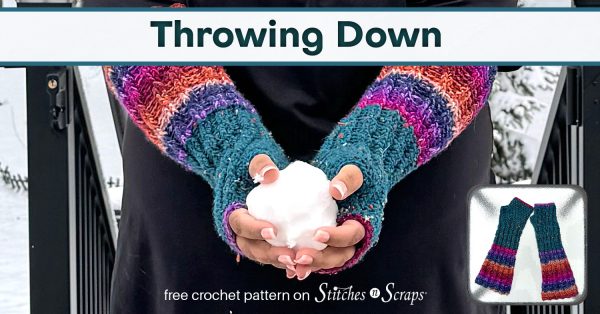
Throwing Down – Crochet Gauntlets
Ready to crochet your new favorite pair of fingerless mitts? Challenge accepted! Throwing Down crochet gauntlets are fun at your fingertips, with a dramatic flair to warm you all the way up to your elbows.
I designed these crochet gauntlets for the 2024 Gift to Myself Crochet Along (CAL) hosted by Underground Crafter. Now that the gift-giving season is done, it’s time to make something just for you!
See the full schedule in the main CAL post. While you’re there, be sure to enter the giveaway for a chance at some fabulous prizes! Crochet along with fun patterns to make for yourself, then share your pictures on social media with the hashtag #GiftToMyselfCAL
King Cole Yarns
King Cole generously provided the Big Value Tweed DK and Bramble DK yarns for this project. Both skeins were part of a larger shipment of samples and I did not pick the colors, but when I saw these two together I just knew I had to pair them up.
The Tweed yarn is color #1552 – Ocean and is full of colorful flecks. The Bramble yarn is #4498 – Elderberry, which draws those flecks of color out into berry-colored stripes. It’s the perfect combination!
Increases and Decreases
As you work through this pattern, you may notice increases and decreases in the palm. Those are there to keep all the stitches lined up nicely.
Shifting Rounds
A natural shift happens when working crochet stitches in the round without turning. It has to do with the placement of the stitch being not quite centered over the post of the stitch below it. Post stitches, because they are centered around the post, do not have this same shift. Read more about this effect in this post about why continuous rounds shift.
Countering the Shift
The palms of these crochet gauntlets are hdc, which shift at a rate of about 1/2 stitch per round. The rest is post stitches, which do not shift. Adding a decrease at the beginning of the palm and an increase at the end forces it to shift 1 stitch in the opposite direction. You’ll see this on alternating rounds to counter the natural shifting.
Cross Stitch (cross): Sk next st, fpdc around next st, working in front of fpdc just made, fpdc around skipped st. Cross counts as 2 fpdc in stitch counts at end of rnd.
First dcSecond dcFinished Cross
Half Double Crochet Decrease (dec): Yo, [insert hook in next ch or st, yo and pull up a loop] twice, yo and pull through all 4 loops on hook.
Front Post Decrease (fp dec): Yo, insert hook from front to back and to front again around post of next st, yo and pull up a loop (3 loops on hook), yo and pull through 2 loops on hook, insert hook in next st, yo and pull up a lp, yo and pull through all 3 loops on hook.
Back Post Decrease (bp dec): Yo, insert hook in next st and pull up a loop, yo and pull through 2 loops on hook (2 loops remaining on hook), insert hook from front to back and to front again around post of next st, yo and pull up a loop, yo and pull through all 3 loops on hook.
Pattern Notes
Join rnds where indicated with a sl st in first st of the rnd. Do not turn unless indicated.
Charts: Each section except the thumb edging has a corresponding chart. For all charts, work only the stitches shown in black. Greyed-out stitches show stitches from previous rounds, and the stitches you are joining into at the ends of rounds.
Instructions
Right Glove
Fingers
With B, ch 25 [31].
Rnd 1: Sc in 2nd ch from hook and in each ch across, join and change to B, fasten off A. (24 [30] sts)
Rnd 2: With B, ch 1, hdc in each st around, join.
Use starting tail to sew the gap closed at the foundation chain.
Rnd 3: Ch 2 (counts as bpdc throughout), fpdc around each of next 2 sts, [bpdc around next st, fpdc around each of next 2 sts] 4 [5] times, dec, hdc in next 7 [10] sts, hdc in same st as beginning ch-2, join. (5 [6] bpdc, 10 [12] fpdc, 8 [11] hdc, 1 dec)
Rnd 6: Ch 2, fpdc around each of next 2 sts, [bpdc around next st, fpdc around each of next 2 sts] 4 [5] times, hdc around, join. (5 [6] bpdc, 10 [12] fpdc, 9 [12] hdc)
Fingers Chart
Click image to expand
Right Thumb opening
Rnd 7: Ch 2, fpdc around each of next 2 sts, [bpdc around next st, fpdc around each of next 2 sts] 4 [5] times, dec, hdc in next 7 [10] sts, hdc in same st as beginning ch-2, ch 12, join. (5 [6] bpdc, 10 [12] fpdc, 8 [11] hdc, 1 dec, 12 chs)
Rnd 8: Ch 2, cross, [bpdc around next st, cross] 4 [5] times, hdc in next 9 [12] sts, dec, hdc in next 8 chs, dec, join. (5 [6] bpdc, 10 [12] fpdc, 17 [20] hdc, 2 dec)
Rnd 9: Ch 2, fpdc around each of next 2 sts, [bpdc around next st, fpdc around each of next 2 sts] 4 [5] times, dec, hdc in next 6 [9] sts, 2 hdc in next st, dec, hdc in next 3 sts, bpdc around next st, fpdc around each of next 2 sts, dec, join. (6 [7] bpdc, 12 [14] fpdc, 11 [14] hdc, 3 dec)
Rnd 10: Ch 2, fpdc around each of next 2 sts, [bpdc around next st, fpdc around each of next 2 sts] 4 [5] times, hdc in next 9 [12] sts, dec, hdc in next 2 sts, bpdc around next st, fp dec, join. (6 [7] bpdc, 11 [13] fpdc, 11 [14] hdc, 1 dec, 1 fp dec)
Turn, sl st in first 3 sts, turn. (This shifts the starting point of the rnd by 3 sts.)
Right Thumb Opening Chart
Click image to expand
Hand
Rnd 11: Ch 2, fpdc around each of next 2 sts, [bpdc around next st, fpdc around each of next 2 sts] 5 [6] times, dec, hdc in next 10 [13] hdc, hdc in same st as beginning ch-2, join. (6 [7] bpdc, 12 [14] fpdc, 11 [14] hdc, 1 dec)
Rnd 14: Ch 2, fpdc around each of next 2 sts, [bpdc around next st, fpdc around each of next 2 sts] 5 [6] times, hdc around, join. (6 [7] bpdc, 12 [14] fpdc, 12 [15] hdc)
Hand Chart
Click image to expand
Wrist
Rnd 15: Ch 2, fpdc around each of next 2 sts, [bpdc around next st, fpdc around each of next 2 sts] 9 [11] times, join. (10 [12] bpdc, 20 [24] fpdc)
Rnd 16: Ch 2, cross, [bpdc around next st, cross] 6 times, hdc around, join.
Rnds 17-19: Repeat rnd 15.
Rnd 20: Repeat rnd 16.
Rnds 21-28: [Repeat rnds 17-20] twice. At end of last rnd, change to A, fasten off B.
Wrist Chart
Click image to expand
Sleeve
Rnds 29-32: With A, repeat rnds 17-20.
Rnd 33: Repeat rnd 17
First increase section:
Rnd 34: Ch 2, fpdc around each of next 2 sts, hdc in next st, bpdc around same st, fpdc around each of next 2 sts, [bpdc around next st, fpdc around each of next 2 sts, hdc in next st, bpdc around same st, fpdc around each of next 2 sts] 4 [5] times, join. (10 [12] bpdc, 20 [24] fpdc, 5 [6] hdc)
Rnd 35: Ch 2, fpdc around each of next 2 sts, bpdc around each of next 2 sts, fpdc around each of next 2 sts, [bpdc around next st, fpdc around each of next 2 sts, bpdc around each of next 2 sts, fpdc around each of next 2 sts] 4 [5] times, join. (15 [18] bpdc, 20 [24] fpdc)
Rnd 36: Ch 2, cross, bpdc around each of next 2 sts, cross, [bpdc around next st, cross, bpdc around each of next 2 sts, cross] 4 [5] times, join.
Rnds 37-39: Repeat rnd 35
Rnd 40: Rep rnd 36
Rnd 41: Rep rnd 35
Second increase section
Rnd 42: Ch 2, bpdc around first st, fpdc around each of next 2 sts, bpdc around each of next 2 sts, fpdc around each of next 2 sts, [hdc in next st, bpdc around same st, fpdc around each of next 2 sts, bpdc around each of next 2 sts, fpdc around each of next 2 sts] 4 [5] times, join. (16 [19] bpdc, 20 [24] fpdc, 4 [5] hdc)
Rnd 43: Ch 2, bpdc around next st, fpdc around each of next 2 sts, [bpdc around each of next 2 sts, fpdc around each of next 2 sts] 9 [11] times, join. (20 [24] bpdc, 20 [24] fpdc)
Rnd 44: Ch 2, bpdc around next st, cross, [bpdc around each of next 2 sts, cross] 9 [11] times, join.
Rnds 45-47: Repeat rnd 43
Rnd 48: Repeat rnd 44
Rnds 49-54: Repeat rnds 45-48, then rep rnds 45-46 once more.
Sleeve Chart
Click image to expand
Thumb edging
Join B with sl st in any st or row along thumb opening, 14 sc evenly spaced around opening, join.
Fasten off. Weave in all ends.
Left Gauntlet
Fingers
Work as for Right Gauntlet.
Thumb opening
Rnd 7: Ch 2, fpdc around each of next 2 sts, [bpdc around next st, fpdc around each of next 2 sts] 4 [5] times, ch 12, dec, hdc in next 7 [10] sts, hdc in same st as beginning ch-2, join. (5 [6] bpdc, 10 [12] fpdc, 8 [11] hdc, 1 dec, 12 chs)
Rnd 8: Ch 2, cross, [bpdc around next st, cross] 4 [5] times, dec, hdc in next 8 chs, dec, hdc in next 9 [12] sts, join. (5 [6] bpdc, 10 [12] fpdc, 17 [20] hdc, 2 dec)
Rnd 9: Ch 2, fpdc around each of next 2 sts, [bpdc around next st, fpdc around each of next 2 sts] 4 [5] times, dec, bpdc around next st, fpdc around each of next 2 sts, dec, hdc in next 3 sts, dec , hdc in next 7 [10] sts, hdc in same st as beginning ch-2, join. (6 [7] bpdc, 12 [14] fpdc, 11 [14] hdc, 3 dec)
Rnd 10: Ch 2, fpdc around each of next 2 sts, [bpdc around next st, fpdc around each of next 2 sts] 4 [5] times, bp dec, fpdc around each of next 2 sts, hdc in next 2 sts, dec, hdc in next 9 [12] sts, join. (6 [7] bpdc, 11 [13] fpdc, 11 [14] hdc, 1 dec, 1 bp dec)
Left Thumb Opening Chart
Click image to expand
Hand, Wrist, Sleeve, and Thumb Edging
Work as for Right Gauntlet.
Share these crochet gauntlets on Pinterest!
Here’s an image perfect for pinning.
Rate this crochet gauntlets pattern!
I hope you enjoyed this crochet gauntlets pattern. A downloadable pdf of this pattern is available on Ravelry for a small fee. The fee for the pdf format offsets the advertising revenue lost when you print or download the pattern rather than viewing it online.
Do you want the best of Stitches n Scraps delivered right to your inbox? The Stitches n Scraps email newsletter includes highlights from the blog as well as special features not available elsewhere. Don’t miss a stitch – Subscribe now!
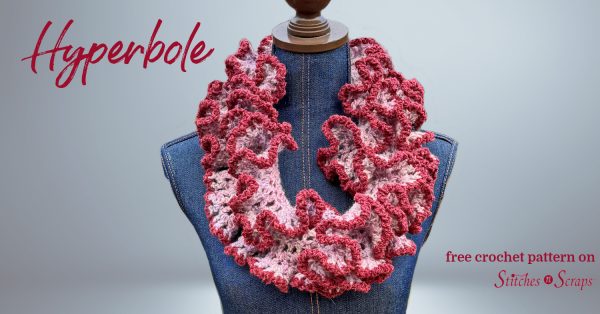
Ruffled Mobius Crochet Cowl
This ruffled Mobius crochet cowl is a lovely statement piece that instantly adds romance to an outfit. It combines a Mobius strip with a lacy, hyperbolic crochet ruffle for big, bold, squishy poofiness. Top it all off with a unique, wrap-around edging in a contrasting color and Hyperbole is literally the best cowl ever! (Yes, that’s hyperbole).
This ruffled Mobius crochet cowl combines two math concepts. A Mobius strip, and hyperbolic crochet.
Mobius Strips
A Mobius strip is a surface that has only one side. Twisting a rectangle and then joining the ends creates a twisted loop with one continuous surface all the way around.
The Mobius strip is established in the first round, creating a continuous round with twice as many stitches as you started with. This twist keeps the hyperbolic ruffle moving around the surface of the cowl. Without it, the cowl would tend to fold in half, creating a straight fold at the neckline with a layered ruffle at the edge.
Hyperbolic Crochet
In geometry, a hyperbolic plane is a surface with a constant, negative, gausian curvature. It means that every point along the surface curves in on itself at a constant rate. I won’t pretend to understand the math completely, but it’s fun and easy to create hyperbolic planes in crochet!
In hyperbolic crochet, the stitch count increases exponentially with each round. Depending on how much ruffling you want, you can double, triple, quadruple (or even more) the number of stitches by working 2, 3, 4 (or more) new stitches into every stitch.
If you are doubling your stitch count, like in this cowl, 2 stitches become 4, then 8, then 16. The rapid growth creates the curvature of the hyperbolic plane – and also makes a pretty ruffle! Adding chain spaces makes the ruffle lighter and airier, and uses less yarn too.
King Cole Yarns
King Cole generously provided the Acorn Aran and Forest Aran yarns for this project. Acorn is a lovely blend of acrylic and wool, which I used for the main section of the cowl. It comes in a variety of colorways with subtle, tweedy stripes. This color is #4954 – Juniper.
The edging is Forest Recycled Aran. I used the same yarn in my Forest Walk Cowl pattern. It’s made from recycled fibers in a blend of wool, acrylic, polyamide and viscose. This color is #1924 – Red Brae Wood.
Reversible Edging
With the hyperbolic, ruffled edge, both sides of the fabric are visible. I struggled to find a simple, low-profile edging that looked great on both sides. So I made one up! See the full wrap-around single crochet edging tutorial:
The wrap-around single crochet starts with a normal single crochet stitch. A slip stitch worked from back to front then pulls the single crochet up and over the edge of the fabric and locks it in place. Finally, a chain gets everything back into position to start the next stitch.
Chainless Starting Double Crochet
Double crochet rows and rounds typically start with a chain-3 that counts as the first stitch. But that chain-3 is noticeably different from the stitches around it.
A chainless starting double crochet replaces that chain-3 and resembles a typical double crochet more closely. It uses the working loop to create a faux yarn over, which you can then use to complete a double crochet in the first stitch. See this chainless starting double crochet tutorial for a closer look.
In this pattern, the csdc stitches will give eyou a more seamless finish. But if you prefer, you can use the typical chain 3 instead.
Chainless Starting Double Crochet (csdc): Pull working loop up to the height of a dc. Hold the loop in place, and in a counterclockwise motion, twist your hook around the loop, creating a “yarn over”. Holding both loops in place, insert your hook into the specified stitch, yo and pull up a loop.
(YO and pull through 2 loops on your hook) twice, just as you would finish a normal double crochet. Csdc counts as a dc in stitch counts at the end of rounds. (See Chainless Starting Double Crochet tutorial here).
If you prefer, you can replace the csdc wherever it appears with “ch 3, counts as dc” instead.
Wrap-Around Single Crochet (wasc): Sc in indicated st or sp, insert hook from back to front in same st or sp, yo and pull through st/sp and through loop on hook (backwards sl st made), ch 1. (See wrap-around single crochet tutorial here)
Instructions
Join rnds where indicated with a sl st in first st of the rnd. Do not turn.
Mobius Strip
Foundation Chain: With A, ch 67.
Rnd 1:
Csdc in first ch, dc in each remaining ch across.
Twist work once so that first stitch of rnd is upside down. Bring ends together to work into bottom of first st.
Dc in bottom of first st and each st around, join in top of first st of rnd. (130 dc)
Use starting tail to sew the gap closed at the foundation chain.
You now have a mobius strip with the Foundation Chain at the center.
Rnd 2: Csdc in first st, dc in each remaining st around, join. (130 dc)
Hyperbolic Crochet Ruffle
Rnd 3: Csdc in first st, ch 1, (dc, ch 1) in each remaining st around, join, sl st in first ch-1 sp. (130 dc, 130 ch-1 sps)
Rnd 4: (Csdc, ch 1, dc, ch 1) in first ch-1 sp, sk next dc, [(dc, ch1) twice in next ch-1 sp, sk next dc] around, join, sl st in first ch-1 sp. (260 dc, 260 ch-1 sps)
Rnd 5: (Csdc, ch 1, dc, ch 1) in first ch-1 sp, sk next dc, [(dc, ch1) twice in next ch-1 sp, sk next dc] around, join, change to B, fasten off A. (520 dc, 520 ch-1 sps)
Wrap-Around Single Crochet Edging
Rnd 6: Ch 1, wasc in first st, wasc in next ch-1 sp, (wasc in next st, wasc in next ch-1 sp) around, join. (1040 wasc)
Fasten off and weave in all ends.
Chart
Chart does not show the twisting of the first round to create the mobius strip. Please follow written instructions for that.
Click image to expand
Share this ruffled mobius crochet cowl on Pinterest!
Here’s an image perfect for pinning.
Rate this Ruffled Mobius Crochet Cowl Pattern!
I hope you enjoyed this mobius cowl pattern with a hyperbolic crochet ruffle. A downloadable pdf of this pattern is available on Ravelry for a small fee. The fee for the pdf format offsets the advertising revenue lost when you print or download the pattern rather than viewing it online.
Do you want the best of Stitches n Scraps delivered right to your inbox? The Stitches n Scraps email newsletter includes highlights from the blog as well as special features not available elsewhere. Don’t miss a stitch – Subscribe now!
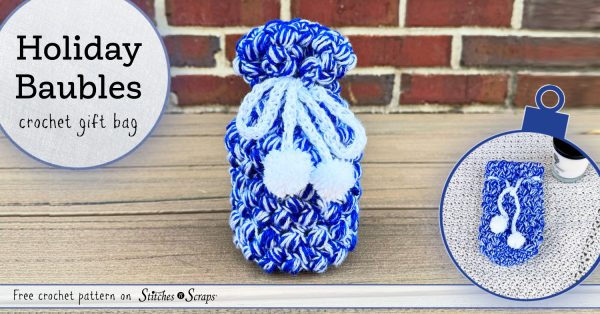
Crochet Holiday Gift Bag
Add a personal touch to your holiday gifts with a Crochet Holiday Gift Bag! The Holiday Baubles bag is fast and fun to make. Change the colors for all your holiday needs!
I designed this crochet cocoa coaster set for the 2023 Holiday Stashdown CAL, hosted by CAL Central Crochet. This is our 9th annual holiday stashdown, and it’s always our most popular CAL of the year.
See the full schedule in the main CAL post. While you’re there, be sure to enter the giveaway for a chance at some fabulous prizes! Then crochet along and join in the fun on the CAL Central Facebook group.
King Cole Glitz DK Yarn
When I closed my yarn store, I had some of this lovely, King Cole Glitz DK yarn left over. It’s a super soft, acrylic yarn with a sparkly thread running through it. The vibrant, jewel-tone colors make it a great choice for all sorts of holiday projects. In fact, I used the same yarn for my Holiday Sparkle Dog Bandana pattern.
Combining Yarns
Most of this crochet holiday gift bag uses 2 colors held together. Choose contrasting colors for a variegated look like the sample picture, or choose similar (or the same) colors for a more tonal or solid look.
If you prefer to work with just one yarn, try making the bag in 1 strand of a heavy worsted (aran) weight yarn instead. Your gauge / size / yardage may vary depending on the yarn you choose.
Increase (inc): Sc in back loop only of next st, sc in both loops (like normal) of same st. (See increase tutorial here)
Bean Stitch (bean): Insert hook in indicated st (without doing a yo first), yo and pull up a loop (2 loops on hook), [yo, insert hook in indicated st, yo and pull up a loop] 3 times, yo and pull through all 8 lps on hook.
When working back into a bean stitch, work into the triangle-shaped space at the side. This is directly under the V-shape at the top, and under the working loop in the last image above. This makes the puffy part of the bean stitch angle towards the opposite side.
Instructions
Join rnds where indicated with a sl st in first st of the rnd. Do not turn unless indicated.
Bottom
Holding 1 strand of each color together, ch 2.
Rnd 1: 6 sc in 2nd ch from hook, join. (6 sts)
Rnd 2: Ch 1, inc in each st around, join. (12 sts)
Rnd 3: Ch 1, inc in first st, sc in next st, [inc in next st, sc in next st] around, join. (18 sts)
Rnd 4: Ch 1, inc in first st, sc in each of next 2 sts, [inc in next st, sc in each of next 2 sts] around, join. (24 sts)
Rnd 5: Ch 1, sc in each of first 2 sts, inc in next st, [sc in each of next 3 sts, inc in next st] around to last st, sc in last st, join. (30 sts)
Work should now measure 3 inches in diameter. For a smaller circumference, skip the last rnd. For a larger circumference, work additional rounds, increasing by 6 sts evenly spaced around. Any changes to the size will affect yarn usage.
Body
(Scroll down for chart for this section)
Rnd 1 (RS): Ch 1, sc in each st around, join.
Rnd 2: Ch 1 (counts as ch-1 sp), turn, sk first st, bean in next st, [ch 1, sk next st, bean in next st], around, join in first ch-1 sp. (15 beans, 15 ch-1 sps)
Rnds 3-4: Ch 1 (counts as ch-1 sp), turn, (bean, ch-1) in each bean and sk each ch-1 sp around, join in first ch-1 sp.
Rnd 5: Ch 1, turn, 2 sc in each bean and sk each ch-1 sp around, join. (30 sc)
Rnds 6-16: Repeat rnds 2-5 twice, then rep rnds 2-4 once more.
To adjust length of bag, work more or fewer repeats of rnds 2-5, ending after a rep of rnd 4. Any changes to the size will affect yarn usage.
Rnd 17 (RS): Skipping all ch-1 sps and working only into beans, turn, sl st in first bean, ch 3, sl st in next bean, ch 3, sk next bean, [sl st in next bean, ch 3, sl st in next bean, ch 3, sk next bean] around, sl st in same bean as beginning of rnd. (10 sl sts, 10 ch-3 sps)
Rnd 18 (RS): Ch 1, do not turn, 3 sc in each ch-3 sp and sk each sl st around. (30 sc)
Rnds 19-22: Rep rnds 2-5.
Fasten off. Use starting tail to sew bottom shut as necessary, then weave in all ends.
Body Chart
Note: Only work the stitches in black. The grey stitches are only there to show where the rounds meet at the join.
Click image to expand
Drawstring
With 1 strand of white only, ch 75, sc in 2nd ch from hook and each ch across, fasten off.
Weave drawstring through ch-3 sps from Rnd 18.
Sew a pom pom to each end of drawstring.
Weave in any remaining ends.
Share this Crochet Holiday Gift Bag on Pinterest!
Here’s an image perfect for pinning.
Rate this Crochet Holiday Gift Bag Pattern!
I hope you enjoyed this crochet holiday gift bag pattern. A downloadable pdf of this pattern is available on Ravelry for a small fee. The fee for the pdf format offsets the advertising revenue lost when you print or download the pattern rather than viewing it online.
Do you want the best of Stitches n Scraps delivered right to your inbox? The Stitches n Scraps email newsletter includes highlights from the blog as well as special features not available elsewhere. Don’t miss a stitch – Subscribe now!
Crochet Pencil Draft Stopper
Feeling the chill where you shouldn’t be? Block drafty windows and doors with a Crochet Pencil Draft Stopper! Customize the colors and length for a whimsical way to stay warm this season. It’s great for offices and kids of all ages, and makes a great gift too!
I designed this crochet pencil draft stopper for the 2023 Giftstravaganza CAL hosted by Underground Crafter. Get ready for holiday gifting with daily patterns, and enter for a chance to win fun prizes too! Each week has a theme, and this week’s theme is “Gifts for Home”. See the full schedule and all the other great patterns in the main CAL post.
Poly Fil Premium Fiber Fill
Fairfield World generously gave me lots of Poly-Fil Premium Polyester Fiber Filling for previous projects, like Playful the Baby Penguin shown below. It’s my go-to for all my amigurumi and stuffed designs because it’s so soft and squishy and easy to use!
My favorite stuffing tip is to tear the stuffing into small bits and stuff just a little at a time, rather than trying to put a whole handful in all at once. This creates a smoother finish and avoids clumps and lumps.
Decrease (dec): Insert hook into front loop only of both of next 2 stitches, yarn over and draw up a loop, yarn over and draw through both loops on hook.
This is an alternative to a single crochet 2-together (sc2tog) stitch. If you prefer, you can use the standard sc2tog instead.
Spike Fan: Worked over 3 sts and counts as 3 sts.
Insert hook in first st, yo and pull up a loop (2 loops on hook), insert hook 2 rows below second st, yo and pull up a loop to height of current row (3 loops on hook), yo and pull through all 3 loops on hook (first stitch made).
Insert hook in same st 2 rows below second st, yo and pull up a loop to height of current row, yo and pull through both loops on hook (2nd stitch made).
Insert hook in same st 2 rows below second st, yo and pull up a loop to height of current row (2 loops on hook), insert hook in 3rd st and pull up a loop (3 loops on hook), yo and pull through all 3 loops on hook (3rd stitch made).
When working back into a spike fan, work into all 3 sts individually.
Instructions
Join rnds where indicated with a sl st in first st of the rnd.
Eraser
Rnd 1: With pink, ch 2, 6 sc in 2nd ch from hook, join. (6 sts)
Rnd 2: Ch 1, inc in each st around, join. (12 sts)
Rnd 3: Ch 1, inc in first st, sc in next st, [inc in next st, sc in next st] around, join. (18 sts)
Rnd 4: Ch 1, inc in first st, sc in each of next 2 sts, [inc in next st, sc in each of next 2 sts] around, join. (24 sts)
Rnd 5: Ch 1, sc in each of first 2 sts, inc in next st, [sc in each of next 3 sts, inc in next st] around to last st, sc in last st, join. (30 sts)
Rnd 6: Ch 1, inc in first st, sc in each of next 4 sts, [inc in next st, sc in each of next 4 sts] around, join. (36 sts)
Rnds 7-11: Sc in each st around, join, change to grey when joining last rnd.
Ferrule
Rnd 12: With grey, ch 1, hdc in each st around, join.
Rnd 13: Ch 1, hdc in tlo of each st around, join.
Rnd 14: Ch 1, sc in tlo of each st around, join.
Rnds 15-17: Rep Rnds 12-14, change to main color when joining last rnd.
Body
Rnd 18: With main color, ch 1, sk first st, sc in each remaining st around, do not join.
Rnd 19: Sc in first ch-1 sp and in each st around, do not join.
Continue to sc in each st around in continuous rnds until pencil measures about 30 inches (or about 8-9″ shorter than desired finished length) from beginning of eraser. There is no need to mark the first st of the rnds, you can end the last rnd wherever you like.
Ending the last rnd: Sl st in next 2 sts, fasten off.
Turn pencil inside out and weave in all ends.
Stuff pencil firmly and evenly, but not so full that stuffing shows through the stitches. For best results, add small pieces of stuffing at a time. Roll pencil back and forth on a hard surface a few times to even out the stuffing.
Point
Leave all tails on RS of work going forward, so that you can weave them in more easily once pencil is finished. Continue stuffing as you go.
Join beige with a sl st in any st on last rnd of body.
Rnd 1: Sc in first 3 sts, spike fan, [sc in next 3 sts, spike fan] around, join. (18 sc, 6 spike fan)
Rnd 2: Ch 1, sc in first 5 sts, dec, [sc in next 10 sts, dec] twice, sc in last 5 sts, join. (33 sts)
Rnd 3: Ch 1, sc in first 9 sts, dec, [sc in next 9 sts, dec] twice, join. (30 sts)
Rnd 4: Ch 1, sc in each st around, join.
Rnd 5: Ch 1, sc in first 4 sts, dec, [sc in next 8 sts, dec] twice, sc in last 4 sts, join. (27 sts)
Rnd 6: Ch 1, sc in first 7 sts, dec, [sc in next 7 sts, dec] twice, join. (24 sts)
Rnd 7: Ch 1, sc in each st around, join.
Rnd 8: Ch 1, sc in first 3 sts, dec, [sc in next 6 sts, dec] twice, sc in last 3 sts, join. (21 sts)
Rnd 9: Ch 1, sc in first 5 sts, dec, [sc in next 5 sts, dec] twice, join. (18 sts)
Rnd 10: Ch 1, sc in each st around, join.
Stuff pencil tip.
Rnd 11: Ch 1, sc in first 2 sts, dec, [sc in next 4 sts, dec] twice, sc in last 2 sts, join. (15 sts)
Rnd 12: Ch 1, sc in first 3 sts, dec, [sc in next 3 sts, dec] twice, join and change to black. (12 sts)
Rnd 13: With black, ch 1, sc in each st around, join.
Finish stuffing (use back of crochet hook to push stuffing into tip if needed).
Rnd 14: Ch 1, sc in first st, dec, [sc in next 2 sts, dec] twice, sc in last st, join. (9 sts)
Rnd 12: Ch 1, sc in first st, dec, [sc in next st, dec] twice, join. (6 sts)
Rnd 13: Ch 1, dec around, fasten off. (3 sts)
Use tail to sew tip of pencil closed as needed.
Weave in all remaining ends, going through the stuffing so that they don’t show on the RS.
Share this Crochet Pencil Draft Stopper on Pinterest!
Here’s an image perfect for pinning.
Rate this Crochet Pencil Draft Stopper Pattern!
I hope you enjoyed this crochet pencil draft stopper pattern. A downloadable pdf of this pattern is available on Ravelry for a small fee. The fee for the pdf format offsets the advertising revenue lost when you print or download the pattern rather than viewing it online.
Do you want the best of Stitches n Scraps delivered right to your inbox? The Stitches n Scraps email newsletter includes highlights from the blog as well as special features not available elsewhere. Don’t miss a stitch – Subscribe now!
Striped Crochet Hat – Bandy Beanie
Top off your winter wardrobe with the big, bold stripes in the Bandy Beanie! This warm and squishy, striped crochet hat works up super quickly, using only one color in each round. The pattern includes 5 sizes from baby to adult!
Rhondda and Amy also run a Scarf of the Month CAL. It works the same way as the hats, and I was the guest designer for October for that CAL as well. Get the Bandy Cowl pattern, and make a matching set!
Don’t Miss the Coupon Codes!
As part of the CAL, each of the patterns is available free with a coupon code for one day only. The offer on this one has now expired. Visit the main Hat of the Month CAL and Scarf of the Month CAL posts and sign up for the monthly reminder emails so you don’t miss the next one!
Gauge and Hook Sizes
To achieve a wider range of sizes without completely altering the pattern, both stitch count AND gauge vary between sizes. 3 sizes are worked with larger hooks, and 2 extra sizes are squeezed in between by using smaller hooks.
For example, the small and large adult sizes have exactly the same instructions, but the small size uses smaller hooks. Make sure to match the appropriate gauge measurements for your size!
Yarn Choices
I chose solid yarns with a lot of contrast for the sample. Yarnspirations originally provided both yarns for other projects.
The higher the contrast between your yarns, the bolder and more dramatic the stripes will be. You could also use a variegated or self-striping yarn for one of the colors, paired with a contrasting solid color yarn. Using 2 color-changing yarns is possible as well, particularly if they are very different color palettes, but it does run the risk of “muddying” the pattern.
Main color (A): 85 [110, 130, 160, 195] yds Caron One Pound – 100% acrylic, worsted weight yarn (812 yds / 454g per skein). Shown in #10546 Midnight Blue
Accent color (B): 30 [40, 45, 55, 70] yds Red Heart With Love – 100% acrylic, worsted weight yarn – 370 yds / 198 g per skein. Shown in #1711 Cameo
Hook:
Baby, Child & Large sizes only: Size K / 6.5 mm hook or size needed to match gauge (main hook)
Toddler & Small sizes only: Size I / 5.5 mm hook or size needed to match gauge (main hook)
All Sizes: Additional hook one size (.5mm) smaller than main hook (ribbing hook).
Notions:
Scissors
Tapestry Needle
Project Level
Intermediate: Working in the round, working into rows below, alternating colors from round to round.
Sizes
Baby [Toddler, Child, Small, Large]
Hat Circumference: 14.5 [17.5, 19.25, 21.75, 24]
To fit head circumference: 13-16 [16-19, 18-21, 20-23, 22-25]
Hat Height: 6 [7.25, 8.25, 9, 9.75] inches
Gauge
Baby, Child, and Large sizes only: 10 dc x 5.5 rnds = 4 inches with main hook.
Toddler & Small sizes only: 11 dc x 6 rnds = 4 inches with main hook.
V-stitch (V): (Dc, ch 1, dc) in indicated st. When working into a V st, work into the ch-1 sp at the center.
Working below a ch-sp: When working into a st or sp below a ch-sp, work around the ch-sp so that it is encapsulated inside the stitch.
Pattern Notes
Pay particular attention to the instructions for color changes in the pattern. It’s written so the main color stays dominant over the accent color, preventing a messy “seam” at the beginning of the rounds.
All rounds are worked on the right side, do not turn your work.
Use main hook for Crown and Body of hat. Ribbing hook is used only for the final Ribbing section.
Instructions
Crown
Rnd 1: With A and main hook, ch 4, sc in 4th ch from hook (skipped chs count as first dc), (dc, sc) 5 times in same ch, join with sl st in first dc. (6 dc, 6 sc)
For all odd numbered rnds, do NOT change colors in the joining sl st. Work the joining sl st in color A. Then drop A and start the next round with color B.
Rnd 2: With B, Ch 2 (counts as ch-1 sp), sk first dc, [V (see Special Stitches) in next sc, ch 1, sk next dc] 5 times, V in next sc changing to A in the last “pull through” step of the last st, do not join. (6 Vs, 6 ch-1 sps)
Rnd 3: With A, ch 1, [3 dc in skipped dc below next ch-1 sp, ch 1, sk next V] around, join with sl st in first st. (18 dc, 6 ch-1 sps)
Rnd 4: With B, ch 3 (counts as ch-2 sp), sk first 3 dc, V in V below next ch-1 sp, [ch 2, sk next 3 dc, V in V below next ch-1 sp] around changing to A in the last “pull through” step of the last st, do not join. (6 Vs, 6 ch-2 sps)
Baby Size Only:
Rnd 5: With A, ch 1, [working into the 3 dc below next ch-2 sp: 2 dc in first dc, dc in 2nd dc, 2 dc in 3rd dc; ch 1, sk next V] around, join with sl st in first st. (30 dc, 6 ch-1 sps)
Crown should measure 4.5 inches in diameter.
Sizes [Toddler, Child, Small, Large] Only:
Rnd 5: With A, ch 1, [working into the 3 dc below next ch-2 sp: dc in first dc, (dc, sc, dc) in 2nd dc, dc in 3rd dc; ch 1, sk next V] around, join with sl st in first st. (24 dc, 6 sc, 6 ch-1 sps)
Rnd 6: With B, ch 2 (counts as ch-1 sp), sk first 2 dc, V in next sc, ch 1, sk next 2 dc, V in V below next ch-1 sp, [sk next 2 dc, V in next sc, ch 1, sk next 2 dc, V in V below next ch-1 sp] around changing to A in the last “pull through” step of the last st, do not join. (12 Vs, 12 ch-1 sps)
Rnd 7: With A, ch 1, [working into 2 dc below next ch-1 sp: dc in first dc, 2 dc in 2nd dc; ch 1, sk next V] around, join with sl st in first st. (36 dc, 12 ch-1 sps)
Chrown should now measure about [5.5, 6.25, 5.5, 6.25] inches in diameter. (Image shows size Small)
Sizes [Small, Large] Only:
Rnd 8: Repeat rnd 4. (12 Vs, 12 ch-2 sps)
Rnd 9: With A, ch 1, [working into 3 dc below next ch-1 sp: dc in first dc, 2 dc in 2nd dc, dc in 3rd dc; ch 1, sk next V] around, join with sl st in first st. (48 dc, 12 ch-1 sps)
Crown should measure [7, 7.75] inches in diameter. (Image shows size Small)
Body (All sizes)
Rnd 1: With B, ch 4 [2, 2, 3, 3] (counts as ch-sp), sk first 5 [3, 3, 4, 4] dc, V in V below next ch-sp, [ch 3 [1, 1, 2, 2], sk next 5 [3, 3, 4, 4] dc, V in V below next ch sp] around, changing to A in the last “pull through” step of the last st, do not join. (6 [12, 12, 12, 12] Vs, 6 [13, 12, 12,12] ch-sps)
Rnd 2: With A, ch 1, [dc in each dc below next ch-sp, ch 1, sk next V] around, join with sl st in first st. (30 [36, 36, 48, 48] dc, 6 [12, 12, 12, 12] ch-sps)
Rnds 3-10 [12, 12, 14, 14]: Repeat [rnds 1-2] 4 [5, 5, 6, 6] times more.
Cut B, leaving a tail to weave in later.
Ribbing
Change to ribbing hook.
Baby size only:
Rnd 1: Continuing with A, ch 2 (counts as bpdc), [fpdc in next st, bpdc in next st] twice, dc in V below next ch-1 sp, *bpdc in next st, [fpdc in next st, bpdc in next st] twice, dc in V below next ch-1 sp, rep from * around, join with sl st in first st. (18 bpdc, 12 fpdc, 6 dc).
Sizes [Toddler, Child] only:
Rnd 1: Continuing with A, ch 2 (counts as bpdc), [fpdc in next st, bpdc in next st, dc in V below next ch-1 sp, [bpdc in next st, fpdc in next st, bpdc in next st, dc in V below next ch-1 sp] around, join with sl st in first st. (24 bpdc, 12 fpdc, 12 dc)
Rnd 2 [Rnds 2-3]: Ch 2 (counts as bpdc), fpdc in next st, [bpdc in next st, fpdc in next st] around, join with sl st in first st. (24 bpdc, 24 fpdc)
Sizes [Small, Large] only:
Rnd 1: Continuing with A, ch 2 (counts as bpdc), fpdc in next st, bpdc in next st, fpdc in next st, dc in V below next ch-1 sp, [fpdc in next st, bpdc in next st] twice, dc in V below next ch-1 sp, *[bpdc in next st, fpdc in next st] twice, dc in V below next ch-1 sp, [fpdc in next st, bpdc in next st] twice, dc in V below next ch-1 sp; rep from * around, join with sl st in first st. (24 bpdc, 24 fpdc, 12 dc)
Rnds 2-3: Ch 2 (counts as bpdc), fpdc in next st, [bpdc in next st, fpdc in next st] around, join with sl st in first st. (30 bpdc, 30 fpdc)
All Sizes:
Fasten off.
Weave in all ends.
Share this Striped Crochet Hat on Pinterest!
Here’s an image perfect for pinning.
Rate this Striped Crochet Hat Pattern!
I hope you enjoyed this striped crochet hat pattern. A downloadable pdf of this pattern is available on Ravelry for a small fee. The fee for the pdf format offsets the advertising revenue lost when you print or download the pattern rather than viewing it online.
Do you want the best of Stitches n Scraps delivered right to your inbox? The Stitches n Scraps email newsletter includes highlights from the blog as well as special features not available elsewhere. Don’t miss a stitch – Subscribe now!
Striped Crochet Cowl – Bandy Cowl
Stay cozy with big, bold stripes in the Bandy Cowl! This warm and squishy, striped crochet cowl works up super quickly, using only one color in each round.
As part of the CAL, you can get the pdf version of this pattern for FREE on Ravelry with a coupon code! But hurry, this code is only valid for a short time and then it’s gone!
Coupon Code: OctoberScarf
Terms: This code expires at 11:59pm Eastern time on Monday, Oct 16th, 2023. Please make sure the discount shows in your cart before completing checkout. Due to the fees involved, I cannot refund accidental purchases.
Rhondda and Amy also run a Hat of the Month CAL. It works the same way as the scarves, and I will be the guest designer for October for that CAL as well. Look for the Bandy Beanie pattern next week, and make a matching set!
Don’t Miss the Coupon Codes!
As part of the CAL, each of the patterns is available free with a coupon code for one day only. The offer on this one has now expired. Visit the main Hat of the Month CAL and Scarf of the Month CAL posts and sign up for the monthly reminder emails so you don’t miss the next one!
Yarn Choices
I chose solid yarns with a lot of contrast for the sample. Yarnspirations originally provided both yarns for other projects.
The higher the contrast between your yarns, the bolder and more dramatic the stripes will be. You could also use a variegated or self-striping yarn for one of the colors, paired with a contrasting solid color yarn. Using 2 color-changing yarns is possible as well, particularly if they are very different color palettes, but it does run the risk of “muddying” the pattern.
V-stitch (V): (Dc, ch 1, dc) in indicated st. When working into a V st, work into the ch-1 sp at the center.
Working below a ch-1 sp: When working into a st or sp below a ch-1 sp, work around the ch-1 sp so that it is encapsulated inside the stitch.
Pattern Notes
Rather than joining the foundation chain to form a circle, the join is done at the end of rnd 1. This makes it easier to join without twisting. There will be a small gap at the bottom, which you can sew closed with the tail when weaving in ends.
Pay particular attention to the instructions for color changes in the pattern. It’s written so the main color stays dominant over the accent color, preventing a messy “seam” at the beginning of the rounds.
Instructions
Scroll down for chart.
With A, ch 81.
Rnd 1: Sc in 2nd ch from hook, sc in each of next 2 chs, dc in next ch, [sc in each of next 3 chs, dc in next ch] across, join with sl st to first st to form a circle. (60 sc, 20 dc)
Rnd 2: Ch 3 (counts as dc), dc in each of next 2 sc, ch 1, sk next dc, [dc in each of next 3 sc, ch 1, sk next dc] around, join with sl st in first st. (60 dc, 20 ch-1 sps)
Do NOT change colors in the joining sl st. Work the joining sl st in color A. Then drop A and start the next round with color B.
Rnd 3: With B, ch 2 (counts as ch-1 sp), sk first 3 dc, V (see Special Stitches) in dc below next ch-1 sp (see Special Stitches), [ch 1, sk next 3 dc, V in dc below next ch-1 sp] around changing to A in the last “pull through” step of the last st, do not join. (20 Vs, 20 ch-1 sps)
Rnd 4: With A, ch 1, [dc in each of the 3 dc below next ch-1 sp, ch 1, sk next V] around, join with sl st in starting ch-1. (60 dc, 20 ch-1 sps)
Do NOT change colors in the joining sl st. Work the joining sl st in color A. Then drop A and start the next round with color B.
Rnd 5: With B, ch 2 (counts as ch-1 sp), sk first 3 dc, V in V below next ch-1 sp, [ch 1, sk next 3 dc, V in V below next ch-1 sp] around changing to A in the last “pull through” step of the last st, do not join. (20 Vs, 20 ch-1 sps)
Rnds 7-14: Repeat [rnds 4-5] 4 times more, then repeat rnd 4 once more.
Rnd 15: Continuing with A, ch 1, [sc in each of next 3 dc, dc in V below next ch-1 sp] around, join with sl st in first st. (60 sc, 20 dc).
Fasten off both colors.
Use the starting color A tail to sew the gap closed at the bottom of rnd 1. Weave in all ends.
Bandy Cowl Chart
Click image to expand
Share this Striped Crochet Cowl Pattern on Pinterest!
Here’s an image perfect for pinning.
Rate this Striped Crochet Cowl Pattern!
I hope you enjoyed this striped crochet cowl pattern. A downloadable pdf of this pattern is available on Ravelry for a small fee. The fee for the pdf format offsets the advertising revenue lost when you print or download the pattern rather than viewing it online.
Do you want the best of Stitches n Scraps delivered right to your inbox? The Stitches n Scraps email newsletter includes highlights from the blog as well as special features not available elsewhere. Don’t miss a stitch – Subscribe now!