Knitting Tutorials
Ready for a new knit stitch, technique, or pattern? You’re in the right place! Browse all the knitting tutorials, or select a category from the dropdown menu. What will you learn today?

Tutorial – Alternating Cable / Seed Stitch Cast On
This cast on is sometimes called the alternating cable cast on, or the seed stitch cast on. It’s similar to the cable cast on, but alternates between knit and purl stitches. Before learning this cast on, you should know the knitted cast on and the cable cast on.

As you would expect, the seed stitch cast on works very well for seed stitch. The alternating knits and purls blend perfectly, making the cast on practically invisible. It works equally well for ribbing.
Because the side edge of garter stitch alternates between knit and purl rows, it also looks very much like this cast on. For some patterns (like mitered squares) this can help create a uniform edge all the way around.
Alternating Cable Cast On – Photo Tutorial:
(Scroll down for video tutorial)
Set up – First 2 stitches
Your first 2 stitches are the same as for a knitted or cable cast on. Place a slip knot on your left needle as your first stitch. The slip knot creates a bump that looks like a purl bump, so we count is as a purl stitch.
Since we are alternating, our next stitch needs to be a knit stitch. Knit into the first stitch and place that new knit stitch onto the left needle, just like you would for a knitted cast on.

Casting on purlwise:
Now we have a purl and a knit, so our next stitch should be a purl. Since this is a cable cast on, we’re still going to insert our needle between the two stitches, but this time do it from the back to the front.

Purl into this space the same way you would normally purl into a stitch: Wrap the yarn around your needle, and scoop it through the hole.

Pull the new stitch up so that it’s quite big. Without twisting it, place the new stitch onto the left needle.

Casting on Knitwise
Our next stitch then needs to be a knit stitch. This is done exactly the same as in a normal cable cast on. Insert your needle between the two stitches from front to back and knit into that space like you would knit into a stitch.

Pull the new stitch up so that it’s quite big. Twist the left needle around and insert it into this new stitch from back to front, placing the new stitch onto the left needle.

Remaining Stitches
Continue alternating between knit and purl stitches until you have cast on as many stitches as you need.

Cable Cast On – Video Tutorial:
Before learning this cast on, you should know the knitted cast on and the cable cast on.

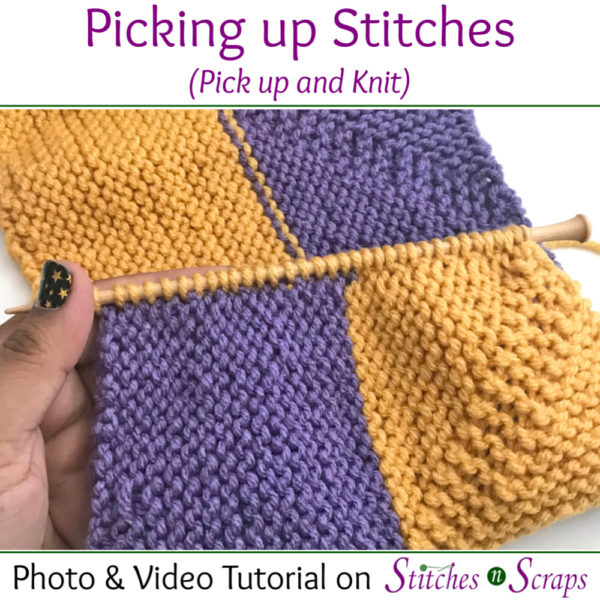
Tutorial – Pick up and Knit
Picking up stitches is an important skill in knitting. It lets you start working in a different direction, from any edge of your work. This is particularly useful for sleeves, collars, and edgings. While it is possible to pick up stitches purlwise, it’s much more common to pick up stitches knitwise, or “pick up and knit”.

The scarf in these photos is my Team Colors pattern.
Picking Up Stitches – Photo Tutorial:
(Scroll down for video tutorial)
Plan the stitch placement first
When picking up stitches, you usually want to space them evenly across your edge. Any unevenness can cause puckers and ruffles in your work, or otherwise distort the shape. Unless that’s what you’re going for, you will want your stitches to be spread out more evenly.
With a small number of stitches, it may be easy to just “eyeball” the placement. Or, if you are picking up on a straight edge, you may be able to calculate how many rows per stitch you have. For example, picking up 1 stitch for every 2 rows of garter stitch is very easy to do without needing any other guides.
If your edge is more complex though, you may need some help. This is where stitch markers can really come to the rescue. Divide your edge evenly into sections, using stitch markers. Now divide the number of stitches you need to pick up by the number of sections you have.

For example, on this edge, I need to pick up 32 stitches. I have divided it into 4 sections, so I know I need to pick up 8 stitches in each section. This is much easier to do than trying to evenly space 32 stitches across the whole thing.
Pick up and knit the first stitch:
With the right side of your work facing you, and working from right to left, insert your needle into the first spot where you want to pick up a stitch. Try to go as close to the edge as you can. Whatever is on top of your needle will fold back and create a seam or ridge, so I like to make sure I’m only going under 1 loop of yarn if possible.

Make a loop with your working yarn, leaving a tail to work in later, and place that on your needle. Then pull that loop through, just as though you are completing a knit stitch.

Here I have shown the first stitch in the middle of the edge, where the color changes. For the remaining pictures, I started over and worked all the way across the edge from the beginning.
Pick up the remaining stitches:
Insert your needle into the next spot where you want to pick up a stitch. Now knit into that space just as though you were knitting into a stitch on the needle. I often prefer to do this continental style, with the yarn in my left hand. Scoop the yarn through the space, just as though you were knitting.

If you prefer to hold the yarn in your right hand, you can do that too. Insert your needle, and wrap the yarn over it just as you would to knit a stitch.

Finish by pulling that loop through.

Continue in this manner, until you have picked up all the stitches that you need.

How to Pick up and Knit – Video Tutorial:

Rate this Pick up and Knit Tutorial!

Tutorial – Cable Cast On
The Cable Cast On creates a firm edge that has a pretty, twisted appearance and doesn’t stretch as much as other cast ons. I particularly love this cast on for washcloths. Before learning this cast on, you should know the knitted cast on. The cable cast on is very similar, but with one slight change.

Cable Cast On – Photo Tutorial:
(Scroll down for video tutorial)
Set up – First 2 stitches
Your first 2 stitches are the same as for a knitted cast on. Place a slip knot on your left needle as your first stitch. Then knit into the first stitch and place that new knit stitch onto the left needle as well.

Casting on remaining stitches:
Here is where the cable cast on is different from the knitted cast on. Instead of working into the last stitch, insert your needle in the space between the two stitches. You should be able to see the whole last stitch in front of your needle.

Knit into this space the same way you would normally knit into a stitch: Wrap the yarn around your needle, and scoop it through the hole.
Pull the new stitch up so that it’s quite big. Twist the left needle around and insert it into this new stitch from back to front, placing the new stitch onto the left needle. This is the same as for the knitted cast on.

Remove the right needle and tighten the stitch. Continue casting on more stitches in this way, until you have the number of stitches you need.

Cable Cast On – Video Tutorial:

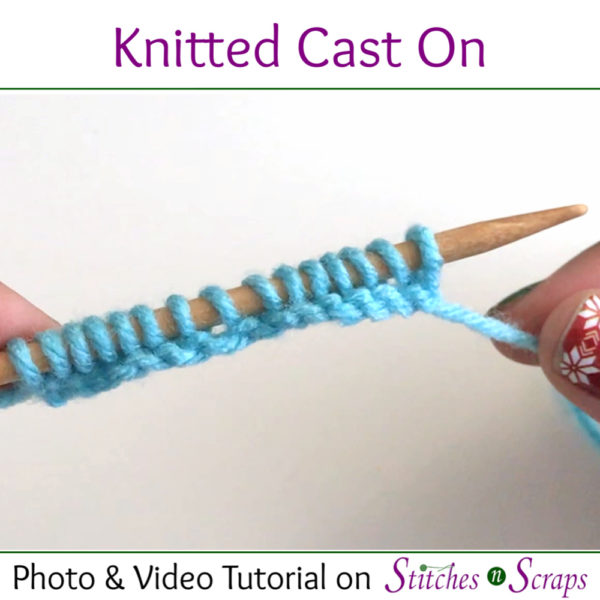
Tutorial – Knitted Cast On
The knitted cast on is one of the most basic cast on techniques. It’s a great one for new knitters to learn, because it uses the same motions as the knit stitch.

Knitted Cast On – Photo Tutorial:
(Scroll down for video tutorial)
Slip Knot
The first thing we need to do is get the yarn onto one of the needles, using a slip knot.
Fold your yarn to make a loop, leaving a 4-6 inch tail. You should have this tail on one side, and the yarn coming from the ball on the other side. The yarn coming from the ball is called your working yarn.

Twist your loop so that the tail yarn is on top.

Reach through that loop and pick up the working yarn.

Holding the ends with one hand, pull the working yarn up through the loop until it makes a knot. You should now have a knot with a loop sticking out of the top. If you pull on the ball end of the yarn, you can adjust the size of the loop.

Place this loop on one of the needles and adjust it so that it is slightly loose and slides easily on the needle. This is now your first stitch.
Knitting on:
If you are right handed, hold the needle with the stitch on it in your left hand. Use your index finger to hold the stitch in place.

Insert your right (empty) needle into the stitch from front to back, so that it crosses under the left needle.

Wrap your working yarn around the tip of your right needle, coming from underneath and up over the top in a clockwise motion.

Pull the right needle back out through the stitch, the same way it went in, but scooping up the working yarn as it comes through. This creates a new stitch.

Pull the new stitch up so that it’s quite big. Twist the left needle around and insert it into this new stitch from back to front, placing the new stitch onto the left needle.

Remove the right needle and tighten the stitch. Continue casting on more stitches in this way, until you have the number of stitches you need.

Knitted Cast On – Video Tutorial:

Tutorial – Fair Isle Locked Down
Fair Isle is a colorwork technique in knitting, in which you work with multiple colors at once. This usually leaves “floats” or loose strands of yarn at the back of the work. In this tutorial, learn how to lock those floats down with every stitch to create a smoother finish at the back.

Fair Isle Locked Down – Photo Tutorial:
(Scroll down for video tutorial)
In typical fair isle knitting, as you switch from one color to another, the inactive color drops to the back of the work. This creates floats, where yarns pass across the back for several stitches. Most often, knitters will “lock” these floats if they become longer than 3 or 4 stitches.

This works perfectly well in cases where the back of the work will not be seen, for example in a sweater or hat. It’s not so great though, for something like a blanket. Even at no more than 3 stitches long, these floats can still snag on toes or fingers.
One solution would be to line the back of your work with fabric. Another is to lock those floats down with every stitch, so there is nothing to snag.
Locking floats:
There are lots of different methods to lock a float, but they all basically do the same thing. They wrap the working yarn around the non-working yarn at the back, so that it is locked in place.
An easy way to do this in every stitch is to make sure that, no matter what stitch you are working, the working yarn is always coming from behind the non-working yarn. This works the same way for purl and knit stitches.
Twisting the yarns:
In this picture, I’m about to knit a yellow stitch, but the yellow yarn is in front of the green yarn. If I leave it like this, that green yarn will not be caught by anything but will instead hang free at the back.

To lock the green yarn in place, I simply pass it over the top of the yellow yarn. Now it is in front, and the yellow yarn is behind and coming up from underneath it. When I work my stitch, the green yarn will be wrapped up in it.

Here’s the same scenario in a purl stitch. Once again, I need to pass the green yarn over the yellow yarn so it will be caught up into my stitch.


When knitting or purling with the green yarn, follow the same rule: The green yarn would be the working yarn, so should always come from behind the yellow yarn.
When to do nothing:
Here I’ve been knitting in green, but am now going to do a knit stitch in yellow. The yellow (working) yarn is already behind the green (non-working) yarn. In this case I don’t have to do anything special.

Here’s the same situation in a purl stitch. Again, I don’t have to do anything special to lock the green yarn. The yellow yarn will twist over the green yarn as I make the stitch, and the green yarn will twist back over again in the next stitch.

Again, follow the same rule when working with the green yarn. If the working yarn is already behind the non-working yarn, you don’t need to do anything special.
Edges of rows:
In this blanket square example, I’m not working all the way to the end of the row in both colors. This means I can drop the yellow when I’m finished with it on each row. However, I do need to pay attention to where I will need to pick it up again for the next row.
If I need it to be a few stitches ahead of where I last used it, then I need to continue to wrap it until it gets to that spot. Here I have passed the yellow yarn 3 stitches forward on the previous row, so I can now pick it up where I need it.

As soon as I reach the dropped yarn going back the other way, I start to twist the yarns together for each stitch again. The yarns twist one way on the right side of the work, and the opposite way on the wrong side, so the skeins never get too twisted up.
This method is a little tedious, because I have to basically stop and maneuver the yarns with each stitch. However, for certain applications (like blanket squares), the results can be well worth it.

Fair Isle Locked Down – Video Tutorial:
Ready to try it out? I’m Still Stranding is a free blanket square pattern that uses this technique!

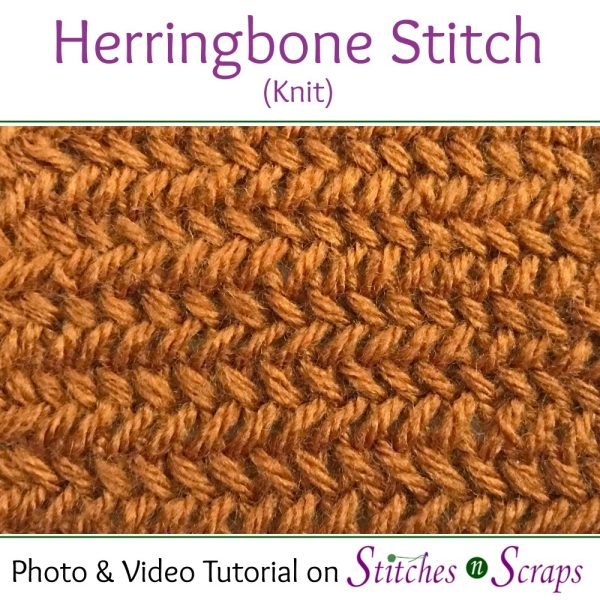
Tutorial – Herringbone Stitch (Knit)
The knit herringbone stitch uses slight modifications to common decrease stitches. This creates a dense, zig-zag texture. Learn how in this tutorial!

Herringbone Stitch Photo Tutorial:
(scroll down for video tutorial)
Herringbone stitch is a stockinette type stitch, meaning it’s always knits on the right side, and always purls on the back. Because of this, it tends to curl. The swatch I’m using in this tutorial is actually a blanket square, and has a garter stitch border on all 4 sides to keep it from curling as much. I’ve ignored that border in the instructions.
Your swatch can have any number of stitches. I recommend at least 15 or 20, so you have a good sized swatch and can see the pattern develop.
Abbreviations used in this tutorial:
- k = knit
- p = purl
- p2tog = purl next 2 stitches together
- sl = slip
- ssk = slip slip knit
- st = stitch
- RS = right side
Right Side (Knit) Row:
Start like a normal ssk decrease: Slip each of the next 2 stitches knitwise. This has the effect of twisting both of those stitches around.

Then insert your left needle back into the 2 stitches and knit.

Here’s where it gets different – instead of dropping both stitches from your left needle, drop only 1.

Now we’re going to continue to do modified ssk stitches, but notice that the first stitch is already turned around backwards. So we don’t need to slip that knitwise, instead we slip it purlwise.

The 2nd stitch is not yet twisted, so slip that one knitwise to twist it.

Now finish as before – insert your left needle into the 2 slipped stitches and knit, dropping only one loop.

Continue in this manner across the row. We’re working into two stitches at a time, but since we only drop one of those stitches each time, so our stitch count does not decrease. When you have only 1 stitch left, knit it.
RS row: Ssk dropping only the first st from the left needle, (sl 1 purlwise, sl 1 kwise, insert left needle into the 2 slipped stitches and knit, drop only the first st from the left needle) across until 1 stitch remains, k last st.
Wrong Side (Purl) Row:
The purl side of Herringbone stitch is much easier than the knit side because no stitches need to get twisted.
Purl 2 stitches together (p2tog), but drop only the first loop from the left needle.

Repeat until only one stitch is remaining, and purl that last stitch.
WS row: (P2tog dropping only the first st from the left needle) across until 1 stitch remains, p last st.
Repeat these 2 rows to continue the pattern. You may not see the herringbone texture develop right away, it doesn’t really look like much for the first two or 3 rows, but you should be able to see it after that.

Herringbone Stitch Video Tutorial:
Ready to try it out? I used this stitch in my Bad to the Herringbone pattern – give it a try!

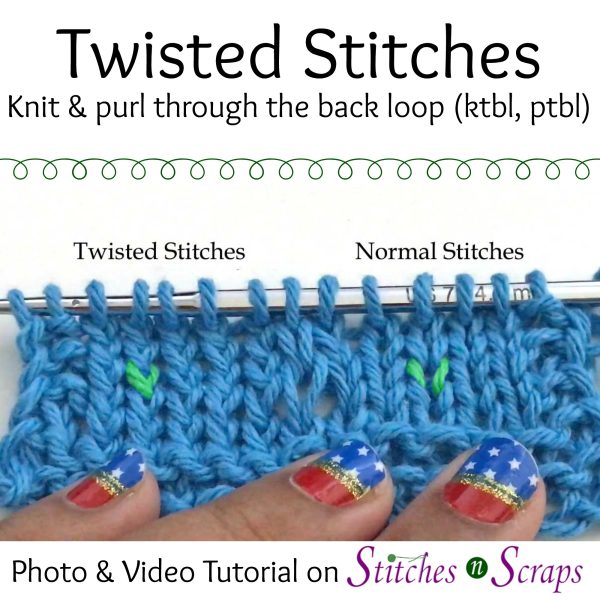
Tutorial – Twisted Stitches – Knit and Purl Through the Back Loop (ktbl, ptbl)
Most of the time in knitting, we want our stitches to lay flat and even. If they twist, it’s often a mistake. Sometimes though, we want to knit twisted stitches on purpose, as a textural element. To do this, we knit through the back loop (ktbl) or purl through the back loop (ptbl).

Twisted Stitches Photo Tutorial:
(scroll down for video tutorial)
Each stitch in knitting is a loop that sits on your needle. It has a right (front, or leading) leg, and a left (back) leg.

When on your needle, the right leg should be sitting in front, and the back leg in the back.

Normally, we knit and purl using the front leg of the stitch. For twisted stitches, we’re going to use the back leg. This makes the legs twist over each other, almost like a mini cable stitch.
With normal stitches (on the knit side), you can see a v shape that’s open at the bottom, and the legs do not cross. On the twisted stitch, you can see this v is closed at the bottom by the legs crossing over one another.

The common abbreviations refer to this as the back “loop”, but I usually think of it as the back “leg.” In this tutorial I will use the two words interchangeably.
Knit Through the Back Loop (ktbl):
In a normal knit stitch, we insert our needle from front to back through the front loop. You can see how this opens up the stitch, and the legs do not cross at the bottom.

For the twisted stitch, insert your needle from front to back through the back loop instead. The direction of the needle doesn’t change, only the loop you are putting it into. The working yarn should still be at the back like for a normal knit stitch.

Finish your stitch as you normally would for a knit. You can see as you do this that it pulls the back leg to the right and pushes the front leg to the left, twisting the stitch.

Purl Through the Back Loop (ptbl):
In a normal purl stitch, we insert our needle from back to front through the front loop.

For the twisted stitch, insert your needle from back to front through the back loop instead. Again, the direction of the needle doesn’t change. Your working yarn should be in front, like a normal purl.

Finish your stitch as you normally would for a purl. This can be a little bit tighter than the ktbl stitch.Twisted purl stitches don’t look much different on the purl side than regular purl stitches. When you turn the work over though, you will see the twisted knit stitch on the other side.
Twisted Stitches Video Tutorial:
Ready to try it out? The Wouldn’t it be Rice blanket square uses this technique. Give it a try!

Tutorial – Knit Bobbles
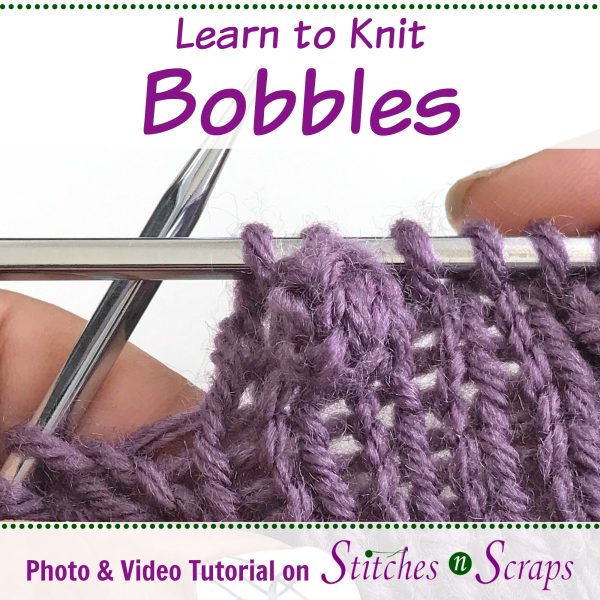
Bobbles are a fun way to add texture to your knitting. As with most techniques in knitting and crochet, there are lots of different ways to make them. Learn the 3 basic steps of making a bobble, and some different variations to try.

BobblePhoto Tutorial:
(scroll down for video tutorial)
Making a bobble can be broken down into 3 basic steps. Increasing to the desired width, knitting back and forth to the desired height, and decreasing back down to the original stitch count.
Step 1 – Increasing:
The number of increases you make in this first step determines the overall width of the bobble. Most bobbles I’ve run into start with one stitch, and increase to either 3 stitches or 5 stitches. This can be done using any increase method, but the one I see most often is to alternate between knitting into the front and back of the stitch.
To increase from one stitch to 3 on the right side of your work, first knit in the front of the stitch without removing it from the left needle (or right needle, if you’re left handed).

Then knit into the back of the same stitch, still without removing it.

Now knit into the front of the stitch again, and go ahead and remove it from the left needle.

Variations:
If you wanted a 5-stitch wide bobble, you would knit in the back and the front one more time before removing the stitch. There are lots of possible variations to this. Any kind of increase can be used, and theoretically you can increase to any number of stitches.
When making larger bobbles, you can start with more stitches. For example, you could do this same knit front-back-front increase again in the next stitch, and you would have a 6-stitch wide bobble with a flatter bottom.
If you would like a more tapered bobble, you could increase more slowly over several rows. For example, increase from one stitch to 3 on the first row, then turn and increase those three stitches to 6 on the next row.
Step 2 – Adding Height:
Once you have your desired width, it’s time to add some height to your bobble. By height, I mean how far the bobble sticks out from the surface of your work. Add height by working back and forth over your stitches. This creates the extra fabric that forms the bobble. For this example, let’s do 3 rows.
Most often, bobbles are made in stockinette stitch. Turn your work to the wrong side, and purl across all three of the stitches you just made.

Now turn again and knit across those same three stitches. Finally, turn once more and purl across the 3 stitches.

Variations:
You can add more height to your bobble by doing more rows, but at some point it will cease to be a bobble and will just become a big loop. I generally find that working as many rows as I have stitches makes a nicely rounded bobble.
You can also change the type of stitches in this step. For a fun texture, try a garter or seed stitch bobble! It won’t be as noticeable on small bobbles, but can make a difference on big ones.
Step 3 – Decreasing:
To finish the bobble, decrease back down to the same number of stitches you started with. In our case, we’re going to do a double decrease called sl1, k2tog, psso (slip1, knit 2 together, pass slipped stitch over). Turn your work back to the right side and slip the first stitch as if to knit.

Then knit the next 2 stitches together.

Finally, pass the slipped stitch over the stitch you just made. You should now be back to only 1 stitch on your needle.

This doesn’t look much like a bobble yet, but after you work a few more stitches it will. If your bobble tries to stick out at on the wrong side of the work, just push it forward with your thumb. Once you finish the next row, the bobble will be pretty well secured and is less likely to try to pop out the back.

Variations:
Just like the increasing section, you can substitute any decrease method. You can also decrease over multiple rows for a more tapered look.
Video Tutorial:
Ready to try it out? My next square in the Harmony Blanket KAL comes on on May 10th, and will have lots of bobbles to practice on. Meanwhile, try a 2-row bobble variation in the Itty Bitty Bobbles Washcloth!

Tutorial – Decoding Cables (with Licorice)
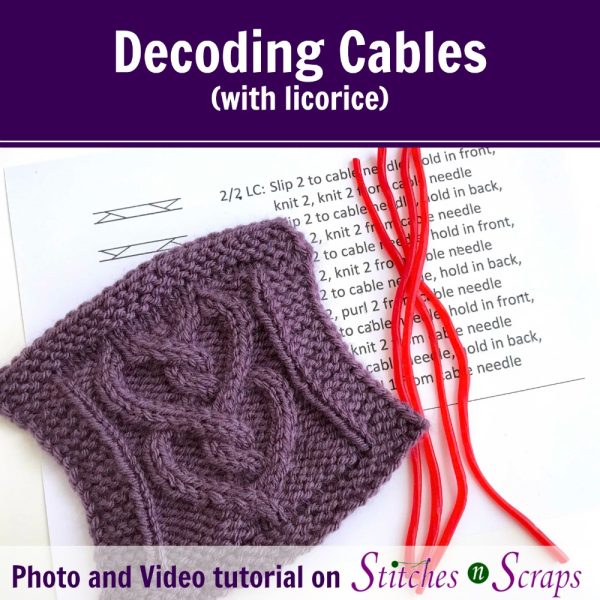
If you’ve never done them, cables can seem intimidating. They have weird abbreviations and symbols, with complicated instructions for each one. But it doesn’t have to be hard! The abbreviations for cable stitches tell you exactly what you need to know to make them – you just need to be able to decode them. This tutorial explains the language of cable stitches…with licorice.

This post contains affiliate links (click for more info). If you click one of these links and then make a purchase, I may be compensated. You get the same great prices, and you will be helping to support this site!
Do you like the Two of Hearts square featured in this tutorial? Get the pattern here!
Photo Tutorial:
(scroll down for video tutorial)
What is a Cable?
A cable is a twist that occurs when you work stitches out of order. If you skip a few stitches, work the next few stitches, and then go back and work the ones you skipped, that will cause the stitches to twist over one another, forming a cable. This is accomplished by slipping some stitches onto a cable needle and holding them out of the way, working the next stitch(es) as normal, then going back and working those stitches from the cable needle.
How Many Stitches?
A cable stitch abbreviation should look something like 2/2 LC. The number part of that abbreviation tells you how many stitches you are dealing with. The “/” should be read as “over”. So 2/2 means you are twisting 2 stitches over 2 other stitches. Similarly, 2/1 means you’re twisting 2 stitches over 1 stitch.
Right or Left?
The stitches can be twisted either to the right or the left. RC and LC in the cable abbreviation mean right cross and left cross, respectively. The direction always refers to which direction the top stitches on a cable are going. So in a 2/2 LC cable, the 2 stitches on top cross over to the left. in a 2/2 RC cable, the 2 stitches on top cross over to the right.
Which direction they cross is determined by whether you hold the cable needle to the front or the back of your work. If you hold your cable needle in front, then when you go back to work those stitches from the cable needle, they will be on top of the other stitches. This makes a left cross. If you hold your cable needle in the back, then they will be behind the other stitches. This makes a right cross.
Knit or Purl?
If there’s no P in the cable abbreviation, all stitches are most likely knit. Your pattern should confirm this, but if it doesn’t say, assume they are knit. Sometimes you will see an abbreviation like 2/2 LPC. The P in that abbreviation means that the stitches on the bottom are purled. So a 2/2 LPC means you are crossing 2 knit stitches over 2 purl stitches. This is accomplished by holding 2 stitches in front on your cable needle, purling the next two stitches, and then knitting the 2 stitches from your cable needle.
More Complex Cables?
Sometimes you’ll see something more complex, like a 2/1/2 RPC. This usually shows up where two cables meet and cross over each other. It’s a little more tricky, but the same rules apply. If you break it down, this says to cross 2 stitches over 1 stitch, which is crossed over 2 more stitches it’s like a cable sandwich with 3 layers.
To work this, break it down into sections. The first stitches we come to are the 2 stitches on the top layer. These come all the way from the left side to the right side, with the other 3 stitches passing under them. Put 3 stitches on your cable needle and hold it behind the work (because it’s a right cross). Then work the next 2 stitches. Now let’s look at the next stitch. This is the middle layer, with 1 stitch over 2. So put the last stitch from the cable needle back onto your left needle and work that 1 for the middle layer. Finally, work the bottom layer – the 2 stitches that are still on your cable needle.
In this case the purl might be confusing. Usually it will mean to purl the middle stitch, but when dealing with a complex cable like this the pattern should specify exactly how to do it.
Video Tutorial:

Knitted Kitchen #46 – Latvian Braid
The Latvian Braid Washcloth is pattern #46 in the 2017 Knitted Kitchen Blog Hop. This stitch is a variant of fair isle / stranded colorwork, alternating between 2 colors. The raised “braids” are created by intentionally carrying the unused color across the right side of the work in a specific way. The pattern includes photos and instructions for the technique, plus a more in depth video tutorial.

The Knitted Kitchen Blog Hop is a knit-along event hosted by the Underground Crafter, and I couldn’t be more excited to be a part of it. Together with a great team of designers and will be bringing you 48 washcloth patterns throughout the year. Each pattern will include a photo and/or video tutorial, so it’s a fun way to learn new stitches and techniques.
Lion Brand has generously provided us with yarn for our designs. I’ve chosen their 24/7 Cotton for all my washcloths and am really enjoying working with it. For more information about the event and links to the patterns, be sure to visit the main #KnittedKitchen post. I hope you’ll join in the fun!
This post contains Sponsored content and affiliate links (click for more info). If you click an affiliate link and then make a purchase, I may be compensated. You get the same great prices, and you will be helping to support this site!
Latvian Braid Washcloth
![]()
Add this to your Ravelry Queue
Materials:
- Lion Brand 24/7 Cotton yarn
- 50-90 yds #172 Grass (A)
- 40-75 yds #143 Lilac (B)
- Size 6 (4mm) knitting needles or size needed to obtain gauge
- Yarn needle
Difficulty:
Experienced – Stranded colorwork with the non-working yarn carried in a particular way.
Sizes:
Instructions are written for a 9″ square, with changes for a 12″ square in [ ]
Gauge:
20 sts x 28 rows = 4 inches in stockinette.
Abbreviations used:
- k = knit
- p = purl
- sl = slip stitch knitwise with yarn in back
- RS = Right Side
- WS = Wrong Side
Recommended Resources:
Stitch multiples:
- The pattern can be worked over any odd number of stitches, and is a multiple of 5 rows plus 3.
- The seed stitch border adds 4 stitches on each side, and 5 rows on the top and bottom
Latvian Braid Technique:
While alternating between 2 colors of stitches, carry the yarn on the right side of the fabric. With each stitch, drop the old color yarn over the top of the new color yarn, and bring the new color up from underneath. The old color should cross over the top of the new color. This is true whether purling or knitting.
Note: Twisting the yarns in the opposite direction will reverse the direction of the braid – that is often done in Latvian braid patterns, but is not done in this specific pattern.
Instructions:
Cast on 45 [61] with A
Seed stitch bottom border:
Row 1 (RS): K 1, (k 1, p 1) across.
Row 2-5: Sl 1, (k 1, p 1) across.
Main section of square – (click any image to enlarge)
Row 6 (WS – set up row): With A, (sl 1, k 1, p 1, k 1); Carrying the unused yarns on the wrong side of the work as normal, p 1 with B, (p 1 with A, p 1 with B) across to last 4 stitches, drop B on right side of work; With A (k 1, p 1) twice.
Row 7 (RS – braid row 1): With A, (sl 1, k 1, p 1, k 1); Using the Latvian braid technique, p 1 with B, (p 1 with A, p 1 with B) across to last 4 stitches, drop B on right side of work, over the top of A, and pick up A from underneath it; With A (k1, p1) twice.
Row 8 (WS – braid row 2): With A, (sl 1, k 1, p 1, k 1); Using the Latvian braid technique, k 1 with B, (k 1 with A, k 1 with B) across to last 4 stitches, drop B on wrong side of work; With A (k1, p1) twice.
Row 9: With A, sl 1, k 1, p 1, k1, k across to last 4 sts, (k1, p1) twice. Carry B up at the wrong side of work when you come to it.
Row 10: With A, sl 1, k 1, p 1, k1, p across to last 4 sts, (k1, p1) twice. Carry B up at the wrong side of work when you come to it.
Row 11 (RS – set up row): With A, (sl 1, k 1, p 1, k 1); Carrying the unused yarns on the wrong side of the work as normal, k 1 with B, (k 1 with A, k 1 with B) across to last 4 stitches, drop B on right side of work; With A (k 1, p 1) twice.
Row 12 (WS – braid row 1): With A, (sl 1, k 1, p 1, k 1); Using the Latvian braid technique, k 1 with B, (k 1 with A, k 1 with B) across to last 4 stitches, drop B on right side of work, over the top of A, and pick up A from underneath it; With A (k1, p1) twice.
Row 13 (RS – braid row 2):With A, (sl 1, k 1, p 1, k 1); Using the Latvian braid technique, p 1 with B, (p 1 with A, p 1 with B) across to last 4 stitches, drop B on wrong side of work; With A (k1, p1) twice.
Row 14: Repeat row 10.
Row 15: Repeat row 9
Rows 16-63: Repeat rows 6-15 four more times, then repeat rows 6-13 once more. Cut B, leaving a tail to weave in later.
Row 64: Repeat row 10, but do not carry B up.
Seed stitch top border:
Rows 65-69 [89-93]: Repeat row 2.
Bind off all stitches and weave in ends.
Video Tutorial:
Go back to written instructions
I hope you enjoy the pattern. Thanks to Lion Brand for providing the yarn!
A downloadable pdf of this pattern is also available in my Craftsy store or on Ravelry, for a small fee. The fee for the pdf format is to offset the advertising revenue lost when you print or download the pattern rather than viewing it online.
Do you want the best of Stitches ‘N’ Scraps delivered right to your inbox? The Stitches ‘N’ Scraps email newsletter includes highlights from the blog as well as special features not available elsewhere. Don’t miss a stitch – Subscribe now!