Free Crochet Patterns
Find the perfect, free crochet pattern for your next project! Browse them all, or select a category from the dropdown menu. Where will your creativity take you today?

#DIW2 – Halfway done!
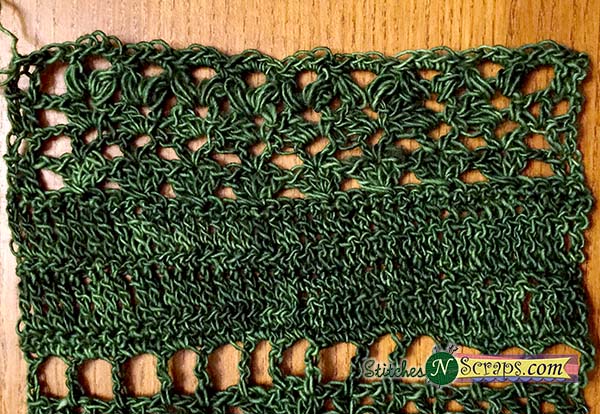
We’ve just finished section 6 of the DIW2 mystery CAL blog hop scarf, so we’re actually a little more than halfway done. Don’t worry though, it’s easy to catch up! each section is only 5 rows, and there will be a little catching up time coming soon.
This has been so much fun to do – it’s exciting to see the new section every couple of days. Here’s my scarf so far:

If you’re participating in this CAL, be sure to keep an eye on the Ravelry group. There just MAY be a secret, surprise, bonus activity there starting on the 23rd…..
The following are affiliate advertisements. If you click the ad and sign up or make a purchase, I may be compensated.

#DIW2 – Mystery blog hop CAL scarf section 1
It’s finally time to start the Design Improv Workshop (#DIW2) Mystery blog hop scarf CAL! For the rules, social media links, etc, please check out this intro post.
Section 2 will be posted by Mistie Bush of American Crochet on 4/3/15. I will update this link once her post is available.
Remember, there are purposely no recommendations as to yarn and/or hook. We want to see variety! Without further ado, here are my first 5 rows:
Each section of this pattern is protected by the author’s respective copyright. Please do not distribute or share any section without prior permission in any way other than by sharing a link to it. Click here for copyright information.
This post contains affiliate links (click for more info). If you click one of these links and then make a purchase, I may be compensated. You get the same great prices, and you will be helping to support this site!
Abbreviations used:
- ch = chain
- fsc = foundation single crochet
- sc = single crochet
- dc = double crochet
- cl = cluster (see special stitch)
- sl st = slip stitch
- st(s) = stitch(es)
- sk = skip
- YO = yarn over
Note:
- Both written and charted versions of the pattern are provided – these are the same pattern so please do only one or the other, not both.
- Foundation crochet stitches are recommended, but an alternate option is provided (again, you only need to do one or the other, not both). If you are not familiar with foundation stitches, here’s a great tutorial: Foundation Crochet Stitches by Jessie at Home
Special Stitches:
Cluster (cl):
Worked over 5 stitches as follows:
- YO twice, insert hook into next st, draw up a loop (4 loops on hook)

- (YO, draw through 2 loops on hook) twice (2 loops remaining on hook)

- Sk next st, YO twice, insert hook into next st, draw up a loop (5 loops on hook)

- (YO, draw through 2 loops on hook) twice (3 loops remaining on hook)

- Sk next st, YO twice, insert hook into next st, draw up a loop (6 loops on hook)

- (YO, draw through 2 loops on hook) twice (4 loops remaining on hook)

- YO and draw through all 4 loops on hook, ch 1 to close.

Loop: Sc in top of next cl, ch 6, sl st in sc just worked.
Section 1:
Row 1: Work 40 fsc OR Ch 41, sc in 2nd ch from hook and in next 39 chs (40 sc)
Row 2: Ch 6 (counts as dc and ch 3), turn, sk next st, cl, (ch 5, sk next st, cl) twice, ch 6, sk 2 sts, cl, (ch 5, sk next st, cl) twice, ch 3, dc in last st.
Row 3: Ch 1, turn, sc in first dc, (sl st in each ch across to next cl, loop in next cluster, 6 times), sl st in next 3 chs, sc in last st.
Row 4: Ch 6 (counts as dc and ch 3), turn, sl st in first loop, (ch 5, sl st in next loop) twice, ch 6, sl in next loop, (ch 5, sl st in next loop) twice, ch 3, dc in last st.
Row 5: Ch 1, turn, sc in first st, (sc in each ch across to next loop, sc in next loop) 6 times, sc in next 3 chs, sc in last st. (40 sc)
I hope you enjoyed this section! We’d love to see your pictures – please check out the intro post for social media links. Remember to visit American Crochet on the third for the next section!
#DIW2 – My yarn choice
I’ve finally decided which yarn I want to use for the Design Improv Workshop #2 scarf (#DIW2). Here it is – this lovely skein of Madelinetosh Merino Light.

This has been one of the nicer skein in my stash for almost a year now. It’s extra special because it’s a souvenir from my visit to Churchmouse Yarns and Teas near Seattle. I keep thinking of using it, but then no project quite seems worthy. I think it has just been waiting for this one.
The Moorland colorway is such a beautiful, mottled shade of green, which is my favorite color. It will be perfect for a light, spring scarf. I had concerns about it being wool, for a lighter scarf, but lets face it – spring can still be really cold. A lighter looking, but still warm scarf may not be a bad idea. At a generous 420 yards, this should be just right.
I’ll be getting this wound and ready to use tonight. I can’t wait to get started – only 2 more days to go!

#DIW2 – Mystery CAL blog hop scarf
Here it is! the big news I’ve been hinting at!
Some of you may remember the first Design Improv Workshop from back in October, where a bunch of designer friends and I got together to create an impromptu pattern. That was SO much fun that we just had to do it again. This time though, we’re going to make it a lot more exciting, and we hope you will all join in.
Instead of putting the pattern together by ourselves, we’re going to make it a mystery CAL blog hop! I will kick things off with a post on April 1st (no joke), with the first few rows of a scarf pattern. After that, another designer will post a new section every 2 days.
The pattern has not been written ahead of time, so it will be brand new to us as we’re creating it. Since the sections will build off each other, each designer will have 2 days to design and post their section. When we run out of sections, the pattern can be repeated as needed for the length of a scarf.
Each row will be 40 stitches wide, and that is the only rule. We are not specifying a gauge, yarn weight, hook, color(s), or number of pattern repeats. This means that you get to add your twist to the design too! Will you make it thick, bulky, and warm for next winter? Or will you make it light and airy for warmer weather? Will you change colors or do it all in one color? Long, or short? We can’t wait to see all the different results!
There are lots of ways to join in, share pictures, and chat about your progress. We’ll be using the tag #DIW2 for all social media, so you can post, pin, tweet, or all of the above! You can join us in this Ravelry group and this Google+ Community.
We also have a group Pinterest board set up. You can follow without doing anything, but if you want to post to the board, please enter your Pinterest username or e-mail address here and hit submit, so I can add you. Please be patient as it may take me time to get to everyone!
(Note: E-mail addresses seem to be working better. If I don’t add you within a day or two, it means I’m having trouble with adding you by name, so please try again with your e-mail. Thanks!)
*** contact form removed – CAL is over and pinterest board is closed ***
Here is a list of all the designers who are participating in this project, and the dates on which they will be posting their sections. Right now, these links will take you to the designers website. As new sections are posted, I will update the links to take you to the actual post.
| April | |
| 1st | Stitches’N’Scraps |
| 3rd | American Crochet |
| 5th | Underground Crafter |
| 7th | Busting Stitches |
| 9th | The Crochet Lounge |
| 11th | Knot your Nana’s Crochet |
| 13th | Crochet Chiq |
| 15th | Crochet Memories |
| 17th | TBD / Catch up day |
| 19th | Kati D Creations |
| 21st | Crochet for you |
With a few days to catch up at the end, be sure to check back here on the 30th for a wrap up post. I can’t wait to get started!

Free Pattern – Bunny Bag
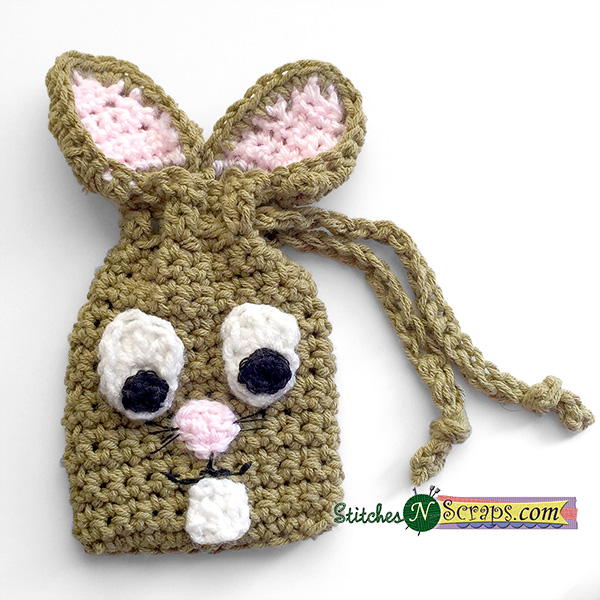
This cute drawstring bag is the perfect addition to any Easter basket! It can be used in so many different ways. It’s just large enough for a few treats. You could also fill it with potpourri and sew it shut just under the drawstring for a pretty sachet. You can make it larger or smaller by using thinner or thicker yarns too. There are so many options!
This pattern is protected by copyright. Please do not distribute or share this pattern in any way other than by sharing a link to this page or to the pattern page on Ravelry. Click here for copyright information.
This pattern contains affiliate links (click for more info). If you click one of these links and then make a purchase, I may be compensated. You get the same great prices, and you will be helping to support this site!
Bunny Bag
Add this to your Ravelry Queue
Materials:
- Worsted weight yarn:
- 50-100 yds main color (MC)
- 10-25 yds each of pink, white, and black
- Size H / 8 (5.0 mm) hook
- Small amount of lighter weight black yarn or embroidery floss (for whiskers and mouth)
- Yarn or tapestry needle
- Locking stitch markers , safety pins, or scrap pieces of yarn.
Difficulty:
Intermediate – worked mostly in the round, some decreases, some working in sides of rows, and some seaming / joining. Foundation single crochet and magic circle are recommended but not required.
Size:
Bag portion is about 4″ x 5″, with the ears adding another 2″.
Gauge:
12 sc x 14 rows = approximately 4″ square. Exact gauge is not critical for this project.
Abbreviations used:
- ch = chain
- fsc = foundation single crochet
- sc = single crochet
- hdc = half double crochet
- dc = double crochet
- sl st = slip stitch
- st(s) = stitch(es)
- sp(s) = space(s)
- sk = skip
- rnd = round
- RS = right side
Notes:
- Foundation stitches are recommended for the first round because they are somewhat stretchier, however an alternate first round is provided for those who prefer a starting chain.
- Remember to turn at the beginning of each round. This helps to keep the sides of the bag straight. You may find it helpful to mark the beginning stitch of each round.
- Instead of the crocheted drawstring, you can use a ribbon or other cord if desired.
- When sewing on facial features, be sure not to leave big loops on the inside of the bag that could get caught or pulled. Instead, try to run the yarn through the stitches so the back stays relatively neat.
Recommended Resources:
- Foundation Crochet Stitches by Jessie at Home
- Joining Foundation Stitches to Work in the Round by Moogly
- Single Crochet: Front Loop Only by Kim Guzman
- How to Work the Bottom Side of a Foundation Chain by Freshstitches
- How to Single Crochet Two Together by Fiberfluxblog
- The Magic Circle by Moogly
Bag:
Rnd 1: With MC, work 12 fsc, turn work upside down and sc in the bottom of each sc. Join with sl st to first st. (24 sc)
OR
Alternate Rnd 1: With MC, ch 13, sc in 2nd ch from hook and in each ch across, turn work upside down, sc in bottom of next 12 chs, join with sl st in first st. (24 sc)
Rnds 2 – 15: Ch 1, turn, sc in each st around, join with sl st to first st. (24 sc)
Rnd 16 (RS): Ch 3 (counts as dc), turn, dc in first st, (sk next st, 2 dc in next st) around, sk last st, join with sl st to top of ch 3. (24 dc)
Rnd 17: Ch 1, turn, sc in first 3 sts, place marker in last st worked, sc in next 14 sts, place marker in last st worked, sc in last 7 sts, fasten off.
Ears:
Outer ears:
With RS facing, join MC with sl st in front loop only of either of the two marked stitches.
Row 1: Working in front loops only, ch 1, sc in first 8 sts. (8 sc).
Row 2: Working both loops, ch 1, turn, sc in each st across, (8 sc)
Row 3: Ch 1, sc2tog over first 2 sts, sc across to last 2 sts, sc2tog over last 2 sts. (6 sts)
Rows 4 – 7: Repeat Rows 2 – 3 twice. Fasten off (2 sts on Row 7)
Join MC with sl st in next marked st on bag. Repeat Rounds 1-7 for 2nd ear. The ears are set closer together in the back. There should be 2 unworked stitches between them at the back, and 6 unworked stitches between them at the front.
Inner ears:
With inside of ear facing, join pink with sl st in first unused loop from bag (see Fig 1).
Row 1: Working in unused loops only, ch 1, sc in each unused loop across. (8 sc)
Rows 2 – 7: Repeat Rows 2 – 7 of outer ear.
Repeat Rounds 1-7 for 2nd ear.
Eding for ears:
With inside of ear facing, join MC with sl st at base of ear. (See Fig 2)
Working along edges of rows and through both thicknesses (to join them), ch 1, 7 sc along side of ear, sc in both sts at top of ear, 7 sc along other side of ear, sl st at base of ear (see Fig 2), fasten off.
Repeat for 2nd ear.
Eyes (make 2):
With white:
Make magic circle, ch 1, (sc, hdc, 2 dc, hdc, 2 sc, hdc, 2 dc, hdc, sc) all in magic circle, join with sl st to first st, close magic circle, fasten off.
OR
Ch 2, (sc, hdc, 2dc, hdc, 2sc, hdc, 2 dc, hdc, sc) all in 2nd ch from hook. Join with sl st to first st, fasten off.
With black:
Make magic circle, ch 1, 6 sc in magic circle, join with sl st to first st, close magic circle, fasten off.
OR
Ch 2, 6 sc in 2nd ch from hook. Join with sl st to first st, fasten off.
Nose (make 1):
Row 1: With pink, ch 2, sc in 2nd ch from hook.
Row 2: Ch 1, turn, (hdc, sc, hdc) in sc, fasten off.
Tooth (make 1):
Row 1: With white, ch 3, sc in 2nd ch from hook and in next ch.
Row 2: Ch 1, turn, sc in each st, fasten off.
Drawstring:
With MC, work 50 fsc, fasten off.
OR ch 51, turn, sc in 2nd ch from hook and each ch across, fasten off.
Finishing:
- Using main picture as a guide, sew eyes, nose, and tooth to the front of the bag.
- With black thread / floss, embroider mouth detail and whiskers. I used typical embroidery floss that has 6 strands. I separated the floss and used 4 strands for the mouth and 2 strands for whiskers.
- Weave drawstring, ribbon, or cord into the gaps on rnd 16 of bag, and tie knots at the ends so it doesn’t pull out.
I hope you enjoy the pattern! An ad-free, downloadable pdf of this pattern is also available in my Craftsy store for a $1 fee. The fee for the pdf format is to offset the advertising revenue lost when you print or download the pattern rather than viewing it online.
If you would like to receive notifications of new posts and patterns as they become available, please follow this blog. You can follow by e-mail (look at the sidebar on the right for the follow by email option), or via RSS feed, or via your WordPress.com reader: Follow Stitches ‘N’ Scraps on WordPress.com

Free Pattern – Accidental Beanie
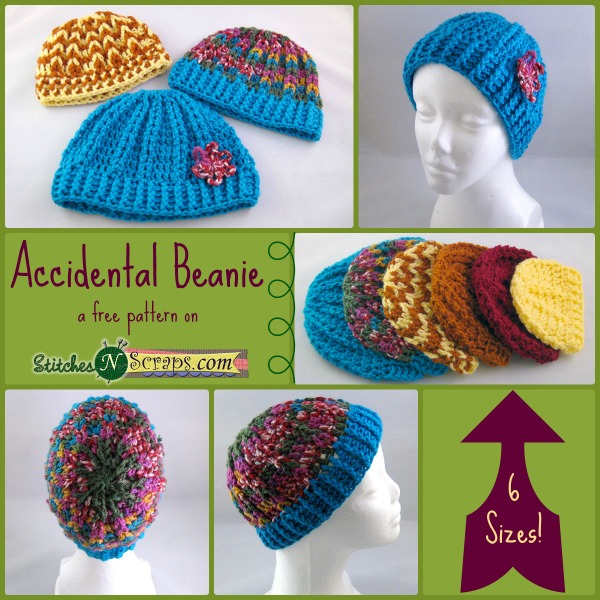
This pattern came about entirely by accident. I was working on a Jacob’s square for the Jake’s blankie CAL by Jessie at Home, but I wasn’t really paying attention. Without realizing it, I had worked the whole first 5 rows without doing any of the increases. When I went to make the Jacob’s ladders, the “square” started curling in, and I found I had accidentally made something that looked remarkably like a hat. A little ribbing on the bottom and it became a fun, chunky beanie! It was a little small, but was easily sized up. The pattern has instructions for premie to adult sizes!
This pattern is protected by copyright. Please do not distribute or share this pattern in any way other than by sharing a link to this page or to the pattern page on Ravelry. Click here for copyright information.
This pattern contains affiliate links (click for more info). If you click one of these links and then make a purchase, I may be compensated. You get the same great prices, and you will be helping to support this site!
Accidental Beanie
Add this to your Ravelry Queue
Materials:
- Worsted weight yarn: 50 – 150 yds total
- Size I / 9 (5.5 mm) hook or size needed to obtain gauge
- Size H / 8 (5 mm) hook, or 1 size smaller than the other hook you are using
- Yarn needle
- Locking stitch markers , safety pins, or scrap pieces of yarn.
Difficulty:
Intermediate – Working in the round, Jacob’s ladder technique, front and back post stitches.
Size:
Premie [baby, toddler, child, teen / small, adult / large]. Hat circumference (should be 1 inch smaller than head) 11 [13, 15, 17, 19, 21] inches, height of hat 4.5 [5, 5.25, 5.75, 6.5, 7.5] inches.
Gauge:
12 dc x 7 rows = approximately 4″ square.
Abbreviations used:
- ch = chain
- dc = double crochet
- fpdc = front post double crochet
- bpdc = back post double crochet
- sl st = slip stitch
- st(s) = stitch(es)
- sp(s) = space(s)
- sk = skip
Notes:
- The magic circle technique is recommended for the beginning because it does not leave a hole at the top, but it can be a little fiddly with all the large chain spaces. If you’re having trouble, an alternative method is provided and you can sew the hole shut when weaving in the tail.
- Do not turn at end of rounds.
- As you get further into the pattern, you may find it helpful to mark the beginning chain of each round.
- Get creative with color! These pictures show examples of alternating colors each row and of changing color at the ribbing section:

- One of the hats pictured has a little flower on it. That was made by working round 1 of the pattern (it’s the same for all sizes), with 3 fewer chains in each ch loop. So ch 8 instead of ch 11, and ch 5 instead of ch 8.
- Sizing tips:
- Choose the size based on circumference – the circumference of the hat should be about 1″ smaller than that of the head, to allow for stretching (of the hat, not the head).
- If you need to adjust the height, you can do it by adding or subtracting rounds at the top or ribbing sections as desired. Every round in the top section adds about a half inch, and every round in the ribbing section adds about a quarter inch. If you’re adding or subtracting rounds in the top section, be sure to do so at the end, after all the increases are done.
- If you prefer tighter ribbing, for a snugger fit, try using a hook 2 sizes smaller than your other hook (instead of only 1 size smaller).
Recommended Resources:
- Jacob’s Square afghan block by Jessie at Home – This is the pattern that caused this happy accident!
- Jacob’s Ladder Tutorial by Jessie at Home – Clearly shows and explains how to form and secure the ladders – just ignore the stitch counts.
- Front and Back Post Stitch Crochet tutorial by Jessie at Home – photo and video.
Top (Premie & Baby Sizes):
Make magic circle OR ch 3, join with sl st to make a circle
Rnd 1: Ch 11 (counts as first dc and ch 8, now and throughout), (2 dc, ch 8) in circle 5 times, dc in circle, join with sl st to 3rd ch of starting ch 11 (top of first dc), If magic circle was used, pull it closed. (12 dc, 6 ch loops)
Rnd 2: Ch 11, (sk next ch sp, dc in each of next 2 sts, ch 8) 5 times, sk last ch sp, dc in last st, join with sl st to 3rd ch of starting ch 11. (12 dc, 6 ch loops)
Rnd 3: Ch 11, (sk next ch sp, 2 dc in each of next 2 sts, ch 8) 5 times, sk last ch sp, 2 dc in last st, dc in same st as start of round, join with sl st to 3rd ch of starting ch 12. (24 dc, 6 ch loops)
Baby size only:
Rnd 4: Ch 11, (sk next ch sp, dc in next 2 sts, 2 dc in next st, dc in next st, ch 8) 5 times, sk last ch sp, dc in next 2 dc, 2 dc in next st, join with sl st to 3rd ch of starting ch. (30 dc, 6 ch loops)
Both sizes:
Next 3 Rnds: Ch 11, (sk next ch sp, dc in each dc across to next ch sp, ch 9) 5 times, sk last ch sp, dc in each dc across, join with sl st to 3rd ch of starting ch. (24 [30] dc, 6 ch loops)
Top (Toddler through Adult sizes):
Make magic circle OR ch 3, join with sl st to make a circle
Rnd 1: Ch 11 (counts as first dc and ch 8, now and throughout), (2 dc, ch 8) in circle 5 times, dc in circle, join with sl st to 3rd ch of starting ch 12 (top of first dc), If magic circle was used, pull it closed. (12 dc, 6 ch loops)
Rnd 2: Ch 11, (sk next ch sp, dc in next st, ch 8, dc in next st, ch 8) 5 times, sk last ch sp, dc in last st, ch 8, join with sl st to 3rd ch of starting ch 12. (12 dc, 12 ch loops)
Rnd 3: Ch 11, (sk next ch sp, dc in next st, ch 8) 11 times, sk last ch sp, join with sl st to 3rd ch of starting ch 12. (12 dc, 12 ch loops)
Rnd 4: Ch 11, (sk next ch sp, 2 dc in next st, ch 8) 11 times, sk last ch sp, dc in same st as starting, join with sl st to 3rd ch of starting ch 12. (24 dc, 12 ch loops)
Child size only:
Rnd 5: Ch 11, *(sk next ch sp, 2 dc in next st, dc in next st, ch 8, sk next ch sp), dc in each of next 2 sts, repeat from * 5 times, then repeat between ( ) once more, dc in last st, join with sl st to 3rd ch of starting ch. (30 dc, 12 ch loops)
Teen size only:
Rnd 5: Ch 11, (sk next ch sp, 2 dc in next st, dc in next st, ch 8) 11 times, sk last ch sp, 2 dc in next st, join with sl st to 3rd ch of starting ch. (36 dc, 12 ch loops)
Adult size only:
Rnd 5: Ch 11, (sk next ch sp, 2 dc in next st, dc in next st, ch 8) 11 times, sk last ch sp, 2 dc in next st, join with sl st to 3rd ch of starting ch. (36 dc, 12 ch loops)
Rnd 6: Ch 11, *(sk next ch sp, dc in next st, 2 dc in next st, dc in next st, ch 8, sk next ch sp), dc in next 3 sts, repeat from * 5 times, then repeat between ( ) once more dc in last 2 sts, join with sl st to 3rd ch of starting ch 12. (42 dc, 12 ch loops)
All four sizes:
Next 3 [3, 4, 5] Rnds: Ch 11, (sk next ch sp, dc in each dc across to next ch sp, ch 9) 11 times, sk last ch sp, dc in each dc across, join with sl st to 3rd ch of starting ch. (24 [30, 36, 42] dc, 12 ch loops)

Ladders (All sizes):
Secure working loop with stitch marker, or pull it up really tall so your stitches don’t get pulled out while making the ladders.
Take any loop from row 1 and twist it once. Take the loop directly above it from row 2, and pull it through the loop from row 1. Continue to pull each loop through the one below it. Note that only the first loop should be twisted. The final loop in each ladder will be secured in the next round. If desired, you can secure them temporarily with stitch markers or safety pins. Repeat for each set of loops around hat.
Next Rnd: Ch 3 (counts as first dc) (sl st in next loop, dc in each dc across to next loop) 5 [5, 11, 11, 11, 11] times, sl st in next loop, dc in each remaining dc, join with sl st to top of starting ch. (24 [30, 24, 30, 36, 42] dc)
Next Rnd: Ch 3, (2 dc in next loop, dc in each dc across to next loop) 5[5, 11, 11, 11, 11] times, 2 dc in next loop, dc in each remaining dc, join with sl st to top of starting ch. (36 [42, 48, 54, 60, 66] dc)
Ribbing (All sizes):
Switch to smaller hook.
Rnd 1: Ch 2 (counts as first bpdc, now and throughout), (fpdc around next st, bpdc around next st) around to last st, fpdc around last st, join with sl st to top of starting ch.
Repeat Rnd 1 once [once, twice, twice, 3 times, 3 times] more, fasten off.
Finishing (All sizes):
- Sew in all ends.
- If you used a chain loop at the top of the hat, remember to sew the end around the hole and pull it tight to close it.
I hope you enjoy the pattern! An ad-free, downloadable pdf of this pattern is also available in my Craftsy store for a $1 fee. The fee for the pdf format is to offset the advertising revenue lost when you print or download the pattern rather than viewing it online.
If you would like to receive notifications of new posts and patterns as they become available, please follow this blog. You can follow by e-mail (look at the sidebar on the right for the follow by email option), or via RSS feed, or via your WordPress.com reader: Follow Stitches ‘N’ Scraps on WordPress.com

Free Pattern – For Emily

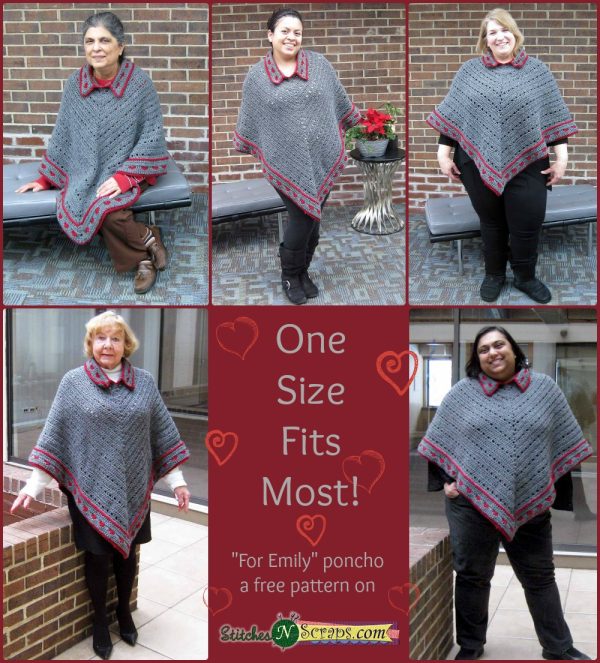
This unique poncho is worked in one piece, from the top down. It has a folded down shirt collar, and a folded up bottom hem, both with a border of little hearts. I have to give a great big thank you to my friend Annie, who convinced me to try the folded up hem!

The “one size fits most” design makes this a great pattern for gifting. All the women shown here are wearing the exact same piece. It’s hard not to want to keep it for yourself though!
This pattern is protected by copyright. Please do not distribute or share this pattern in any way other than by sharing a link to this page or to the pattern page on Ravelry. Click here for copyright information.
This pattern contains affiliate links (click for more info). If you click one of these links and then make a purchase, I may be compensated. You get the same great prices, and you will be helping to support this site!
For Emily
![]()
Add this to your Ravelry Queue
Materials:
- Lion Brand Wool-Ease:
- 6 skeins Oxford Grey
- 1 skein Cranberry (Red)
- Size J / 10 (6 mm) hook
- Yarn needle
- Locking stitch marker, safety pins, or scrap pieces of yarn.
Difficulty:
Intermediate – Increases, decreases, working in the round, and changing colors. Most of the pattern is fairly easy, but the heart stitch rows can be a little tricky on the first try. Charts are provided for these two sections.
Size:
Adult, one size fits most.
Gauge:
12 dc x 7 rows = approximately 4″ square. Row 6 (the narrowest point) should be about 22” long.
Abbreviations used:
- RS = right side
- ch = chain
- sc = single crochet
- dc = double crochet
- sl st = slip stitch
- st(s) = stitch(es)
- sp(s) = space(s)
- sk = skip
- sc2tog = single crochet 2 stitches together
- dc2tog = doube crochet 2 stitches together
- dc3tog = double crochet 3 stitches together
- long dc = long double crochet – see special stitches
- heart = heart stitch – see special stitches
Special Stitches:
- Heart Stitch (heart): Work (2dc, ch1, 2dc) all in the same st.
- Long double crochet (long dc): Work the same as a normal dc, except when you draw up a loop, pull it up a little bit higher than normal so that your stitches come out to the height of the current row.
Notes:
- Because the collar and hem are flipped over, the right and wrong sides will change. On the collar and hem, the odd numbered rows are RS rows. On the main part of the poncho, the even numbered rows are the RS rows.
- Stitch counts shown do not include the corner chain 2 spaces.
- Starting ch 3 counts as first dc. Starting ch 1 or ch 2 does NOT count as a stitch.
- Charts are provided for the collar and hem sections for the sake of clarity. Both the written instructions and charts these sections are the same – you should only work one or the other (either written or charted) for each section, not both.
- In row 3b of the collar and rnd 53b of the hem, the long dc stitches are worked over the red chains, so that the red chains are hidden within the dc stitches.
- If you would like to make the poncho longer, you can add rounds between rounds 43 & 44. Be sure to add them in sets of 4 (repeats of rnds 10 – 13).
- For advanced crocheters – If you want to make changes, here are the multiples you will need to keep in mind (not counting the corner chain spaces):
- Row 1 has a multiple of 12 + 10 stitches, so the starting chain is a multiple of 12 + 3.
- Row 2 (to set up for the heart stitch row) should be a multiple of 12 + 5
- Rnd 43 (to set up for the heart stitch round) should be a multiple of 12 + 4
- Rnd 57 should have the same number of stitches as Rnd 43.
Recommended Resources:
- Heart Hat by Charmed by Ewe – Has a photo tutorial for the heart stitch. The stitch counts are slightly different, but the idea is the same, and the hat would coordinate beautifully with this poncho!
- How to Crochet the Love is Cold ear warmer by Moogly – Entirely different stitches and counts, but the video shows clearly how to work around the chains between the hearts, like on rnds 3b and 53b. It is also another great pattern to coordinate with this one!
- How to crochet Long Double Crochet by Crochet Spot – The ones they are showing are much longer than the ones you will need, but the concept is the same.
- Seeing Stitches by Charles Voth – a great tutorial on reading crochet charts!
Instructions
Collar:
With Grey, ch 87
Row 1 (RS): Sc2tog in 2nd and 3rd chains from hook, sc in next 40 chs, sk next 2 chs, sc in next 40 chs, sc2tog in last 2 chains, turn. (82 sts).
Row 2: Ch 2, sk first st, dc in next 38 sts, dc2tog, ch 2 (corner), dc3tog, dc in next 36 sts, dc2tog, turn. Secure working loop with a stitch marker so it can’t pull out, and remove hook. (77 sts)
Row 3a: Skip first 4 sts, join red with sl st in 5th st. [Ch 3 (counts as dc, now and throughout), (dc, ch1, 2dc) in same sp, (ch 4, sk next 5 sts, heart in next st) 5 times], fasten off red – there should be 3 unworked sts left before the corner. Join red with sl st in the 5th st after the ch sp, repeat between [ ], fasten off red, leaving last 4 sts unworked. Do NOT turn. (12 hearts)
Row 3b: Pick up the grey loop that was set aside at the end of row 2. Ch 2, sk first st, long dc in next 2 sts, [ch 1, sc in ch sp at top of heart, (ch 1, sk the dc just after the heart, working over the red chain, long dc in next 3 dc, ch 1, sc in ch sp at top of heart) 5 times, ch 1, sk the dc just after the heart], dc2tog being sure to draw the loops up to row height just like for the long dc, ch 2, sk ch sp, dc3tog being sure to draw the loops up to row height, repeat between [ ],dc in next st, dc2tog being sure to draw the loops up to row height, turn.
Row 4: Ch 2, sk first st, dc in next dc, dc in next ch sp, (dc in next sc, dc in next ch sp, dc in next 3dc, dc in next ch sp) 5 times, dc in next sc, dc2tog using the next ch sp and the following st, ch2, sk ch sp, (dc3tog using the next st, ch sp, and following st), (dc in next ch sp, dc in next 3 dc, dc in next ch sp, dc in next sc) 5 times, dc in last ch sp, dc2tog, turn. (67 sts)
Row 5: Ch 1, sc2tog, sc in next 31 sts, ch 2, sk ch sp, sc2tog, sc in next 30 sts, sc2tog changing to red, turn, fasten off grey. (64 sts)
Row 6: With red, ch 1, sc in next 32 sts, ch 2, sk ch sp, sc in next 32 sts changing to grey with last st, turn, fasten off red. Mark last st of this row for edging.

Poncho:
Row 7: With grey, and working in BLO: Ch 3, 2dc in same st, dc in next 31 sts, (dc, ch 2, 2dc) in ch sp, dc in next 31 sts, 2dc in last st, turn (70 sts).
Rnd 8 (RS): Working in both loops as normal: Ch 3, 2dc in same st, dc in next 34 sts, (dc, ch 2, 2dc) in ch sp, dc in next 34 sts, 2dc in last st, ch 2, join with sl st in top of starting ch 3 to begin working in rounds, turn. (76 sts)
Rnd 9: Sl st in ch sp, ch 3, dc in same sp, dc in each st across to next ch sp, (dc, ch 2, 2dc) in ch sp, dc in each st across, dc in same ch sp as start of rnd, ch 2, join, turn. (82 sts)
Rnd 10: Sl st in ch sp, ch 3, dc in same sp, [(ch 1, sk next st, dc in next 2 sts) across to last 2 sts before ch sp, ch 1, sk next st, dc in next st], (dc, ch 2, 2dc) in ch sp, repeat between [ ], dc in same ch sp as start of rnd, ch 2, join, turn. (60 sts)
Rnd 11: Sl st in corner ch sp, ch 3, dc in same sp, dc in each ch 1 sp and in each dc across to next corner, (dc, ch 2, 2dc) in corner ch sp, dc in each ch 1 sp and in each dc across, dc in same corner ch sp as start of rnd, ch 2, join, turn. (94 sts)
Rnd 12-13: Sl st in ch sp, ch 3, dc in same sp, dc in each st across to next ch sp, (dc, ch 2, 2dc) in ch sp, dc in each st across, dc in same ch sp as start of rnd, ch 2, join, turn. (106 sts)
Rnds 14-43: Repeat rounds 10-13 seven more times, then repeat rounds 10 and 11 once more. (286 sts)
Rnd 44: Working in BLO: Sl st in corner ch sp, dc in 2nd ch of same ch sp, dc in each dc across to next corner, dc in next ch, ch 2, 2dc in next ch, dc in each st across, dc in first ch of same ch sp as start of rnd, ch 2, join, turn. (292 sts)
Rnd 45: Working in both loops as normal: Repeat Rnd 13. (298 sts)
Rnds 46-48: Repeat Rnds 10 – 12 of poncho. (316 sts)
Hem:
Rnd 49 (RS): Working in BLO: Sl st in corner ch sp, sl st in first st, changing to red. Fasten off grey. With red, ch 1, sc2tog in same st and next st, [sc in each st across to corner, ch 2, sk ch sp], sc2tog, repeat between [ ], join, turn. (314 sts)
Rnd 50: Working in both loops as normal: Sl st in corner ch sp, sl st in first sc changing to grey. Fasten off red. With grey, ch 1, [sc2tog, sc in each st across to 2 sts before corner, sc2tog, ch 2], sk ch sp, repeat between [ ], join, turn. (310 sts)
Rnd 51: Sl st in corner ch sp, sl st in first st, ch 1, [sc in each st across to 2 sts before corner, sc2tog, ch 2], sk ch sp, repeat between [ ], join, turn. (308 sts)
Rnd 52: Sl st in corner ch sp, sl st in first st, ch 1, [sc2tog, sc in each st across to 2 sts before corner, sc2tog, ch 2], sk ch sp, repeat between [ ], join, turn. Secure working loop with a stitch marker so it can’t pull out, and remove hook. (304 sts)
Rnd 53a: Skip ch sp and first 3 sts, join red with sl st in 4th st. [Ch 3 (counts as dc, now and throughout), (dc, ch1, 2dc) in same sp, ch 4, sk next 5 sts, (heart in next st, ch 4, sk next 5 sts) 24 times], fasten off red – there should be 4 unworked sts left before the corner. Join red with sl st in the 4th st after the ch sp, repeat between [ ], fasten off red, leaving last 4 sts unworked. Do NOT turn. (50 hearts)
Rnd 53b: Pick up the grey loop that was set aside at the end of rnd 4. Ch 2, sk first st, long dc in next st, [ch 1, (sc in ch sp at top of heart, ch 1, sk the sc just after the heart, working over the red chain, long dc in next 3 sc, ch 1,) 24 times, sc in ch sp at top of heart, ch 1, sk the sc just after the heart, dc3tog being sure to draw the loops up to row height just like for the long dc, ch 2], sk ch sp, dc2tog being sure to draw the loops up to row height, repeat [ ], join, turn.
Rnd 54: Sl st in corner ch sp, sl st in first st, ch 1, [sc2tog, sc in each st across to 2 sts before corner, sc2tog, ch 2], sk ch sp, repeat between [ ], join, turn. (296 sts)
Rnd 55: Sl st in corner ch sp, sl st in first st, ch 1, [sc in each st across to 2 sts before corner, sc2tog, ch 2], sk ch sp, repeat between [ ], join, turn. (292 sts)
Rnd 56: Repeat Rnd 54. (290 sts)
Rnd 57: Sl st in corner ch sp, sl st in first sc, changing to red, fasten off grey. With red, ch 1, [sc2tog, sc in each st across to corner, ch 2] sk ch sp, repeat between [ ], join, turn. (286 sts)
Joining: If you have any loose ends in the hem area, weave them in before joining. Hem should fold up naturally; just ensure corner ch sps are lined up. Working through both loops of rnd 57 and unused loops from rnd 43, sl st in 2nd ch of ch sp, sl st in each st and ch around, fasten off.

Edging:
- Bottom: With right side facing, join red with sl st in either corner chain space on the bottom edge of poncho. Working in unused loops from row 48, (ch1, sl in next st) across to corner, (ch1, sl, ch1, sl) in corner, (Ch1, sl in next st) across to the corner you started in, (ch1, sl, ch1) in corner, sl to 1st st, fasten off.
- Collar: With right side facing, join red in marked st (last st on row 6).
- Working in sides of rows, work 4sc evenly spaced to corner of collar (row 1)
- Working in bottom of row 1, 3 sc in first st, sc in each st across to last st, 3sc in last st.
- Working in sides of rows, work 8 sc evenly spaced to the bottom of the neckline
- Working in sides of rows, work 4 sc evenly spaced back to marked st, join with sl st to first st of edging, fasten off. Weave in all ends.
I hope you enjoy this Ribbed Fingerless Mitts pattern. A downloadable pdf of this pattern is available on Ravelry for a small fee. The fee for the pdf format offsets the advertising revenue lost when you print or download the pattern rather than viewing it online.
Do you want the best of Stitches n Scraps delivered right to your inbox? Don’t miss a stitch – Subscribe now!

Free Pattern – Jacob & Julia
Jacob & Julia lived on opposite sides of a big wall. They could talk through cracks in the wall, but it wasn’t enough. They needed to be together.
Jacob built a ladder on his side of the wall, and Julia built a ladder on her side.
When they met at the top and embraced, their two hearts joined and became one.
This pattern is protected by copyright. Please do not distribute or share this pattern in any way other than by sharing a link to this page or to the pattern page on Ravelry. Click here for copyright information.
This pattern contains affiliate links (click for more info). If you click one of these links and then make a purchase, I may be compensated. You get the same great prices, and you will be helping to support this site!
Jacob & Julia
Add this to your Ravelry Queue
Materials:
- Worsted weight yarn – 20-30 yds each of red and white
- Size G / 6 (4 mm) hook
- Size I / 9 (5.5 mm) hook
- Yarn needle
- 2-3 locking stitch markers, safety pins, or scrap pieces of yarn.
Difficulty:
Intermediate – Techniques include magic circle, foundation sc, Jacob’s ladder stitch, and working in the sides of rows.
Size:
One size fits most / adjustable
Gauge:
Gauge is not important as the design is adjustable – see Notes.
Abbreviations used:
- RS = right side
- ch = chain
- sc = single crochet
- fsc = foundation single crochet
- hdc = half double crochet
- dc = double crochet
- sl st = slip stitch
- st(s) = stitch(es)
- sp(s) = space(s)
- sk = skip
Notes:
- To change the size of the hearts, try using a smaller or larger hook. If you do, be sure the hook you use for the white heart (Jacob) is 2 sizes smaller than the one for the red heart (Julia). Whatever size hook you use for the red heart, use the same size for the bracelet (the wall).
- The length of the bracelet can be adjusted by doing more or fewer rows. See “the wall” section for more information.
Recommended Resources:
- Magic Circle (photo & video) by Articles of a Domestic Goddess
- Magic Circle or Finger Wrap (video) by Yarn Obsession
- Whip Stitch Seaming (photo & video) by Moogly
- Using the Running Stitch for Attaching Amigurumi (photo) by Freshstitches
- Changing yarn or color (video) by Yarn Obsession
- Braiding Crochet Loops (photo & video) by Moogly
- Jacob’s Ladder Stitch (photo & video) by Jessie at Home
Jacob (white heart):
Make 2
Rnd 1 (RS): With white and with smaller hook, make a magic circle. In magic circle, ch 3 (counts as hdc & ch 1), sc, hdc, 3 dc, ch 1, sl st, ch 1, 3 dc, hdc, sc, ch 1, join with sl st to 2nd ch of starting ch 3. Pull magic circle closed tightly. Fasten off, leaving an extra long (about 12″) tail for sewing.
Finishing: Weave in both short (starting) ends, leaving the longer ones for later. When weaving in one of the ends, bring it up over the top of the heart from the back, then back down through the center of the heart from the front, and pull tightly this will give the top of the heart better definition.
Joining: Place both hearts with wrong sides together. Using the one of the remaining (long) tails, sew them together as desired. I like to use a running stitch just under the tops of the stitches, but a whip stitch over the edge looks nice too. The other long tail will be used for sewing later.
Julia (red heart):
With red and with larger hook, ch 8 and join to form a circle (be careful not to twist the chain).
Rnd 1 (RS): Ch 4 (counts as dc & ch 1), sc in next ch, hdc in next ch, 3dc in next ch, ch 1, sl st in next ch, ch 1, 3dc in next ch, hdc in next ch, sc in last ch, ch 1, join with sl st to 3rd ch of starting ch 4. Fasten off, leaving a long tail for sewing.
Finishing: Weave in starting tail, but leave ending (long) tail for sewing later.
The Wall (bracelet):
With white and with larger hook, ch 5, switch to red.
Row 1 (RS): With red, sc in 2nd ch from hook, ch 7, sk next ch, sc in last ch, turn.
Row 2: Ch 1, sc in first sc, ch 7, sk ch sp, sc in last sc, change to white, turn.
Row 3: With white, ch 1, sc in first sc, ch 7, sk ch sp, sc in last sc, turn.
Row 4: Ch 1, sc in first sc, ch 7, sk ch sp, sc in last sc, change to red, turn.
Row 5: With red, ch 1, sc in first sc, ch 7, sk ch sp, sc in last sc, turn.
Repeat rows 2-5 four more times, or until desired length is reached, then repeat row 2 once more.This is where you can adjust the length as desired. Just be sure to do the rows in sets of 2. If you don’t end with a red row, that’s OK.
Next Row: With white, ch 1, sc in first sc, ch 2, sc in last sc. You can fasten off (and join a new yarn later), or can secure working loop with a stitch marker for later use, whichever you find easier.
Julia’s ladder:
- Position the wall as shown in fig 1a, with right side facing and last row worked on top.
- Find the middle two rows (shown in fig 1a with stitch markers).
- Take the lower of the two middle rows and pull it up under the row above it (fig 1b)
- Twist the same row 1/2 turn to create a loop (fig 1c)
- Pull next row through the loop (fig 1d). There is no need to twist.
- Repeat the last step for the remaining rows, pulling each one through the loop created by the one before it. There is no need to twist any of these rows. You should be left with a loop at the top (fig 1e). Use a stitch marker to secure this for the moment.
Jacob’s ladder:
- Turn the the wall around so the starting chain is on top.
- Twist the remaining center row 1/2 turn to create a loop (fig 2a)
- Pull each row through the loop from the row before, as you did for Julia’s ladder (fig 2b). Remember, there is no need to twist the remaining loops.
Edging:
- With right side facing, pick up the working loop from the wall section, or join a new yarn in that same corner stitch. Ch 1, 3sc in same (corner) sc, ch 1, sl st in top of last loop from Jacob’s ladder, ch 1, 3sc in next (corner) sc.
- Working along sides of rows, sc in the side of each row to next corner st.
- 3 sc in next (corner) sc, ch 1, sl st in last loop from Julia’s ladder, ch 1, 3sc in next (corner) sc.
- Working along sides of rows, sc in the side of each row, join with sl st to first st of edging, fasten off.
Finishing:
- Using the remaining tail, sew Jacob’s heart to the end of Jacobs ladder (fig 3). Tack it down only at the center of the heart, and somewhat loosely, like a button. Do not sew around the edges.
- Using the remaining tail, sew the edge of Julia’s heart to the end of Julia’s ladder (fig 3). Be sure the center (buttonhole) is hanging over the end of the ladder, as shown.
- Weave in any remaining ends.
- Insert Jacob’s heart into the hole in Julia’s heart to join them together.
I hope you enjoy the pattern! An ad-free, downloadable pdf of this pattern is also available in my Craftsy store for a $1 fee. The fee for the pdf format is to offset the advertising revenue lost when you print or download the pattern rather than viewing it online.
If you would like to receive notifications of new posts and patterns as they become available, please follow this blog. You can follow by e-mail (look at the sidebar on the right for the follow by email option), or via RSS feed.

Easy Crochet Scarf Pattern – Mesh Tube Scarf
Wrap yourself in the pillowy softness of a mesh tube scarf! This easy crochet scarf pattern creates a tube, which then flattens into a double layer of mesh. The layers work together to make this scarf thick, cozy, and warm, without being too heavy.

With only basic stitches in a simple, repeating pattern, this is a great introduction to working in continuous rounds. I’ve included instructions for adjusting the length and width, so you can make it to any size you prefer.
This content is protected by copyright. See this Terms of Use / Copyright page for more information.
This post contains sponsored content and/or affiliate links. If you click an affiliate link and make a purchase, I may get a commission.
New and Improved!
I first made this mesh tube scarf in 2014, as a Christmas present for my father-in-law. My original pattern was a little bit different, and there were a couple of things I wanted to change.

I didn’t like the way the ends flared, and I wanted to open up the mesh a bit for a better drape. Now, after many years, I’ve finally given this easy crochet scarf pattern the update it needed.
Video Tutorial
Need a little help? While updating the pattern, I also recorded this video tutorial! Walk through the whole pattern with me step by step.
Lion Brand Yarns
Lion brand provided the Vanna’s Choice yarn for the updated version of this easy crochet scarf pattern. It’s a fantastic all-purpose acrylic yarn that comes in a wide range of vibrant colors. I chose the deep red Cranberry color.
When I made the original version of this scarf, I used Lion Brand Wool-Ease yarn. This is also a great choice! The touch of wool makes it a little bit lighter, and at the same time a little bit warmer.
Materials:
- Yarn: 510 yds Lion Brand Vanna’s Choice worsted weight yarn. Solid colors are 100% acrylic (170 yds / 100g per skein). Sample shown in #180E Cranberry
- Hook: US size K (6.5 mm) hook or size needed to match gauge
- Notions:
- Scissors
- Yarn needle
Project Level:
Easy: Basic stitches, worked in continuous rounds.
Size:
7″ x 60″
Length and width can be adjusted as desired.
Gauge:
12 dc x 6 rnds = 4″
Use pattern as gauge swatch – after rnd 7, work should measure 7″ x 4″
Exact gauge is not critical but will affect yarn usage.
Abbreviations used:
(Pattern is written in US terms)
ch = chain
dc = double crochet
hdc = half double crochet
sc = single crochet
sk = skip
sl st = slip stitch
sp = space
st(s) = stitch(es)
Recommended Resources:
Instructions:
Ch 52 (multiple of 2)
For a wider or narrower scarf, add or remove chains in groups of 2.
Rnd 1: Hdc in 2nd ch from hook, [ch 1, sk next ch, hdc in next ch] across. Being careful not to twist, join with sl st to first st to form a circle. (26 hdc, 25 ch-1 sps)

Rnd 2: Ch 2 (counts as ch-1 sp), Sk first st, [sc in next ch-1 sp, ch 1, sk next st] around, do not join. (25 hdc, 26 ch-1 sps)
From this point forward, you don’t need to keep track of the rnds if you don’t want to. Simply repeat (dc in next ch-1 sp, ch 1, sk next st) around in continuous rounds. This is the same thing as repeating rnds 3 and 4.
Rnd 3: Dc in next ch-1 sp, (ch 1, sk next st, dc in next ch-1 sp) around, do not join. (26 hdc, 25 ch-1 sps)
Rnd 4: Ch 1, sk next st, (dc in next ch-1 sp, ch 1, sk next st) around, do not join. (25 hdc, 26 ch-1 sps)
Repeat rnds 3-4 until work measures 59.5 inches, or about 1/2 inch shorter than desired length. It does not matter if you stop in the middle of a rnd, just be sure to end after a (ch 1, sk next st).
50 repeats of rnds 3 & 4 at the pattern gauge should get you to approximately 59.5 inches.
Joining: Sc in next ch-1 sp, (ch 1, sk next st), Join with a sl st in next ch-1 sp. (1 sc, 1 ch-1 sp)
Last rnd: Ch 1, hdc in first ch-1 sp, (ch 1, sk next st, hdc in next ch-1 sp) around, join with a sl st in first hdc. (26 hdc, 25 ch-1 sps)
Fasten off.
Use the starting tail to sew the bottom of rnd 1 closed.

Weave in ends.
Share this easy crochet scarf pattern on Pinterest!
Here’s an image perfect for pinning.

Rate this easy crochet scarf pattern!
I hope you enjoyed this easy crochet scarf pattern. A paid, pdf version of this pattern is available on Ravelry. The fee for the pdf format is to offset the advertising revenue lost when you print or download the pattern rather than viewing it online.
Do you want the best of Stitches n Scraps delivered right to your inbox? Don’t miss a stitch – Subscribe now!

Free Pattern – Poinsettia bottle cozy
Need a last minute gift or a hostess gift? Slip a nice bottle of wine into this lovely cozy, and you’re ready to go! While it was designed for wine bottles, the pattern includes instructions to make it somewhat wider, narrower, taller, or shorter as needed, so it can easily be adjusted to fit bubble bath, bath salts, olive oil, or other similarly shaped bottles!
This pattern involves some advanced techniques, particularly the colorwork. The border rows are done with alternating colors every stitch, and the main flower pattern is charted and done in the round. I have marked it as an experienced skill level pattern because of these techniques, but it could be a good challenge for an intermediate crocheter as well.
This pattern is protected by copyright. Please do not distribute or share this pattern in any way other than by sharing a link to this page or to the pattern listing either on Ravelry or on Craftsy. Click here for copyright information.
Poinsettia Bottle Cozy
Materials:
- Worsted weight yarn
- Cream – 100 yds
- Red – 50 yds
- Green – 25 yds
- Yellow – small amount for center of flower, as desired.
- US size H/8 (5.00 mm) hook or size needed to obtain gauge
- Yarn needle
Skill Level:
Experienced – Uses back post stitches, working in the round, and charted colorwork.
Size:
Approximately 3.25” (base diameter) x 10” (height)
Gauge:
Rounds 1-3 should measure 3” in diameter.
Abbreviations used:
- RS = right side
- WS = wrong side
- ch = chain
- sc = single crochet
- hdc = half double crochet
- dc = double crochet
- bphdc = back post half double crochet
- sc2tog = single crochet 2 stitches together
- st(s) = stitch(es)
- sl st = slip stitch
- sp(s) = space(s)
- sk = skip
Notes:
- For a narrower or wider bottle, try using a smaller or larger hook – for a very narrow bottle you may want to try a lighter weight yarn as well. The first three rounds of the pattern should give you a circle that is just slightly larger than the base of your bottle.
- For a shorter bottle, you can skip some or all of the following rounds as needed. Be sure to skip entire sets of rows as grouped here (basically an even number of rounds on each end), or your right side / wrong side will be off.
- Rnds 7, 8, 30, & 31 (the striped borders and one adjacent rnd on each side)
- Rnds 9, 10, 28, & 29 (between borders and flowers)
- Rnds 34 & 39 (one round below cord, one above)
- Rnds 35 & 38 (another one round below cord and one above)
- For a taller bottle, you can add rnds of sc in any of the plain cream areas – just be sure to add an even number of rnds on each side of the center.
- For best results when changing colors, make the change in the last step of the previous stitch.
- For rnds 5 – 31, if you find it easier, you can work back and forth in rows instead, and then sew the side seam up and sew the bottom on before starting rnd 32.
- When working the charted section (Rnds 11 – 27):
- Try not to carry one color of yarn behind another – use a different ball for each color section.
- Technically, the odd numbered (right side) rows should be worked from right to left and even numbered (wrong side) rows should be worked from left to right. In this case though, it doesn’t matter – the pattern is symmetrical so it is the same going either way.
- Remember to turn at the end of each row, otherwise the stitches will not line up properly.
- Green squares have a dot in the center for those who have trouble distinguishing the colors.
Recommended Resources:
-
How to Change Colors in the Middle of a Row by Moogly: This is my preferred method for color changes, and can be done at the end of a round as well, in the slip stitch used for joining.
- Color Change Tutorial – by Sincerely Pam: This shows an alternate option for color changes
- Crochet Cord with Two Colors by Pattern Paradise: An alternate way to make the cord.
- How to crochet with 2 colors, stranding by FreshStitches: Use this technique for Rnds 7 & 31
- Basic Intarsia Tutorial by Crochet Ever After: Use this technique for the charted section.
Base:
Leading ch 3 counts as dc throughout.
Rnd 1 (RS): Work 12 dc into a magic circle, pull circle closed and join with sl st to first dc, turn. (12 dc)
OR Alternate Rnd 1: Ch 4, 11 dc inside circle, join with sl st to top of ch 3, turn. (12 dc)
Rnd 2: Ch 3, dc in same st, 2dc in each st around, join with sl st to top of ch 3, turn. (24 dc)
Rnd 3: Ch 3, dc in same st, (dc in next st, 2 dc in next st) 11 times, dc in last st, join with sl st to top of ch 3, turn. (36 dc)
Rnd 4: (Ch3, sk next st, sl st in next st) 18 times, fasten off. (18 ch 3 loops)
Body:
Hold base so that RS is facing you. Join cream with sl st around post of any dc from Rnd 3, as though working a back post stitch (working yarn should be in the back) – see Fig 1.
Rnd 5 (RS): Ch 2 (counts as bphdc), bphdc around each st from Rnd 3, join with sl st (36 bphdc), turn.
Rnd 6: Ch 1, (sc2tog, sc in next 16 sts) twice, join with sl st, turn.(34 sts)
Rnd 7: With green, ch 3, switching to red in 3rd ch, (with red, dc in next st, switching to green, with green, dc in next st, switching to red) 16 times, with red, dc in next st, switching to green, with green, join to top of ch 3, switching to cream, turn.
Rnds 8-10: With cream, Ch 1, sc in each st around, join with sl st, turn.
Rnds 11-27: Using colors as indicated on the chart (Fig 2), sc in each st, join with sl st at end of rnd, turn.
Rnds 28-30: Repeat rnds 8-10, switching to green at the end of rnd 30.
Rnd 31: Repeat Rnd 7
Rnds 32 – 33: With cream, ch 1, sc in each st around, join with sl st, turn.
Rnd 34: Ch 3, sk next st, [(dc, ch1, dc) in next st, sk next 2 sts] 10 times, (dc, ch 1, dc) in next st, sk last st, join with sl st to top of ch 3, turn
Rnd 35: Sc in each st and ch sp around, join with sl st, turn (34 sc)
Rnds 36-37: Ch 1, sc in each st around, join with sl st, fasten off.
Finishing:
- With yellow, embroider stamen as desired in the middle of each flower. The picture shown on page 1 was done using cross stitches with 2 strands of yellow held together. French knots are another good option. You can also sew or glue on small beads or buttons if you prefer.
- Holding red and green together, chain 100 and fasten off. Weave drawstring in and out between V stitches on rnd 34, with the ends meeting around the first ch 3 on that rnd. Trim cord ends like a tassel or sew them in.
- Sew in all ends
I hope you enjoy the pattern! An ad-free, downloadable pdf of this pattern is also available in my Craftsy store for a $1 fee. The fee for the pdf format is to offset the advertising revenue lost when you print or download the pattern rather than viewing it online.
If you would like to receive notifications of new posts and patterns as they become available, please follow this blog. You can follow by e-mail (look at the sidebar on the right for the follow by email option), or via RSS feed.