Free Crochet Patterns
Find the perfect, free crochet pattern for your next project! Browse them all, or select a category from the dropdown menu. Where will your creativity take you today?

Seahorse Crochet Teether
This sweet seahorse crochet teether is a cuddly new friend for your baby, with a teething ring wrapped up in its tail.

This content is protected by copyright. See this Terms of Use / Copyright page for more information.
This post contains sponsored content and/or affiliate links. If you click an affiliate link and make a purchase, I may get a commission.
Red Heart Baby Hugs Yarn
This adorable seahorse teether is made in Red Heart Baby Hugs yarn, which I received free from Red Heart for this design. The pattern uses both worsted weight (medium) and dk weight (light) versions of Baby Hugs Yarn.

Just like the name suggests, this yarn has the soft texture and bright colors that babies love. Moms love that Baby Hugs is OEKO-TEX® Standard 100 Class I certified, which means it has been tested to be free from harmful levels of over 300 substances!
Make the matching blanket
If you like this pattern, be sure to check out the matching Anemone security blanket – you can make both patterns with just one skein of medium and one skein of light!
Continuous Rounds and Running Stitch Markers
Use a stitch marker to keep track of the beginning of the round. You can use a regular stitch marker, but my favorite technique is to use a piece of scrap yarn as a running stitch marker instead. Learn how in this Running Stitch Markers tutorial.

The marker spirals around the work because of the way continuous rounds gradually shift by one stitch every 2 rounds. In the instructions, the shaping also shifts to account for this. Read more about how this works in this post about Why Continuous Rounds Shift.
Materials
- Yarn:
- 55-60 yds Red Heart Baby Hugs Medium – Aloe
- 10-15 yds Red Heart Baby Hugs Light – Peachy
- Small amount of black thread or yarn for eyes.
- 55-60 yds Red Heart Baby Hugs Medium – Aloe
- 10-15 yds Red Heart Baby Hugs Light – Peachy
- Small amount of black thread or yarn for eyes.
- Hook: Size H / 8 (5 mm) hook or size needed to obtain gauge
- Notions:
- Maple teething ring
- Fiberfill / stuffing material
- Yarn or Tapestry needle
- Stitch marker or scrap yarn
Project Level
Intermediate: The stitches are easy but the shaping is more complicated. Most important thing is to keep track of the first stitch of each round.
Size
About 8 inches long when complete, not counting teething ring. Size will vary depending on your gauge and finishing (how tightly you curl the tail, etc).
Gauge
16 sc x 18 rows = 4 inches. Exact gauge is not critical. It’s best to use the smallest hook you are comfortable with for the medium yarn. Your stitches should be a bit tight, so the stuffing doesn’t come out.
Abbreviations used
This pattern uses US terms.
- ch = chain
- sc = single crochet
- hdc = half double crochet
- sc2tog = single crochet next 2 stitches together
- hdc-dec = half double crochet decrease (see special stitches)
- dc = double crochet
- sl st = slip stitch
- st(s) = stitch(es)
- sp(s) = space(s)
- rnd = round
- yo = yarn over
- WS = wrong side
- RS = right side
Special Stitches:
Half Double Crochet Decrease (hdc-dec): Yo, insert hook into next st, yo and draw up a loop (3 loops on hook). Insert hook into next st, yo and draw up a loop (4 loops on hook). Yo and pull through all 4 loops.
Picot: Ch 3, sl st in 3rd ch from hook.
Instructions
The entire body of the seahorse is worked in continuous rounds. Do NOT turn or join rounds unless specifically indicated.
Tail
Rnd 1 (RS): With Aloe, make a magic circle leaving an 8-inch tail for sewing. Ch 1, 4 sc in circle (4 sts)
OR Alternate Rnd 1: With Aloe, ch 2, 4 sc in 2nd ch from hook. (4 sts)
Rnd 2: (2 sc in next st, sc in next st) twice. (6 sts)
Rnds 3-4: Sc in next 3 sts, hdc in next 3 sts.
Rnd 5-6: Hdc in next st, sc in next 3 sts, hdc in next 2 sts.
Rnds 7-8: Hdc in next 2 sts, sc in next 3 sts, hdc in next st.
Rnds 9-10: Hdc in next 3 sts, sc in next 3 sts.
Rnds 11-12: Sc in next st, hdc in next 3 sts, sc in next 2 sts.
Rnds 13-14: Sc in next 2 sts, hdc in next 3 sts, sc in next st.
Rnd 15: Sc in next 2 sts, 2 sc in next st, hdc in next 3 sts. (7 sts)
Rnd 16: Sc in next 4 sts, hdc in next 2 sts, 2 hdc in next st. (8 sts)
Begin stuffing your seahorse and continue stuffing as you go. It should be plump, but not so stuffed that you can see the stuffing through the stitches.
Rnds 17-18: Hdc in next st, sc in next 4 sts, hdc in next 3 sts.
Rnds 19-20: Hdc in next 2 sts, sc in next 4 sts, hdc in next 2 sts.
Rnds 21-22: Hdc in next 3 sts, sc in next 4 sts, hdc in next st.
Rnds 23-24: Hdc in next 4 sts, sc in next 4 sts.
Rnds 25-26: Sc in next st, hdc in next 4 sts, sc in next 3 sts
Rnds 27-28: Sc in next 2 sts, hdc in next 4 sts, sc in next 2 sts
Rnds 29-30: Sc in next 3 sts, hdc in next 4 sts, sc in next st.
Body
Rnd 31: [2 sc in next st, sc in next st] twice, sc in next 4 sts. (10 sts)
Rnd 32: [Sc in next st, 2 sc in next st] twice, sc in next 6 sts. (12 sts)
Rnd 33: Sc in next 2 sts, 2 sc in next st, sc in next 3 sts, 2 sc in next st, sc in next 5 sts. (14 sc)
Rnd 34: [Sc in next 3 sts, 2 sc in next st] twice, sc in next 6 sts. (16 sts)
Rnd 35: Sc in next 4 sts, [2 sc in next st, sc in next 5 sts] twice. (18 sts)
Rnd 36: [Sc in next 5 sts, 2 sc in next st] twice, sc in next 6 sts. (20 sts)
Rnds 37-38: Sc in next 6 sts, hdc in next 9 sts, sc in next 5 sts.
Rnds 39-40: Sc in each st around
Rnd 41: sc in next 8 sts, sc2tog, sc in next 5 sts, sc2tog, sc in next 3 sts. (18 sts)
Rnd 42: Sc in each st around
Rnd 43: Sc in next 8 sts, sc2tog, sc in next 5 sts, sc2tog, sc in next st. (16 sts)
Rnd 44: Sc in each st around
Rnd 45: Sc in next 9 sts, sc2tog, sc in next 3 sts, sc2tog. (14 sts)
Rnd 46: Sc in each st around
Neck
Rnd 47: Sc2tog, hdc in next 9 sts, sc2tog, sc in next st. (12 sts)
Rnd 48: Sc in next st, hdc in next 9 sts, sc in next 2 sts.
Rnd 49: Sc in next st, sc2tog, hdc in next 7 sts, sc2tog. (10 sts)
Rnd 50: Sc in next 2 sts, hdc in next 7 sts, sc in next st.
Rnds 51-52: Sc in next 4 sts, hdc in next 5 sts, sc in next st.
Rnds 53-54: Sc in next 5 sts, hdc in next 5 sts.
Head
Rnd 55: Hdc in next st, [sc in next st, 2 sc in next st] twice, sc in next st, hdc in next 4 sts. (12 sts).
Rnd 56: Hdc in next st, sc in next 2 sts, 2 sc in next st, sc in next st, 2 sc in next st, sc in next 2 sts, hdc in next 4 sts. (14 sts)
Rnd 57: Hdc in next 2 sts, sc in next 2 sts, 2sc in next st, sc in next 3 sts, 2 sc in next st, sc in next 2 sts, hdc in next 3 sts. (16 sts)
Rnd 58: Hdc in next 3 sts, sc in next 9 sts, hdc in next 4 sts.
Rnds 59-60: Hdc in next 5 sts, sc in next 7 sts, hdc in next 4 sts.
Rnd 61: Hdc in next st, hdc-dec, hdc in next 2 sts, sc in next 7 sts, hdc in next 2 sts, hdc-dec (14 sts).
Rnd 62: Hdc in next st, hdc-dec, hdc in next st, sc in next 7 sts, hdc in next st, hdc-dec. (12 sts).
Remember to continue stuffing as you go – head gets very small at the end and will be harder to stuff.
Rnd 63: Hdc in next st, hdc-dec, sc in next 7 sts, hdc-dec. (10 sts)
Rnd 64: Hdc in next st, hdc-dec, sc in next 5 sts, hdc-dec. (8 sts)
Rnd 65: Hdc in next 3 sts, sc in next 5 sts.
Rnd 66: Sc in each st around.
Rnd 67: Sc2tog, sc in next 4 sts, sc2tog. (6 sts)
Rnd 68: Sc in each st around.
Rnd 69: [Sc in next st, sc2tog] twice. (4 sts)
Rnd 70: Sc in each st around.
Rnd 71: [2 sc in next st, sc in next st] twice. (6 sts)
Rnd 72: Sc in each st around.
Rnd 73: Sc2tog 3 times, fasten off.
Finish stuffing and weave in any ends except for the long starting tail.
Eye and neck pictures show fin already attached – please ignore that, it will be done later.
Make eye: With black yarn or thread, sew through both sides of head at the same time where you want the eye to be. Pull snuggly so the eye sinks in a little. When you’re happy with it, sew in the ends.

Secure neck: If you leave the neck as-is, the head will be able to move up and down a bit more. If you prefer a more secure / sharper crease in the neck as shown, use a scrap of Aloe to sew it in place. Fold the head down against the neck, and sew them together at the crease.

Fin
Foundation chain: With Peachy, ch 46
Row 1: Turn, sl st in 2nd ch from hook, sc in next ch, (picot, sc in next 3 chs) 10 times, sc in next 4 chs, leaving remaining chains unworked.
Row 2: Turn, sk first 2 sc, [ch 1, dc] 5 times in next sc, ch 1, sk next 2 sc, sl st in next sc.
Row 3: Turn, sk sl st, sc in first ch-1 sp, [picot, sc in next dc, sc in next ch-1 sp] 5 times; continuing in unworked chs from foundation chain, sc in next ch, picot, [sc in next 3 chs, picot] twice, sc in next ch, sl st in last ch.
Fasten off, leaving an 18-inch tail for sewing.
Attach Fin
You may find it helpful to pin or baste fin in place before sewing. Using long tail, Sew through the base of the fin from front to back, then through the seahorse underneath, from back to front. Continued in this manner to attach entire length of the fin. If desired, repeat seam in opposite direction to make it extra secure. Weave in fin ends.

Attach Teething Ring
Slide the teething ring onto the tail, curl the tail up, and sew it securely in place using the end.

Weave in any remaining ends.
I hope you enjoy this Seahorse Crochet Teether pattern. Special thanks to Red Heart for providing the beautiful yarn, and to MixedKreations, dollyBambas, DalColloLungo, wilmaelee, and asdlane for testing the pattern!
A downloadable pdf of this pattern is available on Ravelry for a small fee. The fee for the pdf format offsets the advertising revenue lost when you print or download the pattern rather than viewing it online.
Do you want the best of Stitches n Scraps delivered right to your inbox? Don’t miss a stitch – Subscribe now!

Free Pattern – Breezy Baby Tank
This simple tank top is a breeze to make, and light and airy to wear too – perfect for hot summer weather! Buttoned straps make it easy to put on, and can be made longer or shorter if needed, for just the right fit. It’s designed in a linen blend, but could be made in a cotton or bamboo too.
In this sample, I used Plymouth Yarns Linen Concerto in Aqua for the main color. For the edging I used a different linen yarn which is now discontinued. Linen Concerto also comes in a Grape colorway, which would be a great option for the edging.
This pattern is protected by copyright. Please do not distribute or share this pattern in any way other than by sharing a link to this page or to the pattern page on Ravelry. Click here for copyright information.
This pattern contains affiliate links (click for more info). If you click one of these links and then make a purchase, I may be compensated. You get the same great prices, and you will be helping to support this site!
Breezy Baby Tank

![]()
Add this to your Ravelry Queue
Materials:
- Worsted weight yarn, preferably a soft linen or cotton blend.
- 80-100 yds main color (MC)
- 20-25 yds accent color (AC)
- Size H / 8 (5 mm) hook or size needed to obtain gauge
- Yarn or Tapestry needle
- Stitch marker
- Two 1/2 inch buttons
Difficulty:
Easy – mostly sc and dc, some shaping (increases and decreases). Some working in the round.
Sizes:
Pattern is written for 6 months, with changes for 12 months shown in [ ]
Gauge:
15 sc x 16 rows = 4 inches. Gauge is important for a good fit. Take time to check your gauge.
Abbreviations used:
- ch = chain
- sc = single crochet
- fsc = foundation single crochet
- sc2tog = single crochet 2 stitches together
- dc = double crochet
- sl st = slip stitch
- st(s) = stitch(es)
- sp(s) = space(s)
- rnd = round
- MC = main color
- AC = accent color
- WS = wrong side
- RS = right side
Recommended Resources:
- Foundation Singe Crochet (fsc) by Moogly
- How to Single Crochet 2 Together (sc2tog) by Fiber Flux
- Invisible Join by Look What I Made
Notes:
- Join rounds as indicated with slip stitch in first st of round, unless otherwise stated.
- Ch 3 at beginning of round counts as first double crochet
- Ch 1 at the beginning of each row (turning ch) does not count as a stitch or a space.
Instructions:
Body:
Rnd 1 (WS): With MC, work 78 [82]) fsc, join (78 [82] sts)
OR Alternate Rnd 1: With MC, ch 79 [83], sc in 2nd ch from hook and in each ch across, join. (78 [82] sts)
Rnd 2: Ch 3, turn, (ch 1, sk next st, dc in next st) around to last st, ch 1, sk last st, join. (39 [41] dc, 39 [41] sps)
Rnd 3: Ch 1, turn, sk first st, (2 sc in next sp, sk next st) around, join. (78 [82] sts)
Rnds 4-6 [7]: Ch 3, turn, dc in next st and in each st around, join.
Rnd 7 [8]: Ch 1, turn, sc in each st around, join.
Rnd 8 [9]: Repeat Rnd 2
Rnd 9 [10]: Repeat Rnd 3, placing a marker in 75th (3rd) stitch of round. Fasten off.
Front:
Continuing from rnd 9 [10] of body, turn, sk first 20 sts, join MC in next st.
NOTE: Ch 1 at the beginning of each row (turning ch) does not count as a sp.
Row 1 (RS [WS]): Ch 1, sc2tog, (ch 1, sk next st, sc in next st) 17 [18] times, ch 1, sk next st, sc2tog (19 [20] sts, 18 [19] sps)
Row 2: Ch 1, turn, sk first st, sc in first sp, (ch 1, sk next st, sc in next sp) across to last sp, sc2tog in last sp and last st. (18 [19] sts, 17 [18] sps)
Row 3: Ch 1, turn, sc in first st, (sc in next sp, ch 1, sk next st) across to last sp, sc in last sp, sc in last st. (19 [20] sc, 16 [17] sps).
Row 4: Ch 1, turn, sc in first st, (ch 1, sk next st, sc in next sp) across to last 2 sts, ch 1, sk next st, sc in last st. (18 [19] sts, 17 [18] sps).
Rows 5-16 [19]: Repeat rows 2-4, four [five] more times. (14 sc, 13 sps at end of row 19).
6 months only – Row 17: Repeat row 2. (13 sc, 12 sps)
Both sizes – Fasten off.
Straps:
With WS facing, join MC in marked stitch on back.
Back
Row 1 (WS): Ch 1, sc in next 5 sts. (5 sc)
Note: Strap should be centered at the back, with 17 [18] unworked stitches on each side.
Rows 2-6: Ch 3, turn, dc in next 4 sts. (5 dc)
Row 7: Ch 3, turn, dc in next st, 2 dc in next st, dc in next 2 sts (6 dc)
Now we will split for left and right straps:
Right strap
Row 8r (RS): Ch 3, turn, dc in same st, dc in next 2 sts, leaving last 3 sts unworked. (4 dc)
Rows 9r-16r: Ch 3, turn, dc in next 3 sts (4 dc)
Note: At this point, strap is about 1.25″ shorter than it will be when finished. If you have the child available, this is a good time to try it on for size. The strap should comfortably reach the top of the front – the extra 1.25 inches will be overlapping for the button. You can adjust the strap size if needed at this point, by adding more rows (repeat row 9), or ripping back a row or two. It does not matter if you end up on a right side or wrong side row.
Row 17r: Ch 1, turn, sc in each st across (4 sc)
Row 18r: Ch 1, turn, sc2tog, ch 2 (buttonhole), sc2tog (2 sts, 1 sp)
Row 19r: Ch 1, turn, sc in first st, 2 sc in sp, sc in last st (4 sc)
Row 20r: Ch 1, turn, sc in each st across, fasten off. (4 sc)
Left strap
With right side facing, join MC in first unworked st from row 7 of strap.
Row 8L (RS): Ch 3, dc in next st, 2 dc in next st (4 dc)
Rows 9L – 20L: Work as for rows 9r-20r of right strap
Note: If you changed the number of rows on the right strap, be sure to make the same changes for the left strap. If you do make any changes, it would be a good idea to try it on the child again before starting the edging.
Top / Straps Edging:
With RS facing, join AC in first unworked stitch on back, after strap (see picture)
- Sc in the 17 [18] unworked sts from back (17 [18] sts)
- Working in sides of rows, work 15 [17] sc evenly spaced along edge of front, up to top corner (15 [17] sc)
- Working across top of front, 3 sc in first st, (sc in next sp, sc in next st) across to last sp, sc in last sp, 3 sc in last st. (29 [31] sts)
- Working in sides of rows, work 15 [17] sc evenly spaced along edge of front. (15 [17] sc)
- Sc in each of the remaining 17 [18] unworked sts from back (17 [18] sc)
- Working in sides of rows, work 35 sc up side of right strap, to top corner (35 sc)
- Working across top of right strap, 3 sc in first st, sc in next 2 sts, 3 sc in next st (8 sc)
- Working in sides of rows, work 23 sc down the side of the right strap to the center where the straps split, then work 23 sc up the side of the left strap, to top corner. (46 sc)
- Working across top of left strap, 3 sc in first st, sc in next 2 sts, 3 sc in next st. (8 sc)
- Working in sides of rows, work 35 sc down side of left strap. Join with sl st to beginning of edging. Fasten off. (35 sc)
Note: for a more seamless final join on your edging, try the invisible join technique instead.
Bottom Edging:
With RS facing, and working into the bottom of the foundation chain, join AC in any stitch around bottom, sc in each st around, join, fasten off. (78 [82] sts)
Note: for a more seamless final join on your edging, try the invisible join technique instead.
Finishing:
- Sew buttons to front. If you have the child available, you may want to try it on at this point to find the best placement for the buttons. Otherwise you can use the picture as a guide.
- Weave in all ends
I hope you enjoy the pattern. Special thanks to Kyla Marie of Keep Me in Stitchez, and wilmalee for testing it!
A downloadable pdf of this pattern is also available in my Craftsy store or on Ravelry, for a $1 fee. The fee for the pdf format is to offset the advertising revenue lost when you print or download the pattern rather than viewing it online.
If you would like to receive notifications of new posts and patterns as they become available, please follow this blog. You can follow by e-mail (look at the sidebar on the right for the follow by email option), or via RSS feed, or via your WordPress.com reader: Follow Stitches ‘N’ Scraps on WordPress.com-

Free Pattern – Business Card Pouch
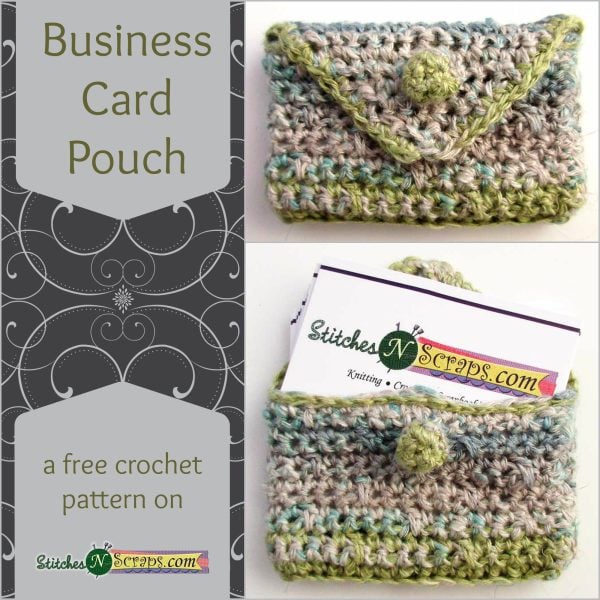
My old business card pouch is falling apart. It’s starting to look scruffy, and the button is loose. It seemed like the perfect time for a new one, so here it is! This little pouch holds standard sized business cards, and features a button flap. The pattern includes instructions for a crocheted button. It’s is made all in one piece, without any seams. It can be made with a variety of yarns, but I chose a durable linen yarn for mine.
This pattern is protected by copyright. Please do not distribute or share this pattern in any way other than by sharing a link to this page or to the pattern page on Ravelry. Click here for copyright information.
This pattern contains affiliate links (click for more info). If you click one of these links and then make a purchase, I may be compensated. You get the same great prices, and you will be helping to support this site!
Business Card Pouch

![]()
Add this to your Ravelry Queue
Materials:
- 50-60 yds DK weight yarn (Shown in Bella Lino from Classic Elite Yarns)
- Size G (4mm) hook or size needed to meet gauge
- Yarn or Tapestry needle
- Optional: 5/8″ or 15mm button (if you don’t want to crochet one).
Difficulty:
Easy – mostly single crochet and double crochet, some decreases, one round of working in back loops only. The optional button is a little more difficult just because it’s small.
Size:
3.75″ x 2.25″
Gauge:
18 sc x 20 rows = 4 inches
Abbreviations used:
- ch = chain
- sc = single crochet
- sc2tog = single crochet 2 stitches together
- dc = double crochet
- spike = spike double crochet (see Special Stitch)
- st(s) = stitch(es)
- sl st = slip stitch
- sp(s) = space(s)
- WS = wrong side
- RS = right side
Recommended Resources:
- Crochet Decreases – Jessie at Home (includes sc2tog)
- The magic circle – Moogly
- Single crochet in front loop or back loop only – CrochetKim
Special Stitch:
Spike double crochet (spike): Dc in skipped stitch below next ch sp.
Instructions:
Note: Join rounds where indicated by making a slip stitch into the first stitch of the round.
Pouch
Rnd 1: Ch 18, 3 sc in 2nd ch from hook, sc in next 15 chs, 3 sc in last ch. Working across opposite side of chain, sc in next 15 chains, join (36 sc)
Note: Your work should now be about 3.75 inches wide. If it is not, try using a different hook size or yarn. A little bit bigger is ok, but if it’s too small the business cards won’t fit.
Rnd 2 (RS): Ch 1, turn, working in back loops only, sc in each st around, join
Rnd 3: Ch 1, turn, sc in first st, (ch 1, sk next st, sc in next 5 sts) 5 times, ch 1, sk next st, sc in last 4 sts, join.
Rnd 4: Ch 1, turn, sc in first 4 sts, (spike, sc in next 5 sts) 5 times, spike, sc in last st.
Rnd 5: Ch 1, turn, sc in first 4 st, (ch 1, sk next st, sc in next 5 sts) 5 times, ch 1, sk next st, sc in last st, join.
Rnd 6: Ch 1, turn, sc in first st, (spike, sc in next 5 sts) 5 times, spike, sc in last 4 sts.
Rnds 7-14: Repeat Rnds 3-6 twice
Note: Your pouch should now measure 2.5″ tall. If it does not, continue repeating rnds 3-6 until it does, ending on an even numbered (RS) round.
Flap:
Row 1: Turn, sl st in first 2 sts, ch 1, sc2tog, sc in next 14 sts, sc2tog, leaving remaining 18 sts unworked. (16 sts, not counting sl sts)
Rows 2-3: Ch 1, turn, sc in each st across (16 sts)
Row 4: Ch 1, turn, sc2tog, sc in each st across to last 2 sts, sc2tog (14 sts)
Row 5: Repeat Row 2 (14 sts)
Row 6: Repeat Row 4 (12 sts)
Row 7: Ch 1, turn, sc2tog, sc in next 2 sts, sc2tog, ch 2 (buttonhole), sc2tog, sc in next 2 sts, sc2tog (8 sts, 1 ch sp)
Row 8: Ch 1, turn, sc2tog, sc in next 2 sts, 2 sc in ch sp, sc in next 2 sts, sc2tog (8 sts)
Rows 9-10: Repeat Row 4. (4 sts on row 10)
Row 11: Ch 1, turn, sc2tog twice. (2 sts)
Edging rnd:
- Ch 1, turn, sc2tog, working in sides of rows, work 14 sc evenly spaced along side of flap. (15 sc)
- Working around front of pouch, sl st in each unworked st from Rnd 14 of pouch (18 sl sts)
- Working in sides of rows, work 14 sc evenly spaced along side of flap, join, fasten off.
Button (optional):
Rnd 1: Work 6 sc inside a magic circle, pull circle closed, join. (6 sc)
Rnd 2: Ch 1, turn, 2 sc in each st around, join. (12 sc)
Rnd 3: Ch 1, turn, sc2tog 6 times, join. (6 sc)
Fasten off, leaving a 10 inch tail.
Stuff button lightly (I used some cut up pieces of the same yarn as stuffing).
Sew in starting tail. With ending tail, sew last round of button closed tightly. Do not cut ending tail.
Finishing:
Sew button into place on front of pouch. If you made the crocheted button, you can use the remaining tail to sew it on.
Weave in any remaining tails.
I hope you enjoy the pattern. Special thanks to wilmaelee and lynnbeggs for testing it!
A downloadable pdf version of this pattern is also available in my Craftsy store or on Ravelry, for a $1 fee. The fee for the pdf format is to offset the advertising revenue lost when you print or download the pattern rather than viewing it online.
If you would like to receive notifications of new posts and patterns as they become available, please follow this blog. You can follow by e-mail (look at the sidebar on the right for the follow by email option), or via RSS feed, or via your WordPress.com reader: Follow Stitches ‘N’ Scraps on WordPress.com–

Crochet Stash Buster – Linen Stitch Scrap Rug
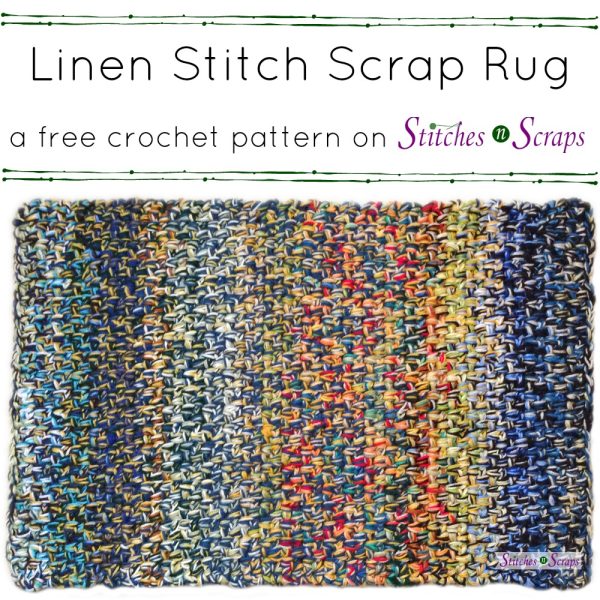
Use up all your yarn scraps with a Linen Stitch Scrap Rug! This crochet stash buster is thick, soft, and squishy, and designed to use up lots of yarn, very quickly, without weaving in a lot of ends. The stitch pattern is a simple 2 stitch repeat, so can easily be adjusted to any size.

This post contains sponsored content and/or affiliate links. If you click an affiliate link and make a purchase, I may get a commission.
5 strands at a time
Using 5 strands of yarn at a time gives this rug its luscious, squishy softness. It’s also a real yarn eater! If you only change one strand at a time, and work over the ends before changing another strand, then the ends should be secure and won’t need to be woven in. See this tutorial for more details.
Remember, what makes this work is the number of strands in the bundle, which help hold that single end in place. If you use fewer strands, you may find yourself needing to weave in the ends.
So many uses
Since I first published this pattern, it’s been one of my most popular. Talented crocheters have come up with some beautiful color schemes, and have used the pattern in lots of different ways. There are pet beds, throw rugs, runners, bath mats, even a sofa cover! Check out the amazing variety of projects on Ravelry. What will you make?
Stash busting yarn choices
For my rug, I used mostly Red Heart Super Saver, with a few other yarns mixed in. I chose to stick to all worsted weight yarns, to keep a very uniform size. You absolutely can mix different weights of yarn, but try to keep the size of the total bundle of yarns as consistent as possible.
Different fibers can also be fun! Just remember that the bundle of fibers is what holds the ends in place without weaving in. If you choose yarns that are too slippery, you may need to weave in your ends.
Pattern continues below
My Recent Videos
Materials:
- Yarn: 1500-1800 yds worsted weight yarn in a variety of colors.
- Hook: Size P (11.5 mm) hook or appropriate size for your yarns with 5 strands together
- Notions: Yarn needle
Project Level:
Easy – 2 stitch repeat using only chains and single crochets. The only challenging parts are working with 5 strands of yarn at once, and changing colors one at a time (see this Combining Scraps tutorial).
Size:
20 inches x 30 inches – Instructions include notes for adjusting size if desired.
Gauge:
8 st x 8 rows = 4 inches in linen stitch. After row 3 of pattern, your work should measure approximately 20 inches x 2 inches.
Exact gauge is not critical for this project, and in fact if you are working with scraps of different brands, your gauge may vary slightly. Choose a hook size that is comfortable to work with but still gives you a dense, somewhat stiff fabric – it should feel a little tight as you are working with it. The overall size can be adjusted as necessary by using more or fewer stitches/rows.
Abbreviations used:
(Pattern is written in US terms)
- ch = chain
- sc = single crochet
- sk = skip
- st(s) = stitch(es)
- sp = space
- ch sp = chain space
- WS = wrong side
- RS = right side
Recommended Resources:
Instructions:
With 5 strands of yarn held together, ch 41.
To adjust width of rug, add or remove chains as desired, using an odd number of chains.
Row 1 (WS): Sc in 2nd ch from hook, (ch 1, sk next ch, sc in next ch) across to last ch, sc in last ch.
Row 2: Ch 1, turn, sc in first st, (ch 1, sk next st, sc in next ch-1 sp) across to last st, sc in last st.
Change colors as needed, but only change one strand at a time. Work over the ends until they are completely gone before changing another color. See this Combining Scraps tutorial for more details.
Repeat last row 56 more times, or until desired length is reached, ending on a RS row.
Fasten off. Weave in remaining ends. Do not try to sew in the whole bundle of 5 yarns at once, or it will be very thick and noticeable. Instead, separate the 5 strands of yarn and sew them in one or two at a time.
I hope you enjoy the pattern. Special thanks to mbuchanan5, wilmalee, MixedKreations, lynne1, Megan Hampson & merryJ for testing it!
A downloadable pdf of this pattern is also available in my Craftsy store or on Ravelry, for a small fee. The fee for the pdf format is to offset the advertising revenue lost when you print or download the pattern rather than viewing it online.
Do you want the best of Stitches n Scraps delivered right to your inbox? The Stitches n Scraps email newsletter includes highlights from the blog as well as special features not available elsewhere. Don’t miss a stitch – Subscribe now!
Rate this crochet stash buster pattern!

Free Pattern – Bow-Tie Bracelet
This pretty bow-tie bracelet works up in a snap! The lightly ribbed band stretches for a perfect fit, and the big bow looks oh so cute on little wrists. The pattern is adjustable to fit anyone, so this would make a great “mommy & me” design.
This pattern is protected by copyright. Please do not distribute or share this pattern in any way other than by sharing a link to this page or to the pattern page on Ravelry. Click here for copyright information.
This pattern contains affiliate links (click for more info). If you click one of these links and then make a purchase, I may be compensated. You get the same great prices, and you will be helping to support this site!
Bow-Tie Bracelet
![]()
Add this to your Ravelry Queue
Materials:
- Worsted weight yarn – 25-40 yds each of 2 colors – shown in pink (A) and blue (B).
- Size I / 9 (5.5 mm) hook or size needed to obtain gauge
- Yarn or tapestry needle
Difficulty:
Easy – All single crochet, chains, and slip stitches. Some working in back loop only.
Size:
Adjustable.
Gauge:
13 sc x 15 rows = 4 inches. Gauge is not particularly important for this project, as it can be adjusted for size. Band should measure about 1 inch across, including the edging.
Abbreviations used:
- ch = chain
- sc = single crochet
- sl st = slip stitch
- st(s) = stitch(es)
- RS = right side
- WS = wrong side
Instructions:
Bracelet:
Row 1: With A, ch 5, turn, sc in 2nd ch from hook and in each ch across (4 sc)
Row 2: Ch 1, turn, sc in back loop only of each st across.
Repeat Row 2 until band is desired length. For a child size bracelet, you should need about 15-18 rows, for an adult size, you will need about 17-20 rows. It should fit pretty snugly around the wrist at this point – the edging will give it a little extra room.
Edging (RS):
- Ch 1, working in sides of rows, (sl st, ch 1) in each row.
- Working across bottom of row 1, (sl st, ch 1) in each st.
- Working in sides of rows, (sl st, ch 1) in each row
- Working across last row, (sl st, ch 1) in each st. Join with sl st to first st. Fasten off, leaving an 8 inch tail for sewing

Stop to check the size – at this point it should stretch to fit comfortably around the wrist. If it’s too loose, it will want to turn when you wear it.
With right sides together, join the piece into a circle by sewing first and last rows together. Weave in ends, and set band aside.
Bow:
Row 1 (RS): With B, ch 7, turn, sc in 2nd ch from hook and in each ch across (6 sc).
Row 2: Ch 1, turn, sc in each st across.
Rows 3-25: Repeat Row 2
Edging: Work the same as the edging for the bracelet.
With right sides together, join the piece into a circle by sewing first and last rows together. Weave in ends.
Turn bow so right side is facing, and flatten the circle so that the seam lies in the middle – this is where the tie at the center of the bow will go.
Join color A by sewing it in, starting at the center of the seam. Weave in and trim the tail. You should now have color A coming from your skein or ball, to the center of the seam as shown below.

Wrap the yarn around the center of the bow tightly 2 or 3 times. This will create the bow shape. Fluff it out and adjust as needed until it looks even. When you’re happy with the shape, continue wrapping the yarn around the center until you’re happy with the effect and it feels secure. I wrapped it about 20 times.
Cut the yarn, leaving an 8 inch tail for sewing. At the back of the bow, sew this tail back and forth through the center wrap a couple of times to secure it. Once it’s secure, use the remaining tail to attach the bow to the bracelet, and weave in the end.
I hope you enjoy the pattern. Special thanks to MixedKreations for testing it!
A downloadable pdf of this pattern is also available in my Craftsy store or on Ravelry for a $1 fee. The fee for the pdf format is to offset the advertising revenue lost when you print or download the pattern rather than viewing it online.
If you would like to receive notifications of new posts and patterns as they become available, please follow this blog. You can follow by e-mail (look at the sidebar on the right for the follow by email option), or via RSS feed, or via your WordPress.com reader: Follow Stitches ‘N’ Scraps on WordPress.com–

Free Pattern – Cera the Triceratops Bib
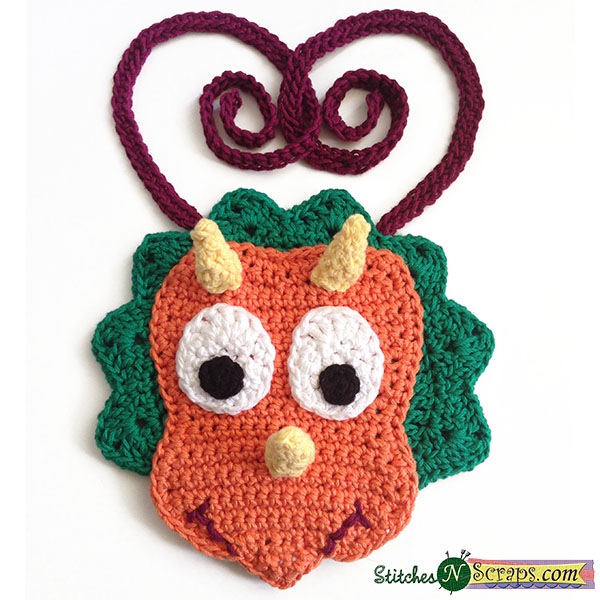
Meet Cera, the friendly triceratops bib, who is much more than just cute! With 3 soft layers of brightly colored, cotton / acrylic yarn, she’s sure to add some fun to mealtimes, while helping to keep baby’s clothes clean.
The sample is shown in mostly Cascade Avalon yarn (I made the eyes and horns with other scraps from my stash). I’ve used this yarn for a few projects now and I love it It’s very soft and smooth, and it comes in lots of fun colors too.
This pattern is protected by copyright. Please do not distribute or share this pattern in any way other than by sharing a link to this page or to the pattern page on Ravelry. Click here for copyright information.
This pattern contains affiliate links (click for more info). If you click one of these links and then make a purchase, I may be compensated. You get the same great prices, and you will be helping to support this site!
Cera the Triceratops Bib

![]()
Add this to your Ravelry Queue
Materials:
- Cascade Avalon worsted weight, cotton/acrylic yarn
- 100 yds #14 Golf Green (green)
- 50 yds #09 Bird of Paradise (orange)
- 10-20 yds each of #01 White, #11 Mellow Yellow (yellow), and #27 Raspberry (red)
- 5 yds of #03 Pirate Black (black)
- Size H / 8 (5 mm) hook or size needed to obtain gauge
- Yarn or Tapestry needle
Difficulty:
Intermediate – Lots of shaping (increases, decreases). Several small pieces that need to be assembled.
Sizes:
About 8 inches across.
Gauge:
13 dc x 8 rows = 4 inches. Gauge is not critical for this project. Rnds 1-3 of spikes should measure about 3.5 inches in diameter.
Abbreviations used:
- ch = chain
- sc = single crochet
- sc2tog = single crochet 2 stitches together
- fsc = foundation single crochet
- hdc = half double crochet
- dc = double crochet
- tr = treble crochet
- sl st = slip stitch
- st(s) = stitch(es)
- sp(s) = space(s)
- rnd = round
- yo = yarn over
- WS = wrong side
- RS = right side
Notes:
- Join rounds as indicated with slip stitch in first st of round, unless otherwise stated.
- Ch 3 at beginning of round counts as first double crochet.
- If you leave long tails, you can use them to sew pieces together.
- To stuff the horns, I cut up some small pieces of the same yellow yarn and used those instead of normal stuffing.
Recommended Resources:
- The Magic Circle by Moogly
- How to Single Crochet 2 Together (sc2tog) by Fiber Flux
- Extending a Row with Foundation Single Crochet (fsc) by Moogly
Instructions:
Frill: (Make 2)
Rnd 1 [RS]: Make a magic ring, ch 3 (counts as dc now and throughout), 11 dc in ring, pull ring closed, join. (12 sts)
OR Alternate Rnd 1: Ch 4 (counts as dc and ch), 11 dc in 4th ch from hook, join. (12 sts)
Rnd 2: Ch 3, turn, dc in first st, 2 dc in each st around, join. (24 sts)
Rnd 3: Ch 3, turn, dc in first st, (dc in next st, 2 dc in next st) 11 times, dc in last st, join. (36 sts)
Note: Circle should now measure about 3.5 inches in diameter.
Rnd 4: Ch 3, turn, dc in first st, (dc in next 2 sts, 2 dc in next st) 11 times, dc in last 2 sts, join. (48 sts)
Rnd 5: Ch 3, turn, dc in first st, (dc in next 3 sts, 2 dc in next st) 11 times, dc in last 3 sts, join. (60 sts)
Rnd 6: Ch 1, turn, sc in first 7 sts, 2 sc in next st, sc in next 2 sts, {sc in next st, hdc in next st, (dc, ch 1, dc) in next st, hdc in next st, sc in next st} 8 times, sc in next 7 sts, 2 sc in next st, sc in last 2 sts, join. (70 sts, 8 ch sps)
Rnd 7: Ch 1, turn, sc in first 6 sts, 2 sc in next st, sc in next 5 sts, {hdc in next st, dc in next st, (dc, ch 1, tr, ch 1, dc) in next ch sp, dc in next st, hdc in next st, sc2tog in next 2 sts} 7 times, hdc in next st, dc in next st, (dc, ch 1, tr, ch 1, dc) in next ch sp, dc in next st, hdc in next st, sc in next 6 sts, 2 sc in next st, sc in last 5 sts. Fasten off. (89 sts, 16 ch sps)
Ties: (Make 2)
With red, ch 76. Working in back bump of chain, sc in 2nd ch from hook and in each ch across, (75 sc)
Face:
Row 1 (RS): With orange, ch 2, sc in 2nd ch from hook. (1 st)
Row 2: Ch 1, turn, (hdc, sc, hdc) in first st. (3 sts)
Row 3: Ch 1, turn, (hdc, sc) in first st, sc in next st, (sc, hdc) in last st. (5 sts)
Row 4: Ch 1, turn, (hdc, sc) in first st, sc in next 3 sts, (sc, hdc) in last st. (7 sts).
Row 5: Ch 4, turn, sc in 2nd ch from hook, sc in next 2 chs, sc in next 7 sts, 3 fsc. (13 sts).
Rows 6-8: Ch 1, turn, (hdc, sc) in first st, sc across to last st, (sc, hdc) in last st. (19 sts on row 8)
Row 9-11: Ch 1, turn, sc in each st across.
Row 12: Ch 1, turn, sc2tog, sc in each st across, sc2tog. (17 sts)
Row 13: Ch 1, turn, sc in each st across
Row 14: Repeat row 12. (15 sts)
Rows 15-16: Repeat row 13.
Row 17: Ch 1, turn, (hdc, sc) in first st, sc across to last st, (sc, hdc) in last st. (17 sts).
Rows 18-20: Repeat row 13.
Row 21: Repeat row 17 (19 sts)
Row 22-26: Repeat row 13.
Row 27: Ch 1, turn, sc2tog, sc in next st, hdc in next st, dc in next 2 sts, hdc in next st, sc in next 2 sts, sl st in next st, sc in next 2 sts, hdc in next st, dc in next 2 sts, hdc in next st, sc in next st, sc2tog. (16 sts, 1 sl st)
Row 28: Ch 1, sc2tog, hdc in next 4 sts, sc in next 2 sts, sk next sl st, sc in next 2 sts, hdc in next 4 sts, sc2tog. (14 sts).
Edging Rnd:
- Ch 1, turn, sc in each st across top of head (14 sts)
- Working in sides of rows, work 30 sc evenly spaced down to row 1 (point at bottom of face)
- 3 sc in bottom of row 1
- Working in sides of rows, work 30 sc evenly spaced up to Row 28 (starting point), join, fasten off.
Eyes: (Make 2)
White:
Rnd 1 [RS]: With white, make a magic ring, ch 1, 6 sc in ring, pull ring closed, join. (6 sts)
OR Alternate Rnd 1: Ch 2, 6 sc in 2nd ch from hook, join. (6 sts)
Rnd 2: Ch 1, turn, 2 sc in each st around, join. (12 sts)
Rnd 3: Ch 1, turn, sc in same st, 2 sc in next st, sc in next st, 2 sc in next st, hdc in next st, 2 dc in each of next 2 sts, hdc in next st, (2 sc in next st, sc in next st) twice, join, fasten off. (18 sts)
Pupil:
Rnd 1: With black, work as for Rnd 1 of whites, fasten off.
Sew pupil to white, weave in black ends.
Horns: (Make 3)
With yellow, ch 7.
Rnd 1: Sc in 2nd ch from hook and in each ch across, join to form a circle. (6 sc)
Note: This will leave a small gap at the bottom, but you can sew that closed later.
Rnd 2: Ch 1, sc in each st around, join.
Rnd 3: Ch 1, (sc2tog, sc in next st) twice, join. (4 sts)
Rnd 4: Repeat Rnd 2.
Rnd 5: Ch 1, sc2tog twice, join. (2 sts)
Rnd 6: Ch 1, sc through both stitches at once, fasten off.
Assembly:
Using picture as a guide:
- Sew eyes to face
- Stuff horns lightly and sew in place onto face
- With red, sew mouth. I used a running stitch and went over each stitch twice to double the thickness.
- Weave in all ends from facial features.
- Sew ties onto wrong side of one frill piece
- Sew face onto right side of same frill piece.
- Weave in ends.
- Weave in the beginning (center) tail on the second frill piece.
- Place second frill piece on to the back of the first frill piece, with wrong sides together and lining up the edges. This will cover up all the messy seams from the face and ties. Sew around the entire edge to join – be careful not to sew through the face when working at the bottom edge.
- Weave in any remaining ends.
I hope you enjoy the pattern. Special thanks to wilmalee, Aurora from Dragonflymomof2, Heartscar28 & Gaelle from La laine de l’ogre for testing it!
A downloadable pdf of this pattern is also available in my Craftsy store or on Ravelry, for a $1 fee. The fee for the pdf format is to offset the advertising revenue lost when you print or download the pattern rather than viewing it online.
If you would like to receive notifications of new posts and patterns as they become available, please follow this blog. You can follow by e-mail (look at the sidebar on the right for the follow by email option), or via RSS feed, or via your WordPress.com reader: Follow Stitches ‘N’ Scraps on WordPress.com-

Free Pattern – Round the Mulberry Bush
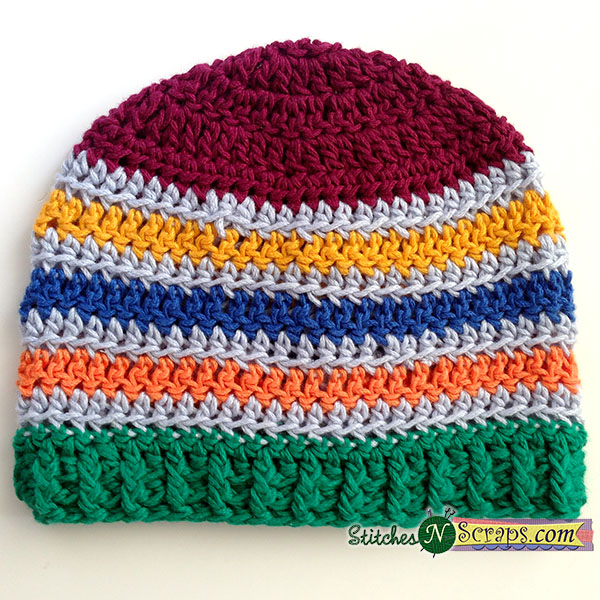
Rainbow colors go round and round, punctuated by lightly textured, grey stripes. With a cotton/acrylic blend in vivid colors, this simple hat is just right for summer. It uses small amounts of several different colors, so is a great stashbuster project too.
Here’s a fun fact: despite the popular nursery rhyme, mulberries actually grow on trees, not bushes!
This pattern is protected by copyright. Please do not distribute or share this pattern in any way other than by sharing a link to this page or to the pattern page on Ravelry. Click here for copyright information.
This pattern contains affiliate links (click for more info). If you click one of these links and then make a purchase, I may be compensated. You get the same great prices, and you will be helping to support this site!
Round the Mulberry Bush

![]()
Add this to your Ravelry Queue
Materials:
- Cascade Avalon worsted weight, cotton/acrylic yarn
- 30-40 yds #27 Raspberry (red)
- 25-35 yds #20 Heather (grey)
- 10-20 yds #10 Artisan’s Gold (gold)
- 10-20 yds #18 Turkish Sea (blue)
- 10-20 yds #09 Bird of Paradise (orange)
- 30-40 yds #14 Golf Green (green)
- Size H / 8 (5 mm) hook or size needed to obtain gauge
- Size G / 6 (4 mm) hook or 1 size smaller than larger hook
- Yarn or Tapestry needle
- Locking Stitch markers
Difficulty:
Easy – worked in the round, with some stitches worked into back or front loop only.
Sizes:
Pattern is written for 6-12 months, with changes for 18-24 months & 3-5 years in [ ].
- Circumference: 16 inches [18 inches, 20 inches] (note, this should be 1-2 inches smaller than the actual head measurement)
- Height: 6.5 inches [7 inches, 7.5 inches]
Gauge:
13 dc x 8 rows = 4 inches, with larger hook. Gauge is important for a good fit. Take time to check gauge.
Abbreviations used:
- ch = chain
- sc = single crochet
- hdc = half double crochet
- dc = double crochet
- bpdc = back post double crochet
- fpdc = front post double crochet
- sl st = slip stitch
- st(s) = stitch(es)
- sp(s) = space(s)
- rnd = round
- WS = wrong side
- RS = right side
Notes:
- Join rounds as indicated with slip stitch in first st of round, unless otherwise stated.
- Ch 3 at beginning of round counts as first double crochet.
Recommended Resources:
- Front Loop Only (flo) and Back Loop Only (blo) by Moogly
- Front and Back Post Stitch Crochet by Jessie at Home
Instructions:
Top Circle:
Rnd 1 (WS [WS, RS]): With red, work 12 dc in a magic ring and pull ring closed, join. (12 sts)
OR – alternate Rnd 1 (WS [WS, RS]: With red, ch 4, 11 dc in 4th ch from hook, join. (12 sts)
Rnd 2: Ch 3, turn, dc in same st, 2 dc in each st around, join. (24 sts)
Rnd 3: Ch 3, turn, (2 dc in next st, dc in next st) 11 times, 2 dc in last st, join (36 sts)
Rnd 4: Ch 3, turn, (2 dc in next st, dc in next 2 sts) 11 times, 2 dc in next st, dc in last st, join (48 sts).
Size 6-12 months only:
Rnd 5: Ch 1, turn, sc in first st, (2 sc in next st, sc in next 7 sts) 5 times, 2 sc in next st, sc in last 6 sts, join, changing to grey. (54 sts)
Size 18-24 months only:
Rnd 5: Ch 3, turn, (2 dc in next st, dc in next 3 sts) 11 times, 2 dc in next st, dc in last 2 sts, join, changing to grey. (60 sts)
Size 3-5 yrs only:
Rnd 5: Ch 3, turn, (2 dc in next st, dc in next 3 sts) 11 times, 2 dc in next st, dc in last 2 sts, join, changing to grey. (60 sts)
Rnd 6: Ch 1, turn, sc in first st, (2 sc in next st, sc in next 9 sts) 5 times, 2 sc in next st, sc in last 8 sts, join, changing to grey. (66 sts)
Stripes:
Rnd 1 (RS): With grey, ch 1, turn, hdc in first st and in each st around, join in back loop only of first st, changing to gold. (54 [60, 66] sts)
Rnd 2: With gold, Ch 3, turn, dc in front loop only of next st and of each st around, join, changing to grey.
Rnd 3: Repeat rnd 1, changing to blue at the end instead of gold
Rnd 4: With blue, repeat rnd 2
Rnd 5: Repeat rnd 1, changing to orange at the end instead of gold
Rnd 6: With orange, repeat rnd 2
Rnd 7: Repeat Rnd 1, changing to green at the end instead of gold
Rnd 8: With green, ch 1, turn, sc in each st around, join.
Ribbing:
With smaller hook:
Rnd 1 (RS): With green, ch 3, turn, dc in next st and in each st around, join.
Rnds 2-3 [2-4, 2-5]: Ch 2 (counts as bpdc), do not turn, (fpdc around next st, bpdc around next st) around to last st, fpdc around last st, join.
Fasten off, weave in all ends.
I hope you enjoy the pattern. Special thanks to JStockert & MixedKreations for testing it!
A downloadable pdf of this pattern is also available on Ravelry, for a fee. The fee for the pdf format is to offset the advertising revenue lost when you print or download the pattern rather than viewing it online.
If you would like to receive notifications of new posts and patterns as they become available, please follow this blog. You can follow by e-mail (look at the sidebar on the right for the follow by email option), or via RSS feed, or via your WordPress.com reader: Follow Stitches ‘N’ Scraps on WordPress.com–

Crochet Flower Necklace Pattern – Dew Drop Necklace
Create a chain of delicate “beads” and simple flower embellishments, using tiny puff stitches! This crochet flower necklace is easily customizable for a special occasion showpiece, or an everyday wardrobe staple. It’s great for gifting and craft fairs too!
This content is protected by copyright. See this Terms of Use / Copyright page for more information.
This post contains sponsored content and/or affiliate links. If you click an affiliate link and make a purchase, I may get a commission.
Holiday Stashdown Crochet Along
This crochet necklace was designed for the Holiday Stashdown CAL 2016 (#HolidayStashdownCAL2016). If you’re not sure what that is, you can learn more in this post from the Underground Crafter. With this CAL, you can clean out your stash and end up with some beautiful items for holiday gifting, plus there are some really nice giveaway prizes to be won. The schedule of new patterns will ramp up as we get closer to the holiday too, so it’s a great time to join.
Customize your Necklace!
Use a clasp for a short necklace, or make it long enough to go over your head. Add beads or other decorations as desired to the center of each flower. Try using a different color thread for the flowers, or even make the whole design in fingering weight yarn for a more casual look.
Use your choice of pendant or charm on the drop part of the necklace, or change them out for different looks. You could even make an extra small flower and attach that to the bottom instead of a pendant
There are so many ways to make this design your own. Check out the projects on Ravelry for more inspiration!
Dew Drop Crochet Flower Necklace


Add this to your Ravelry Queue
Materials
- Thread: 30-50 yds size 10 Crochet Thread in a metallic silver color
- Hooks:
- Size B / 1 (2.25 mm) hook
- Size D / 3 (3.25 mm) hook`
- Notions:
- Embroidery needle
- Small pendant or charm
- 1 jump ring
- Optional:
- Necklace clasp
- Small beads for the center of the flowers
Project Level
Intermediate – Easy stitches, but I’m calling it intermediate because it’s done in thread.
Size
Customizable to any length.
Gauge
Gauge is not particularly important for this project. If you feel your stitches are coming out too tight or too loose for your taste, feel free to change hook sizes.
Abbreviations used
ch = chain
sc = single crochet
sc3tog = single crochet 3 stitches together (see special stitches)
puff = puff stitch (see special stitches)
sl st = slip stitch
st(s) = stitch(es)
sp(s) = space(s)
rnd = round
yo = yarn over
Recommended Resources
Special Stitches:
Single Crochet 3 stitches together (sc3tog): (Yo and draw up a loop) in each of next 3 sc, yo and pull through all 4 loops on your hook.
Puff stitch (puff): (Yo, insert hook into specified st or ch, yo and draw up a loop) 3 times, yo and pull through all 7 loops on hook, ch 1 to close.
Flower mount: Work the following 3 rows where indicated in pattern below. This forms a little circle that you will be sewing a flower onto later.
- Row 1: 3 sc in 2nd ch from hook
- Row 2: Ch 1, turn, sc in each sc
- Row 3: Ch 1, turn, sc3tog.
Instructions:
Drop
With smaller hook, Ch 2, puff in 2nd ch from hook, (ch 1, puff in top of last puff) twice, ch 5, work flower mount (for center flower).
Left Side
Ch 5, puff in 2nd ch from hook, ch 1, puff in top of last puff, ch 4, work flower mount, ch 4, *puff in 2nd ch from hook, ch 1, puff in top of last puff, ch 4, repeat from * until desired length is reached.
Secure working loop with a stitch marker and cut thread, leaving a 12 inch tail in case you want to make it longer or shorter later.
Feel free to add a few extra chains to the end if needed to get the size you want. I made mine about 10.5 inches on each side of the drop.
Right Side
With smaller hook, join thread with sl st in the top of the sc3tog from row 3 of the center flower mount. Work the same as for left side, being sure to do the same number of repeats.
Check the sizing, make any adjustments, and then fasten off both sides. If not using a clasp, make sure the necklace is long enough to fit easily over your head.
Small Flower (make 2)
Rnd 1: With smaller hook, ch 2, 6 sc in 2nd ch from hook, join with sl st in first st.
Rnd 2: Turn, *ch 2, (yo, insert hook in same st, yo and draw up a loop) 5 times, yo and pull through all 11 loops on hook, ch 2, sl st in same st (petal made),** sl st in next st, rep from * 5 times more, ending at ** on last repeat, fasten off. (6 petals).
Large Flower
With larger hook and with 2 strands of thread held together, repeat instructions for small flower.
Assembly:
- Sew flowers to flower mounts, with large flower on center mount, as shown below. If desired, sew beads into the center of each flower. Weave in flower ends.
- Using the starting tail, sew a jump ring securely to the end of the drop, and then weave in the tail. Do not attach a pendant yet.
- Clasp/joining:
- If not using a clasp, tie/sew the two sides together at the back and then weave in the ends.
- If using a clasp, tie or sew the clasp on using the ends, and then weave in the ends.
Finishing:
- Wash your necklace gently and lay it out flat to dry. For a little added stiffness, try using some liquid starch.
- Once the necklace is totally dry, attach a pendant or charm of your choice to the jump ring.
Rate this Crochet Flower Necklace Pattern!
I hope you enjoy the pattern. Special thanks to AnnaMarie, Leslie from An (Un)Fair Life, AmberShrugged, Yarn-Artz, Mona from BunnyMuff, and knitgrl for testing it!
A downloadable pdf of this pattern is available on Ravelry for a small fee. The fee for the pdf format is to offset the advertising revenue lost when you print or download the pattern rather than viewing it online.
Do you want the best of Stitches n Scraps delivered right to your inbox? The Stitches n Scraps email newsletter includes highlights from the blog as well as special features not available elsewhere. Don’t miss a stitch – Subscribe now!

Bandkerchief Crochet Kerchief Headband
What goes on easy like a headband but looks like a kerchief? A Bandkerchief of course! This crochet kerchief headband pattern is quick and easy. With 5 sizes from baby to adult, this lacy design makes a great summer accessory for the whole family!

This content is protected by copyright. See this Terms of Use / Copyright page for more information.
This post contains sponsored content and/or affiliate links. If you click an affiliate link and make a purchase, I may get a commission.
Redesigned for 2024!
This crochet kerchief headband pattern was completely redesigned in April 2024, now in 5 sizes! Originally it called for fingering weight yarn, starting from the band and working down to the point of the kerchief. This new version starts at the bottom point and works up to the band, in DK weight yarn.
Why the changes?
While it has been a popular pattern, most users adjusted it to work with sport or DK-weight yarns. At one point, I changed the yarn recommendation to sport weight, but users seemed to prefer DK. Later, I created a knit version of the Bandkerchief, using worsted-weight yarn.
In designing that one, I added multiple size options and worked from the point up to the band. This construction made it easy to adjust the size as needed at the end. Starting from just one stitch also made it an easier pattern overall. So I decided to change this pattern to better match the knit version.
If you want to work with a lighter weight yarn, you can easily adjust the sizing by adding more repeats in the kercheif section!
King Cole Cotton Top DK
King Cole sent me a sample of Cotton Top DK to try some time ago. It’s an acrylic/cotton blend, which is super soft and lightweight. I also love the specks of white mixed in with the pastel colors. For the sample, I used #4227 – Jasmin.

Materials
- Yarn: 65 [80, 100, 125, 155] yds King Cole Cotton Top DK (78% premium acrylic, 22% Cotton; 100g / 284 yds per skein) #4227 Jasmine
- Hooks:
- Size F (3.75 mm) hook or size needed to match gauge
- Size G (4 mm) hook or 1 size (.25 – .5 mm) larger than smaller hook.
- Notions: Yarn needle
Project Level
Easy: V stitches, front post and back post double crochet ribbing.
Sizes
Baby [toddler, child, teen/adult small, adult large]
13 [14.5, 16, 18, 20] inches band circumference
Stretches to fit 14-16 [16-18, 18-20, 20-22, 22-24] inch head circumference.
Gauge
In ribbing pattern with smaller hook: [fpdc, bpdc] 8 times = 4 inches; 16 rows = 4 inches
With larger hook, after Row 7 of Kerchief, work should measure 4 inches wide x 4 inches tall.
Abbreviations used
This pattern uses US terms.
- bpdc = back post double crochet
- ch = chain
- dc = double crochet
- fpdc = front post double crochet
- rnd = round
- RS = right side
- sc = single crochet
- sl st = slip stitch
- sp = space
- st(s) = stitch(es)
- V = v-stitch (see Special Stitch)
- WS = wrong side
Special Stitch
V-Stitch (V): (Dc, ch 1, dc) in indicated st or sp. When working into a V-stitch, work into the ch-sp at the center.
Instructions
Kerchief
Row 1: With larger hook, ch 2, sc in 2nd ch from hook. (1 sc)
Row 2: Ch 4 (counts as dc and ch-1 throughout), turn, dc in same st. (2 dc, 1 ch-1 sp)
Row 3: Ch 4, turn, V in ch-1 sp, ch 1, dc in last st (3rd ch of turning ch-4). (1 V, 2 dc, 2 ch-1 sps)
Row 4: Ch 4, turn, dc in first ch-1 sp, V in next V, dc in next ch-1 sp, ch 1, dc in last st. (1 V, 4 dc, 2 ch-1 sps).
Row 5: Ch 4, turn, V in first ch-1 sp, V in each V across to last ch-1 sp, V in last ch-1 sp, ch 1, dc in last st. (3 V, 2 dc, 2 ch-1 sps)
Row 6: Ch 4, turn, dc in first ch-1 sp, V in each V across to last ch-1 sp, dc in last ch-1 sp, ch 1, dc in last st. (3 V, 4 dc, 2 ch-1 sps)
[Repeat Rows 5 & 6] 4 [5, 6, 7, 8] times. (11 [13, 15, 17, 19] Vs, 4 dc, 2 ch-1 sps)
Last Rnd: Ch 4, turn, V in first ch-1 sp, V in each V across to last ch-1 sp, V in last ch-1 sp, ch 1, dc in last st, ch 9 [9, 9, 11, 13] (back of Band), join with sl st in first st to begin working in rounds. (13 [15, 17, 19, 21] V, 2 dc, 2 ch-1 sps, 9 [9, 9, 9, 11, 13] chs)
Band
Band is worked in rnds all on the RS, using smaller hook. Do not turn unless indicated.
Rnd 1: With smaller hook, ch 3 (counts as dc), dc in first ch-1 sp, 3 dc in each V across to last ch-1 sp, dc in last ch-1 sp, dc in last st, dc in each ch around, join with sl st in first st. (52 [58, 64, 72, 80] sts)

This is a good time to check for fit. Band should fit snuggly but not uncomfortably tight. If you need to adjust, you can either add/remove rows in the kerchief section (for larger adjustments), or add/remove chains at the end of the Last Rnd (for smaller adjustments). Be sure to add/remove rows and/or chs in groups of 2.
For larger adjustments: Undo Rnd 1 of band and last rnd of Kerchief. Then, add/remove repeats of Rows 5 & 6 as desired.
For smaller adjustments: Undo Rnd 1 of band and joining sl st at end of last rnd of Kercheif. Then, add/remove chains in groups of 2 at the end of Last Rnd of Kerchief.
Rnd 2: Ch 2 (counts as bpdc throughout), fpdc around next st, [bpdc around next st, fpdc around next st] around, join with sl st in first st.
[Repeat Rnd 2] 2 [2, 3, 4, 5] more times.
Fasten off. Weave in ends.
Edging (optional)
This is a plain, sc edging worked along the edge of the Kerchief section only.
Using larger hook, with RS facing and positioned to work in ends of rows along Kerchief edge, join yarn with sl st in first of added chs at back of Band.

Edging Row: Working in ends of rows along Kerchief, 2 sc in each row to Row 1, (sc, ch 1, sc) in bottom of Row 1, 2 sc in each row across Kerchief, sl st in last of added chs at back of Band.
Fasten off. Weave in ends.
Share this Crochet Kerchief Headband Pattern on Pinterest!
Here’s an image perfect for pinning

Rate this Crochet Kerchief Headband Pattern!
I hope you enjoy this crochet kerchief headband pattern. Special thanks to Tricia Jones and Jean (agd509) for testing it!
A downloadable pdf of this pattern is available on Ravelry for a fee. The fee for the pdf format is to offset the advertising revenue lost when you print or download the pattern rather than viewing it online.
Do you want the best of Stitches n Scraps delivered right to your inbox? Don’t miss a stitch – Subscribe now!

Free Pattern – Hugging Tree
Happy Earth Day! Celebrate the “tree huggers” in your life today, by making them this cute little tree to hug! The pattern is designed in Lion Brand Vanna’s Choice yarns, which I received free from Lion Brand for this project. It’s squishably soft and durable, and the tonal Taupe Mist colorway adds a great textured look to the trunk. If you prefer to use natural fibers, Lion Brand’s 24/7 Cotton is a great choice as well!

This pattern is protected by copyright. Please do not distribute or share this pattern in any way other than by sharing a link to this page or to the pattern page on Ravelry. Click here for copyright information.
This pattern contains sponsored content and affiliate advertisements (click for more info). If you click one of these advertisements and then make a purchase, I may be compensated. You get the same great prices, and you will be helping to support this site!
Hugging Tree
Add this to your Ravelry Queue
Materials:
- Lion Brand Vanna’s Choice worsted weight yarn:
- 125 yds each of Fern (green) and Taupe Mist (brown)
- 10-20 yds each of White, Black and Scarlet (red)
- OR Lion Brand 24/7 Cotton worsted weight yarn:
- 125 yds each of Grass (green) and Cafe Au Lait (brown)
- 10-20 yds each of White, Black, and Red.
- Size I / 9 (5.5 mm) hook
- Yarn or tapestry needle
- Stuffing / fiber fill
Difficulty:
Easy – Basic stitches with some shaping.
Size:
About 12-13 inches tall.
Gauge:
14 sc x 16 rows = 4 inches. Gauge is not critical for this project, as long as it is tight enough so that stuffing doesn’t fall out.
Abbreviations used:
- ch = chain
- sc = single crochet
- sc2tog = single crochet 2 stitches together
- dc2tog = double crochet 2 stitches together
- dc3tog = double crochet 3 stitches together
- st(s) = stitch(es)
- sl st = slip stitch
- sk = skip
- sp(s) = space(s)
- RS = Right Side
- WS = Wrong Side
Recommended Resources:
- How To Crochet – Single Crochet 2 Stitches Together (sc2tog), by Yarn Obsession
- Double Crochet 2 Together (dc2tog) by Jessie at Home
- Tutorial – Double Crochet 3 Together (dc3tog)
- The Magic Circle, by Moogly
- How to Keep a Magic Circle closed, by Moogly
Notes:
- The tree tops and trunk are purposely not symmetrical. Make sure the tree tops are both facing the same direction when you sew them together. What is the right side on one will be the wrong side on the other.
- If you leave long tails, you can use them for sewing pieces together.
Instructions:
Tree tops (make 2):
Chain 28 loosely.
Row 1: Sc in second ch and in next ch, sc2tog, sc in next 3 chs, 3 sc in next ch, sc in next 3 chs, sc2tog, sc in next 3 chs, 3 sc in next ch, sc in next 4 chs, sc2tog, sc in last 4 chs. (28 sts)
On first tree top, mark row 1 as RS. On 2nd tree top, mark row 2 as RS.
Row 2: Ch 1, turn, 2 sc in first st, sc in next 3 sts, sc2tog, sc in next 4 sts, 3 sc in next st, sc in next 3 sts, sc2tog, sc in next 4 sts, 3 sc in next st, sc in next 3 sts, sc2tog, sc in next st, 2 sc in last st. (31 sts)
Row 3: Ch 1, turn, 2 hdc in first st, hdc in next st, dc3tog, hdc in next st, sc in next 5 sts, hdc in next 2 sts, dc3tog, hdc in next st, sc in next 4 sts, hdc in next 3 sts, dc3tog, hdc in next 3 sts, 2 hdc in last st (27 sts)
Row 4: Ch 1, turn, 2 sc in first st, sc in next st, hdc in next 2 sts, dc2tog, hdc in next 2 sts, sc in next 2 sts, 2 sc in next st, sc in next st, hdc in next st, dc2tog, hdc in next 2 sts, sc in next 2 sts, 2 sc in next st, sc in next st, hdc in next st, dc2tog, hdc in next 2 sts, 2 hdc in last st. (28 sts)
Row 5: Ch 1, turn, 2 sc in first st, sc in each st across to last st, 2 sc in last st. (30 sts)
Rows 6-8: Ch 1, turn, sc in each st across.
Row 9: Ch 1, turn, sc2tog, sc in each st across, sc2tog. (28 sts)
Row 10: Ch 1, turn, sc2tog, sc in each st across to last 2 sts, sc2tog. (26 sts)
Row 11: Ch 1, turn, 2 sc in first st, sc in each st across. (27 sts)
Row 12: Ch 1, turn, sc in each st across to last st, 2 sc in last st. (28 sts)
Row 13: Ch 1, turn, 2 sc in first st, sc in each st across to last st, 2 sc in last st. (30 sts)
Row 14: Ch 1, turn, 2 sc in first st, sc in each st across. (31 sts)
Row 15: Ch 1, turn, sc in each st across to last st, 2 sc in last st. (32 sts)
Row 16: Ch 1, turn, sc in each st across.
Row 17: Ch 1, turn, sc in each st across to last 2 sts, sc2tog. (31 sts)
Row 18: Ch 1, turn, sc2tog, sc in each st across. (30 sts)
Rows 19 – 21: Ch 1, turn, sc2tog, sc in each st across to last 2 sts, sc2tog. (24 sts)
Row 22: Ch 1, turn, sc2tog, sc in next st, hdc in next 3 sts, sc in next st, hdc in next 8 sts, sc in next st, hdc in next 5 sts, sc in next st, sc2tog. (22 sts)
Row 23: Ch 1, turn, sc in first 2 sts, hdc in next 4 sts, sc in next 3 sts, hdc in next 6 sts, sc in next 2 sts, hdc in next 2 sts, sc in next st, sc2tog. (21 sts)
Row 24: Ch 1, turn, sc2tog, hdc in next st, sc in next st, sl st in next 3 sts, sc in next st, hdc in next 3 sts, sc in next st, sl st in next 3 sts, sc in next st, hdc in next 2 sts, sc in next st, sc2tog. (13 sts, 6 sl sts)
Edging: Ch 1, do not turn, work 23 sc evenly spaced in sides of rows across to the foundation chain. Ch 1, sc in bottom of each ch across foundation chain. Ch 1, work 25 sc evenly spaced in sides of rows up to the top. Ch 1, join with sl st to first st of row 24, fasten off.
Trunk:
Chain 10.
Rnd 1: 2 sc in 2nd ch from hook, sc in next 7 chs, 3 sc in last ch, working on opposite side of chain, sc in next 8 chs, join. (20 sts)
Rnd 2: Ch 1, turn, 2 sc in first st, sc in next 7 sts, 2 sc in each of next 3 sts, sc in next 7 sts, 2 sc in each of next 2 sts, join. (26 sts)
Rnd 3 (RS): Ch 1, turn, working in back loops only, sc in each st around, join.
Rnd 4: Ch 1, turn, sc in each st around, join.
Rnd 5: Ch 1, turn, (sc2tog, sc in next 11 sts) twice, join. (24 sts)
Rnd 6: Ch 1, turn, sc in next 2 sts, sc2tog, sc in next 16 sts, sc2tog, sc in last 2 sts, join. (22 sts)
Rnd 7: Ch 1, turn, sc in first st, sc2tog, sc in next 16 sts, sc2tog in next 2 sts, sc in last st, join (20 sts)
Rnd 8: Ch 1, turn, sc in next 7 sts, sc2tog twice, sc in next 9 sts, join. (18 sts)
Rnds 9-12: Ch 1, turn, sc in each st around, join.
Rnd 13: Ch 1, turn, (sc2tog, sc in next 7 sts,) twice, join. (16 sts)
Rnds 14-18: Ch 1, turn, sc in each st around, join.
Rnd 19: Ch 1, turn, sc in first st, 3 sc in next st, sc in next 7 sts, 3 sc in next st, sc in last 6 sts, join. (20 sts)
Rnd 20: Ch 1, turn, sc in first 6 sts, 2 sc in next st, 3 sc in next st, 2 sc in next st, sc in next 8 sts, 3 sc in next st, sc in last 2 sts, join. (26 sts)
Rnd 21: Ch 1, turn, sc in first 3 sts, 3 sc in next st, sc in next 12 sts, 3 sc in next st, sc in next 10 sts, join. (30 sts)
Rnds 22 – 23: Ch 1, turn, sc in each st around, join, fasten off.
Now we need to divide the trunk into 2 flaps, to make it easier to attach it to the tree top later.
Row 24a: Turn, sk first 10 sts from end of last rnd, join Taupe with sl st in next st (this should be at one of the side edges), ch 1, sc in same st and in next 14 sts, leaving remaining 15 sts unworked.
Row 25a – 27a: Ch 1, turn, sc in each st across. Fasten off at end of row 27a.
Row 24b: Do not turn, join taupe in first unworked st from row 23, ch 1, sc in same st and in next 14 sts.
Rows 25b – 27b: Repeat rows 25a – 27a. Fasten off.
Weave in ends
Face:
Pupils (make 2): Make a magic circle, work 6 sc inside the circle, pull circle closed, fasten off, use seamless join. (see Recommended Resources)
Whites of eyes (make 2):
Rnd 1 (WS): Make a magic circle, work 6 sc inside the circle, pull circle closed and join with a sl st to first st.
Rnd 2: Ch 1, turn, 2 sc in first st, 2 hdc in next st, 3 dc in next st, 2 hdc in next st, 2 sc in each of next 2 sts, use seamless join. (13 sts)
Sew pupils to whites of eyes, weave in black ends.
Mouth: With red, ch 15, fasten off.
Assembly / Finishing:
(use main image as a guide)
- Sew eyes and mouth to RS of first tree top securely (so little fingers can’t rip them off!). You may find it helpful to pin them in place first.
- With green yarn, sew top flaps of trunk to wrong side of each tree top as shown below. Be sure the edges of the tree tops line up with each other. The separate trunk flaps will allow for a little movement, but it’s important to get it lined up as closely as possible. To do this, sew one flap onto one tree top piece, then line up the other piece and pin or baste the other flap into place before sewing. I sewed 2 seams on each flap, just to be sure they were secure.
- Weave in all ends and stuff trunk
- Hold tree tops together so that the front (face side) is facing you, and edging stitches line up. Working through both pieces, join yarn with sl st in the stitch closes to the right edge of the trunk, (ch 1, sl st) in each st around, stuffing as you go.
- Make dimples: Secure a length of yarn near where the first dimple should be, by weaving in one end. Insert your needle through the stuffing, across to the other side of the face where the 2nd needle should be. Pull GENTLY – the harder you pull, the deeper the dimple will be. Now insert your needle in the next stitch over, and go back through to the starting point. Weave in the end, cut it with a little bit of a tail, and tuck the tail into the stuffing (I like to sew it through to the other side, pull gently, and cut the yarn so it gets sucked back inside when it is cut.)
- Weave in remaining ends the same way, using them to sew up any gaps.
- HUG your tree! (No really, it helps to distribute the stuffing more evenly).
I hope you enjoy the pattern! Special thanks to Gaelle from La laine de l’ogre for testing it!
A downloadable pdf of this pattern is also available in my Craftsy store or on Ravelry, for a small fee. The fee for the pdf format is to offset the advertising revenue lost when you print or download the pattern rather than viewing it online.
Do you want the best of Stitches ‘N’ Scraps delivered right to your inbox? The Stitches ‘N’ Scraps email newsletter includes highlights from the blog as well as special features not available elsewhere. Don’t miss a stitch – Subscribe now!