Free Crochet Patterns
Find the perfect, free crochet pattern for your next project! Browse them all, or select a category from the dropdown menu. Where will your creativity take you today?
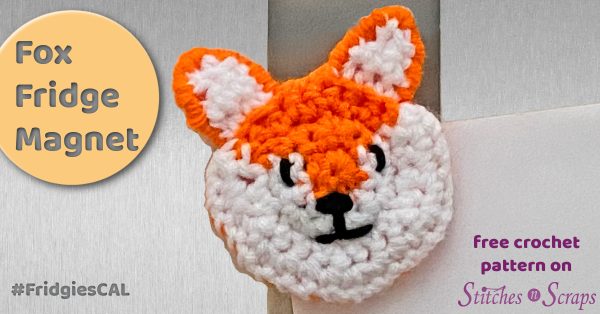
Bear Fridge Magnet Crochet Pattern
This darling little bear is happy to hold your photos and notes for you. Did you know a group of bears is called a sleuth? With this quick bear fridge magnet pattern, you can crochet a whole sleuth of bears for your fridge!

This content is protected by copyright. See this Terms of Use / Copyright page for more information.
This post contains sponsored content and/or affiliate links. If you click an affiliate link and make a purchase, I may get a commission.
2021 Fridgies CAL
This bear fridge magnet is the first pattern in the 2021 Fridiges CAL! Crochet along through 12 magnet patterns. At the end of the year, you’ll have an adorable set of fridgies for yourself or for a gift! You may want to make 2 sets, so you don’t have to decide.

Enter the Giveaway
There will be several giveaways throughout the Fridgies CAL. This quarter, you could win a zippered pouch from Global Backyard Industries!
Learn all about the Fridgies Crochet Along here, including how to enter the giveaways for a chance to win some fabulous prizes too!
Lion Brand DIY Yarn
Lion Brand provided all the yarn for this crochet along. Their DIY yarn comes in small balls, which is just perfect for the small amounts needed for each magnet. For the bear fridge magnet, you will need: White, Camel, Black, and Hot Pink.

If you’re not able to get this yarn or the colors you need, Lion Brand Vanna’s Choice or Basic Stitch are also good options.
Xyron Glue Gun
The easiest way to attach your magnet to your crochet is with hot glue. For my magnets, I’m using this mini hot glue gun that Xyron gave me to try out.

I used it on this bear fridge magnet and was very happy with it. It heated up quickly and produced a nice steady bead of glue. Watch it in action in the tutorial video below!
Materials
- Yarn: Lion Brand DIY Yarn
- 30 yds Camel
- 5 yds each Hot Pink (pink) and White
- 2 yds Black
- Hook: Size H / 5 mm crochet hook or size needed to match gauge.
- Notions:
- Yarn Needle
- Stitch marker or scrap piece of yarn.
- Strong, flat magnet that will fit inside the bear
- Xyron hot glue gun and glue stick
Project Level
Intermediate: Worked in the round with some sewing and embroidery required.
Size
About 2.5 inches in diameter, not counting ears.
Gauge
12 sc x 13 rounds = 4 inches
Use pattern as gauge swatch – back should measure about 2.5 inches in diameter. Exact gauge is not critical. Your fabric should be tight enough that the magnet won’t show through.
Abbreviations used
(Pattern is written in US terms)
ch = chain
sc = single crochet
hdc = half double crochet
dc = double crochet
inc = increase (see Special Stitches)
st(s) = stitch(es)
sl st = slip stitch
RS = right side
WS = wrong side
Recommended Resources
- To Knot or Not
- Back Loop Only and Front Loop Only
- Almost Invisible Single Crochet Increase
- 3 Ways to Weave in Ends
- How to Sew Crochet Pieces Together on Winding Road Crochet – shows both whipstitch and running stitch.
Special Stitch
Increase (inc): Sc in back loop only of indicated st, then sc in both loops of same st. This counts as two stitches in the end of round stitch counts.
See this tutorial for a more detailed look.

Instructions
The pattern is made in 3 separate sections: The back with ears and magnet, the front, and the muzzle. You can make these 3 sections in any order you prefer.
Join rounds where indicated with a slip stitch in the first stitch of the round. Slip stitches are not included in stitch counts.
Back
Back circle
With Camel, ch 2.
Rnd 1 (RS): 6 sc in 2nd ch from hook, join. (6 sts)
Rnd 2: Ch 1, inc in each st around, join. (12 sts)
Rnd 3: Ch 1, sc in first st, inc in next st, (sc in next st, inc in next st) around, join. (18 sts)
Rnd 4: Ch 1, sc in first 2 sts, inc in next st (sc in next 2 sts, inc in next st) around, do not join. (24 sts)
Remove loop from hook and secure it with a stitch marker or scrap piece of yarn.

Work should now measure about 2.25 to 2.5 inches in diameter.
Ears
Turn work over to WS.
First inner ear:
Join pink with sl st in front loop only of the first st from rnd 4 as shown. This should be the stitch next to the working loop.

(Sc, hdc, dc, hdc, sc, sl st) in same front loop, fasten off pink. (5 sts)

2nd inner ear
Skip next 6 sts, join pink with sl st in front loop only of next st.

(Sc, hdc, dc, hdc, sc, sl st) in same front loop, fasten off pink. (5 sts).

Turn work so that RS is facing, and place working loop of Camel back onto hook.
1st outer ear:
Row 1 (RS): Sl st in unused front loop of the same st as first inner ear, ch 1, (sc hdc, dc, hdc, sc, sl st) in same loop. (5 sts)


Row 2 (WS): Turn, working through both inner and outer layers, (ch 1, sl st) in each st across ear, do not fasten off.

Sl st in front loop only of next 6 sts on back circle. (These are the 6 stitches between the two ears.)
2nd outer ear:
Sl st in unused (back) loop of the same st as second inner ear, turn.

Row 1 (RS): Ch 1, (sc, hdc, dc, hdc, sc, sl st) in same loop. (5 sts)
Row 2 (WS): Turn, working through both inner and outer layers, (ch 1, sl st) in each st across ear, fasten off.
Weave in all ends on the wrong side (where the pink of the ears is showing).

Magnet
Using hot glue gun, glue magnet to center of WS of work.

Set back piece aside.

Front
Rnds 1-4: Repeat rnds 1-4 of back. At the end of rnd 4, join and fasten off Camel, leaving an 18 inch tail for sewing.

Muzzle
With White, ch 2
Rnd 1 (RS): (2 sc, hdc, 3 sc, hdc, sc) in 2nd ch from hook, join. (8 sts)
Rnd 2 (RS): Ch 1, sc in first st, [(sc, hdc) in next st, 2 hdc in next st, (hdc, sc) in next st], sc in next st, repeat [ ], join, fasten off leaving a 12 inch tail for sewing. (14 sts)
Assembly
Using long White tail, sew muzzle to right side of front, so it rests along the edge as shown. Place muzzle so that it covers up the “seam” where you joined your rounds.

Embroider nose, mouth, and eyes with Black yarn.

Line up front and back with wrong sides together. The magnet should be on the inside and the ears should line up appropriately with the face. With the face on top, you should be able to see the pink side of the ears.

Using long Camel tail, sew front and back pieces together around edge with a whipstitch up to the first ear.

When you get to the ear, use a running stitch across the front of the ear, and then continue whipstitching around to the next ear.

Use a running stitch across the second ear, and then continue whipstitching the rest of the way around.
Fasten off and weave in any remaining ends.
Video Tutorial
Watch This Video on YouTube

Rate this Bear Fridge Magnet Pattern!
I hope you enjoyed this Bear fridge magnet pattern. Big thanks to Karen Navoy for testing it!
A downloadable pdf of this pattern is available on Ravelry for a small fee. The fee for the pdf format is to offset the advertising revenue lost when you print or download the pattern rather than viewing it online.
Do you want the best of Stitches n Scraps delivered right to your inbox? Don’t miss a stitch – Subscribe now!

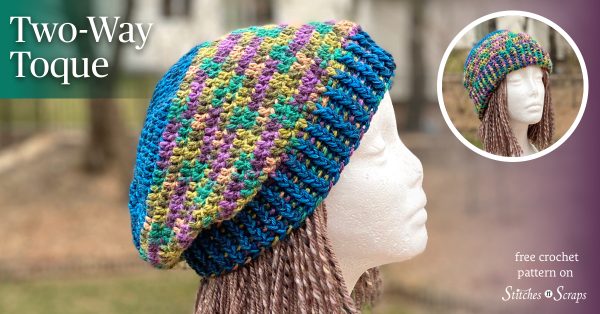
Crochet Hat with Reversible Ribbing – Two Way Toque
Make a crochet hat with two looks in one! Wear the ribbing folded down for a contrasting edge, or fold it up to make it match. Either way, the two-way toque is as fun to make as it is to wear!

This content is protected by copyright. See this Terms of Use / Copyright page for more information.
This post contains sponsored content and/or affiliate links. If you click an affiliate link and make a purchase, I may get a commission.
Scrappy Stitchers Stash Bash Crochet Along
The Two-Way Toque is the last design for the 2020 Stash Bash Crochet Along. Each month, I posted a new, stash-busting pattern, and a giveaway prize too! See the giveaway details below, and join in the fun on the Scrappy Stitchers Facebook group. Remember to use the hashtag #ScrappyStitchersStashBash in your social media posts!

Color A is Fyberspates Vivacious DK in #807 Deep Aqua, left over from a Yarnbox subscription. It’s a tonal, 100% merino wool yarn. I had previously used 1 skein of the Vivacious DK in my Straight UP Beanie pattern.
Color B is Universal Infusion Handpaints – a variegated, 50/50 wool and acrylic blend. Any DK weight yarn will work for this crochet hat.

When you think crochet, think CGOA!
As many of you know, I’m a huge fan of the Crochet Guild of America (CGOA). I’ve been a member for several years, and this year am serving on the board as vice president. With classes, crochet alongs, conferences and social events, the CGOA has something to offer everyone, regardless of skill level. As a professional, the contacts and opportunities have been invaluable. I’ve also found some of my closest friendships, expanded my skills, and most importantly, had a ridiculous amount of fun!
I wrote about some of my CGOA experiences back in 2017, and it’s only gotten better since. Even with a cancelled conference due to covid, the guild is still active with lots of new on line opportunities.
I believe in the CGOA so passionately, that I’ve decided to give away a 1 year membership as our final Stash Bash prize! Because of my position as vice president, I felt awkward asking them to sponsor this prize, so this is not a sponsored prize. Stitches n Scraps will be providing a membership for one lucky winner! (See details below)

Enter the giveaway
Specifically, the prize is a 1 year, digital membership, valued at $35. You can read more about the membership options here. If you prefer a different membership level, the $35 can be credited towards that cost instead. If you’re already a member, the $35 can be credited towards your next renewal.
To be eligible, you must be 18 years of age or older and a US resident. This giveaway is void outside of the US and where prohibited. The winner will be contacted by email, and must reply to that email to confirm their contact information within 1 week in order to receive the prize. If the winner does not reply within 1 week, a new winner will be selected. The giveaway ends on January 7th, 2020 (at 11:59pm, central time). Hurry and enter below!
a Rafflecopter giveawayMaterials
- Yarn: DK weight yarn
- 80-150 yds color A (shown in blue)
- 100-175 yds color B (shown in multi)
- Hook: Size H / 5 mm crochet hook or size needed to match gauge.
- Notions: Yarn Needle
Project Level
Intermediate: Increases, 2-color post stitch ribbing.
Sizes
Newborn [Baby, Toddler, Child, S, M, L]
Instructions are shown for newborn size, with other sizes listed in [ ]
| Size | To fit head circumference: |
|---|---|
| Newborn | 12-14 inches |
| Baby | 14-16 inches |
| Toddler | 16-18 inches |
| Child | 18-20 inches |
| S | 20-21 inches |
| M | 21-22 inches |
| L | 22-23 inches |
Gauge
16 dc x 8 rows = 4 inches
Abbreviations used
(Pattern is written in US terms)
ch = chain
dc = double crochet
csdc = chainless starting double crochet (optional – see Recommended Resources)
inc = increase (see Special Stitch)
fpdc = front post double crochet
bpdc = back post double crochet
st(s) = stitch(es)
rnd = round
Special Stitch
Increase (inc): Dc in back loop only of next st, then dc in both loops (as normal) of same st. This is a less visible increase than the traditional dc2tog, and counts as 2 dc in the stitch counts.
Instructions
Entire pattern is worked on the right side. Join rnds where indicated with a sl st in the first st.
The chainless starting double crochet (csdc) stitch creates a cleaner look. However, if you prefer, you can replace csdc with “ch 3, counts as dc” throughout the pattern.
Top (color A):
Rnd 1: With A, ch 4 (counts as dc), 11 dc in 4th ch from hook, join. (12 dc)
Rnd 2: Csdc, dc in same st, inc around, join. (24 dc)
Rnd 3: Csdc, inc, (dc in next st, inc) around, join. (36 dc)
Rnd 4: Csdc, dc in same st, (dc in next 2 sts, inc) around, join. (48 dc)
Newborn: Skip rnds 5-7
Rnd 5: Csdc, dc in next 2 sts, inc, (dc in next 3 sts, inc) around, join. (60 dc)
Baby & Toddler: Skip rnds 6-7
Rnd 6: Csdc, dc in same st, (dc in next 4 sts, inc) around, join. (72 dc)
Child & S: Skip rnd 7.
Rnd 7: Csdc, dc in next 2 sts, inc, (dc in next 5 sts, inc) around, join. (84 dc)
Newborn, Toddler, S & L only:
Next rnd: Csdc, dc in same st, (dc in next 9 sts, inc) around, join. (54 [66, 78, 90] dc)
All Sizes:
Next rnd: Csdc, dc in next st and in each st around, join, changing to B. (54 [60, 66, 72, 78, 84, 90] dc)
Fasten off A.

Middle (color B):
Rnd 1: With B, csdc, dc in next st and in each st around, join.
Repeat rnd 1 6 [7, 8, 9, 9, 10, 10] more times.

Ribbing (both colors):
Scroll down for video tutorial for this section.
Unless otherwise specified, change colors in the last part of the previous stitch (see this tutorial for more info on changing colors).
When not in use, always drop color A to front of the work and color B to the back of the work.
Rnd 1: Ch 2 with B then ch 1 with A (counts as bpdc), fpdc with A around next st, (bpdc with B around next st, fpdc with A around next st) around, changing to B in last st, join.
Repeat rnd 1 2 [3, 3, 4, 4, 5, 5] more times.
Fasten off
Weave in all ends.
Ribbing Tutorial Video:
See the Full Tutorial Here
Rate this Crochet Hat Pattern!
I hope you enjoyed this crochet hat pattern. Thanks to Adrienne McCarthy for testing it!
A downloadable pdf of this pattern is available on Ravelry for a small fee. The fee for the pdf format is to offset the advertising revenue lost when you print or download the pattern rather than viewing it online.
Do you want the best of Stitches n Scraps delivered right to your inbox? The Stitches n Scraps email newsletter includes highlights from the blog as well as special features not available elsewhere. Don’t miss a stitch – Subscribe now!

Easy Crochet Wrap – Icing on the Cape
Wrap yourself in luxury with Icing on the Cape! The full circle construction and soft, wool blend yarn give this cape a generous, flowing fit and amazing drape. A contrasting border adds a dramatic flair. With a single row repeat through most of the design, this easy crochet wrap really is a piece of cake…complete with icing!

This content is protected by copyright. See this Terms of Use / Copyright page for more information.
This post contains sponsored content and/or affiliate links. If you click an affiliate link and make a purchase, I may get a commission.
Furls Blog Hop 2020 Make Along
I designed this easy crochet wrap pattern for the 2020 Furls Blog Hop. This event has been running throughout the year, with a new pattern each week. Check out all the great patterns so far, and keep checking back for the new ones!
As part of the blog hop event, Furls provided me with all the yarn for this design, plus a free hook.
Whims Merino Z-Twist Yarn
This cape design was my first time trying Whims Merino Z-Twist Yarn, and I’m completely in love! It checks all the boxes for me.
What is Z-twist?
Z-twist refers to the direction in which the yarn is spun. In most commercial yarns, the plies are spun together counterclockwise, which is called an S-twist. In a Z-twist yarn, the plies are spun together clockwise.
Why does this matter? Crocheting produces a clockwise motion, which can actually untwist an S-twist yarn, leading to splitting. With a Z-twist yarn, the crochet motion tightens the twist instead, creating stunning stitch definition.

Mad for merino
As a spinner, merino wool is my absolute favorite fiber to work with. Individual merino fibers tend to be long and have a lot of crimp to them, like tiny springs. This makes the finished yarn incredibly soft, smooth, and bouncy.
Nylon for strength and shine
Whims Merino is a 50/50 blend of nylon and merino. Nylon adds durability to make your finished project last longer. It also adds amazing shine! Combined with merino, it’s a strong, glossy, springy yarn that’s just a joy to work with.
Furls Odyssey Crochet Hook
I wasn’t sure I would like a Furls hook. The shape is so different from what I’m used to, and they are heavier than my normal hooks too. I thought I would find it uncomfortable. I was wrong.
Generally I use metal hooks, so I chose an Odyssey hook for it’s metal tip. I went with blue and nickel. It took about 2 rows for me to get used to it, and then I was hooked. The shape fits comfortably in my hands, and I found I was able to crochet a bit longer than usual without my hands getting tired. The metal tip is slick and fast, and I love the sparkles in the handle too!

The thing that took the most getting used to was the smoothness of the handle. I’m used to soft grips that are more “squishy” so at first the hook slid around in my hand a bit. But once I got used to it, I think I automatically adjusted my grip slightly and that stopped happening.
Materials
- Yarn: Whims Merino Z-twist, Worsted weight yarn. 100g/196 yds per skein.
- 9 skeins charcoal
- 2 skeins white
- Hook: Size H / 5 mm crochet hook or size needed to match gauge.
- Notions:
- Yarn Needle
- 2 stitch markers
- 3 1-inch buttons
Project Level
Easy: Basic stitches, repeating pattern, working into sides of rows, picots.
Gauge
13 dc x 7 rows = 4 inches
Abbreviations used
(Pattern is written in US terms)
ch = chain
sc = single crochet
dc = double crochet
csdc = chainless starting double crochet (optional – see Recommended Resources)
ch-sp = chain space
st(s) = stitch(es)
sk = skip
RS = right side
WS = wrong side
Special Stitch
Picot: Ch 3, sl st in last st worked.
See this tutorial for a more detailed look and other placement options.

Instructions
Main section is worked from the top down. First 3 chs of row 1 count as a dc.
The chainless starting double crochet (csdc) stitch creates a cleaner edge. However, if you prefer, you can replace csdc with “ch 3, counts as dc” throughout the pattern.
Main Section (Charcoal)
Foundation: With charcoal, ch 65
Row 1 (WS): Dc in 4th ch from hook and in next 4 chs, [(dc, ch 1, dc) in next ch, dc in next 9 chs] 5 times, (dc, ch 1, dc) in next ch, dc in last 6 chs. (69 dc, 6 ch-1 sps)
Row 2: Turn, csdc, [dc in each st to next ch-1 sp, (dc, ch 1, dc) in next ch-1 sp] 6 times, dc in each st across. (81 dc, 6 ch-1 sps)
Rows 3-31: Repeat row 2. (429 dc, 6 ch-1 sps)
Main Section Edging (Charcoal):
Rnd 1 RS: (Total: 600 sts, 4 ch-1 sps)
- Bottom: Turn, csdc, [dc in each st to next ch-1 sp, (dc, ch 1, dc) in next ch-1 sp] 6 times, dc in each st across. (441 dc)
- Right Front: Do not turn. Ch 1, place a marker in this ch, working in sides of rows, 48 sc evenly spaced along side edge. (48 sc, 1 ch-1 sp)
- Top: Working in bottom of foundation chains, ch 1, place a marker in this ch, sc in each ch across. (63 sc, 1 ch-1 sp)
- Left Front: Ch 1, working sides of rows, 48 sc evenly spaced along side edge, ch 1, sl st to first st of rnd, fasten off. (48 sc, 2 ch-1 sps)

Collar (White)
Row 1 (RS): Join white with sl st in marked ch-1 sp on top, remove marker. Sc in same ch-1 sp, sc in next 63 sts, sc in next ch-1 sp. (65 sc)
Row 2: Ch 1, turn, sc in each st across, fasten off. (65 sc)
Bottom Border (White)
Row 1 (WS): Join white with sl st in marked ch-1 sp on bottom, remove marker. Ch 2 (counts as dc), [dc in each st to next ch-1 sp, (dc, ch 1, dc) in next ch-1 sp] 6 times, dc in each st across to next ch-1 sp (corner), dc in ch-1 sp. Do not fasten off. (455 dc, 6 ch-1 sps)
Button Band & Edging (White)
Rnd 1 (RS):
- Bottom: Turn, csdc, [dc in each st to next ch-1 sp, (dc, ch 1, dc) in next ch-1 sp] 6 times, dc in each st across. Do not fasten off. (467 dc, 6 ch-1 sps)
- Right front: Ch 1, working in sides of rows, 3 sc evenly spaced across bottom border, working into right front edging, sc next 28 sts, ch 9, sl st in last sc worked, [sc in next 10 sts, ch 9, sl st in last sc worked] twice, working in sides of rows, sc in each row across collar. (54 sc, 3 ch-9 loops, 1 ch-1 sp)

- Collar: Ch 1, sc in each st around collar (65 sc, 1 ch-1 sp)
- Left front: Ch 1, working in sides of rows, 3 sc evenly spaced across collar, sc in each st across left front edging, working in sides of rows 3 sc evenly spaced across bottom border, ch 1, join with sl at to first st. (54 sc, 2 ch-1 sps)
On next rnd, work behind ch-9 loops when you come to them.
Rnd 2 (RS): (643 sc, 118 picots)
- Bottom: Do not turn. Ch 1, sc in same st and next 3 sts, picot, [sc in next 4 sts or sps, picot] 116 times across bottom (you should end in the ch-1 sp at the corner) (468 sc, 117 picots)
- Right front: Do not turn. Ch 1, sc in each st across to next ch-1 sp, sc in ch-1 sp. (55 sc)
- Collar: Sc in each st around collar (65 sc)
- Left front: Sc in next ch-1 sp, sc in each st across to last ch-1 sp, (sc, picot) in last ch-1 sp, join with sl st to first st of rnd, fasten off. (55 sc, 1 picot)

Rate this Easy Crochet Wrap!
I hope you enjoyed this easy crochet wrap pattern. A downloadable pdf of this pattern is available on Ravelry for a small fee. The fee for the pdf format is to offset the advertising revenue lost when you print or download the pattern rather than viewing it online.
Do you want the best of Stitches n Scraps delivered right to your inbox? The Stitches n Scraps email newsletter includes highlights from the blog as well as special features not available elsewhere. Don’t miss a stitch – Subscribe now!

Scrappy Crochet Christmas Ball Ornament
Did you ever make Christmas ornaments by gluing wedges of scrap fabric to a foam ball? This Scrappy Crochet Christmas Ball Ornament is the same idea, but in crochet! Use up scraps or mini-skeins and add a touch of nostalgia to your tree.

I made these a couple of years ago, and the pattern was originally published in I Like Crochet Magazine.
This content is protected by copyright. See this Terms of Use / Copyright page for more information.
This post contains sponsored content and/or affiliate links. If you click an affiliate link and make a purchase, I may get a commission.
Fabric Christmas Ball Ornaments
I remember being very young and making these ornaments with fabric scraps. I think it might have been a project we did in girl scouts. We all brought in fabric scraps from home and cut them into wedge shapes. The adults may have actually done the cutting.
Then they helped us glue them on to foam balls with a hot glue gun. We used strips of rick rack to cover the messy seams. Mine had a red fabric, and a white fabric with tiny little strawberries on it.
I wish I could show you, but I’ve lost those ornaments now. They were on our tree every year when I was a child.
Lion Brand Bonbons Yarn
For my ornaments, I used Lion Brand Bonbons Metallic yarns in several different colors. I love BonBons because the color sets have colors that all go really nicely together, and the skeins are just the right size for small projects like this. You can get 2 ornaments out of 3 skeins.

I have lots of bon bons left over and they’re great for embellishments on amigurumi and other patterns. See what I did with the gold metallic color on my Trim the Tree Pillow pattern!
Note that Bonbons are not all the same size yarn. The metallic yarns are a size 2 (sport weight), while the solid colors are a size 3 (DK weight). The pattern will work with the different size yarn, but you will need a larger ball to stuff it with, or will need to use some other stuffing material.
Styrofoam balls or stuffing
I originally designed these to fit around 2 inch foam balls, but you can also stuff them with fiber fill if you prefer. In this picture, the ball on the right was stuffed with fiber fill, while the other two used a foam ball.
Styrofoam balls make a lighter and smoother ornament, while fiber fill makes a softer, denser, and more rustic looking ornament. I like Smoothfoam brand balls, because of the smooth and even finish. For fiber fill, my favorite choice is PolyFil Royal Silk, for the same reason.
Materials
- Yarn: Lion Brand Bonbons Metallic yarn – 3 mini skeins in different colors.
- Hook: Size D / 3.25 mm crochet hook or size needed to match gauge.
- Notions:
- Yarn Needle
- 2.5 inch foam ball or stuffing material
Project Level
Easy: Basic stitches with some increases, decreases, and seaming. Working into sides of rows for edging.
Size
Fits a 2.5 inch diameter ball.
Gauge
23 sc x 28 rows = 4”
Use pattern as gauge swatch – each section should measure approximately 1” x 3.75”.
Abbreviations used
(Pattern is written in US terms)
ch = chain
sc = single crochet
st(s) = stitch(es)
sl st = slip stitch
sk = skip
rnd = round
RS = Right side
WS = Wrong side
Recommended Resources
Instructions
Section
(Make 2 in each of the 3 colors – 6 total)
Ch 2
Row 1 (RS): Sc in 2nd ch (1 sc)
Row 2: Ch 1, turn, 3 sc in first st (3 sc)
Row 3: Ch 1, turn, sc in each st across
Row 4: Ch 1, turn, sc in first st, 3 sc in next st, sc in last st (5 sc)
Rows 5-19: Ch 1, turn, sc in each st across
Rows 20-23: Ch 1, turn, sk first st, sc in each remaining st. (1 sc)
Edging:
Rnd 1 (RS): Ch 1, turn, sc in first st, ch 1, sc in side of each row to end, ch 1, sc in bottom of row 1, ch 1, sc in side of each row to end, ch 1, join with sl st to first st. (48 sc, 4 ch-1 sps)
Rnd 2 (WS): Ch 1, turn, sl st loosely in each st and in each ch sp around. Fasten off, leaving a 10-12 inch tail. (52 sl sts)
Seaming:
Hold first 2 sections with right sides together. Using one of the long tails and working through only the slip stitches from rnd 2 of the edging, sew the pieces together. This should leave the tops of the stitches from rnd 1 of the edging visible on the right side. Continue for remaining sections but do not sew the last section to the first one yet.

Hanging loop:
Join any of the 3 colors with sl st at one end of any section. Ch 20 or to desired length of loop, sl st in same st as joining, fasten off.
Weave in all tails except for the one remaining long tail.
Finishing:
The remaining long tail should be at one end (top or bottom). Use the tail to sew that end closed.
With right sides facing, sew the final edges together about 2/3 of the way. Go as far as you can while still being able to fit the foam ball into the hole. If you are using stuffing, you can go almost all the way closed.
Turn work right side out, insert the foam ball, and carefully sew the remaining portion of the seam. It’s ok to switch to a running stitch at this point if that’s easier, just try to keep the seam hidden under the slip stitch edging.
Sew the other end shut the same way you did the first end, then weave in the tail.

Rate this Scrappy Crochet Christmas Ball Ornament Pattern!
I hope you enjoyed this ornament pattern. A downloadable pdf of this pattern is also available on Ravelry, for a small fee. The fee for the pdf format is to offset the advertising revenue lost when you print or download the pattern rather than viewing it online.
Do you want the best of Stitches n Scraps delivered right to your inbox? The Stitches n Scraps email newsletter includes highlights from the blog as well as special features not available elsewhere. Don’t miss a stitch – Subscribe now!

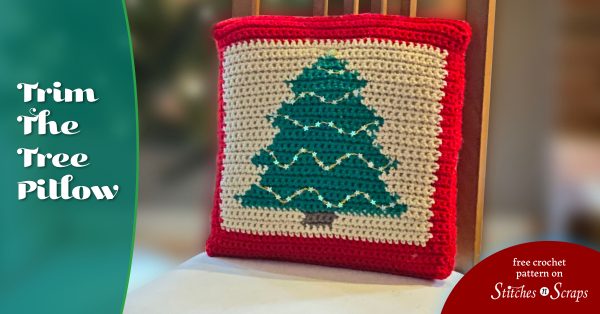
Christmas Crochet Pattern – Trim the Tree Pillow
Deck your halls with this Christmas crochet pattern! Just like a real tree, this festive holiday pillow is a blank canvas for your decorations. Trim the tree with buttons, pom poms, embroidery or whatever else you like for a one of a kind design!

This content is protected by copyright. See this Terms of Use / Copyright page for more information.
This post contains sponsored content and/or affiliate links. If you click an affiliate link and make a purchase, I may get a commission.
Scrappy Stitchers Stash Bash Crochet Along
This Christmas crochet pillow pattern is the November design for the 2020 Stash Bash Crochet Along. Each month, I will post a new, stash-busting pattern, and a giveaway prize too! See the giveaway details below, and join in the fun on the Scrappy Stitchers Facebook group. Remember to use the hashtag #ScrappyStitchersStashBash in your social media posts!
Trim the Tree
Decorating the tree is the most fun part of making this pillow. It’s a blank slate for your creativity. Decorate it any way you like! When selecting your decorations, keep in mind that your choices may affect your ability to wash the pillow later.
Years ago, my aunt and uncle gave me these adorable pin cushions. Among all the other attached findings were packets of star shaped sequins that were perfect for my tree!

I embroidered a garland with some sparkly, Lion Brand Bon Bons yarn, and then added the sequins. I first marked the “peaks” and “valleys” with pins, and loosely strung the yarn across them to make sure I liked the placement. Then, using the pins as a guide, I sewed the garland with small back stitches.

Intarsia Crochet Colorwork
Intarsia colorwork uses a separate ball of yarn for each section of color. I demoed this technique in my October 8th Lunchtime Live video. Since the unused yarns are not being carried through the stitches, this method avoids the “bleed through” you can sometimes get with other colorwork techniques.
Yarn Bobbins from We Crochet
Working with multiple balls of yarn can present a challenge of its own. Through most of the tree portion, you will have 5 balls of yarn attached at one time. Unruly balls or skeins easily tangle, creating tension issues and a lot of wasted time untangling.
To tame the tangles, I use these handy Knit Picks yarn bobbins. My mom got them for me years ago, and they’ve come in handy every time I do multiple strand projects. When closed, they prevent the yarn from unravelling. This means you can leave them attached closely to your fabric, and they won’t tangle with each other or other yarns!
Knit Picks is the same company that owns We Crochet, and you can buy these bobbins on either site. The Knit Picks site also has them in an Intarsia Kit, together with tapestry needles and a chart keeper!
I showed the yarn bobbins in this Lunchtime Live video. Here’s an excerpt of just that section, so you can see how they work!
Watch the whole video on YouTube
Enter the giveaway
We Crochet is providing a fantastic prize package for our giveaway this month! One lucky winner will get a set of these bobbins in each of the three sizes, AND a copy of the new WeCrochet Magazine (Issue #5). That’s 4 large bobbins, 6 medium bobbins, and 6 small bobbins, plus the magazine! Wow!

To be eligible, you must be 18 years of age or older, with a valid, US shipping address. The winner will be contacted by email, and must reply to that email and provide their shipping address within 1 week in order to receive the prize. If the winner does not reply within 1 week, a new winner will be selected. The giveaway ends on December 9th, 2020 (at 11:59pm, central time). Hurry and enter below!
This giveaway is powered by Rafflecopter, and they may ask for some log-in information if you are not already logged in. See the Rafflecopter privacy policy for more information.
a Rafflecopter giveawayMaterials
- Yarn: Worsted weight yarn
- 250 yds red
- 60 yds cream
- 10 yds brown
- 40 yds green
- Hook: Size I / 5.5 mm crochet hook or size needed to match gauge.
- Notions:
- Yarn Needle
- 4 stitch markers
- Embellishments as desired
- 14 inch square pillow form
Project Level
Intermediate: Intarsia crochet colorwork, working in back loops only, seaming.
Size
14 inches square. This is designed to fit snuggly around a 14 inch pillow form. The cover can be slightly less than 14 inches, but should stretch comfortably to fit.
Gauge
11 sc x 13 rows = 4 inches
Abbreviations used
(Pattern is written in US terms)
ch = chain
sc = single crochet
dc = double crochet
csdc = chainless starting double crochet (optional – see Recommended Resources)
st(s) = stitch(es)
RS = right side
Instructions
The chainless starting double crochet (csdc) creates a cleaner edge which will make seaming easier. However, if you prefer you can replace csdc with “ch 3, counts as dc” throughout the pattern.
Prepare Bobbins
For the front of the pillow, you will need separate balls of yarn for each color section. Before you start, wind a separate ball or bobbin with about 25 or 30 yards of red yarn. Do the same with cream.
Bottom Back
Ch 40 with red
Row 1: (RS) Working into the back bumps of the chain, sc in each ch across. (39 sts)
Row 2: Turn, csdc, dc in next st and each st across.
Row 3: Ch 1, turn, sc in each st across.
Rows 4-13: Repeat rows 3-4 5 times more. Place a marker at each end of row 13
Rows 14-28: Repeat rows 2-3 7 times more, then repeat row 2 once more.
Front
Change colors as indicated in the last part of the previous stitch. See this changing colors tutorial for more details on clean color changes. Use a separate ball of yarn for each section of color – do not carry yarn from one section to another. Cut yarns when they are no longer needed, leaving tails to weave in.

Row 29: Ch 1, turn, sc in back loop only of each st across. This leaves a line of unused loops to mark the fold line.
(Scroll down for chart of rows 30-74)
Rows 30-34: Ch 1, turn, sc in each st across.
Rows 35-73: Ch 1, turn, sc in each st across, changing colors as indicated below:
- Rows 35-36: 3 red, 33 cream, 3 red
- Rows 37-39: 3 red, 14 cream, 5 brown, 14 cream, 3 red
- Row 40: 3 red, 4 cream, 25 green, 4 cream, 3 red
- Row 41: 3 red, 3 cream, 27 green, 3 cream, 3 red
- Row 42: 3 red, 5 cream, 23 green, 5 cream, 3 red
- Row 43: 3 red, 6 cream, 21 green, 6 cream, 3 red
- Rows 44-45: 3 red, 7 cream, 19 green, 7 cream, 3 red
- Row 46: 3 red, 8 cream, 17 green, 8 cream, 3 red
- Row 47: 3 red, 6 cream, 21 green, 6 cream, 3 red
- Row 48: 3 red, 5 cream, 23 green, 5 cream, 3 red
- Row 49: 3 red, 7 cream, 19 green, 7 cream, 3 red
- Row 50: 3 red, 8 cream, 17 green, 8 cream, 3 red
- Rows 51-52: 3 red, 9 cream, 15 green, 9 cream, 3 red
- Row 53: 3 red, 10 cream, 13 green, 10 cream, 3 red
- Row 54: 3 red, 8 cream, 17 green, 8 cream, 3 red
- Row 55: 3 red, 7 cream, 19 green, 7 cream, 3 red
- Row 56: 3 red, 9 cream, 15 green, 9 cream, 3 red
- Row 57: 3 red, 10 cream, 13 green, 10 cream, 3 red
- Row 58: 3 red, 11 cream, 11 green, 11 cream, 3 red
- Row 59: 3 red, 12 cream, 9 green, 12 cream, 3 red
- Row 60: 3 red, 11 cream, 11 green, 11 cream, 3 red
- Row 61: 3 red, 10 cream, 13 green, 10 cream, 3 red
- Row 62: 3 red, 12 cream, 9 green, 12 cream, 3 red
- Row 63: 3 red, 13 cream, 7 green, 13 cream, 3 red
- Row 64: 3 red, 14 cream, 5 green, 14 cream, 3 red
- Row 65: 3 red, 15 cream, 3 green, 15 cream, 3 red
- Row 66: 3 red, 16 cream, 1 green, 16 cream, 3 red
- Row 67-68: 3 red, 33 cream, 3 red
Rows 69-74: Ch 1, turn, sc in each st across.

Top Back
If you haven’t already, cut all yarns except for current working ball of red, leaving tails to weave in later.
Row 75: Turn, working in back loops only, csdc in first st, dc in each st across. This leaves a line of unused loops to mark the fold line.
Row 76: Ch 1, turn, sc in each st across
Row 77: Turn, csdc in first st, dc in each st across.
Row 78: Repeat row 76. Place a marker at each end of this row.
Row 79: Repeat row 77
Rows 80-90: Repeat rows 76-77 5 times more, then repeat row 76 once more.
Fasten off.
Finishing:
Weave in all ends
Trim the Tree (optional):
Decorate the tree as desired. Embroidery, sequins, buttons, pom poms and felt appliques are all good options.
Seaming:
Lay pillow flat with tree upright and right side facing up.

Fold the top down first, being sure to fold at the line formed by the unused loops.

Fold the bottom up in the same manner. The ends of the top and bottom sections should line up evenly with the markers, creating a 13 row overlap.

With red, sew side edges closed, working through all layers.

Weave in any remaining ends and remove markers.
Turn pillow right-side-out and insert pillow form.

Fluff and enjoy!

Rate this Christmas Crochet Pattern!
I hope you enjoyed this Trim the Tree Pillow pattern. A downloadable pdf of this pattern is available on Ravelry for a small fee. The fee for the pdf format is to offset the advertising revenue lost when you print or download the pattern rather than viewing it online.
Do you want the best of Stitches n Scraps delivered right to your inbox? The Stitches n Scraps email newsletter includes highlights from the blog as well as special features not available elsewhere. Don’t miss a stitch – Subscribe now!

How to Crochet a Baby Blanket – Electric Bubblegum
Crochet a baby blanket of interwoven “bubbles” in bold candy colors. The Electric Bubblegum Baby Blanket pattern is easy to memorize and easy to adjust in size. That means, while the high contrast colors are perfect for baby, you can actually make one for everyone on your list!

This content is protected by copyright. See this Terms of Use / Copyright page for more information.
This post contains sponsored content and/or affiliate links. If you click an affiliate link and make a purchase, I may get a commission.
One color at a time
Not a fan of managing multiple colors? Don’t worry! Spike stitches dip down into previous rows to blend the colors together. So throughout this entire blanket pattern, you only need to use one color at time.
Yarnspirations sent me the Red Heart With Love yarn for free for this design.
Materials
- Yarn: Red Heart With Love worsted weight, acrylic yarn.
- 725 yds #1701 Hot Pink (pink)
- 725 yds #1803 Blue Hawaii (blue)
- Red Heart With Love worsted weight, acrylic yarn. 75 yds #140 Pewter (grey)
- Hook: Size K/ 6.5 mm crochet hook or size needed to match gauge.
- Notions: Yarn Needle
Project Level
Easy: Basic stitches, one color at a time, with some spike stitches.
Size
36 x 48 inches
Gauge
11.5 dc x 7 rows = 4 inches. Exact gauge is not critical.
Abbreviations used
(Pattern is written in US terms)
ch = chain
sc = single crochet
hdc = half double crochet
dc = double crochet
spike dc = spike double crochet (see Special Stitch)
sk = skip
st(s) = stitch(es)
sl st = slip stitch
RS = right side
Special Stitch
Spike Double Crochet (spike dc): Working around the chain and sl st, dc into the stitch below the next ch-2 sp.

Instructions
Blanket
Carry unused color up along the side between rows. To change the width of the blanket, start with more or fewer chains, in a multiple of 6 plus 4.
With blue, ch 94 (multiple of 6 + 4)
Row 1 (WS): Sc in 2nd ch from hook and in next 2 chs, (hdc in next ch, dc in next ch, hdc in next ch, sc in each of next 3 chs) across, changing to pink at end of row. (93 sts)
Row 2: With pink, Ch 1, turn, hdc in first st, dc in next st, hdc in next st, (sc in next st, ch-1, sk next st, sc in next st, hdc in next st, dc in next st, hdc in next st) across. (78 sts, 15 ch-1 sps)
Row 3: Ch 1, turn, hdc in first st, dc in next st, hdc in next st, (sc in next st, sl st in next ch-1 sp, sc in next st, hdc in next st, dc in next st, hdc in next st) across, changing to blue at end of row. (78 sts, 15 sl sts)
Row 4: With blue, ch 1, turn, sc in first st, ch 1, sk next st, sc in next st, (hdc in next st, spike dc, hdc in next st, sc in next st, ch 1, sk next st, sc in next st) across. (78 sts, 15 ch-1 sps)
Row 5: Ch 1, turn, sc in first st, sl st in next ch-1 sp, sc in next st, (hdc in next st, dc in next st, hdc in next st, sc in next st, ch 1, sk next st, sc in next st) across, changing to pink at end of row. (78 sts, 15 sl sts)
Row 6: With pink, Ch 1, turn, hdc in first st, spike dc, hdc in next st, (sc in next st, ch-1, sk next st, sc in next st, hdc in next st, spike dc, hdc in next st) across. (78 sts, 15 ch-1 sps)

Rows 7-127: Repeat rows 3-6 30 times more, then repeat row 3 once more.
To make the blanket longer or shorter, work more or fewer repeats of rows 3-6. Be sure to end after a repeat of row 3. You will need to make an adjustment on the first round of the edging as well.
Row 128: With blue, ch 1, turn, sc in each of first 3 sts, (hdc in next st, spike dc, hdc in next st, sc in each of next 3 sts) across. (93 sts) Do not fasten off.
Edging
Edging is worked on RS only, do not turn between rounds.
Rnd 1: Continuing with blue:
- Working in sides of rows, ch 3 (counts as ch-2 sp), work 129 sc evenly spaced to bottom. (129 sc, 1 corner ch-2 sp)
- Working in bottom of foundation chains, ch 2, sc in each ch across. (93 sc, 1 corner ch-2 sp)
- Working in sides of rows, ch 2, work 129 sc evenly spaced to top. (129 sc, 1 corner ch-2 sp)
- Sc in each st across top, join with sl st to starting ch-2 sp, changing to pink. (93 sc, 1 corner ch-2 sp)
If you adjusted the number of rows, also adjust the number of stitches in the sides of the rows on rnd 1. Instead of 129 sc, use 1 more sc than your total number of rows. This should always be an odd number.
Rnd 2: With pink, [(sc, ch 2, sc) in ch-2 sp, ch 1, sk next st, (sc in next st, ch 1, sk next st) across to next corner] 4 times, join with sl st to first st. (232 sc, 220 ch-1 sps, 4 corner ch-2 sps)
Rnd 3: Sl st in first ch-2 sp, changing to blue, with blue, ch-1, [(sc, ch 2, sc) in ch-2 sp, ch 1, sk next st, (sc in next ch-1 sp, ch 1, sk next st) across to next corner] 4 times. (236 sc, 224 ch-1 sps, 4 corner ch-2 sps)
Rnd 4: Sl st in first ch-2 sp, changing to pink, with pink, ch-1, [(sc, ch 2, sc) in ch-2 sp, ch 1, sk next st, (sc in next ch-1 sp, ch 1, sk next st) across to next corner] 4 times. (240 sc, 228 ch-1 sps, 4 corner ch-2 sps).
Rnd 5: Sl st in first ch-2 sp, changing to blue, with blue, ch-1, [3 sc in ch-2 sp, sc in each st and each ch-1 sp across to next corner] 4 times. (480 sc)
Fasten off, weave in all ends.

Rate this Crochet Baby Blanket Pattern!
I hope you enjoyed this crochet baby blanket pattern. A downloadable pdf of this pattern is available on Ravelry for a small fee. The fee for the pdf format is to offset the advertising revenue lost when you print or download the pattern rather than viewing it online.
Do you want the best of Stitches n Scraps delivered right to your inbox? The Stitches n Scraps email newsletter includes highlights from the blog as well as special features not available elsewhere. Don’t miss a stitch – Subscribe now!

Crochet Glasses Case – Seeing Spots
Big dots, little dots, I’m seeing lots of spots! Protect your eyeglasses with the Seeing Spots crochet glasses case.

This tapestry crochet pattern has a different polka dot design on each side, with little dots on the front and big dots on the back. Pull it all together with a circular button, and you have a fun and functional pouch to protect your glasses.
This content is protected by copyright. See this Terms of Use / Copyright page for more information.
This post contains sponsored content and/or affiliate links. If you click an affiliate link and make a purchase, I may get a commission.
Scrappy Stitchers Stash Bash Crochet Along
This crochet glasses case is the October pattern for the 2020 Stash Bash Crochet Along. Each month, I will post a new, stash-busting pattern, and a giveaway prize too! See the giveaway details below, and join in the fun on the Scrappy Stitchers Facebook group. Remember to use the hashtag #ScrappyStitchersStashBash in your social media posts!
Tapestry Crochet Colorwork
It may look intimidating at first, but I think tapestry crochet is the easiest form of colorwork to do. By carrying both yarns through every stitch, you create a dense, squishy fabric and don’t have a ton of ends to weave in when you’re done!
I demoed this technique in my September 24th Lunchtime Live video. Here’s an excerpt of just that section.
Watch the whole video on YouTube!
In another video, I showed how to work the first round of my Tapestry Crochet Gift Card Holder pattern This eyeglass case uses the same technique for working into the chain, though the stitch counts and color pattern are different. Watch that video here.
Crochet Button
You can use almost any type of button for this pattern, as long as it fits through the hole securely. I had a few buttons that would work in my stash, but none looked super cute with the design. So I chose to crochet my own button, using a variation of button #4 from this collection of 4 button patterns.
I have included the instructions, but feel free to use any button you like, for your own personal touch!
Reading Glasses from Readers.Com
I made this crochet glasses case for my new pair of reading glasses. About a month ago, Readers.Com gave me a free pair of their readers to try out and review. I didn’t realize how much I was straining to see my stitches, particularly at night, until I tried them on! You can find the full review of the reading glasses here.
Enter the giveaway
Readers.Com is providing a free pair of glasses for one lucky winner! They have put together a collection of featured styles, and the winner will get to choose their style, color, and strength from this selection. Which one would you choose? My choice was the Laura, in black.

To be eligible, you must be 18 years of age or older, with a valid, US shipping address. The winner will be contacted by email, and must reply to that email and provide their selections and shipping address within 1 week in order to receive the prize. If the winner does not reply within 1 week, a new winner will be selected. The giveaway ends on November 11th, 2020 (at 11:59pm, central time). Hurry and enter below!
This giveaway is powered by Rafflecopter, and they may ask for some log-in information if you are not already logged in. See the Rafflecopter privacy policy for more information.
a Rafflecopter giveawayMaterials
- Yarn: Worsted weight yarn
- 25 yds color A (shown in red)
- 25 yds color B (shown in grey)
- Hook: Size H / 5 mm crochet hook or size needed to match gauge.
- Notions:
- Yarn Needle
- Stitch marker
- 3/4 inch to 7/8 inch button (optional)
Project Level
Intermediate: Tapestry crochet colorwork in the round, working in back loops only, decreases and buttonhole in flap.
Size
About 3.5 inches x 6 inches not including flap.
Gauge
15 sc in back loop only x 12 rounds = 4 inches
Use pattern as gauge swatch – After round 6, work should measure about 3.5 inches wide x 2 inches tall. Exact gauge is not critical.
Abbreviations used
(Pattern is written in US terms)
ch = chain
ch-sp = chain space
sc = single crochet
tsc-A = Tapestry single crochet in color A (see Special Stitch)
tsc-B = Tapestry single crochet in color B (see Special Stitch)
blo = back loop only
sc2tog = single crochet next 2 stitches together
st(s) = stitch(es)
sl st = slip stitch
rnd = round
RS = right side
Recommended Resources
- Changing Colors Tutorial
- How to Crochet Into the Back Bump
- Lunchtime Live demos
- Crochet decreases tutorial from Jessie at Home (includes sc2tog)
Special Stitches / Techniques
Tapestry Single Crochet (tsc-A / tsc-B):
Single crochet in back loop only, using indicated color (A or B). Work over the other, unused color so that it is hidden inside of the stitch.

For the first half of round 1 ONLY, work the tapestry single crochet stitches into the back bump of the starting chain. See this back bump tutorial for more about working into the back bump of a chain.

Color Changes: Change colors in the last part of the previous stitch. See this changing colors tutorial for more details on clean color changes.

Instructions
Main Section
Join rounds where indicated with a sl st in the first st of the round, using color B. Mark the first stitch of each round to make joining easier. Be sure you are actually joining into the first single crochet of the round, not into the previous slip stitch or chain.
Do not turn your work unless specifically indicated.
Chart
(scroll down for written instructions)

Written instructions:
Ch 13 with color A, then ch 1 with color B.

Rnd 1:
Working into the back bumps of the chain, tsc-B in 2nd ch from hook, tsc-A in next 11 chs, tsc-B in next ch.

On the opposite side of the chain, there will be 2 unused loops remaining for each stitch – a front loop and a back loop. Working into the back loops only, tsc-B in next 5 chs, tsc-A in next 3 chs, tsc-B in last 5 chs, join. (26 sts)

Rnd 2: Ch 1, tsc-B in first st, tsc-A in next 11 sts, tsc-B in next 6 sts, tsc-A in next 3 sts, tsc-B in last 5 sts, join.
Rnd 3: Ch 1, tsc-B in first 2 sts, tsc-A in next 9 sts, tsc-B in next 2 sts, tsc-A in next st, tsc-B in next 3 sts, tsc-A in next 5 sts, tsc-B in next 3 sts, tsc-A in last st, join.
Rnd 4: Ch 1, tsc-B in first 4 sts, tsc-A in next 5 sts, tsc-B in next 4 sts, tsc-A in next 5 sts, tsc-B in next 3 sts, tsc-A in last 5 sts, join.
Rnd 5: Ch 1, tsc-B in first 6 sts, tsc-A in next st, tsc-B in next 7 sts, tsc-A in next 3 sts, tsc-B in next 5 sts, tsc-A in next 3 sts, tsc-B in last st, join.


Rnd 6: Ch 1, tsc-B in first 4 sts, tsc-A in next 5 sts, tsc-B in next 5 sts, tsc-A in next 3 sts, tsc-B in next 5 sts, tsc-A in next 3 sts, tsc-B in last st, join.
Rnd 7: Ch 1, tsc-B in first 2 sts, tsc-A in next 9 sts, tsc-B in next 2 sts, tsc-A in next 5 sts, tsc-B in next 3 sts, tsc-A in last 5 sts, join.
Rnd 8: Ch 1, tsc-B in first st, tsc-A in next 11 sts, tsc-B in next st, tsc-A in next st, tsc-B in next 3 sts, tsc-A in next 5 sts, tsc-B in next 3 sts, tsc-A in last st, join.
Rnds 9-10: Repeat rnd 2
Rnd 11: Repeat rnd 8
Rnd 12: Repeat rnd 7
Rnd 13: Repeat rnd 6


Rnd 14: Repeat rnd 5
Rnd 15: Repeat rnd 4
Rnd 16: Repeat rnd 3
Rnds 17-18: Repeat rnd 2
Fasten off color B only.


Flap
This section is worked back and forth in rows, with color A only.
Row 1 (RS): Ch 1, do not turn, sc in first 13 sts, leaving remaining sts unworked. (13 sts)
Row 2: Ch 1, turn, sc in each st across.
Row 3: Ch 1, turn, sc in first st, sc2tog, sc in next 7 sts, sc2tog, sc in last st. (11 sts)
Row 4: Ch 1, turn, sc in each st across.
Row 5: Ch 1, turn, sc in first st, sc2tog, sc in next 5 sts, sc2tog, sc in last st. (9 sts)
Row 6: Ch 1, turn, sc2tog twice, ch 1, sk next st, sc2tog twice. (4 sts, 1 ch-sp)
Row 7: Ch 1, turn, sc2tog, sc in ch-1 sp, sc2tog. Fasten off. (3 sts)

Edging: With RS facing and working in sides of rows, join A with sl st in first st of row 1. (Ch 1, sl st) in each row to top of flap, (ch 1, sl st) in next 3 sts from row 7, (ch 1, sl st) in side of each row to bottom of flap. Fasten off. (17 sts)

Crochet Button (optional)
With B, ch 2, leaving a 6 inch tail for sewing.
Rnd 1: 3 sc in 2nd ch from hook, do not join.
Rnd 2: 2 sc in each st around, do not join.
Rnd 3: (Sc in next st, sk next st) 3 times, fasten off.
Sew button closed with ending tail and bring it out at the bottom, next to the other tail.
Finishing:
Sew button in place so it fits through the ch-1 sp on the flap. If using a crocheted button, use the longer of the two tails to sew it on.

Weave in all ends.

Rate this Crochet Glasses Case Pattern!
I hope you enjoyed this Seeing Spots crochet glasses case pattern. A downloadable pdf of this pattern is available on Ravelry for a small fee. The fee for the pdf format is to offset the advertising revenue lost when you print or download the pattern rather than viewing it online.
Do you want the best of Stitches n Scraps delivered right to your inbox? The Stitches n Scraps email newsletter includes highlights from the blog as well as special features not available elsewhere. Don’t miss a stitch – Subscribe now!

Tapestry Crochet Gift Card Holder
Are there any gift cards on your holiday gifting list this year? Add a personal touch to your gift with this Tapestry Crochet Gift Card Holder. It’s perfect for any gifting occasion, and is a great project for using up small amounts of yarn!

This content is protected by copyright. See this Terms of Use / Copyright page for more information.
This post contains sponsored content and/or affiliate links. If you click an affiliate link and make a purchase, I may get a commission.
CAL Central Holiday Stashdown Crochet Along
I designed this pattern for the CAL Central Holiday Stashdown Crochet Along. This is our biggest and most popular event every year at CAL Central, and there have been lots of exciting patterns already.
Join us in using up your stash on fun holiday gifts and decorations! Find all the details and pattern links in this intro post. And don’t forget to enter the giveaway!
Supporting Small Business
Make your gift as meaningful as the gift card holder – Consider giving an Etsy gift card! Your gift will help support small business, while offering your recipient a world of unique items to choose from.

Materials
- Yarn: Worsted weight yarn. 20 yds each of background color (A) and accent color (B)
- Hook: Size H / 5 mm crochet hook or size needed to match gauge.
- Notions:
- Yarn Needle
- Stitch Markers
Project Level
Intermediate: Single crochet colorwork with carried yarns, working in back loops or front loops only.
Size
3.25 x 4.5 inches
Gauge
15 sc in back loop only x 11 rounds = 4 inches
Use pattern as gauge swatch – After round 5, work should measure about 3.25 inches wide x 2 inches tall. Exact gauge is not critical.
Abbreviations used
(Pattern is written in US terms)
ch = chain
sc = single crochet
tsc-A = Tapestry single crochet in color A (see Special Stitch)
tsc-B = Tapestry single crochet in color B (see Special Stitch)
flo = front loop only
blo = back loop only
st(s) = stitch(es)
sl st = slip stitch
rnd = round
Recommended Resources
- Changing Colors Tutorial
- How to Crochet Into the Back Bump
- Lunchtime Live demos
Special Stitches
Tapestry Single Crochet (tsc-A / tsc-B):
Single crochet in back loop only, using indicated color (A or B). Work over the other, unused color so that it is hidden inside of the stitch.

For the first half of round 1 ONLY, work the tapestry single crochet stitches into the back bump of the starting chain. See this back bump tutorial for more about working into the back bump of a chain.
Pattern Notes:
- The entire gift card holder is worked in rounds, without turning.
- Mark the first stitch of each round to make joining easier. Be sure you are actually joining into the first single crochet of the round, not into the previous slip stitch or chain.
- Only work over the unused color yarn when working tapestry stitches. Otherwise, do not carry the yarn, leave it where it is and you will pick it up again in the next round.
- Change colors in the last part of the previous stitch. See this changing colors tutorial for more details on clean color changes.

Instructions
Bottom
(Scroll down for chart for this section only)
With A, ch 13.
Lay color B across your work, leaving a tail, so that you can start working over color B for the tapestry stitches.

Rnd 1:
Working into the back bumps of the chain, tsc-A in 2nd ch from hook, *tsc-A in next ch, [tsc-B in next ch, tsc-A in next 3 chs] twice, tsc-B in next ch, tsc-A in next ch.
On the opposite side of the chain, there will be 2 unused loops remaining for each stitch – a front loop and a back loop. Working into the back loops only, tsc-A in first ch, repeat from *, join with sl st to back loop only of first st. (24 sts)

Rnd 2: Ch 1, tsc-A in first st, [tsc-B in next st, tsc-A in next 3 sts] 5 times, tsc-B in next st, tsc-A in last 2 sts, join with sl st to back loop only of first st.
Rnd 3: Ch 1 changing to B. Tsc-B in first st, [tsc-A in next 3 sts, tsc-B in next st] 5 times, tsc-A in last 3 sts, join with sl st to back loop only of first st.
Rnd 4: Ch 1, tsc-A in first 3 sts, [tsc-B in next st, tsc-A in next 3 sts] 5 times, tsc-B in last st changing to A, join with sl st to back loop only of first st.
Rnd 5: Ch 1, tsc-A in first 2 sts, [tsc-B in next st, tsc-A in next 3 sts] 5 times, tsc-B in next st, tsc-A in last st, join with sl st to back loop only of first st.
Your work should now measure about 2.25 inches in diameter.
Rnds 6-9: Repeat Rnds 2-5.


Top:
Rnd 10 (ruffle): Do not carry unused yarn in this round. Ch 1 changing to B. Sl st in flo of first st, (ch 1, sl st) in flo of each st around, join with sl st to first ch. (24 sts, 24 chs)
Rnd 11: Do not carry unused yarn in this round. Working in the unused back loops from rnd 9, sl st in blo of first st changing to A, sc in blo of same st and each st around, join with sl st to blo of first st. (24 sts)

Rnd 12: Ch 1 changing to B, tsc-B in first st, (tsc-A in next st, tsc-B in next st) around, tsc-A in last st, join with sl st to blo of first st.
Rnd13: Do not carry unused yarn in this round. Ch 1 changing to A. Sc in blo of each st around, join with sl st to blo of first st.

Optional Loop:
With both yarns held together, ch 10, sl st in same st.

Finishing:
Fasten off both colors, weave in all ends.

Rate this Tapestry Crochet Gift Card Holder Pattern!
I hope you enjoyed this tapestry crochet gift card holder pattern. A downloadable pdf of this pattern is available on Ravelry for a small fee. The fee for the pdf format is to offset the advertising revenue lost when you print or download the pattern rather than viewing it online.
Do you want the best of Stitches n Scraps delivered right to your inbox? The Stitches n Scraps email newsletter includes highlights from the blog as well as special features not available elsewhere. Don’t miss a stitch – Subscribe now!

Crochet Penguin Amigurumi – Playful the Baby Penguin
Playful the Baby Penguin has arrived just in time for the holidays! She’s an emperor penguin chick, so she loves the cold weather and playing in the snow with her friends. This crochet penguin amigurumi pattern is fast to make, so you can make the whole set.

This content is protected by copyright. See this Terms of Use / Copyright page for more information.
This post contains sponsored content and/or affiliate links. If you click an affiliate link and make a purchase, I may get a commission.
80 Days of PolyFil
I designed this crochet amigurumi penguin pattern for the 80 Days of PolyFil celebration. This event is sponsored by Fairfield, in celebration of their 80th anniversary!
Poly Fil Premium Fiber Fill
Fairfield World generously sent me lots of Poly-Fil Premium Polyester Fiber Filling for these softie designs. This is my go to stuffing material for all my crochet amigurumi patterns because it’s so soft and squishy and easy to use. It also makes great fake snow for pictures!
My favorite stuffing tip is to tear the stuffing into small bits and stuff just a little at a time, rather than trying to put a whole handful in all at once. This creates a smoother finish and avoids clumps and lumps.
Baby Buddies
Playful is similar in style and design to her friends, Awesome the Baby Elephant, Noble the Lion Cub, Bravo the Bear Cub, Sunny the Baby Bunny, and Breezy the Baby Bat. Make them all!


Materials
- Yarn: Worsted weight yarn
- 60 yds body color (A – shown in grey)
- 20 yds head color (B – shown in white)
- 20 yds hood color (C – shown in black)
- Hook: Size H/ 5 mm crochet hook or size needed to match gauge.
- Notions:
- Fairfield Poly-Fil Premium Polyester Fiber Filling
- Yarn Needle
- Stitch Marker or scrap of yarn to use as marker.
Project Level
Intermediate: Mostly single crochet in the round, with some increases and decreases.
Size
7 inches tall
Gauge
14 sc x 14 rows = 4 inches. Use pattern as gauge swatch – Rounds 1 – 4 should measure 2.25 inches in diameter. Exact gauge is not critical.
Abbreviations used
(Pattern is written in US terms)
ch = chain
sc = single crochet
inc = increase (see Special Stitches)
dec = decrease (see Special Stitches)
sk = skip
st(s) = stitch(es)
sl st = slip stitch
sp = space
ch-sp = chain space
rnd = round
RS = right side
Special Stitches
Increase (inc): Sc in back loop only of next st, then sc in both loops of the same st. See full tutorial here.
Decrease (dec): Insert hook into front loop only of both of next 2 stitches, yarn over and draw up a loop, yarn over and draw through both loops on hook. This is an alternative to a single crochet 2 together (sc2tog) stitch. If you prefer, you can use the standard sc2tog instead.


Instructions
Body
Everything except the hood is worked in continuous rounds. Do not join or turn unless indicated. Mark first stitch of each round.
With A, ch 2
Rnd 1 (RS): 6 sc in 2nd ch from hook. (6 sc)
Rnd 2: Inc around. (12 sc)
Rnd 3: (Inc in next st, sc in next st) around. (18 sc)
Rnd 4: (Inc in next st, sc in each of next 2 sts) around. (24 sc)
Rnd 5: Sc in each st around.
Rnd 6: (Inc in next st, sc in each of next 3 sts) around. (30 sc)
Rnds 7-10: Sc in each st around.
Rnd 11: (Dec, sc in each of next 3 sts) around. (24 sts)
Rnds 12-15: Sc in each st around.
Rnd 16: (Dec, sc in each of next 2 sts) around. (18 sts)
Rnds 17-18: Sc in each st around.
Rnd 19: (Dec, sc in next st) around, changing to B at the end of the rnd. (12 sts)
Stuff body most of the way full and continue stuffing as you go.

Head
Rnds 20-22: Repeat rnds 3-5
Rnd 23: Sc in next 9 sts, ch 3, sk next 3 sts, sc in last 12 sts. (21 sc and ch-3 sp for beak)
Rnd 24: Sc in each st and each ch around. (24 sc)
Rnd 25: Sc in each st around.
Rnd 26: (Dec, sc in next 2 sts) around. (18 sc)
Rnd 27: (Dec, sc in next st) around. (12 sc)
Rnd 28: Dec around, fasten off. (6 sc)
Using tails, sew top of head and bottom of body closed, then weave in all ends.
Finish stuffing head through beak opening.

Hood
With C, Ch 13, leaving a 30 inch tail for sewing.
Row 1: Sc in 2nd ch from hook and in each ch across. (12 sts)
Row 2: Ch 1, turn, sc in each st across.
Rows 3-4: Ch 1, turn, sc in first st, dec, sc across to last 3 sts, dec, sc in last st. (8 sts)
Rows 5-7: Repeat row 2.
Row 8: Repeat row 3. (6 sts)
Rows 9-10: Repeat row 2.
Row 11: Ch 1, turn, sc in first st, dec twice, sc in last st. (4 sts)
Rows 12-13: Repeat row 2.
Row 14: Ch 1, turn, dec, sc in last st. (3 sts)
Row 15: Repeat row 2.

Beak
The beak starts by joining the hood to the beak opening.
Rnd 1: Ch 1, turn, with body and head upside down, hold the 3 stitches of the last row of the hood against the 3 stitches at the top of the beak opening.

Working through both layers, sc in next 3 sts. Continuing around the beak opening only, sc in the next 3 stitches at the bottom of the beak opening.

Rnd 2: (Dec, sc in next st) twice. Fasten off. (4 sts)

Wings (Make 2)
With A, ch 7, leaving a 12 inch tail for joining.
Rnd 1: Sc in 2nd ch from hook and in each ch across, working in bottom of chains, sc in each ch across. (12 sts)
Rnds 2-4: Sc in each st around.
Rnd 5: (Dec, sc in next 4 sts) twice. (10 sts)
Rnds 6-7: Sc in each st around.
Rnd 8: (Dec, sc in next 3 sts) twice. (8 sts)
Rnd 9: Sc in each st around
Rnd 10: (Dec, sc in next 2 sts) twice. (6 sts)
Rnd 11: (Dec, sc in next st) twice. Fasten off. (4 sts)

Assembly
Using tails, sew wings in place at the neckline, where head meets body.
Fold hood down so that the bottom of it wraps around the back of the neck.

With the long tail, sew hood in place around the edge – all around the face and across the back of the neck.
Embroider the eyes.

Backstitch across front of neck, to hide color change.

Weave in all ends.

Rate this Crochet Penguin Amigurumi Pattern!
I hope you enjoyed this crochet penguin amigurumi pattern. A downloadable pdf of this pattern is available on Ravelry for a small fee. The fee for the pdf format is to offset the advertising revenue lost when you print or download the pattern rather than viewing it online.
Do you want the best of Stitches n Scraps delivered right to your inbox? The Stitches n Scraps email newsletter includes highlights from the blog as well as special features not available elsewhere. Don’t miss a stitch – Subscribe now!

Crochet Dog Bed with Fairfield Project Foam
This post contains sponsored content and/or affiliate links. If you click an affiliate link and make a purchase, I may get a commission.
Give your dog a cozy, supportive place to sleep! This crochet dog bed has 5 inches of foam inside and a soft, fur top. It’s the ultimate in comfort for your fur baby. The cover is removable, to make cleaning easier!

This content is protected by copyright. See this Terms of Use / Copyright page for more information.
Fairfield Project Foam
I asked the folks at Fairfield for some of their 5 inch project foam for my pet stairs design. They’re so generous, that they sent me 2 pieces of foam, plus a roll of Poly-Fil Cushion Wrap and a whole bunch of other goodies too!
The project foam is soft enough that I can squish it by pressing hard on it. But it’s also firm enough that it doesn’t compress when my dog, Millie walks on it. I know she thinks it’s comfy because she sometimes just lays on the stairs instead of climbing up into the bed!

For the bed I decided to add a layer of the cushion wrap. This helps to fill out the cover, and adds a luxurious, pillowy feel to the top.

Red Heart Yarns
Red Heart provided the yarn for the removable, crochet cover on this pet bed. The sides and bottom are made with With Love, while the top is made with Hygge Fur. The snuggly fur is warm and can be calming for dogs. The label says it’s machine washable, but I will likely hand wash this cover just to make sure it lasts longer.

Gluing Batting to Foam
Foam is tricky to glue because it’s a porous surface. Most glues tend to sink in rather than stick to the top. Spray glue is generally the best bet. There are several on the market specifically made for furniture foam and upholstery projects. Some of the stronger multi-purpose spray glues will do the job as well.
On the pet stairs, I used some Elmer’s Craft Bond Spray Adhesive that I got in a goodie bag at a conference. That bottle was nearly empty, so I bought some 3M Super 77 to finish the job.
I found the two adhesives pretty comparable, though I didn’t need quite as much of the 3M Super 77. I think they both work well, but would likely choose the 3M glue if I had to pick.
Materials
- Yarn:
- Red Heart With Love Yarn 800 yds #1801 Navy (3 skeins)
- Red Heart Hygge Fur Yarn 1000 yds Soft Taupe (4 skeins)
- Hook: Size K / 6.5 mm crochet hook or size needed to match gauge.
- Notions:
- Fairfield 5″ Project Foam (24 x 36 x 5 inches)
- Fairfield Poly-Fil Cushion Wrap (30 inches x 10 ft)
- Spray Glue for foam
- Yarn Needle
- 5 stitch markers
Project Level
Intermediate: Some post stitches, working with fur yarn, join as you go.
Size
24 inches wide x 36 inches long x 5 inches tall.
Gauge
10 dc x 6.5 rows = 4 inches.
Abbreviations used
(Pattern is written in US terms)
ch = chain
sc = single crochet
dc = double crochet
bpdc = back post double crochet
st(s) = stitch(es)
sl st = slip stitch
sk = skip
rnd = round
Recommended Resources
Instructions
Wrap the Foam
Do this outdoors or in a well ventilated location. Follow any safety guidelines per your glue bottle.
Lay the Cushion Wrap down, and place the Project foam on top of it, so that there’s a 2-3 inch overlap on the front and sides. Wrap the Cushion Wrap up and over the foam as shown. It should now go around the top, bottom, and back side.

Trim the front so there is a 2-3 inch overlap.

Fold back the cushion wrap and spray the top of the foam with adhesive, then slowly replace the wrap, stretching it into place. Turn the cushion over and do the same on the back side and the bottom.

Now fold the side edges down and glue them into place as well. Trim away any overlap, particularly in the corners. It’s ok if there are some gaps here, but do not let the wrap overlap.

Set fully wrapped foam aside to dry while you make the cover. Allow it to dry for at least the full time shown on your glue label before trying to insert it into the cover.

Bottom
Long piece:
With A, Ch 62
Ch 3 at the beginning of a row counts as a dc throughout.
Row 1 (WS): Dc in 4th ch from hook and in each ch across. (60 dc)
Row 2: Ch 3, turn, dc in next st and in each st across. (60 dc)
Place markers at the beginning and end of row 2.
Rows 3-55: Repeat row 2.
Fasten off.
Short Piece:
With A, Ch 62
Rows 1-9: Work as for rows 1-9 of long piece, including placing the markers. Do not fasten off. Secure working loop with a stitch marker or scrap of yarn and remove hook.
Join Bottom:
With right sides up, place short piece on top of long piece so that the bottom edges of each piece line up with the markers on the other piece. They should overlap by 7 rows.

Sew the two pieces together where they overlap, along the side edges only. This creates an open flap across the back, which will be used later to insert the foam.

Sides:
Rnd 1 (RS): Place working loop back onto hook. Continuing from back,
- Ch 1, turn, bpdc around each st across (60 bpdc)
- Working in sides of rows, 90 dc evenly spaced across to corner. (90 dc)
- Working around sts of row 1, bpdc around each st across. (60 bpdc)
- Working in sides of rows, 90 dc evenly spaced across to corner, join with sl st to first st of round. (90 dc)
Rnds 2-8: Ch 3, turn, dc in next st and each st around, join with sl st to first st, changing to 2 strands of B held together. Fasten off A. Do not turn. (300 dc)

Top
Entire top is worked with 2 strands of B held together, for added fullness. Row 1 should be worked across a short edge (60 sts).
Instead of chaining to start each new row, you will work slip stitches into the stitches from the side rounds. These slip stitches act as turning chains, while also joining the top to the sides. These slip stitches are not included in the stitch counts at the ends of the rows.
With 2 strands of B held together,

Row 1 (RS): Sl st in next st, turn, sk sl st, (2 sc in next st, ch 1, sk next st) 30 times, sl st in next 2 sts. (60 sc, 20 ch-1 sps)

Rows 2-89: Turn, (2 sc in next ch-1 sp, ch 1, sk next 2 sc) across, sl st in next 2 unworked sts on side. (60 sc, 20 ch-1 sps)

Row 90: Turn, (2 sc in next ch-1 sp, ch 1, sk next 2 sc) across, sl st in next unworked st on side, changing to A, Fasten off B. (60 sc, 20 ch-1 sps)
There should now be 60 unworked sts left from rnd 8 of side.
Row 91: With A, ch 1, turn, 2 sc in first ch-1 sp, sk next 2 sc, (2 sc in next ch-1 sp, sk next 2 sc) across to last ch-1 sp, sc in last ch-1 sp, sk next st, sc in last st, fasten off leaving a 36 inch tail for sewing. (60 sc)
Joining Top
With tail, sew row 91 of top to remaining unworked sts of side.
Finishing:
- Weave in all ends.
- Insert wrapped foam into cover through back opening. I’ve found this is easiest to do like you would put on a stocking – crumple the cover up so you’re only dealing with the last few inches, insert the bottom of the foam, and then shimmy the cover up over the top. Finally, fold the top flap down over the edge.

The flap should be enough to keep the cover closed on its own, and you don’t want buttons or a zipper rubbing against the floor. If you want to hold it firmly shut, you can sew in an optional tie closure. This rough seam is tied closed with a bow so it can easily be removed when needed.
- Optional tie closure: Cut a 30 inch piece of A. Sew it through both layers across the middle of the opening, in a very large running stitch. Go over at least 3 to 4 stitches at a time so it’s easy to pull out later. Pull this yarn until the ends are roughly even. Then, sew each end back in towards the middle in a similar running stitch. When they meet at the middle, tie a bow.

To remove cover for cleaning, undo tie and slide foam out from opening.

Rate this Crochet Dog Bed Pattern!
I hope you enjoyed this crochet dog bed pattern. A downloadable pdf of this pattern is available on Ravelry for a small fee. The fee for the pdf format is to offset the advertising revenue lost when you print or download the pattern rather than viewing it online.
Do you want the best of Stitches n Scraps delivered right to your inbox? The Stitches n Scraps email newsletter includes highlights from the blog as well as special features not available elsewhere. Don’t miss a stitch – Subscribe now!