Crochet Tutorials

Ready for a new crochet stitch, technique, or pattern? You’re in the right place! Browse all the crochet tutorials, or select a category from the dropdown menu. What will you learn today?

How to Crochet into the Back Bump of a Chain
There are several different ways to crochet into a chain, and all produce different results. My favorite for creating a ...More
front post single crochet - StitchesNScraps.com
When you see front post and back post stitches, you almost always see them done in double crochet. The reality ...More
Setting a Bead - StitchesNScraps.com
Ready to add a bit of sparkle to your crochet? There are several different ways to add beads to crochet, ...More
Linked dc tutorial on StitchesNScraps
Double crochets are fast and easy, but for some applications they are too loose and leave unwanted gaps. Linked double ...More
Puff Stitch tutorial on StitchesNScraps.com
Puff stitches are soft, squishy, versatile, and easy to make. Learn how with this tutorial! ...More
Basic Bruges Lace tutorial on StitchesNScraps.com
Welcome to the New Year, New Technique CAL! This week's technique is Bruges lace, and one of the patterns is ...More
Split / Center Stitches tutorial on StitchesNScraps.com
Split or center stitches are just like normal stitches except for where you place your hook. It's much easier to ...More
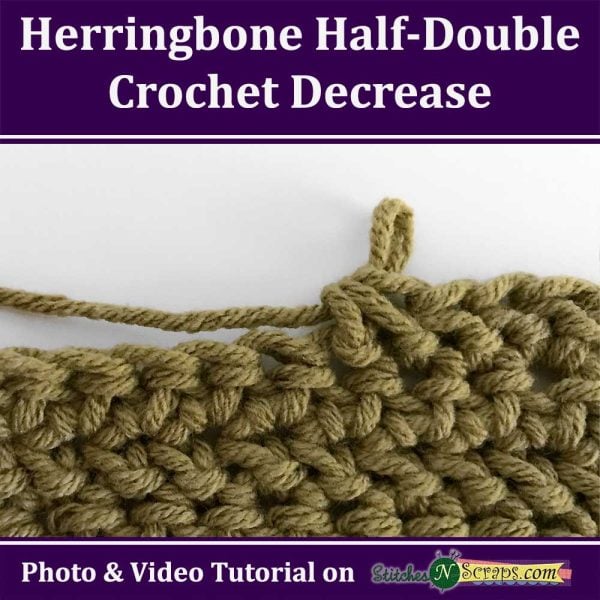
Herringbone Half Double Crochet Decrease tutorial on StitchesNScraps.com
Earlier, I showed you how to do the herringbone half-double crochet stitch (hhdc). If you're not familiar with the hhdc ...More
How to Crochet into the Back Bump of a Chain

How to Crochet into the Back Bump of a Chain

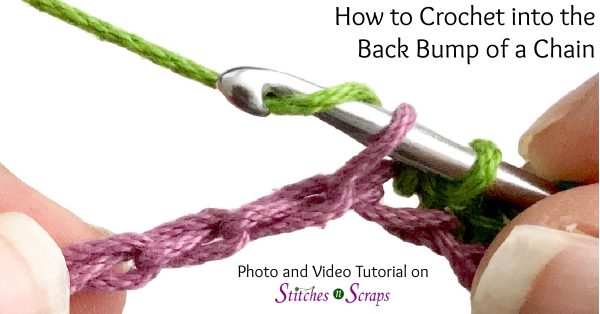
There are several different ways to crochet into a chain, and all produce different results. My favorite for creating a nice, finished looking bottom edge is to crochet into the back bump.

How to Crochet into the Back Bump of a Chain

This post contains sponsored content and/or affiliate links. If you click an affiliate link and make a purchase, I may get a commission.

This content is protected by copyright. See this Terms of Use / Copyright page for more information.

Where is the Back Bump?

Each chain is made up of three separate strands of yarn.  From the front, you can see the two strands you are most familiar with. The top loop and bottom loop make up that “V” shape we all know and love.

Top and bottom loops at the front of the chain

If you flip the chain around to the back though, you will see a third, hidden loop. This is the back bump.

Back bump location

Most people first learn to crochet by working into the top loop or into the top loop and back bump together, because it is relatively easy.

Why Crochet into the Back Bump?

Crocheting into just the back bump leaves that V shape in the front completely undisturbed. So when you finish your row, that V still shows on the bottom of your work.

Bottom of chain with V shapes showing

Since most stitches have the same V shapes on the top, the bottom edge matches the top edge nicely. This means you can leave the bottom edge as-is and it will still look finished, without the need to work an edging.

Top of row with V shapes showing

How to Crochet into the Back Bump

To create this nice edge, work your stitches under the back bump of the chain. Instead of inserting your hook where you normally would to work your stitch, put it just under this back bump instead.

Working into the back bump

You can use this technique with almost any stitch you want to start with. Try it out on my Sheet Metal Scarf pattern!


How to Crochet into the Back Bump Video Tutorial:

Watch this video on YouTube

Rate this Crochet Tutorial!


Do you want the best of Stitches n Scraps delivered right to your inbox? The Stitches n Scraps email newsletter includes highlights from the blog as well as special features not available elsewhere. Don’t miss a stitch – Subscribe now!

front post single crochet - StitchesNScraps.com

Tutorial – Front & back post single crochet (fpsc, bpsc)

When you see front post and back post stitches, you almost always see them done in double crochet. The reality is, you can do them in any stitch! Working around the post turns the stitches at a 90 degree angle from the previous row. So front and back post single crochet (fpsc and bpsc) stitches are useful as textural elements, or to change the direction of your work.

This post contains affiliate advertisements (click for more info). If you click one of these links and then make a purchase, I may be compensated. You get the same great prices, and you will be helping to support this site!

Front and Back Post Single Crochet (fpsc / bpsc) Photo Tutorial

(scroll down for video tutorial)

Front post single crochet

A normal single crochet is worked into the top of the stitch. For a post stitch, we want to work around the post of the stitch instead. To do this, insert your hook from front to back on the first side of the stitch, then bring it back out from back to front on the other side of the stitch. If you’re right handed, the first side is the right side (as shown). If you’re left handed, you start from the left side.

front post single crochet - StitchesNScraps.com

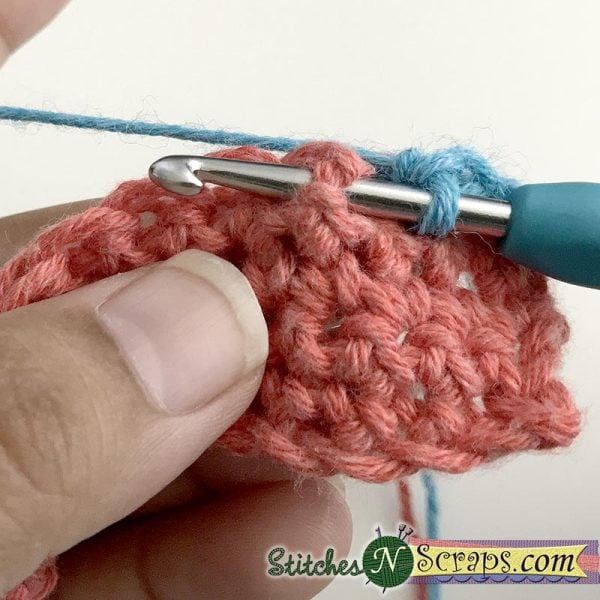
You can see that the post of the stitch is lying in front of the hook. This means it’s a front post stitch. Yarn over, and pull up a loop around that post.

front post single crochet - StitchesNScraps.com

Now finish your single crochet as normal – yarn over, and pull through both loops on your hook.

front post single crochet - StitchesNScraps.com

After you work a few stitches, you will be able to see this new row forms a ridge on the front of your work. If we continue working the next row into this one, we’ll have made a sharp corner. Since the tops of the previous row were left unworked, we could also go back and work into them later instead, leaving this ridge as a decorative element.


Affiliate Advertisement

[the_ad_group id=”1380″]


Back Post Single Crochet (bpsc)

With the front post stitch, we wanted the post in front of our hook. For the back post stitch, we want the post at the back. So we insert our hook the opposite way. Start by inserting your hook from back to front on the first side of the stitch, then back down from the front to the back on the other side. Again, righties go from right to left (as shown), and lefties go from left to right.

back post single crochet - StitchesNScraps.com

You can see now that the hook is in front, so the post of the stitch is at the back. Yarn over and draw up a loop – from this side you can see how that loop is wrapped around the post of the stitch.

back post single crochet - StitchesNScraps.com

Now yarn over and draw through both loops to complete your stitch.

back post single crochet - StitchesNScraps.com

Front and back post single crochet are actually the same stitch, just worked from opposite sides of the fabric. If you turn your work around, your fpsc stitches now look like bpsc, and vice versa. Front post stitches stick out on the front of the fabric, and back post stitches stick out on the back. So choose your stitch based on what direction you want to go, and whether you’re on the right or wrong side of the fabric.

Front and back post single crochet - StitchesNScraps.com


Front and Back Post Single Crochet (fpsc / bpsc) Video Tutorial:

(back to top)


Setting a Bead - StitchesNScraps.com

Tutorial – Crocheting with Beads (pre-strung)

Ready to add a bit of sparkle to your crochet? There are several different ways to add beads to crochet, and all end up having a slightly different effect. In this tutorial we’re looking at crocheting with beads that have been pre-strung. This means we string the beads onto the yarn first, and then work them in as we go along.

Crocheting with Beads (pre-strung) Photo Tutorial

(scroll down for video tutorial)

Stringing the Beads

This method requires stringing the beads before you start crocheting, which means you have to know how many beads you are going to need. If it’s written in your pattern, that’s great, but if you’re working without a pattern this may require a little extra planning up front.

To actually get the beads onto the yarn, I like to use a flexible needle threader as a beading needle. I learned about these in a beading class I took from Laurinda Reddig – thanks Laurinda! They’re made of something similar to heavy duty fishing line, and the “eye” is basically a large flexible loop. Thread your yarn through the eye, and use the other end as the point to load up the beads.

Adding some beads from #beadbiz! Aren’t they pretty? #beadcrochet #crochetersofinstagram

A post shared by Pia Thadani (@stitchesnscraps) on

My friend at Bead Biz also recommends a big eye needle like this one. I haven’t tried that type yet, but it looks like another great option. I always like to add a few extra beads, just to have a bit of a buffer in case I miscounted, make a mistake, or a bead breaks. The unused beads can be removed after finishing off.

Affiliate Advertisement

[the_ad_group id=”1362″]

Crocheting with the Beads

To “set” a bead, just slide it right up to your work. It should lie against the last stitch you worked.

Setting a Bead - StitchesNScraps.com

Now when you work your next stitch or chain, it will get incorporated into it.  I particularly like to use this method to place beads into chains, because the bead hangs down a bit into the space below the chain. The beads tend to show more prominently on the back of the work, so it works better if you do this on wrong side rows.

Beads in chain spaces - Crocheting with Beads tutorial - StitchesNScraps.com

You can work a bead into any stitch or any part of a stitch. Here’s what it looks like in 3 different positions: into a chain, into the top of a double crochet, and into the middle of a double crochet. Just set the bead at the part of the stitch where you want it to be.

beads in 3 positions - Crocheting with Beads on StitchesNScraps.com

This picture is showing the right side of the row. The bead crocheted into a chain space is sitting further back – this will be more prominent on the wrong side. The next one, at the top of the double crochet is pretty well centered, and will show nicely on either side. The last bead, in the middle of the double crochet, is entirely on top of the stitch and doesn’t show at all from the wrong side. There really is no right or wrong, so play around with different placements until you find one that you like for your project.

Crocheting with Beads (pre-strung) Video Tutorial:

(back to top)


Linked dc tutorial on StitchesNScraps

Tutorial – Linked Double Crochet (ldc)

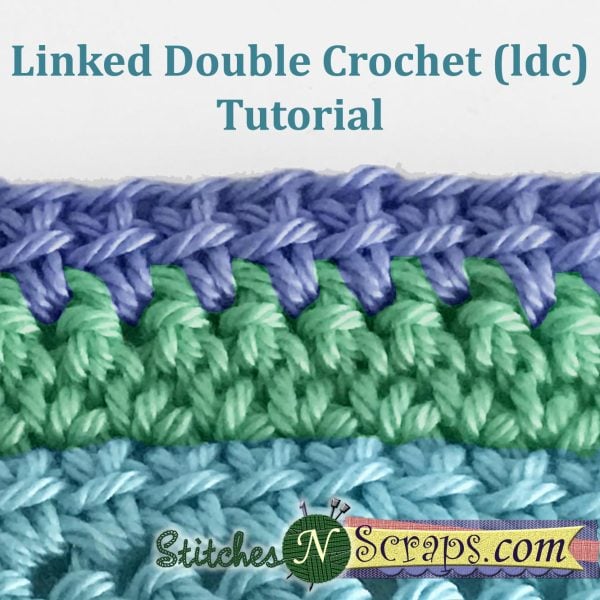
Double crochets are fast and easy, but for some applications they are too loose and leave unwanted gaps. Linked double crochet (ldc) stitches close those gaps by linking the stitches together in the middle. This creates a firmer, denser fabric that’s not quite as stiff or thick as single crochet. I love ldc for borders on lacier items. It can add shape and structure to an otherwise floppy piece, while at the same time creating a decorative edge. It’s also great for things like pockets where you still want a little drape, but want to limit gaps.

This post contains affiliate advertisements (click for more info). If you click one of these links and then make a purchase, I may be compensated. You get the same great prices, and you will be helping to support this site!

Linked Double Crochet (ldc) Photo Tutorial

(scroll down for video tutorial)

The first 2 stitches

A normal double crochet stitch has a diagonal bar that goes across the middle. For linked double crochet, we’re going to connect each stitch to the the middle bar of the previous stitch. This pulls that diagonal bar down a bit, so it lies horizontally. To start an ldc row, ch 3 and turn. This chain 3 counts as the first stitch.

chain 3 - linked dc tutorial on StitchesNScraps

Now normally, to start the next stitch we would do a yarn over, but we want to link this next stitch to the chain. So instead of the yarn over, insert your hook into the 2nd chain and draw up a loop. I like to work into the back bump of the chain, because I think that looks nicest. Now we are connected to the middle of the chain.

pull up loop in 2nd ch - Linked dc tutorial on StitchesNScraps

Insert the hook into the next stitch and draw up a loop, and now you have 3 loops on your hook just like for a normal dc. The only difference is that instead of the yarn over, we have a connecting loop.

pull up loop in next st - Linked dc tutorial on StitchesNScraps

Finish the dc stitch as normal – (yarn over and draw through 2 loops) twice. You can see that the finished stitch has a diagonal bar, just like a normal dc. I’ve highlighted it here in orange.

second stitch - Linked dc tutorial on StitchesNScraps


Affiliate Advertisement

[the_ad_group id=”1380″]


Continuing the row

For the next stitch, we’re going to connect to that bar by inserting our hook into it and drawing up a loop. Again, this replaces the yarn over that we would normally do.

draw up loop in middle bar - Linked dc tutorial on StitchesNScraps

Now draw up a loop in the next stitch, and finish the dc as normal.

draw up loop in next st 2 - Linked dc tutorial on StitchesNScraps

After a few stitches, you will notice that the connected bars form a horizontal line across the middle of the row. The wrong side of the work looks completely different, with a slight pucker across the middle. Working back and forth in rows creates a fun striped effect.

right and wrong side rows - Linked dc tutorial on StitchesNScraps

Linked double crochet can be worked flat or in the round. You do need to be careful with gauge though, as it tends to pull the stitches in and make the row just a little bit narrower. If this becomes a problem, try working the ldc stitches with a slightly larger hook.

Linked Double Crochet (ldc) Video Tutorial:

(back to top)


Puff Stitch tutorial on StitchesNScraps.com

Tutorial – Puff Stitches

Puff stitches, to me, are the definition of soft and squishy. They’re formed basically by gathering a bunch of loops up into one clump. These are not the same as clusters and bobbles. I plan to have tutorials for those available soon too.

Puff Stitch Photo Tutorial

(scroll down for video tutorial)

To make a puff stitch, you start by drawing up a bunch of loops in the same stitch or chain. If you’re working a pattern, it should specify how many loops. The more loops you draw up, the puffier your puff will be. Let’s look at a puff with 13 loops.

Yarn over (yo), insert hook into specified stitch or space, and draw up a loop to the same height as your current row. Repeat this 5 more times in the same stitch or space, for a total of 13 loops. Yo and draw through all 13 loops. Some people will stop here, but I always like to finish with a slip stitch to close.

Puff Stitch - Diagonal Puff Stitch Tutorial on StitchesNScraps.com

 Your pattern should specify whether or not to add the slip stitch at the end. If it doesn’t say to do it, don’t do it (unless you intentionally want to modify the pattern).

Puff Stitch “Beads”:

Recently, I’ve been infatuated with making puffs into chains instead of stitches. When you make a puff into a chain, it looks a little bit like a bead. Plus, the leading chains help you position it wherever you want, even sideways! Let’s do this with a 7 loop puff.

Start with a ch 3. The chain furthest from our hook (green, in the picture below) is just going to be a chain space leading up to the puff. The 2nd chain from the hook (red) is going to be the base of the puff – this is the one we’re going to work into. The chain closest to our hook (blue) helps set the height of the puff and gives us a little wiggle room with our hook. We’re going to work our puff into the 2nd ch from the hook. I like to work into the back bump of the chain, but you can work into the chain any way you normally do.

3 chains - Puff stitch tutorial on StitchesNScraps.com

Now work the puff up to 7 loops, this means (yo, insert hook in specified ch, draw up a loop) 3 times. Be sure to pull all your loops up to the same height. Then yo and pull through all 7 loops, and chain to close.

Puff stitch tutorial on StitchesNScraps.com


Chain one more (as a spacer), skip a few stitches (I skipped 5 here) and continue across the row. The puff stitch “bead” should turn and lie sideways. I did my row in dc stitches, which left plenty of space for the puff stitch. You can do it with smaller or taller stitches though too, for different looks.

Puff stitch "bead" - StitchesNScraps.com

I love the versatility of puff stitches, and recently have been using them a lot. You’ll find them in my Storm Clouds pillow, Jelly Beads, and Dew Drop Necklace, plus I’m incorporating them in a new project coming out soon!


Video Tutorial:

(back to top)


Basic Bruges Lace tutorial on StitchesNScraps.com

Tutorial – Introduction to Bruges Lace

Welcome to the New Year, New Technique CAL! For this event we will be exploring new crochet techniques each week, with free patterns to practice on. Learn more in the main CAL post, and join in the fun on the CAL Central Crochet Facebook group!

New Year, New Skill CALThis week’s technique is Bruges lace, and one of the patterns is my Bruges Lace Napkin Ring. If you’ve never done Bruges lace before, this pattern is a wonderful introduction.

Bruges Lace Napkin Ring

Photo Tutorial:

(scroll down for video tutorial)

Making the tape

At its most basic, Bruges lace is a “tape” or column of simple stitches, with chain loops sticking out at the start of each row. Here you can see a straight tape where each row is ch 5 to form the loop, and then 3 dc.

Straight tape - Basic Bruges Lace tutorial on StitchesNScraps.com

As you turn your work back and forth for each row, the loops will alternate on either side of the tape. By adjusting the stitches used, and joining the loops together, you can create lace that curves and twists to make various shapes.

Affiliate Advertisement

[the_ad_group id=”1362″]

Making curves

To make the tape curve, use smaller stitches at one end and larger stitches at the other. The tape will curve in the direction of the smaller stitches. Here you see the rows are sc on the inside edge of the curve, hdc for the middle stitch, and dc on the outside edge. Each row still has a loop at the beginning. These loops are joined together in the middle on the inside of the curve.

Making a curve - Basic Bruges Lace tutorial on StitchesNScraps.com

Joining loops

After the curve, the tape is worked straight again, down the other side. The loops on the inside are joined together as well, creating the lattice like look. To make a joining loop, do not ch 5, instead ch 2, sl st in the loop you want to join to, and ch 2 again.  The slip stitch counts as the 3rd ch of the loop, so instead of a ch 5 loop you have a (ch 2, sl st, ch 2) loop.

Joined loops - Basic Bruges Lace tutorial on StitchesNScraps.com

You now know everything you need to make these napkin rings. Once you get the hang of it, they only take a few minutes to make. Go ahead and make yourself a whole set!

Affiliate Advertisement

[the_ad_group id=”1380″]

These are just the basics of Bruges lace, and there are more advanced things you can do with it. Here are a few example swatches from a class I took – I never did quite finish the inside of the heart:


Bruges Lace swatches - StitchesNScraps.com

Video Tutorial:

(back to top)


Split / Center Stitches tutorial on StitchesNScraps.com

Tutorial – Split / Center Stitches in the Round

Split or center stitches are just like normal stitches except for where you place your hook. It’s much easier to work split stitches from the right side than from the wrong side, so they’re particularly great for working in the round without turning your work. Normal stitches are staggered between the stitches from previous rounds. As we’ve discussed before, this can cause the rounds to shift. Split stitches, on the other hand, line up directly above the stitches below them, so there’s no shifting!

Split / Center Stitches tutorial on StitchesNScraps.com

This post contains affiliate links (click for more info). If you click one of these links and then make a purchase, I may be compensated. You get the same great prices, and you will be helping to support this site!

Split / Center Stitches – Photo Tutorial:

(scroll down for video tutorial)

The basics:

Almost every crochet stitch has a V shape at the top (shown here in blue). As we discussed when we talked about changing colors, this V is formed by the loop that was already on the hook before you started the stitch. for normal stitches, we insert our hook just under this V.

normal stitch placement - split stitch tutorial on SitthcesNScraps.com

If you look at the post of a crochet stitch, you will see at least one more V. This is true whether it’s a single crochet or taller stitches. For split or center stitches, we’re going to insert our hook into this V at the top of the post.

center of stitch - split stitch tutorial - StitchesNScraps.com

Split stitches are worked exactly like normal stitches, except for where you place your hook. So really it’s not so much about what stitch you are making, but rather about what stitch you are working into. Here’s what it looks like to work into the different kinds of stitches.

Working into an sc

The sc is the smallest of the stitches and the entire post is just the one V, so it’s pretty easy to see. So for a split stitch, insert your hook in the center of that V to pull up your loop, and then finish your stitch as normal. Here I have worked a split dc into the sc.

working into sc - Split / Center Stitches tutorial on StitchesNScraps.comI’ve used a dc stitch here because it’s easier to see. If you work only split sc stitches for several rounds instead, it will look almost identical to knitting!

Affiliate Advertisement

[the_ad_group id=”1380″]

Working into a dc or taller stitches

From a dc on up, you will find this same V at the top of the post. It’s a little harder to see this one because it twists a bit instead of lying straight. The picture above labelled “center of stitch” shows this on a dc stitch. All the tall stitches will look the same at the top, so just ignore the bottom of the post and focus on that V at the top. Here’s a split dc stitch, worked into a treble crochet from the round below.

working into tall sts - Split / Center Stitches tutorial on StitchesNScraps.com

Working into an hdc

Hdcs are a little trickier, because the yarn over creates a horizontal bar across the stitch. When working into an hdc, you could just ignore that bar and work into the center of the stitch like this:

working into an hdc - Split / Center Stitches tutorial on StitchesNScraps.com

The other option is to work through both that horizontal bar and the center of the stitch, like this:

working into an hdc - Split / Center Stitches tutorial on StitchesNScraps.com

Either way is ok, but both give the stitch a slightly different look. In the first case, the horizontal bar is more hidden. I don’t like this as much because it looks almost the same as working into an sc. In the 2nd case, the horizontal bar still shows across the stitch, so I tend to prefer that method.

Affiliate Advertisement

[the_ad_group id=”1362″]

Working into a decrease or cluster stitch

A decrease or cluster combines several partial stitches into one. The key is to find that topmost loop of each partial stitch, and work through all of them together. So for example, let’s work into this dc2tog. Here you can see the topmost V from the 1st stitch (highlighted in red), and from the 2nd stitch (highlighted in blue), so you want to put your hook into both of those highlighted loops.

Working into a decrease - Split / Center Stitches tutorial on stitchesnscraps.com

Here’s a split dc being worked into a dc2tog.

Working into a decrease - Split / Center Stitches tutorialA cluster is similar, it just has more loops on the top. This 5 dc cluster has 5 loops:

top loops of a cluster - Split / Center Stitches tutorial on StitchesNScraps.com

So to work a dc into this cluster, we just have to go into all 5 loops:

working into a cluster - Split / Center Stitches tutorial on StitchesNScraps.com

Just because you CAN work a split stitch into a cluster doesn’t mean I necessarily would. The top of a cluster is already pretty centered, so just working the stitch normally has a similar effect. The only thing working a center stitch does is twist the loops forward a little, and make the stitch you’re making a little bit shorter.

Split / Center Stitches – Video Tutorial:

(back to top)

If you’ve enjoyed these split/center stitches, I’ll have a pattern coming out soon that uses them!  Look for that later this month.

Herringbone Half Double Crochet Decrease tutorial on StitchesNScraps.com

Tutorial – Herringbone Half-Double Crochet Decrease

Earlier, I showed you how to do the herringbone half-double crochet stitch (hhdc). If you’re not familiar with the hhdc stitch, please take a look at that tutorial first. Now let’s look at how to decrease (and increase too) in hhdc.

Herringbone Half Double Crochet Decrease tutorial on StitchesNScraps.com

Herringbone Half-Double Crochet Decrease (and Increase) – Photo Tutorial:

(scroll down for video tutorial)

Hhdc increase:

Increasing in hhdc is so easy, it really doesn’t need it’s own tutorial. Just make 2 hhdc stitches in the same stitch.

Hhdc decrease:

Decreasing in hhdc is much like decreasing in double crochet. You work the first stitch halfway, then work the 2nd stitch halfway, and then finish both stitches off together.  Start the same way you would for a normal hhdc stitch: Yarn over insert hook in next stitch, pull up a loop, pull that loop (shown in red) through the yarn over (shown in blue).

pull through yo - Herringbone Half Double Crochet (hhdc) tutorial on StitchesNScraps.comNow do the exact same thing in the next stitch. Here you can see we have the first half of 2 separate stitches

Herringbone Half Double Crochet Decrease tutorial on StitchesNScraps.comTo finish both stitches off together (creating the decrease), yarn over and pull through all three loops on the hook.

completed decrease - Herringbone Half Double Crochet Decrease tutorial on StitchesNScraps.com

Herringbone Half Double Crochet Decrease – Video Tutorial:

(back to top)


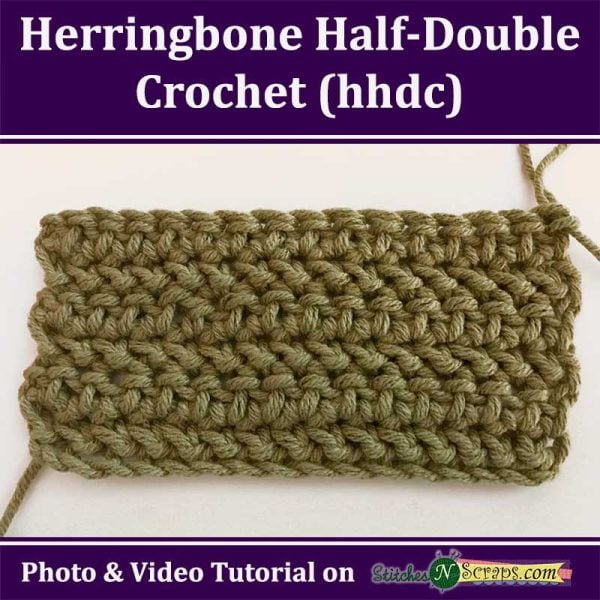
Herringbone Half Double Crochet (hhdc) tutorial on StitchesNScraps.com

Tutorial – Herringbone Half-Double Crochet (hhdc)

The herringbone half-double crochet stitch creates a lovely, reversible texture, with stitches leaning to the left on one row and the right on the next row. It sounds much more complicated than it is. It’s really just a slight variation on the half-double crochet.

Herringbone Half Double Crochet (hhdc) tutorial on StitchesNScraps.com

Herringbone Half-Double Crochet (hhdc) – Photo Tutorial:

(scroll down for video tutorial)

Half Double Crochet (hdc)

Let’s first look, in detail, at how a normal half double crochet works. As you know, you start with a yarn over, then insert your hook in the next stitch, yarn over and pull up a loop. In the picture below, the purple loop is the one that was already on the hook, the blue loop is the yarn over, and the red loop is the one that was pulled up.

3 loops - Herringbone Half Double Crochet (hhdc) tutorial on StitchesNScraps.comTo finish the hdc, you yarn over and pull through all 3 loops on the hook. Note the position of the yarn over (shown in blue).

normal hdc - Herringbone Half Double Crochet (hhdc) tutorial on StitchesNScraps.com

Herringbone half-double crochet (hhdc)

For the herringbone variation, we’re going to move that yarn over, so it lays down flat. We start exactly the same way as for an hdc: Yarn over, insert hook in next stitch, pull up a loop. Now there’s the difference – take that loop you pulled up (shown in red), and pull it through the yarn over (shown in blue).

pull through yo - Herringbone Half Double Crochet (hhdc) tutorial on StitchesNScraps.comNow you can see the yarn over is laying flat at the bottom of the stitch, and we have only 2 loops left on the hook. To finish the stitch, yarn over and pull through both loops.

Herringbone Half Double Crochet (hhdc) tutorial on StitchesNScraps.comMoving that yarn over creates a little more bulk at the bottom of the stitch, and less on top. This gives hhdc a little bit more drape than a normal hdc. It also makes the top of the stitch appear to be leaning to the left. Since you turn your work with every row, each row will alternate the direction that it leans. This is what creates the reversible herringbone effect.

angled stitches - Herringbone Half Double Crochet (hhdc) tutorial on StitchesNScraps.com

Changing Colors – Video Tutorial:

(back to top)


Changing Colors Tutorial on StitchesNScraps.com

Tutorial – Changing Colors

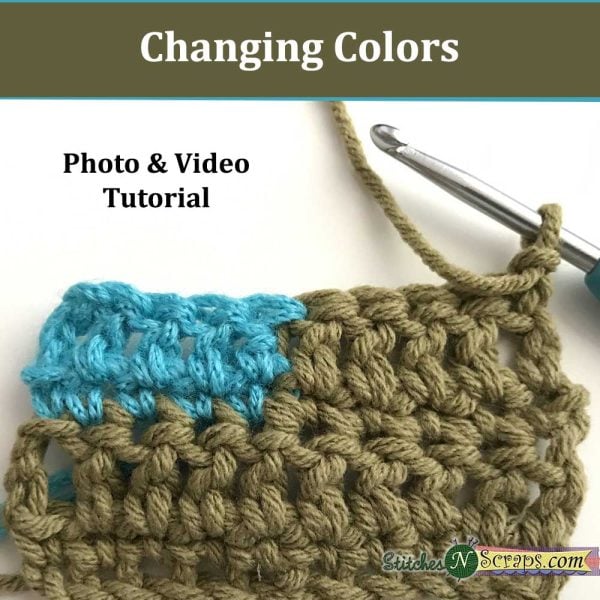
When changing colors, the goal is (usually) to get a nice, clean edge between your color sections. You don’t want to end up with any part of the first color showing in the stitches of the 2nd color.

Changing Colors Tutorial on StitchesNScraps.com

Changing Colors – Photo Tutorial:

(scroll down for video tutorial)

Here I have a row with a few single crochet, and I’m going to change from green to blue. Take a look at the green working loop that comes out of the last stitch. That loop is going to become the top of the next stitch.

ready to add new color - Changing Colors Tutorial on StitchesNScraps.com

If we just start the next stitch with blue, we would end up with the bottom of the stitch being blue and the top of the stitch being green. That’s not what we want.

Green on top - Changing Colors Tutorial on StitchesNScraps.com

In order to make that top loop blue, we need to change to blue in the last part of the previous stitch. So let’s rip out this last green stitch and do it again. We start the stitch just like a normal single crochet by pulling up a loop. Now we have 2 loops on the hook.

2 loops on hook - Changing Colors Tutorial on StitchesNScraps.com

Instead of pulling through them with green, let’s use blue. This leaves us with our last green stitch completed, and a blue loop on the hook.

changed to blue in sc - Changing Colors Tutorial on StitchesNScraps.com

Now when we work the next stitch in blue, you can see the top and bottom of the stitch are both blue. This gives us a much cleaner transition between the colors.

first blue sc - Changing Colors Tutorial on StitchesNScraps.com

The same technique works for double crochet (or any other crochet stitch). Whatever stitch you’re working, use the new color to complete the very last part of the stitch.

Color change in dc - Changing Colors Tutorial on StitchesNScraps.com

This is in the middle of the row, but the same thing can be done at the end of a row. Change colors in the last stitch of the current row – that way your starting chain will be the right color.

changed to blue at end of row - Changing Colors Tutorial on StitchesNScraps.com

If you’re working an hdc, there will be 3 loops on the hook when you change colors. With a fancier stitch like a cluster or popcorn, there may be more. The key is to make the color change in the very last step of the stitch. When working in the round and joining each round, I usually change colors in the slip stitch that joins the round.


Changing Colors – Video Tutorial:

(back to top)