Free Knitting Patterns

Find the perfect, free knitting pattern for your next project! Browse them all, or select a category from the dropdown menu. Where will your creativity take you today?


Cotton Candy Stripes Scarf crochet pattern
Snuggle up in billowy, cotton candy stripes! This knit scarf pattern has a fun, seed stitch texture, works up fast, ...More
Halloween Ghost Ornament - Free knitting pattern on Stitches n Scraps
Hang this adorable Halloween ghost ornament anywhere you need a little more holiday spirit! With a pretty beaded edge, they're ...More
Date Night Clutch - Free knitting pattern on Stitches n Scraps
It's time to sparkle! Bring a dramatic flair to your next night out with the Date Night Clutch. This easy, ...More
Mosaic Sampler Blanket - Free pattern on Stitches n Scraps
Soft, squishy garter stitch in striking geometric patterns - what's not to love? The mosaic sampler blanket looks complex, but ...More
Dorothy's Square knitting pattern
Delicate diamonds flow into a ring of eyelets, wrapped in a cabled border. Dorothy's Square is a soothing mix of ...More
Swirling Snowflakes Knit Beanie Pattern on Stitches n Scraps
Spiraling winds set snowflakes in motion, swirling around a deep blue, winter sky. Stay warm through the wintry weather with ...More
Simply Sweet Raglan Knit Baby Sweater
Simple, snuggly, and oh so cute! The Simply Sweet knit baby sweater is fast and easy to knit. It makes ...More
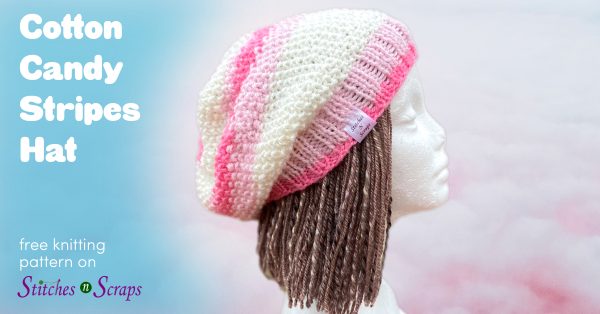
Cotton Candy Stripes Knit Hat Pattern
What could be sweeter than simple stripes in soft, pastel, cotton candy colors? This knit hat pattern has a fun, ...More
Hand in Hand Reversible Knit Fingerless Mitts
Mix them or match them, your hands will be toasty warm either way! These knit, reversible fingerless mitts have 2 ...More
Happy Harvest Headband - an easy knit headband pattern on Stitches n Scraps
It's that time of year again! Pumpkins are everywhere, apples are almost at their peak season, and even some of ...More
Cotton Candy Stripes Scarf crochet pattern

Knit Scarf Pattern – Cotton Candy Stripes

Snuggle up in billowy, cotton candy stripes! This knit scarf pattern has a fun, seed stitch texture, works up fast, and is a great choice for beginners!

Cotton Candy Stripes Scarf crochet pattern

This content is protected by copyright. See this Terms of Use / Copyright page for more information.

This post contains sponsored content and/or affiliate links. If you click an affiliate link and make a purchase, I may get a commission.

Make the Hat Too!

This was a custom order from an old work friend. A couple of years ago he asked me to make a hat to match a pair of mittens for his wife. Working from some old photos, I made the Cotton Candy Stripes Hat.

Cotton Candy Stripes Knit Hat Pattern

She loved it so much that he asked me to make this matching scarf as well. Make both for a cozy winter set!


Cotton Candy Stripes Scarf

4-medium
Project-Level-Basic - Craft Yarn Council Standards

Add this to your Ravelry queue

Materials

  • Yarn: Paintbox Simply Aran yarn (Worsted weight, 100% acrylic)
    • 250 yds #202 Champagne White (off-white)
    • 125 yds #250 Bubblegum Pink (pink)
    • 150 yds #249 Candyfloss Pink (lt pink)
  • Needles: Size 9 / 5.5 mm knitting needles
  • Notions:
    • Yarn Needle
    • 5 to 8 mm crochet hook for fringe

Project Level

Basic: Knit and purl stitches, fringe.

Size

9 x 64 inches without fringe, 9 x 70 inches with 3 inches of fringe on each side.

Gauge

14.5 sts x 28.5 rows = 4 inches in seed stitch pattern. Use pattern as gauge swatch – after row 15, work should measure about 9 inches x 2 inches.

Exact gauge isn’t critical, but will affect yarn usage.

Abbreviations used

k = knit
p = purl
st(s) = stitch(es)

Instructions

The striping pattern is mirrored on either side of the middle off-white section. The stitches on every row are the same, the only thing that changes is the color you’re using.

For best results, do not carry unused colors. Cut the yarn at each color change, leaving a tail to weave in later. It’s a lot of tails, but worth it to keep the edges neat.

With pink, cast on 33 stitches. I used a seed stitch cast on, but you can use any simple cast on that you prefer.

Scarf

First side

Row 1: With pink, k1, (p1, k1) across. (1 row pink)

Rows 2-10: With lt pink, k1, (p1, k1) across. (9 rows lt pink)

Rows 11-31: With off-white, k1, (p1, k1) across. (21 rows off-white)

Rows 32-39: With lt pink, k1, (p1, k1) across. (8 rows lt pink)

Rows 40-44: With pink, k1, (p1, k1) across. (5 rows pink)

Rows 45-47: With lt pink, k1, (p1, k1) across. (3 rows lt pink)

Rows 48-60: With off-white, k1, (p1, k1) across. (13 rows off-white)

Rows 61-71: With pink, k1, (p1, k1) across. (11 rows pink)

Rows 72-80: With lt pink, k1, (p1, k1) across. (9 rows lt pink)

Rows 81-220: Repeat rows 11-80 twice more.

Middle:

Rows 221-241: With off-white, k1, (p1, k1) across. (21 rows off-white)

Cotton candy stripes scarf spread out on a table.

Opposite side

Rows 242-250: With lt pink, k1, (p1, k1) across. (9 rows lt pink)

Rows 251-261: With pink, k1, (p1, k1) across. (11 rows pink)

Rows 262-274: With off-white, k1, (p1, k1) across. (13 rows off-white)

Rows 275-277: With lt pink, k1, (p1, k1) across. (3 rows lt pink)

Rows 278-282: With pink, k1, (p1, k1) across. (5 rows pink)

Rows 283-290: With lt pink, k1, (p1, k1) across. (8 rows lt pink)

Rows 291-311: With off-white, k1, (p1, k1) across. (21 rows off-white)

Rows 312-320: With lt pink, k1, (p1, k1) across. (9 rows lt pink)

Rows 321-460: Repeat rows 11-80 twice more.

Row 461: With pink, k1, (p1, k1) across.

Bind off with pink. I bound off in pattern, but any basic bind off will work.

Finishing

Wash your scarf and lay it flat to dry, pinning it into shape as needed.

Cotton Candy Stripes Scarf laid flat on blocking boards

Weave in all ends

Fringe:

Check out this great fringe tutorial from Very Pink Knits!

Cut 51 strands of pink at least 10 inches long. The easiest way to do this is wrap the yarn 51 times around an object that’s about 5 inches wide, and then cut through all the wraps on one side.

Place the scarf right side up, and start placing the fringe (as follows) in the first stitch along one short edge.

For each fringe bundle:

  • Hold 3 strands together and fold them in half to form a loop.
  • Insert your crochet hook from back to front through the stitch where you want the fringe, grab the folded loop, and pull it through about 1/3 of the way. You should now have a loop sticking out of the bottom of the fabric, and 6 tails sticking out of the top.
  • Using your crochet hook, pull all the tails down through the loop. Pull on the tails to tighten. Try to get the ends fairly even so that none are too short when you trim them.

(Skip the next stitch and place another fringe bundle in the next stitch) across to the end. You should have 17 fringe bundles along the edge.

Cotton Candy Stripes Scarf rolled up and showing the fringe

Trim the fringe to 3 inches or desired length. The easiest way to do this is to lay the fringe out flat along a cutting surface and use a straight edge and rotary cutter to cut across it evenly.

Repeat for the other short edge of the scarf.

Cotton Candy Stripes Scarf crochet pattern

Rate this Knit Scarf Pattern!


I hope you enjoyed this knit hat pattern. A downloadable pdf of this pattern is available on Ravelry for a small fee. The fee for the pdf format is to offset the advertising revenue lost when you print or download the pattern rather than viewing it online.

Do you want the best of Stitches n Scraps delivered right to your inbox? Don’t miss a stitch – Subscribe now!

Halloween Ghost Ornament - Free knitting pattern on Stitches n Scraps

Halloween Ghost Ornament Knitting Pattern

Hang this adorable Halloween ghost ornament anywhere you need a little more holiday spirit! With a pretty beaded edge, they’re perfect for curtain ties, wreaths, garlands, and more.

Halloween Ghost Ornament - Free knitting pattern on Stitches n Scraps

This content is protected by copyright. See this Terms of Use / Copyright page for more information.

This post contains sponsored content and/or affiliate links. If you click an affiliate link and make a purchase, I may get a commission.

Potomac Czech Glass O Beads

Color

Potomac Beads recently let me choose a selection of free beads to use for some designs. For this pattern, I chose Czech glass O beads, 2 x 4mm, in the color “Jet Purple Iris Gold”. The product number is 76819.

Potomac O Beads tube - 1640 Purple Iris Gold

I chose this color because it has an overall copper feel, which is perfect for fall, but with twinkles of golds, purples, and greens mixed in. They’re even more vibrant in person, and feel slightly iridescent when they catch the light.

Shape and hole size

The beads themselves are similar to seed beads, but with half the thickness. The best way to describe them is like tiny, shiny, donuts, with nice big holes in the middle. I love the way they nestle between the stitches on the bind off edge.

beaded bind off

For this project, my yarn was on the thinner end of the medium (#4 – worsted/aran weight) spectrum. I tested the beads with a thicker, aran weight yarn as well and was able to get them on without too much trouble. I wouldn’t recommend using them on anything thicker than that though.

All the other beads Potomac sent me are really beautiful as well, and you’ll be seeing them in projects soon!

Beading with Floss Threaders

For this pattern, you will be adding the beads one at a time while knitting, rather than stringing them on the yarn ahead of time. Typically, this is done by pulling the stitch through the bead with a crochet hook. Check out this knitting with beads tutorial for a closer look.

Knitting with Beads Tutorial on Stitches 'N' Scraps

With larger yarns, the hook that’s small enough to go through the bead is often too small to easily grasp the yarn. This is particularly true with slippery or splitty yarns. So I prefer to use a floss threader instead! Floss threaders are meant for threading floss through dental work, but they make excellent and versatile beading needles too. We explored beading with floss threaders in Lunchtime Live episode 58.

Lunchtime Live Episode 58 - Floss threader beading needle

Materials

  • Yarn: 55 yds worsted weight yarn
  • Needles: Size 4 / 3.5 mm needles or size needed to match gauge, for knitting in the round. Use a set of double pointed needles, or a circular needle long enough for the magic loop method.
  • Notions:

Project Level

Intermediate: Kfb and yo increases, k2tog decreases, beaded bind off.

Size

About 5 inches tall, not counting hanging loop.

Gauge

25 sts x 36 rnds = 4 inches in stockinette

Exact gauge isn’t critical but will affect the yardage needed. Stitches should be tight enough so that stuffing doesn’t show.

Abbreviations used

k = knit
k2tog = knit 2 together
kfb = knit front and back
p = purl
pm = place marker
rnd = round
sm = slip marker
st(s) = stich(es)
yo = yarn over

Instructions

Head

Cast on 8 sts, leaving an 18-inch starting tail.

Any lower profile cast on will work – I used a long tail cast on for mine.

Distribute stitches evenly on double-pointed needles or magic loop, to knit in the round.

Rnd 1: Kfb around (16 sts)

All even rnds in head: K around

Rnd 3: [K1, kfb] around. (24 sts)

Rnd 5: [K2, kfb] around. (32 sts)

Rnd 7: [K3, kfb] around. (40 sts)

Use starting tail to sew top of head closed. Weave tail in enough to secure but do not cut it. Leave it on the right side of the work, sticking out the top of the head.

The pictures show the tail on the wrong side of the work, but it should actually be on the right side

Close top of head

Rnds 8-12: K around.

Rnd 13: [K3, k2tog] around. (32 sts)

Rnd 15: [K2, k2tog] around. (24 sts)

Rnd 17: [K1, k2tog] around. (16 sts)

Rnd 19: K2tog around. (8 sts)

Rnd 20: K around.

Head of Halloween Ghost Ornament

Body

Rnd 21: Kfb around. (16 sts)

Rnd 22: K around.

Rnd 23: [K1, yo, k2, yo, k1, pm] 4 times. (24 sts, 4 markers)

Use a unique marker for the end of the round. If a marker placement would fall at the end of one of your needles or at your magic loop, you can skip placing the marker, and instead count the end of the needle or magic loop as a marker.

I did this for the first few rounds, and then added the other 2 markers when it got bigger.

imaginary markers at ends of magic loop

Rnd 24: K around, slipping markers as you come to them.

Rnd 25: [K1, yo, k to 1 st before marker, yo, k1, sm] 4 times. (32 sts)

Rnds 26-47: Repeat rnds 24-25 16 times. (120 sts)

Rnd 48: K around, slipping markers as you come to them.

head and body

Edging

Rnd 49: P around, removing markers as you come to them.

Rnd 50: (Yo, k2tog) around.

Rnd 51: P around.

Beaded Bind Off

Knit first stitch.

*Remove the new stitch from your needle and use a crochet hook or floss threader to pull the loop through a bead.

Pull loop through bead

K1, then pass the beaded stitch over the stitch you just knit.

pass previous stitch over

Repeat from * until all stitches are bound off.

Cut yarn and fasten off.

To close the gap at the end of the round, place a bead on the tail and then sew the tail into the first stitch of the round.

Sew in last bead

Weave in the end.

Finishing

Stuff Head

With starting tail on the outside (top) of the head, stuff head firmly with poly fil.

Sew starting tail down through the head and out through the opening

Bring tail out through bottom of head

Use this tail to sew the bottom of the head closed.

Weave in all ends.

Hanging Loop

Cut a 12-inch length of yarn, fold it in half to form a loop and tie a knot about 1.5 inches from the fold.

Make a loop and tie a knot.

Weave each tail separately into the top of the head to secure the loop to the ghost.

Alternately, you can use a piece of ribbon, wire, or clear fishing line to create a hanging loop.

Wash and hang to dry/block.

Halloween Ghost Ornament - Free knitting pattern on Stitches n Scraps

I hope you enjoyed this Halloween ghost ornament pattern. A downloadable pdf of this pattern is available on Ravelry for a small fee. The fee for the pdf format is to offset the advertising revenue lost when you print or download the pattern rather than viewing it online.

Do you want the best of Stitches n Scraps delivered right to your inbox? The Stitches n Scraps email newsletter includes highlights from the blog as well as special features not available elsewhere. Don’t miss a stitch – Subscribe now!

Date Night Clutch - Free knitting pattern on Stitches n Scraps

Easy Knit Purse Pattern – Date Night Clutch

It’s time to sparkle! Bring a dramatic flair to your next night out with the Date Night Clutch. This easy, knit purse pattern has a lovely seed stitch texture that lets the sparkly yarn shine. Try it with the optional felt lining!

Date Night Clutch - Easy knit purse pattern on Stitches n Scraps

This content is protected by copyright. See this Terms of Use / Copyright page for more information.

This post contains sponsored content and/or affiliate links. If you click an affiliate link and make a purchase, I may get a commission.

Christmas in July Make Along

This pattern is my first contribution to this year’s Christmas in July Make Along, hosted by Underground Crafter. I’ll have another pattern in the event a bit later in the month. Be sure to check out all the great patterns, and enter to win the giveaway too!

2021 Christmas in July Make Along with Underground Crafter

Lion Brand Date Nights Yarn

Lion Brand sent me this stunning yarn earlier this year, as a free sample to play with. The chainette construction makes it feel soft and silky, with the perfect drape for all sorts of accessories. Theres just enough sparkle to make it stand out, without making the fabric itchy.

Lion Brand Date Nights Yarn

I enjoyed this yarn so much I want to share it with all of you. So Lion Brand is providing 3 skeins of it as the 3rd quarter giveaway prize in the 2021 Fridgies Crochet Along! See all the details and enter the giveaway in the main CAL post.

Alternating Cable Cast On

For this pattern, you will cast on twice. First, there’s the initial cast on to start the flap. After finishing the flap, you will cast on additional stitches and begin to work in the round for the bag section.

You can use your preferred cast on method for both of these cast ons, but I recommend using the Aternating Cable / Seed Stitch cast on method. This gives a really pretty, seamless look to seed stitch patterns. See my full Seed Stitch Cast On Tutorial here.

Alternating Cable (Seed Stitch) Cast on Tutorial on Stitches n Scraps

3 Needle Bind Off

The pattern starts at the flap, and ends at the bottom of the bag. We finish by closing the bag with a 3 needle bind off. This bind off works the front and back layers together, while binding off the stitches. Learn how in this 3-needle bind off tutorial.

How to Knit the 3 Needle Bind Off - Tutorial on Stitches n Scraps

If you prefer not to use this bind off, there are a couple of other options. One option is to graft the live stitches together with kitchener stitch. Another option is to bind off all the stitches with your choice of bind off, and then sew the bottom closed.


Date Night Clutch

4-medium
Project Level Easy

Add this to your Ravelry queue

Materials

  • Yarn: 175 yds Lion Brand Date Nights Yarn (Worsted weight, 82% acrylic / 18% polyester). Shown in color #311 Topaz.
  • Needles:
    • Size 6 / 4 mm circular knitting needles or size needed to match gauge, with 16-18″ cord length.
    • 3rd needle for bind off – can be same size or one size larger. (see notes below)
  • Notions:
    • Yarn Needle
    • Stitch marker
    • 1 inch button
  • Optional Lining:
    • 9 x 12 sheet of felt
    • Sewing thread that matches the felt lining
    • Sewing thread that matches the yarn clutch
    • A pen or pencil that works on your felt
    • Sewing needle

The extra bind off needle just needs to hold 2 stitches at a time, so any type of needle will do. If you tend to bind off tightly, use one size larger than your main needles.

Project Level

Easy: Alternating cable cast on, seed stitch in rows and rounds, a few increases and decreases, buttonhole, 3 needle bind off.

Size

Approximately 4.5 x 8.5 inches.

Gauge

16 sts x 37 rows = 4 inches in seed stitch. Use pattern as gauge swatch – Flap should measure 2.5 x 8.5 inches.

Abbreviations used

k = knit
k2tog = knit 2 together
kfb = knit front and back
p = purl
RS = right side
st(s) = stitch(es)
WS = wrong side
yo = yarn over

Instructions

Chart shows flap and bag, up to the bind off. Scroll down for written instructions

Flap

Cast on 25 sts with the alternating cable / seed stitch cast on.

Row 1 (RS): Kfb twice, (k1, p1) across to last 3 sts, kfb twice, k1. (29 sts)

Row 2: (K1, p1) across to last st, k1.

Row 3: Repeat row 1 (33 sts)

Rows 4-6: Repeat row 2

Row 7: Kfb twice, (k1, p1) 6 times, k1, k2tog, yo, k1, (k1, p1) 6 times, kfb twice, k1. (37 sts)

Rows 8-24: Repeat row 2

Work should now measure about 2.5 inches tall. It’s ok to work a few more or fewer repeats of row 2 to achieve the correct height if needed, just be sure to end after a wrong side row.

Flap measures 2 and a half inches

Bag

Continuing from flap

Rnd 1 (RS): (K1, p1) across to last st, k1, cast on 36 sts using a cable cast on, join to work in the round. (73 sts)

Place a marker to mark the first stitch of the round. Slip the marker whenever you come to it.

Rnd 2: (K1, p1) around to last st, k1.

Rnd 3: (P1, k1) around to last st, p1.

Rnds 4-43: Repeat rnds 2-3 20 times.

Bag section should now measure about 4.5 inches tall. It’s ok to work a few more or fewer repeats of rnds 2-3 to achieve the correct height if needed, just be sure to end after a repeat of rnd 3.

Bag measures 4 and a half inches

Rnd 44: K2tog, (k1, p1) around to last st, k1. (72 sts)

Remove the marker.

Bind Off:

Arrange your stitches so that the first 36 stitches of the round are on one needle, and the last 36 stitches are on the 2nd needle. This should put all the stitches that originally came from the flap (the back of the bag) on one needle. The stitches on the other needle should be the ones that you cast on later for the front.

Bind off using a 3 needle bind off to join the front and back layers together.

Three needle bind off

Sew button in place so that it fits through the buttonhole in the flap.

Finished knit clutch

Weave in all ends. Wash and block.

Lining (optional)

Make a pouch

Place the 9 x 12 felt sheet on a table with the right side up and the short edges at the top and bottom. Measure 4.5 inches from the bottom edge and fold the bottom up, creating a 4.5 inch overlap.

Fold lining up to create pouch

With the thread that matches the lining, sew the side edges together where they overlap, leaving about a 1/4 inch seam allowance on each side. This creates a pouch that should fit inside your clutch.

Sew side edges of pouch

I used a backstitch, but any flat stitch will do, this seam will not be seen. My seam allowance in this picture could have been just slightly bigger.

Shape the Flap

Trim the seam allowance if desired, then insert the felt pouch into your clutch, pressing it into the corners and making sure it is centered inside of the clutch.

Insert lining into clutch

Turn the clutch over and trace the edge of the flap onto the felt with your pen or pencil.

Trace flap onto felt

Fold the flap out of the way, and cut just inside the edge you traced. Make sure that no pen marks show and the felt rests just inside the edge of the flap.

Trim felt for flap

Attach Lining to Clutch

With a whipstitch, sew the felt to the clutch around the flap edge and around the front edge of the opening. The felt should rest just slightly below the knit edge, so that it doesn’t show when the flap is closed. On the flap, I added a backstitch underneath the whipstitch edge. It’s not necessary, I just liked how it looked.

backstitch under flap seam

Buttonhole

Place the flap knit side up, and sew a stitch into the lining to mark the center of the buttonhole.

Mark buttonhole

Flip the flap over and very carefully make a small snip in the lining where this stitch is. You can put your finger or another object through the buttonhole to push the lining away from the knit fabric so that you don’t accidentally cut your knitting.

Snip lining for buttonhole

Whipstitch the clutch and lining together around the edge of the buttonhole.

Sew around buttonhole

Your clutch is finished and ready for a night out!

Date Night Clutch - Easy knit purse pattern on Stitches n Scraps

I hope you enjoyed this Date Night clutch pattern. A downloadable pdf of this pattern is available on Ravelry for a small fee. The fee for the pdf format is to offset the advertising revenue lost when you print or download the pattern rather than viewing it online.

Do you want the best of Stitches n Scraps delivered right to your inbox? The Stitches n Scraps email newsletter includes highlights from the blog as well as special features not available elsewhere. Don’t miss a stitch – Subscribe now!

Mosaic Sampler Blanket - Free pattern on Stitches n Scraps

Mosaic Sampler Blanket Knitting Pattern

Soft, squishy garter stitch in striking geometric patterns – what’s not to love? The mosaic sampler blanket looks complex, but is actually easy! It uses the magic of slipped stitches to create intricate designs, with only one color on each row. This pattern comes in 3 sizes, and includes instructions to adjust to any other size you like!

Mosaic Sampler Blanket - Free pattern on Stitches n Scraps

This content is protected by copyright. See this Terms of Use / Copyright page for more information.

This post contains sponsored content and/or affiliate links. If you click an affiliate link and make a purchase, I may get a commission.

Mosaic Sampler Blanket Mystery Knit Along

I originally released this blanket pattern in 6 sections, as the Mosaic Sampler Blanket Mystery Knit Along. Check out the main KAL post to find all the section tutorials, and giveaway details too!

Mosaic Sampler Blanket MKAL on Stitches n Scraps

Lion Brand Basic Stitch Anti-Pilling Yarn

Lion Brand provided the Basic Stitch Anti-Pilling yarn for this design. I chose colors: #135 Adobe, #404 Silver Heather, #132 Olive, #158 Mustard, #109 Steel Blue, and #122 Hazelnut for my blanket. It’s a luxuriously soft yarn with a beautiful shine!

Enter the Giveaway

The giveaway for the KAL is open until November 21st, 2021. Enter for a chance to win 6 skeins of Lion Brand Basic Stitch Anti-Pilling yarn from Lion Brand! That’s enough to make the baby size blanket. Find all the details and the entry form in the main Mosaic Sampler Blanket MKAL post.

Basic Stitch Anti Pilling

Pattern repeats

For each of the 6 sections, the stitch patterns will work with a 12 stitch repeat. Some, like the first section, may be a 6 stitch repeat, or even a 4 stitch repeat, but all will work out evenly to multiples of 12. For the sake of consistency across all 6 sections, each chart will show 12 stitch repeats, even if it could be shown in 4 or 6 stitches.

Choose your size

I’ve included three sizes in the pattern, but you can easily make the blanket any size you want, and in any gauge! Your cast on determines the width. Cast on fewer stitches for a narrower piece, and more for a wider piece. As long as you cast on a multiple of 12 + 5, you can choose any width you like and the pattern will work as written.

The length is broken up into 6 sections. This means each section is 1/6 the length of the final piece. Decide what length you want, and work each section to 1/6 of the total length. Just remember that adjusting your size will affect your yarn usage. You may need more or fewer skeins of yarn if you make changes.


Mosaic Sampler Blanket

4-medium
Project Level Easy

Add this to your Ravelry queue

Materials

  • Yarn:Lion Brand Basic Stitch Anti-Pilling Yarn (Worsted weight, 100% acrylic), 1 [2, 3] skeins each of:
    • #135 Adobe (A)
    • #404 Silver Heather (B)
    • #132 Olive (C)
    • #158 Mustard (D)
    • #109 Steel Blue (E)
    • #122 Hazelnut (F)
  • Needles: Size 8 / 5 mm knitting needles or size needed to match gauge. Needle/cord length should be long enough to fit the entire width of your blanket.
  • Notions:
    • Yarn Needle
    • Stitch markers (optional, you can use these to mark each repeat if desired)

Project Level

Easy: All knits and slip stitches with only 1 color at a time.

Sizes

Baby [Lapghan, Afghan] (30 x 30 [36 x 48, 52 x 60] inches)

3 blanket sizes

Gauge

15 sts x 35 rows = 4 inches in garter stitch. Row gauge is not important for the pattern.

Abbreviations used

k = knit
sl = slip
st(s) = stitch(es)
RS = right side
WS = wrong side
wyib = with yarn in back
wyif = with yarn in front

Instructions

To adjust width, cast on more or fewer stitches in groups of 12.

I have written each row out for clarity, but all WS rows follow the same rules:

Continuing with the same color as the previous row, k all stitches that were knit in the previous row (these stitches will be the same color as the working yarn); sl wyif all sts that were slipped in the previous row (these stitches will be a different color from the working yarn).

Section 1 – Stairsteps

See the video for this section here.

Section 1 stair steps chart
Click image to expand

With A, cast on 113 [137, 197] (multiple of 12 + 5).

Row 1 (RS): With A, k across.

Row 2: With A, k across.

Row 3: With B, (k5, sl1 wyib) across to last 5 sts, k5.

Row 4: With B, (k5, sl1 wyif) across to last 5 sts, k5.

When changing colors, always hold both yarns at the back of your work, and pick up the new color from under/in front of the previous color. This will make the carried yarns twist around each other and form a neat edge.

Pick up new yarn in front of old yarn

Row 5: With A, k1, (k5, sl1 wyib) across to last 4 sts, k4.

Row 6: With A, k4, (sl1 wyif, k5) across to last st, k1.

Row 7: With B, k2, (k5, sl1 wyib) across to last 3 sts, k3.

Row 8: With B, k3, (sl1 wyif, k5) across to last 2 sts, k2.

Row 9: With A, k2, (sl1 wyib, k5) across to last 3 sts, sl1 wyib, k2.

Row 10: With A, k2, (sl1 wyif, k5) across to last 3 sts, sl1 wyif, k2.

Row 11: With B, k3, (sl1 wyib, k5) across to last 2 sts, k2.

Row 12: With B, k2, (k5, sl1 wyif) across to last 3 sts, k3.

Row 13: With A, k4, (sl1 wyib, k5) across to last st, k1.

Row 14: With A, k1, (k5, sl1 wyif) across to last 4 sts, k4.

Repeat rows 3-14 until work measures 5 [8, 10] inches from cast on edge. You can stop after any WS row in color A (i.e. after any repeat of row 6, 10, or 14).

Stop at 5 inches for baby size

To make a different length, stop when work measures 1/6 of your total desired length. Still make sure to end after a WS, color A row.

Section 2 – Swiss Cross

See the video for this section here.

Section 2 chart - Swiss Cross
Click image to expand

Row 1 (RS): With B, k across.

Row 2: With B, k across.

Row 3: With C, k4, (sl1 wyib, k3) across to last 5 sts, sl1 wyib, k4.

Row 4: With C, k4, (sl1 wyif, k3) across to last 5 sts, sl1 wyif, k4.

Row 5: With B, k3, (sl1 wyib, k1) across to last 2 sts, k2.

Row 6: With B, k3, (sl 1 wyif, k1) across to last 2 sts, k2.

Row 7: With C, k2, (sl1 wyib, k3) across to last 3 sts, sl1 wyib, k2.

Row 8: With C, k2, (sl1 wyif, k3) across to last 3 sts, sl1 wyif, k2.

Row 9: With B, k4, (sl1 wyib, k3) across to last 5 sts, sl1 wyib, k4.

Row 10: With B, k4, (sl1 wyif, k3) across to last 5 sts, sl1 wyif, k4.

Rows 11-12: Repeat rows 7-8

Rows 13-14: Repeat rows 5-6

Rows 15-16: Repeat rows 3-4

Row 17: With B, k2, (sl1 wyib, k3) across to last 3 sts, sl1 wyib, k2.

Row 18: With B, k2, (sl1 wyif, k3) across to last 3 sts, sl1 wyif, k2.

Repeat rows 3-18 until section 2 measures the same height as section 1. You can stop after any WS row in color B (i.e. after any repeat of row 6, 10, 14, or 18).

Swiss Cross - Section 2 - close up of pattern

Section 3 – Dotty Diamonds

See the video for this section here.

Section 3 chart - Dotty Diamonds
Click image to expand

Row 1 (RS): With C, k across.

Row 2: With C, k across.

Row 3: With D, k7, (sl1 wyib, k1, sl1 wyib, k9) across to last 10 sts, sl1 wyib, k1, sl1 wyib, k7.

Row 4: With D, k7, (sl1 wyif, k1, sl1 wyif, k9) across to last 10 sts, sl1 wyif, k1, sl1 wyif, k7.

Row 5: With C, k3, (sl1 wyib, k1, sl1 wyib, k5, sl1 wyib, k1, sl1 wyib, k1) across to last 2 sts, k2.

Row 6: With C, k3, (sl1 wyif, k1, sl1 wyif, k5, sl1 wyif, k1, sl1 wyif, k1) across to last 2 sts, k2.

Row 7: With D, k6, (sl1 wyib, k3, sl1 wyib, k7) across to last 11 sts, sl1 wyib, k3, sl1 wyib, k6.

Row 8: With D, k6, (sl1 wyif, k3, sl1 wyif, k7) across to last 11 sts, sl1 wyif, k3, sl1 wyif, k6.

Row 9: With C, k2, (sl1 wyib, k1, sl1 wyib, k7, sl1 wyib, k1) across to last 3 sts, sl1 wyib, k2.

Row 10: With C, k2, (sl1 wyif, k1, sl1 wyif, k7, sl1 wyif, k1) across to last 3 sts, sl1 wyif, k2.

Row 11: With D, k5, (sl1 wyib, k5) across.

Row 12: With D, k5, (sl1 wyif, k5) across.

Row 13: With C, k2, (k1, sl1 wyib, k9, sl1 wyib) across to last 3 sts, k3.

Row 14: With C, k2, (k1, sl1 wyif, k9, sl1 wyif) across to last 3 sts, k3.

Row 15: With D, k4, (sl1 wyib, k7, sl1 wyib, k3) across to last st, k1.

Row 16: With D, k4, (sl1 wyif, k7, sl1 wyif, k3) across to last st, k1.

Row 17: With C, k2, (sl1 wyib, k11) across to last 3 sts, sl1 wyib, k2.

Row 18: With C, k2, (sl1 wyif, k11) across to last 3 sts, sl1 wyif, k2.

Rows 19-20: Repeat rows 15-16.

Rows 21-22: Repeat rows 13-14.

Rows 23-24: Repeat rows 11-12.

Rows 25-26: Repeat rows 9-10.

Rows 27-28: Repeat rows 7-8.

Rows 29-30: Repeat rows 5-6.

Repeat rows 3-30 until section 3 measures the same height as each of the previous sections. You can stop after any WS row in color C (i.e. after any repeat of row 6, 10, 14, 18, 22, 26, or 30).

Dotty Diamonds - Mosaic Sampler Blanket MKAL Section 3

Section 4 – Square Tiles

See the video for this section here.

Section 4 Square Tiles Chart
Click image to expand

Row 1 (RS): With D, k across.

Row 2: With D, k across.

Row 3: With E, k3, (sl1 wyib, k3, sl1 wyib, k1) across to last 8 sts, (sl1 wyib, k3) twice.

Row 4: With E, k3, (sl1 wyif, k3, sl1 wyif, k1) across to last 8 sts, (sl1 wyif, k3) twice.

Row 5: With D, k4, (sl1 wyib, k1, sl1 wyib, k3) across to last 7 sts, sl1 wyib, k1, sl1 wyib, k4.

Row 6: With D, k4, (sl1 wyif, k1, sl1 wyif, k3) across to last 7 sts, sl1 wyif, k1, sl1 wyif, k4.

Row 7: With E, k3, (sl1 wyib, k9, sl1 wyib, k1) across to last 2 sts, k2.

Row 8: With E, k3, (sl1 wyif, k9, sl1 wyif, k1) across to last 2 sts, k2.

Row 9: With D, k6, (sl1 wyib, k3, sl1wyib, k7) across to last 11 sts, sl1 wyib, k3, sl1wyib, k6.

Row 10: With D, k6, (sl1 wyif, k3, sl1wyif, k7) across to last 11 sts, sl1 wyif, k3, sl1wyif, k6.

Row 11: With E, k3, (sl1 wyib, k1) across to last 2 sts, k2.

Row 12: With E, k3, (sl1 wyif, k1) across to last 2 sts, k2.

Rows 13-14: Repeat rows 9-10.

Rows 15-16: Repeat rows 7-8.

Rows 17-18: Repeat rows 5-6.

Rows 19-20: Repeat rows 3-4.

Rows 21-22: Repeat rows 1-2.

Repeat rows 3-22 until section 4 measures the same height as each of the previous sections. You can stop after any WS row in color D (i.e. after any repeat of row 6, 10, 14, 18, or 22).

Square Tiles - Section 4

Section 5 – Flower Garden

See the video for this section here.

Section 5 Flower Garden Chart
Click image to expand

Row 1 (RS): With E, k across.

Row 2: With E, k across.

Row 3: With F, [k5, (sl1 wyib, k1) 3 times, sl1 wyib] across to last 5 sts, k5.

Row 4: With F, [k5, (sl1 wyif, k1) 3 times, sl1 wyif] across to last 5 sts, k5.

Row 5: With E, k4, (sl1 wyib, k7, sl1 wyib, k3) across to last st, k1.

Row 6: With E, k4, (sl1 wyif, k7, sl1 wyif, k3) across to last st, k1.

Row 7: With F, k3, (sl1 wyib, k3, sl1 wyib, k1) across to last 2 sts, k2.

Row 8: With F, k3, (sl1 wyif, k3, sl1 wyif, k1) across to last 2 sts, k2.

Row 9: With E, k6, (sl1 wyib, k3, sl1 wyib, k7) across to last 11 sts, sl 1 wyib, k3, sl1 wyib, k6.

Row 10: With E, k6, (sl1 wyif, k3, sl1wyif, k7) across to last 11 sts, sl1 wyif, k3, sl1wyif, k6.

Row 11: With F, k3, [sl1 wyib, k1, sl1wyib, k5, (sl1 wyib, k1) twice] across to last 2 sts, k2.

Row 12: With F, k3, [sl1 wyif, k1, sl1wyif, k5, (sl1 wyif, k1) twice] across to last 2 sts, k2.

Row 13: With E, k2, (sl1 wyib, k4, sl1 wyib, k1, sl1 wyib, k4) across to last 3 sts, sl1 wyib, k2.

Row 14: With E, k2, (sl1 wyif, k4, sl1 wyif, k1, sl1 wyif, k4) across to last 3 sts, sl1 wyif, k2.

Rows 15-16: Repeat rows 11-12.

Rows 17-18: Repeat rows 9-10.

Rows 19-20: Repeat rows 7-8.

Rows 21-22: Repeat rows 5-6.

Repeat rows 3-22 until section 5 measures the same height as each of the previous sections. You can stop after any WS row in color E (i.e., after any repeat of row 2, 6, 10, 14, 18, or 22).

Flower garden detail

Section 6 – Mosaic Chevrons

See the video for this section here.

Section 6 Mosaic Chevrons Chart
Click image to expand

Row 1 (RS): With F, k across.

Row 2: With F, k across.

Row 3: With A, k3, [sl1 wyib, k2, sl1 wyib, k3, sl1 wyib, k2, sl1 wyib, k1] across to last 2 sts, k2.

Row 4: With A, k3, [sl1 wyif, k2, sl1 wyif, k3, sl1 wyif, k2, sl1 wyif, k1] across to last 2 sts, k2.

Row 5: With F, [k2, sl1 wyib] across to last 2 sts, k2.

Row 6: With F, [k2, sl1 wyif] across to last 2 sts, k2.

Row 7: With A, k4, [sl1 wyib, k2, sl1 wyib, k1, sl1 wyib, k2, sl1 wyib, k3] across to last st, k1.

Row 8: With A, k4, [sl1 wyif, k2, sl1 wyif, k1, sl1 wyif, k2, sl1 wyif, k3] across to last st, k1.

Row 9: With F, k3, [sl1 wyib, k2, sl1 wyib, k3, sl1 wyib, k2, sl1 wyib, k1] across to last 2 sts, k2.

Row 10: With F, k3, [sl1 wyif, k2, sl1 wyif, k3, sl1 wyif, k2, sl1 wyif, k1] across to last 2 sts, k2.

Row 11: With A, [k2, sl1 wyib] across to last 2 sts, k2

Row 12: With A, [k2, sl1 wyif] across to last 2 sts, k2

Row 13: With F, k4, [sl1 wyib, k2, sl1 wyib, k1, sl1 wyib, k2, sl1 wyib, k3] across to last st, k1.

Row 14: With F, k4, [sl1 wyif, k2, sl1 wyif, k1, sl1 wyif, k2, sl1 wyif, k3] across to last st, k1.

Repeat rows 3-14 until section 6 measures the same height as each of the previous sections. You can stop after any WS row in color F (i.e. after any repeat of row 2, 6, 10, or 14).

Section 6 Mosaic Chevrons detail

Top Border:

Row 1 (RS): With A, k across.

Row 2: With A, k across.

With A, bind off all sts.

Mosaic Sampler Blanket - Free pattern on Stitches n Scraps

I hope you enjoyed this mosaic sampler blanket pattern. A downloadable pdf of this pattern is available on Ravelry for a small fee. The fee for the pdf format is to offset the advertising revenue lost when you print or download the pattern rather than viewing it online.

Do you want the best of Stitches n Scraps delivered right to your inbox? The Stitches n Scraps email newsletter includes highlights from the blog as well as special features not available elsewhere. Don’t miss a stitch – Subscribe now!

Dorothy's Square knitting pattern

Knit Blanket Square Pattern – Dorothy’s Square

Delicate diamonds flow into a ring of eyelets, wrapped in a cabled border. Dorothy’s Square is a soothing mix of subtle textures and blocks of color. This soft, light, knit blanket square is perfect for a sweet summer baby blanket.

Dorothy's Square knitting pattern

This content is protected by copyright. See this Terms of Use / Copyright page for more information.

This post contains sponsored content and/or affiliate links. If you click an affiliate link and make a purchase, I may get a commission.

KAL Corner Sweet Summer Baby Blanket

This square kicks off the 2021 Sweet Summer Baby Blanket Knit Along at KAL Corner. You can read more about the event in this main post, and enter the giveaway too! Join in the fun on the KAL Corner Facebook group.

2021 Sweet Summer Baby Blanket KAL at KAL Corner

Vinnis Colours Nikkim Yarn

The generous folks at Vinnis Colours sent all the KAL designers some free Nikkim yarn to use for our designs. The yarn was sent through Yarnized, one of their US distributers. Check out all the great yarns and other fun items in their store!

This was my first time using this yarn and I really enjoyed it. It’s 100% cotton, but has a soft and airy feel to it. I suspect (though I don’t know for sure) that the multiple plies are twisted together somewhat more loosely than I’m used to, allowing for the lighter texture. I did have to take some care not to split the yarn, but it wasn’t hard to work with and I love the finished product.

Vinnis Colors Nikkim yarn

Best of all, Nikkim is hand dyed by women in economically depressed communities in South Africa. They offer a huge array of colors, with a subtle tonal quality from the hand dying. I can feel good knowing that I am supporting economic opportunities for women.

As with all cotton yarns, this yarn will stretch when washed for the first time. My square grew nearly a full inch from blocking, so be sure to wash and block your swatch before measuring it.

Twisted Eyelets

I used yarn overs to create the round of eyelets on this square, but traditional yarn over eyelets can be a bit large. Since this square is for a baby blanket, I still wanted that lacy feel, but with somewhat smaller holes.

Twisted eyelets

Working into the back leg of the yarn overs forces the yarn over to twist. This takes up some of the excess yarn and makes the eyelet just a bit smaller.

The Left Cross or Left Twist Stitch

The tiny cables in the border of this knit blanket square are made with left cross stitches. Two stitches are crossed over each other, so that the first stitch is in front and leans to the left. You will sometimes also see this stitch called a left twist.

Finished Left Cross (LC) stitch

There are many different techniques to accomplish this, both with or without a cable needle, and any of these techniques is fine to use for this pattern. In the Special Stitch segment of the pattern, I’ve included options for the way I do it, and how to do it with a cable needle.

I plan to have a full tutorial available soon, showing 3 different methods, and will add that link here when I have it. In the meantime, I linked to a great tutorial from Purl Soho in the Recommended Resources section. She does it slightly differently from me, and her way results in a twisted stitch hidden at the back.


Dorothy’s Square

CYC yarn symbol for Size 3 - Light
Project level Intermediate

Add this to your Ravelry queue

Materials

  • Yarn: Vinnis Nikkim Yarn (100% cotton, DK weight, 50 g / 130yds per ball)
    • 50 yds #512 Denim (A)
    • 20 yds #579 Antique (B)
    • 60 yds #513 Washed Denim (C)
  • Needles: (See note below)
    • Size 6 / 4 mm knitting needles or size needed to match gauge.
  • Notions:
    • Yarn Needle
    • 4 stitch markers (preferably one different from the others)
    • Cable needle (optional)

The center portion is knit flat so any needles will do. 32″ Circulars, double pointed, 2 circulars, or longer circulars with magic loop are all fine for the eyelets and border.

Project Level

Intermediate: Provisional cast on, knit / purl stitch pattern, eyelets, twisted stitches, crossed stitches, knit in rows and in the round.

Sizes

12 inch square

Gauge

15 sts x 23 rows = 4 inches after blocking.

Abbreviations used

k = knit
p = purl
k2tog = knit 2 together
kfb = knit front and back
lc = left cross (see Special Stitch)
sm = slip marker
st(s) = stitch(es)
tbl = through back leg
rnd = round
RS = right side
WS = wrong side
yo = yarn over

Special Stitch

Left Cross (LC)

Worked over 2 stitches.

Option 1: Bring working needle up from the back, between the next 2 stitches, and knit the 2nd stitch.

Left Cross - Knit the first stitch
Left Cross - Knit the first stitch (2)

Then knit the first stitch and drop both stitches from the left needle.

Finished Left Cross (LC) stitch

Option 2: Place the next stitch on a cable needle and drop it in front of your work, knit the following stitch,

Knit next stitch

Then knit the stitch off the cable needle.

Knit from cable needle

Instructions

Cast on 30 stitches with waste yarn.

Seersucker Stitch

Seersucker Stitch chart
Click image to expand

With A,

Row 1 (RS): K2, (p1, k1) across.

Row 2 (WS): Repeat row 1

Row 3: K1, (p1, k3) across to last st, k1.

Row 4: K1, (p3, k1) across to last st, k1.

Rows 5-6: Repeat row 1

Row 7: (K3, p1) across to last 2 sts, k2

Row 8: K1, p1, (k1, p3) across to last 4 sts, k1, p2, k1.

Repeat rows 1-8 4 times more, then repeat rows 1-6 once more.

Cut A, leaving a tail to weave in later.

Seersucker Stitch square

Work should now measure about 8 inches square. You can add or remove rows as needed, just end after a wrong side (even numbered) row.

We will now begin working in rounds, and will be working on the right side of the fabric only.

Border

Dorothy's square border
Click image to expand

Twisted Eyelets

With B:

Rnd 1 RS:

  • K across, place marker for corner. (30 sts)
  • Pick up and knit 30 sts evenly spaced across side edge, place marker for corner. (30 sts)
  • Carefully remove provisional cast on and place stitches on non-working needle. Make sure you have all 30 stitches picked up. K across these 30 sts, place marker for corner. (30 sts)
Picking up cast on stitches
  • Pick up and knit 30 sts evenly spaced across side edge, place marker for end of round (it is helpful if this marker is different from the others). (30 sts)
Rnd 1 of eyelet stripe

Rnd 2: P around, slipping markers as you come to them. (120 sts)

Rnd 3: [Yo, k1, (yo, k2tog) 8 times, yo, k1, sm] 4 times. (128 sts)

Rnd 4: (P1 tbl, p1) around, slipping markers as you come to them. (128 sts)

On rnd 4, the purl through back legs should all be worked into yarn overs from the previous row. These are the twisted eyelets.

Cut B, leaving a tail to weave in later.

Dorothy's square with eyelet round completed

Cabled Border:

With C:

Rnd 5: (Kfb, k to 1 st before marker, kfb, sm) 4 times. (136 sts)

Rnd 6: [P2, (lc, p2) to marker, sm] 4 times. (136 sts)

Rnd 7: Repeat rnd 5. (144 sts)

Rnd 8: [P3, (lc, p2) to 1 st before marker, p1, sm] 4 times

Rnd 9: Repeat rnd 5. (152 sts)

Rnd 10: [P4, (lc, p2) to 2 sts before marker, p2, sm] 4 times

Rnd 11: Repeat rnd 5. (160 sts)

Rnd 12: [P5, (lc, p2) to 3 sts before marker, p3, sm] 4 times

Rnds 13-15: Repeat rnds 5-7 (176 sts).

Work should measure 12 inches square. You can work fewer rnds or add more rnds, repeating rnds 8-15 as needed. Every odd numbered rnd will add 8 more stitches. End after an odd numbered rnd.

Bind off.

Weave in all ends.

Dorothy's Square knitting pattern

Rate this Knit Blanket Square Pattern!


I hope you enjoyed this knit blanket pattern. A downloadable pdf of this pattern is available on Ravelry for a small fee. The fee for the pdf format is to offset the advertising revenue lost when you print or download the pattern rather than viewing it online.

Do you want the best of Stitches n Scraps delivered right to your inbox? Don’t miss a stitch – Subscribe now!

Swirling Snowflakes Knit Beanie Pattern on Stitches n Scraps

Knit Beanie Pattern – Swirling Snowflakes

Spiraling winds set snowflakes in motion, swirling around a deep blue, winter sky. Stay warm through the wintry weather with the Swirling Snowflakes knit beanie pattern! With 7 sizes, from Newborn to Adult Large, you can make one for everyone in the family.

Swirling Snowflakes Knit Beanie Pattern on Stitches n Scraps

This content is protected by copyright. See this Terms of Use / Copyright page for more information.

This post contains sponsored content and/or affiliate links. If you click an affiliate link and make a purchase, I may get a commission.

2021 KAL Corner Hat KAL

This hat is my design for the 2021 Hat KAL over at KAL Corner. You can read more about the event in this kick-off post, and enter the giveaway too! Join in the fun on the KAL Corner Facebook group.

2021 KAL Corner Hat Knit Along

Indigo Shibori SuperChunk Bulky Yarn

My friend at Global Backyard Industries sent me some of her fabulous new Indigo Shibori SuperChunk Bulky Yarn to try out for this pattern! She had dyes this yarn right in her shop and it’s absolutely stunning!

Indigo Shibori SuperChunk Bulky Yarn from Global Backyard Industries

Because it is merino, it does grow considerably after blocking. My gauge increased about 20% with blocking. Different yarns and fibers react differently to blocking, so be sure you’re checking your gauge after blocking and not before.

Special Coupon Code

Global Backyard Industries has generously offered a coupon code just for our KAL! Use the code KCHatKAL to get 15% off this beautiful yarn! The code is valid until 11:59pm on February 17th, 2021. So don’t miss out – get yours now! As always, please make sure the discount shows in your cart before you complete your checkout.

The Left Cross or Left Twist Stitch

The texture in this knit hat pattern comes from a combination of slipped stitches and left cross stitches. Left cross stitches are basically tiny cables, where two stitches are crossed over each other, so that the first stitch is in front and leans to the left. You will sometimes also see this stitch called a left twist.

Finished Left Cross (LC) stitch

There are many different techniques to accomplish this, both with or without a cable needle, and any of these techniques is fine to use for this pattern. In the Special Stitch segment of the pattern, I’ve included options for the way I do it, and how to do it with a cable needle.

I plan to have a full tutorial available soon, showing 3 different methods, and will add that link here when I have it. In the meantime, I linked to a great tutorial from Purl Soho in the Recommended Resources section. She does it slightly differently from me, and her way results in a twisted stitch hidden at the back.


Swirling Snowflakes Hat

Project level Intermediate

Add this to your Ravelry queue

Materials

16″ circulars, double pointed, 2 circulars, or longer circulars with magic loop are all fine for main portion of hat. For crown, 16″ circulars won’t work well and you will need to switch to one of the other options.

Project Level

Intermediate: Bottom up construction, worked in the round, decreases, slipped stitches and crossed stitches.

Sizes

Newborn [Baby, Toddler, Child, S, M, L]

Instructions are shown for newborn size, with other sizes listed in [ ]

SizeTo fit head circumference:
Newborn12-14 inches
Baby14-16 inches
Toddler16-18 inches
Child18-20 inches
S20-21 inches
M21-22 inches
L22-24 inches

Gauge

14 sts x 20 rows = 4 inches with larger needles, after blocking.

Abbreviations used

k = knit
p = purl
sl = slip purlwise with yarn at back
lc = left cross (see Special Stitch)
ssk = slip slip knit
st(s) = stitch(es)
rnd = round

Special Stitch

Left Cross (LC)

Worked over 2 stitches.

Option 1: Bring working needle up from the back, between the next 2 stitches, and knit the 2nd stitch.

Left Cross - Knit the first stitch
Left Cross - Knit the first stitch (2)

Then knit the first stitch and drop both stitches from the left needle.

Finished Left Cross (LC) stitch

Option 2: Place the next stitch on a cable needle and drop it in front of your work.

first stitch on cable needle

Knit the following stitch.

Knit next stitch

Then knit the stitch off the cable needle.

Knit from cable needle

Instructions

With larger needles, cast on 32 [40, 44, 48, 52, 56, 60] sts using the alternating cable / seed stitch cast on. Join to work in the round.

Ribbing

With smaller needles:

Rnds 1-6 [8, 10, 10, 12, 12, 12]: (K1, p1) around.

Sizes Toddler, S & L only:

Next Rnd: (k10 [12, 14], kfb) around. (48 [56, 64] sts)

Middle:

The stitch count should now be a multiple of 8 for all sizes. There will be one spiral for each group of 8 stitches.

If you do not plan to fold up the brim, or prefer a shorter hat, you can eliminate any even number of rounds in this section (end after an even numbered round). I would suggest eliminating no more than 4 [4, 6, 6, 8, 8, 8] rounds.

Rnd 1: (Sl 1, k7) around.

Rnd 2: (LC, k6) around.

Rnd 3: (K1, sl 1, k6) around.

Rnd 4: (K1, LC, k5) around.

Rnd 5: (K2, sl 1, k5) around.

Rnd 6: (K2, LC, k4) around.

Rnd 7: (K3, sl 1, k4) around.

Rnd 8: (K3, LC, k3) around.

Rnd 9: (K4, sl 1, k3) around.

Rnd 10: (K4, LC, k2) around.

Rnd 11: (K5, sl 1, k2) around.

Rnd 12: (K5, LC, k1) around.

Rnd 13: (K6, sl 1, k1) around.

Rnd 14: (K6, LC) around.

Rnd 15: K7, (sl 1, k7) around to last st, leave last st unworked.

Leaving one stitch unworked effectively shifts the beginning of the round backwards by one stitch, so that we can continue the spiraling pattern.

Swirling Snowflakes hat after the first pattern repeat

Size Newborn only:

Rnds 16-28: Repeat rnds 2-8.

Sizes Baby, Toddler & Child only:

Rnds 16-28: Repeat rnds 2-14.

Sizes S, M, L only:

Rnds 16-36: Repeat rnds 2-15, then repeat rnds 2-8 once more.

Crown:

Depending on your size, you may not start on rnd 1 of the crown. Start with the round indicated for your size.

Size L only

Rnd 1: (Ssk, k6) around. (56 sts)

Rnd 2: K

Sizes S, M, L only

Rnd 3: (Ssk, k5) around. (48 sts)

Rnd 4: K

Sizes Toddler, Child, S, M, and L only

Rnd 5: (Ssk, k4) around. (40 sts)

Rnd 6: K

Sizes Baby, Toddler, Child, S, M, and L only

Rnd 7: (Ssk, k3) around. (32 sts)

Rnd 8: K

All sizes:

Rnd 9: (Ssk, k2) around. (24 sts)

Rnd 10: K

Rnd 11: (Ssk, k1) around (16 sts)

Rnd 12: K

Rnd 13: Ssk around. (8 sts)

Fasten off, leaving an 8 inch tail.

Swirling Snowflakes Knit Beanie Pattern on Stitches n Scraps

Finishing

With tapestry needle, sew tail through live stitches and draw closed.

Weave in all ends.

Swirling Snowflakes Knit Beanie Pattern on Stitches n Scraps

Rate this Knit Beanie Pattern!


I hope you enjoyed this knit beanie pattern. Thanks to Wendy Bonvie and Stephanie Garland for testing it!

A downloadable pdf of this pattern is available on Ravelry for a small fee. The fee for the pdf format is to offset the advertising revenue lost when you print or download the pattern rather than viewing it online.

Do you want the best of Stitches n Scraps delivered right to your inbox? Don’t miss a stitch – Subscribe now!

Simply Sweet Raglan Knit Baby Sweater

Knit Baby Sweater – Simply Sweet

Simple, snuggly, and oh so cute! The Simply Sweet knit baby sweater is fast and easy to knit. It makes a great introduction to raglan sweater shaping.

Simply Sweet Raglan Knit Baby Sweater

This content is protected by copyright. See this Terms of Use / Copyright page for more information.

This post contains sponsored content and/or affiliate links. If you click an affiliate link and make a purchase, I may get a commission.

Simply Sweet Raglan Baby Sweater Knit Along

This sweater was released in 5 parts as the Simply Sweet Raglan Baby Sweater KAL. The 5th and final section has now been released, so the pattern is complete. Check out the main KAL post to find video tutorials for all 5 sections.

Simply Sweet Raglan Baby Sweater KAL on Stitches n Scraps

The giveaway for the KAL is still open until April 30th, 2021. Enter for a chance to win this fabulous prize from our sponsor, Knit Picks! Find all the details and giveaway information in the main Raglan Baby Sweater KAL post.

Knit Picks Brava Yarn

We Crochet / Knit Picks provided the Brava Worsted yarn for this design. I chose Fig (#28432) as my main color, and Dublin (#28429) as my accent color.

Knit Picks Brava Worsted Yarn

I’ve really enjoyed working with this yarn. It’s soft and easy to knit with. Plus there’s a huge array of colors to choose from!

Knit Picks Prism Options Interchangeable Needles

I knit my sweater using Knit Picks Prism Options needles, which Knit Picks sent me for free for this project. Due to an error on my end, I got them a bit late, so you will see some other needles in the videos and pictures for the first few sections.

Knit Picks Prism Options Needles

Make your own button!

Don’t have a button on hand? Consider crocheting one! I love crocheting buttons with the same yarn used in the sweater, so that they match perfectly. For my button, I used button #4 from my 4 buttons pattern.

4 crochet buttons

Simply Sweet Raglan Baby Sweater

4-medium
Project Level Easy

Add this to your Ravelry queue

Materials

  • Yarn: Knit Picks Brava Worsted yarn  (Worsted weight, 100% acrylic)
    • 175-275 yds #28432 Fig (A)
    • 50-75 yds #28429 Dublin (B)
  • Needles: (See note below)
    • Size 8 / 5 mm knitting needles or size needed to match gauge
    • Size 7 / 4.5mm knitting needles, or one size (.5 mm) smaller than your other needles.
  • Notions:
    • Yarn Needle
    • 5 Stitch markers, preferably with 1 different from the other 4.
    • 2 stitch holders or 2 yds of waste yarn
    • 1/2 to 3/4 inch button

This pattern is worked mainly in the round, but is not specific to a particular method. double pointed, circulars, 2 circulars, or magic loop are all fine options for the main portion of the sweater. If using one set of circulars, you may need to switch to one of the other options for the sleeves.

Project Level

Easy: Basic stitches, increases, working in the round.

Sizes

6 mo [12 mo, 18 mo, 2T, 3T, 4T]

Instructions are shown for 6 month size, with other sizes listed in [ ]

SizeTo Fit Chest Circumference:
6 mo17 inches
12 mo18 inches
18 mo19 inches
2T20-21 inches
3T22-23 inches
4T24-25 inches

Gauge

16 dc x 24 rows = 4 inches in stockinette stitch.

Abbreviations used

k = knit
p = purl
m1l = Make 1 left
m1r = Make 1 right
k2tog = knit next 2 stitches together
yo = yarn over
pm = place marker
sm = slip marker
sl = slip
st(s) = stitch(es)
rnd = round
RS = right side
WS = wrong side

Instructions

Collar Ribbing

See the video for this section here.

Collar ribbing is worked flat, in rows, to allow for a button flap at one end.

With B and smaller needles, cast on 54 [54, 54, 58, 58, 62].

Row 1 (WS): (K1, p1) across.

Row 2: Sl 1 purlwise with yarn in front, p1, k1, yo, k2tog, p1, (k1, p1) across.

Row 3: Sl 1 purlwise with yarn in front, p1, (k1, p1) across

Row 4: Bind off 6 in pattern, (k1, p1) across. (48 [48, 48, 52, 52, 56] sts).

Sizes 2T, 3T, 4T only: Repeat row 3 twice more.

Switch to larger needles

Next Row (WS): With larger needles, p across, cut B, leaving a tail to weave in later.

Yoke

See the video for this section here.

Row 1 (RS): With A, k 7 [7, 7, 9, 9, 10], m1r, k1, pm, k1, m1l, 6 [6, 6, 5, 5, 5], m1r, k1, pm, k1, m1l, 14 [14, 14, 17, 17, 19], m1r, k1, pm, k1, m1l, 6 [6, 6, 5, 5, 5], m1r, k1, pm, k1, m1l, k to end of row. (56 [56, 56, 60, 60, 64] sts)

Row 2 (WS): P across, slipping markers as you come to them.

We are now going to switch from rows to rounds. Turn your work before rnd 3, as though you were starting a new row. At the end of the round, do not turn but rather continue working in rounds for the rest of the sweater. You should now always be on the right side of the fabric.

Rnd 3 (RS): (K to 1 st before marker, m1r, k1, sm, k1, m1l) 4 times, k to end of rnd. (64 [64, 64, 68, 68, 72] sts)

Place a marker to mark the beginning of the round. It is helpful if this marker looks different from the others. Slip this marker whenever you come to it, unless otherwise specified. Continue working in rounds.

Rnd 4: K around, slipping markers as you come to them.

Rnd 5 (RS): (K to 1 st before marker, m1r, k1, sm, k1, m1l) 4 times, k to end of rnd. (72 [72, 72, 76, 76, 80] sts)

Repeat rnds 4-5 6 [7, 8, 8, 9, 9] times more. (120 [128, 136, 140, 148, 152] sts)

Repeat rnd 4 4 [3, 4, 5, 4, 5] times more. (120 [128, 136, 140, 148, 152] sts)

From beginning of collar, work should now measure about 4 [4.25, 4.75, 5, 5.25, 5.5] inches tall. It’s ok to work some more or fewer repeats of rnd 4 if needed to reach the correct length.

Measuring armhole depth

Body

See the video for this section here.

Split for sleeves

Rnd 1: (K to marker, remove marker, place all sts up to next marker on a stitch holder or waste yarn, remove marker, cast on 4 [4, 4, 5, 5, 5] ) twice, k to end of rnd. (26 [28, 30, 29, 31, 31] sts removed for each sleeve, 76 [80, 84, 92, 96, 100] sts remaining for body)

Body and sleeve caps

Rnds 2-24 [33, 33, 32, 34, 35]: K around.

From beginning of collar, work should now measure about 8 [9.75, 10.25, 10.25, 11, 11.25] inches tall. It’s ok to work some more or fewer plain knit rounds if needed to reach the correct length.

Measuring body

Cut A, leaving a tail to weave in later.

Hem

See the video for this section here.

Switch to color B.

Rnd 1: With B, k around. (76 [80, 84, 92, 96, 100] sts)

Change to smaller needles.

Rnd 2: Sl 1, p1, (k1, p1) around.

Rnds 3-6 [6, 6, 8, 8, 8]: (K1, p1) around.

From beginning of collar, work should now measure about 8.75 [10.5, 11, 11.25, 12, 12.25] inches tall. It’s ok to work a few more or fewer ribbing rounds if needed to reach the desired length.

Bind off all stitches using a tubular bind off.

Tubular bind off

If you prefer, you can bind off in pattern instead, the same way as the button flap bind off.

Button

Lay sweater flat, back side up, and align the button flap so that it sits smoothly without any bunching. Carefully place a safety pin or stitch marker through the buttonhole and into the fabric beneath.

Button placement

Remove the button flap by pulling it over the marker or pin. Sew the button onto this marked position.

sew in button

Weave in all ends.

Sleeve

See the video for this section here.

Starting from the edge of either underarm, place the 26 [28, 30, 29, 31, 31] live stitches from the waste yarn onto your larger needles. Note that we have not yet attached a working yarn, simply picked up the live stitches.

Picking up stitches for rnd 1 of sleeve

Rnd 1 (RS): With A, and starting at the center of the underarm, pick up and knit 3 [3, 3, 4, 4, 4] sts across half of the underarm, k all stitches on the needle, pick up and knit 3 [3, 3, 4, 4, 4] sts across the other half of the underarm. (32 [34, 36, 37, 39, 39] sts)

Rnd 1 of Sleeve Finished

Rnd 2: K1, ssk, k to last 3 sts, k2tog, k1. (30 [32, 34, 35, 37, 37] sts)

Sizes 6 mo, 12 mo, 18 mo, 2T, 3T only:

Rnds 3-6: K around

Rnd 7: Repeat rnd 2. (28 [30, 32, 33, 35] sts)

Rnds 8-12: K around

Repeat rnds 7-12 3 [4, 4, 4, 4] times, then repeat rnd 7 once more. (20 [20, 22, 23, 25] sts)

Repeat rnd 8 3 [2, 3, 5, 6] times more.

Size 4T only:

Rnds 3-7: K around

Rnd 8: Repeat rnd 2. (35 sts)

Rnds 9-14: K around

Repeat rnds 8-14 4 times then repeat rnds 8-11 once more. (25 sts)

Sizes 2T, 3T, 4T only:

Last rnd: K2tog, K around. (22 [24, 24]) sts.

Cut color A, leaving a tail to weave in later.

Finished sleeve without cuff

Cuff

Switch to color B.

Rnd 1: With B, k around. (76 [80, 84, 92, 96, 100] sts)

Change to smaller needles.

Rnd 2: Sl 1, p1, (k1, p1) around.

Rnds 3-6 [6, 8, 8, 10, 10]: (K1, p1) around.

Bind off all stitches using the same bind off that you used for the hem.

Sleeve should now measure 6.5 [7.5, 8, 8.5, 9, 9.5] inches from underarm. It’s ok to work one or two more or fewer ribbing rounds if needed to reach the desired length. Be sure to track any modifications so that you can repeat them for the other sleeve.

Simply Sweet Raglan Baby Sweater Sleeve

Repeat Sleeve and Cuff instructions for 2nd sleeve.

Finishing:

Weave in all ends

Wash and block

Simply Sweet Raglan Knit Baby Sweater

I hope you enjoyed this Raglan baby sweater pattern. A downloadable pdf of this pattern is available on Ravelry for a small fee. The fee for the pdf format is to offset the advertising revenue lost when you print or download the pattern rather than viewing it online.

Do you want the best of Stitches n Scraps delivered right to your inbox? The Stitches n Scraps email newsletter includes highlights from the blog as well as special features not available elsewhere. Don’t miss a stitch – Subscribe now!

Cotton Candy Stripes Knit Hat Pattern

Knit Hat Pattern – Cotton Candy Stripes

What could be sweeter than simple stripes in soft, pastel, cotton candy colors? This knit hat pattern has a fun, seed stitch texture, works up fast, and is a great choice for beginners!

Cotton Candy Stripes Knit Hat Pattern

Paintbox Simply Aran Yarn

The folks at LoveCrafts sent me the yarn for free for this design. Paintbox Simply Aran has become one of my go-tos for solid color, worsted weight yarn. I used it once for a rug pattern in Simply Crochet magazine, and I was hooked! It’s soft and comfy, and comes in loads of colors so you can always find just the right shades.

This was a custom order, made to match a pair of mittens, working from some old photos. The wide range of shades gave us all the options we needed, and my happy customer assures me it’s a close to perfect match!

Cotton Candy Stripes Knit Hat Pattern on Stitches n Scraps

Cotton Candy Stripes Hat

4-medium
Project Level Easy

Add this to your Ravelry queue

Materials

  • Yarn: Paintbox Simply Aran yarn (Worsted weight, 100% acrylic)
    • 100 yds #202 Champagne White (off-white)
    • 50 yds #250 Bubblegum Pink (pink)
    • 50 yds #249 Candyfloss Pink (lt pink)
  • Needles: Size 9 / 5.5 mm knitting needles (see note below).
  • Notions:
    • Yarn Needle
    • Stitch marker

16″ circulars, double pointed, 2 circulars, or longer circulars with magic loop are all fine for main portion of hat. For crown, 16″ circulars won’t work well and you will need to switch to one of the other options.

Project Level

Easy: Basic stitches, decreases, working in the round.

Size

Adult, one size fits most.

Gauge

14 sts x 20 rows = 4 inches in stockinette stitch.

Abbreviations used

k = knit
p = purl
kfb = knit front and back
k2tog = knit next 2 stitches together
p2tog = purl next 2 stitches together
st(s) = stitch(es)
rnd = round

Instructions

With pink, cast on 66 stitches using your favorite stretchy cast on. I used the German twisted cast on for the sample. Join to work in the round.

Mark the first stitch of the round and move marker with each round.

Ribbing

Rnds 1-3: With pink, (k 2, p 1) around.

Rnds 4-12: With lt pink, (k 2, p 1) around.

To check sizing, transfer all stitches onto a length of waste yarn, then try on band. It should stretch to fit comfortably around your head.

Cotton Candy Stripes Hat on Stitches n Scraps

Bottom off-white section

Rnd 13: With off-white, (k 2, p 1) around.

Rnd 14: kfb, (k 1, p1) to last st, k 1. (67 sts)

Rnd 15: (P 1, k 1) to last st, p 1.

Rnd 16: (K 1, p 1) to last st, k 1.

Rnd 17-33: Repeat rnds 15-16 8 times, then repeat rnd 15 once more.

Pink stripes

Rnd 34: With lt pink, rep rnd 16.

Rnds 35-41: Rep rnds 15-16 3 times, then rep rnd 15 once more.

Rnds 42-46: With pink, rep rnd 16, then rep rnds 15-16 twice more.

Rnds 47-49: With lt pink, rep rnds 15-16, then rep rnd 15 once more.

Top off-white Section

Rnd 50: With off-white, rep rnd 16

Rnds 51-59: Rep rnds 15-16 4 times, then rep rnd 15 once more.

Cotton Candy Stripes Hat on Stitches n Scraps

Crown

Rnd 60: (K 1, p 1) twice, [k2tog, p2tog, (k 1, p 1) 3 times, k 1, p2tog, k2tog, (p 1, k 1) 3 times, p 1] twice, k2tog, p2tog, (k 1, p 1) 3 times, k 1, p2tog, k2tog, (p 1, k 1) twice. (55 sts)

Rnds 61-62: Rep rnds 15-16.

Rnd 63: With pink, p 1, k 1, p 1, [k2tog, p2tog, (k 1, p 1) twice, k 1, p2tog, k 2 tog, (p 1, k 1) twice, p 1] twice, k2tog, p2tog, (k 1, p 1) twice, k 1, p2tog, k 2 tog, p 1, k 1, p 1. (43 sts)

Rnds 64-65: Rep rnd 16, then rep rnd 15.

Rnd 66: K 1, p 1, [k2tog, p2tog, k 1, p 1, k 1, p2tog, k2tog, p 1, k 1, p 1] twice, k2tog, p2tog, k 1, p 1, k 1, p2tog, k2tog, p 1, k 1. (31 sts)

Rnds 67-68: Rep rnds 15-16.

Rnd 69: (P 1, k2tog, p2tog, k 1, p2tog, k2tog) 3 times, p 1. (19 sts)

Rnds 70-71: Rep rnd 16, then rep rnd 15.

Rnd 72: (K 1, k2tog, p 1, k2tog) 3 times, p 1. (13 sts)

Rnd 73: (K2tog, p2tog) 3 times, k 1. (7 sts)

Finishing

Cut yarn, leaving a 6 inch tail.

Sew tail through remaining stitches, remove knitting needles, and pull tight to close top of hat.

Weave in all ends.

Cotton Candy Stripes Knit Hat Pattern

Rate this Knit Hat Pattern!


I hope you enjoyed this knit hat pattern. Thanks to Aimee Benswanger & Courtney for testing it!

A downloadable pdf of this pattern is available on Ravelry for a small fee. The fee for the pdf format is to offset the advertising revenue lost when you print or download the pattern rather than viewing it online.

Do you want the best of Stitches n Scraps delivered right to your inbox? The Stitches n Scraps email newsletter includes highlights from the blog as well as special features not available elsewhere. Don’t miss a stitch – Subscribe now!

Hand in Hand Reversible Knit Fingerless Mitts

Hand in Hand Reversible Knit Fingerless Mitts

Mix them or match them, your hands will be toasty warm either way! These knit, reversible fingerless mitts have 2 layers, with a different design on each side. Change the design to match your outfit or your mood, simply by turning them inside out!

Hand in Hand Reversible Knit Fingerless Mitts

This post contains sponsored content and/or affiliate links. If you click an affiliate link and make a purchase, I may get a commission.

This content is protected by copyright. See this Terms of Use / Copyright page for more information.

KAL Corner 2020 Knit Along

This design is part of the 2020 Knit Along at KAL Corner Knitting. Join us in knitting a new design every month, using DK weight yarn! You can find all the info on the main post, and join in the fun on the Facebook group. Don’t forget to enter the giveaway too!

KAL Corner 2020 Knit Along

This is my third and last pattern for this KAL. Check out my other two patterns – Lucky Hearts Coaster and Happy Harvest Headband!

Stretchy Fit

My husband asked me for a new pair of fingerless mitts, so I designed these with him in mind. The fit is stretchy and forgiving. He has larger hands than mine, and the mitts fit both of us well. If you have very large or very small hands, you may want to adjust your gauge up or down slightly, but otherwise these should fit a wide range of sizes.

2 Layers of Warmth

He specifically asked for mitts that were very warm and soft, as opposed to the lighter and thinner ones I have made him in the past. Two layers of fabric joined together not only makes these mitts extra smooth and insulating, but it also makes them reversible! The right sides of the fabric are visible, and the wrong sides are hidden between the layers.

Both layers of mitt before seaming

Not Double Knitting

Double knitting is one way to achieve this reversible effect, but these gloves use a different method. Each layer of the glove is knit separately. Knit the first layer from the wrist up, then continue into the 2nd layer, knitting from the fingers down. Finally, tuck the first layer inside and sew the layers together at the cuff and thumb.

The bulk of each layer is one color, with the 2nd color only showing up in the ribbing sections. Using this method rather than double knitting means that, most of the time, you are only managing 1 working yarn instead of two.

Yarn Choices

I made my mitts with a couple of yarns that have been in my stash for years. For color A, I used Universal Infusion Handpaints which I had bought at a local yarn store and which is now discontinued. This is a variegated, 50/50 wool and acrylic blend.

Color B is Fyberspates Vivacious DK in #807 Deep Aqua, left over from a Yarnbox subscription. I had previously used 1 skein of the Vivacious DK in my Straight UP Beanie pattern, and had another left over. It’s a tonal, 100% merino wool yarn.

Any DK weight yarn that will hold its shape would be good for this project. I particularly recommend wool because it’s lightweight, warm, and somewhat water resistant.

yarn cakes for mitts

Hand in Hand Reversible Knit Fingerless Mitts

CYC yarn symbol for Size 3 - Light
Project level Intermediate

Add this to your Ravelry queue

Materials

  • Yarn: DK weight yarn
    • 150 yds variegated (A)
    • 150 yds solid or tonal (B)
  • Needles:
    • Knitting needles for knitting in the round* – Size 6 / 4 mm or size needed to match gauge.
      *Use any appropriate needles for your favorite method of knitting in the round – a set of double pointed needles, 2 circulars of any length, or 1 circular at least 32 inches long for magic loop.
    • Stitch holder or second set of needles in similar size to hold live stitches for grafting.
  • Notions:
    • Yarn Needle
    • 1 stitch marker of any kind
    • 3 locking / removable stitch markers

Project Level

Intermediate: Waste yarn / provisional cast on, 2 color ribbing, knitting in the round, picking up stitches, increases and decreases, Kitchener stitch / grafting.

Size

Adult, one size fits most.

Gauge

21 sts x 32 rounds = 4 inches in stockinette

Abbreviations used

k = knit
p = purl
k2tog = knit 2 stitches together
ssk = slip slip knit
m1l = make 1 left
m1r = make 1 right
yf-A = bring the yarn of color A forward (see Special Stitch)
yf-B = bring the yarn of color B forward (see Special Stitch)
yb = bring all yarn(s) to the back.
pm = place marker
sm = slip marker
st(s) = stitch(es)
rnd = round

Special Stitch

Yarn Forward A or B (yf-A / yf-B): Bring the working yarn of only the specified color forward. If you are working with two yarns, leave the other yarn at the back of the work.

yarn forward B

Instructions

First Layer Cuff

With waste yarn, cast on 36 sts and join to work in the round.

Rnd 1: (K1 with A, yf-B, p1 with B) around. (36 sts)

Place a locking stitch marker or scrap of yarn in the last st of rnd 1 and leave it in place throughout. This is to help with seaming later.

Rnds 2-12: Repeat rnd 1 – do not move stitch marker.

Cut A, leaving a tail to weave in later.

Cuff should fit comfortably around wrist. For the rest of the first layer, you can keep trying it on as you go.

First layer cuff

First Layer Hand

Below thumb:

With B

Rnd 13: (K1, m1l, k16, m1r, k1) twice. (40 sts)

Rnd 14-17: K around.

In this section, you will increase 2 sts every 2nd rnd.

Rnd 18: K18, m1r, k4, m1l, pm, k 18. (42 sts)

Rnd 19: K around, slipping marker as you come to it.

Rnd 20: K 18, m1r, k to marker, m1l, sm, k18 (44 sts).

Rnds 21-26: Repeat rnds 19-20 3 more times. (50 sts at end of rnd 26).

Rnd 27: K around, slipping marker as you come to it.

In this section you will increase 2 sts every 3rd rnd.

Rnd 28: Repeat rnd 20 (52 sts)

Rnds 29-30: K around, slipping marker as you come to it.

Rnds 31 – 36: Repeat rnds 28-30 twice more. (56 sts at end of rnd 36).

first layer hand below thumb

Thumb opening

Rnd 37: K 18, transfer next 20 sts to waste yarn, remove marker, cast on 4 sts, k 18. (40 sts)

For the cast on stitches on both thumbs, you can cast on with waste yarn or you can use a low profile cast on like a knitted cast on or backward loop cast on. Anything too chunky will leave a ridge you will feel when you pick up stitches later for the thumb. On the sample, I used the backward loop cast on.

first layer thumb opening

Above thumb

Rnds 38-54: K around. (40 sts)

first layer hand above thumb

Top ribbing

Rnds 55-60: (K1 with A, yf-B, p1 with B, yb) around. (40 sts)

First layer top ribbing

Second Layer Hand

Top ribbing

Rnds 61-66: (Yf-A, p1 with A, yb, k1 with B) around. (40 sts)

Cut B, leaving a tail to weave in later.

2nd layer top ribbing

Above thumb

With A,

Rnds 67-84: K around. (40 sts)

2nd layer hand above thumb

Thumb opening

Rnd 85: K 18, transfer next 4 sts to waste yarn, cast on 20 sts, pm, k 18. (56 sts)

2nd layer thumb opening

Below thumb:

In this section you will decrease 2 sts every 3rd rnd

Rnds 86-87: K around, slipping marker as you come to it.

Rnd 88: k 18, k2tog, k to 2 sts before marker, ssk, k 18. (54 sts)

Rnds 89 – 94: Repeat rnds 86-88 twice more. (50 sts at end of rnd 94).

In this section, you will decrease 2 sts every 2nd rnd until you get to 40 sts.

Rnd 95: K around, slipping marker as you come to it.

Rnd 96: Repeat rnd 89. (48 sts)

Rnds 97-104: Repeat rnds 95-96 4 more times. (40 sts at end of rnd 104).

Rnds 105-108: K around, removing marker when you come to it.

2nd layer hand below thumb

Second Layer Cuff

Rnd 109: [Yf-A, p1 with A, yb, k2tog with B, (yf-A, p 1 with A, yb, k1 with B) 7 times, yf-A, p2tog with A, yb, k1 with B] twice. (36 sts)

Rnds 110-120: (Yf-A, p1 with A, yb, k1 with B) around. (40 sts)

Cut both yarns, leaving a short tail of one to weave in, and a 30 inch tail of the other for seaming.

Transfer all stitches to waste yarn and place a locking stitch marker in the first stitch of the last round.

2nd layer cuff

First Thumb:

With right side facing, and working on thumb opening of first hand, slip the 20 live stitches from the waste yarn back onto your needle. With B, pick up and knit 6 stitches evenly spaced around top of thumb opening. This will be the bottom of the 4 cast on stitches, plus 1 extra at each corner. (26 sts)

Pick up stitches for thumb

Rnd 1: k 20, k2tog, k2, ssk. (24 sts)

Rnd 2: k 20, k2tog, ssk. (22 sts)

Rnd 3: K 20, k2tog. (21 sts)

Rnd 4: Ssk, k16, k2tog, k1. (19 sts)

Rnds 5-13: K around.

Cut yarn, leaving a 24 inch tail for seaming. Place all stitches onto waste yarn.

First layer thumb

Place a locking stitch marker on the last stitch of the last rnd.

Second Thumb:

With right side facing, and working on thumb opening of second hand, slip the 4 live stitches from the waste yarn onto your needle.

With A, pick up and knit 22 stitches evenly spaced around bottom of thumb opening (i.e. the 20 cast on stitches, plus 1 extra at each corner). (26 sts)

pick up stitches for 2nd thumb

Turn, slip first st purlwise with yarn at front, turn. (This basically shifts the beginning of the round so that the last st picked up becomes the first st of the round.)

Rnd 1: K2tog, k2, ssk, k20. (24 sts)

Rnd 2: K2tog, ssk, k20. (22 sts)

Rnd 3: K2tog, k20. (21 sts)

Rnd 4: K1, ssk, k 16, k2tog. (19 sts)

Rnds 5 – 13: K around.

Cut yarn leaving a 6 inch tail to weave in.

You can leave the live stitches on the needle or put them on waste yarn while you weave in ends. Whatever is more comfortable for you.

2nd layer thumb

Finishing

Weave in all ends except for the long tails at thumb and cuff for seaming.

Fold mitt so that first layer fits smoothly inside second layer, with wrong sides touching.

Line up the marked stitches on the cuff. Carefully remove the waste yarn and place the live stitches onto needles. If you have a really long circular, you can use one end for each layer like I did in the picture below. Otherwise you may need a second needle. It’s ok if it’s a slightly different size. Make sure both needle tips are at the marked stitches.

seaming cuffs

Using the long tail, graft the two layers together with a Kitchener stitch, and then weave in the end.

Line up the first st on the 2nd thumb with the marked st on the first thumb.

Line up thumbs

Carefully remove waste yarn and place all stitches back onto needles as for the cuff. Make sure needle points come out at the marked st on the first thumb and first st on the 2nd thumb.

Seaming thumb

Using the long tail, graft the two layers together with a Kitchener stitch, and then weave in the end.

Thumb seamed

Repeat instructions for 2nd mitt.

Hand in Hand Reversible Knit Fingerless Mitts

Rate this Knit Reversible Fingerless Mitts Pattern!


I hope you enjoyed this knit reversible fingerless mitts pattern. A downloadable pdf of this pattern is available on Ravelry for a small fee. The fee for the pdf format is to offset the advertising revenue lost when you print or download the pattern rather than viewing it online.

Do you want the best of Stitches n Scraps delivered right to your inbox? The Stitches n Scraps email newsletter includes highlights from the blog as well as special features not available elsewhere. Don’t miss a stitch – Subscribe now!

Happy Harvest Headband - an easy knit headband pattern on Stitches n Scraps

Easy Knit Headband – Happy Harvest

It’s that time of year again! Pumpkins are everywhere, apples are almost at their peak season, and even some of the leaves have started to turn. Welcome autumn with this easy knit headband! The colorful, beginner-friendly, Happy Harvest Headband pattern is fun to make and to wear. You can easily adjust the size too, for a personalized fit.

Happy Harvest Headband - an easy knit headband pattern on Stitches n Scraps

This post contains sponsored content and/or affiliate links. If you click an affiliate link and make a purchase, I may get a commission.

This content is protected by copyright. See this Terms of Use / Copyright page for more information.

KAL Corner 2020 Knit Along

This design is part of the 2020 Knit Along at KAL Corner Knitting. Join us in knitting a new design every month, using DK weight yarn! You can find all the info on the main post, and join in the fun on the Facebook group. Don’t forget to enter the giveaway too!

KAL Corner 2020 Knit Along

This is my second pattern for this KAL. Check out my first pattern too – Lucky Hearts Coaster!

Yarn Choices

I made my headband with some stash yarn that is discontinued. It’s a DK weight, cotton / wool blend. Pure cotton would not be the best choice because it could grow and sag over time or with washing. However, the wool content adds the elasticity that the cotton is missing.

Any DK weight yarn with a little bounce to it would be fine for this project. Acrylic and wool, or blends with acrylic or wool, are all good choices.

Schulana cotton/merino yarn

Happy Harvest Headband

CYC yarn symbol for Size 3 - Light
Project-Level-Basic - Craft Yarn Council Standards

Add this to your Ravelry queue

Materials

  • Yarn: DK weight yarn
    • 25 yds orange (A)
    • 25 yds yellow (B)
    • 10 yds green (C)
  • Needles: Size 6 / 4 mm knitting needles or size needed to match gauge.
  • Notions: Yarn Needle

Project Level

Basic: Knits and purls in a repeating pattern with no shaping.

Size

19 inches circumference – stretches to fit up to 22 inches.

Gauge

22 sts x 30 rows = 4 inches in stockinette

Abbreviations used

k = knit
p = purl
st(s) = stitch(es)
RS = right side

Instructions

Headband

With A, cast on 15 sts, leaving an 8 inch tail for seaming.

To adjust width, cast on more or fewer stitches.

Row 1 (RS): K across.

Rows 2-3: K across.

Row 4: K1, p to last st, k1.

Rows 5 – 76: Repeat rows 1-4 18 times more.

Cut A, leaving a tail to weave in later.

Work should stretch to fit comfortably halfway around head. To adjust length, work more or fewer repeats. Make the same adjustment in color B.

Rows 77-152: With B, repeat rows 1-4 19 times.

Bind off.

Wash and block to help keep edges from curling.

Headband flat before seaming

Wrap

With C, cast on 10 sts, leaving an 8 inch tail for seaming.

Rows 1-22: Knit across.

Bind off.

Wrap for Happy Harvest Headband

Finishing

Weave in all tails except for the two long starting tails for seaming.

All seams will be hidden, so neatness or type of seam is not very important for this pattern.

Being careful not to twist, fold headband in half and seam ends together.

Sew headband ends together

Pinch seam to gather it and sew to hold in place. Weave in remaining tail.

Pinch headband seam and sew in place

Place wrap around seam and sew edges closed using tail.

Sew wrap ends together

Make sure wrap is centered on headband seam, and the wrap seam is at the back / wrong side. Sew through both layers to secure, being careful not to sew all the way through to the front.

Sew wrap to headband seam

Weave in remaining tail.

Happy Harvest Headband

Rate this Easy Knit Headband Pattern!


I hope you enjoyed this easy knit headband pattern. A downloadable pdf of this pattern is available on Ravelry for a small fee. The fee for the pdf format is to offset the advertising revenue lost when you print or download the pattern rather than viewing it online.

Do you want the best of Stitches n Scraps delivered right to your inbox? The Stitches n Scraps email newsletter includes highlights from the blog as well as special features not available elsewhere. Don’t miss a stitch – Subscribe now!