Free Crochet Patterns
Find the perfect, free crochet pattern for your next project! Browse them all, or select a category from the dropdown menu. Where will your creativity take you today?

Crochet Scarf or Cowl – Starry Skies
Lacy diamonds sparkle in this crochet scarf or cowl. The lightweight, open design makes it a perfect transitional piece for spring or fall. With three lengths to choose from, you can wear it as a cowl, scarf, or infinity scarf. Complete the set with the matching Starry Skies Boot Cuffs!

This content is protected by copyright. See this Terms of Use / Copyright page for more information.
This post contains sponsored content and/or affiliate links. If you click an affiliate link and make a purchase, I may get a commission.
Recently Updated
This is such a fun crochet scarf pattern that I can’t stop remaking it! I originally published it as a premium (paid only) pattern in 2014. In 2016, I posted it for free on the blog. Now in 2022, I’m re-making it again to give it a fresh new look and update it to my current pattern format.
Yarn choices
The yarn you choose can completely change the feel of a project. I’ve made this crochet scarf in 3 very different yarns now, and each one gives it a completely different feel!
Sleek and shiny

For my first version, I used Caron Simply Soft Party yarn in black sparkle. The sparkles in the yarn are what gave the scarf its name. Between the solid black color and the silvery sparkles, it had a very “dressed up” feel to it.
Cozy and casual

I crocheted just the cowl version again, along with a set of matching boot cuffs. This time, I used Classic Shades from Universal Yarn, which is unfortunately discontinued. It was a self-striping, wool blend, single ply yarn. Singles have a fuzzier look, and the wool content made it warmer and cozier. The self-striping colorway worked up into blocks of color. Overall it made a more wintery and casual effect.
Get the Starry Skies Boot Cuffs pattern for a matching set!
Rustic and Relaxed

For this final version, I used some yarn that I spun myself. I called the yarn “Clouded Glory” and you can read all the details in my Ravelry handspun entry.
This yarn is all wool, with some thin spots, and some lumps. The unevenness gives the crochet scarf an overall rustic feel. You could get the same effect with a homespun type of yarn, or any yarn with some bumps and texture to it.
Joining Options
To make the cowl or infinity scarf, you will need to fold your fabric in half and join the starting and ending edges together. I’ve included 2 options for this join. You can crochet the edges together as you work the last row. Or, you can work the last row and then sew the two edges together at the end. Either option will work, so choose whichever one you like best!
Materials:
- Yarn: 130 [275, 320] yds worsted weight yarn (see Sizes below)
- Hook: Size J /10 6 mm hook or size needed to obtain gauge
- Notions: Yarn needle
Project Level:
Intermediate – Cluster stitches, working in bottoms of stitches and ends of rows.
Sizes:
Cowl [Infinity Scarf, Scarf]
- Cowl: 8” x 12” (24″ folded in half)
- Infinity scarf: 8” x 25” (50″ folded in half)
- Scarf: 8” x 60”
Gauge:
Use pattern as gauge swatch. After row 8, work should measure 8″ x 4″. Exact gauge is not critical.
Abbreviations used:
ch = chain
cl = cluster (see Special Stitches)
dc = double crochet
ecl = ending cluster (see Special Stitches)
RS = right side
sc = single crochet
sk = skip
sl st = slip stitch
sp = space
st(s) = stitch(es)
WS = wrong side
yo = yarn over
Recommended Resources
Special Stitches:
Cluster (cl) – Worked over 3 ch-1 sps:
(Yo, insert hook in next ch-1 sp, yo and draw up a loop, yo and pull through 2 loops on hook, sk next st), 3 times, yo and pull through all 4 loops on hook.

Ending Cluster (ecl) – Worked at end of row, over last ch-1 sp and last 2 sts:
Yo, insert hook in next ch 1 sp, yo and draw up a loop, yo and pull through 2 loops on hook, sk next st, yo, insert hook in last st, yo and draw up a loop, yo and draw through 2 loops on hook, yo and draw through all 3 loops on hook.

Instructions:
Main Section
(Scroll down for chart)
Ch 38 (foundation chain)
Row 1: (RS) Sc in 2nd ch from hook and in next ch, (ch 1, sk next ch, sc in next ch) across to last ch, sc in last ch. (20 sc, 17 ch-1 sps)
Row 2: Ch 2 (does not count as a st), turn, sk first 2 sts, dc in next ch-1 sp, (ch 5, sk next st, cl) 5 times, ch 5, ecl. (5 clusters, 1 ecl, 1 dc, 5 ch-5 sps)
Row 3: Ch 1, turn, sc in first st, (ch 5, sc in top of next cl) 5 times, ch 5, sc in last dc. (7 sc, 6 ch-5 sps)
Row 4: Ch 4 (counts as dc and ch 1), turn, dc in same st, ch 1, [sk next ch 5 sp, (dc, ch 1) 3 times in next sc] 5 times, sk last ch 5 sp, (dc, ch 1, dc) in last sc. (19 dc, 18 ch-1 sps)
Row 5: Ch 1, turn, sc in first st, sc in first ch 1 sp, (ch 1, sk next st, sc in next ch 1 sp) across to last st, sc in last st. (20 sc, 17 ch-1 sps)
Repeat rows 2-5 of stitch pattern 10 [23, 27] more times, then repeat rows 2-3 once more.
Joining – Cowl & Infinity Scarf only
Option 1 – Crochet join
(Scroll down for chart)
In this method, we are going to join by working row 4 of the pattern, but replacing each ch 1 with a slip stitch into the bottom of the sc stitches on row 1. You won’t need to work into any of the skipped foundation chs.
Fold piece in half lengthwise, with right sides together, so that the current row lines up with the bottom of row 1.

Joining Row (WS): Ch 2, sl st in bottom of each of first 2 sts on row 1, dc in same sc on current row, *sl st in bottom of next sc on row 1, sk next ch 5 sp on current row, dc in next sc on current row, (sl st in bottom of next sc on row 1, dc in same st on current row) twice. Repeat from * 4 times more, sl st in bottom of next sc on row 1, dc in last sc on current row, sl st in bottom of next sc on row 1, dc in same st on current row, sl st in bottom of last sc on row 1.
Fasten off and weave in all ends.
Option 2 – Sewn Join:
Repeat row 4. Fasten off, leaving a long tail for sewing.
Fold piece in half lengthwise, with right sides together, so that the current row lines up with the bottom of row 1. Sew these two edges together.
Weave in all ends.
Edging – Scarf only
Ending edge
Repeat row 4. Fasten off.
Starting edge
(Scroll down for chart)
Working along bottom of row 1 of main section, treat skipped chs as ch 1 sps.
Row 1: With right side facing, join yarn with sl st in first st, ch 2 (does not count as a st), sk first 2 sts, dc in next ch 1 sp, sk next st, (ch 5, cl) 5 times, ch 5, ecl. (5 clusters, 1 ecl, 1 dc, 5 ch-5 sps)
Rows 2-3: Repeat rows 3 & 4 of main section.
Fasten off and weave in all ends.

Rate this crochet scarf or cowl pattern!
I hope you enjoyed this crochet cowl and scarf pattern.
A downloadable pdf of this pattern is available on Ravelry for a small fee. The fee for the pdf format is to offset the advertising revenue lost when you print or download the pattern rather than viewing it online.
Do you want the best of Stitches n Scraps delivered right to your inbox? Don’t miss a stitch – Subscribe now!

Cute Crochet Monster Pattern – Wittle Wubble
Meet my new friend, Wittle Wubble! This cute crochet monster has long arms for hugging, hanging, and getting into all sorts of mischief. Make a Wittle Wubble friend of your very own, or give one as a gift. They have a little pocket that’s perfect for hiding treasures (and gift cards too)!

This content is protected by copyright. See this Terms of Use / Copyright page for more information.
This post contains sponsored content and/or affiliate links. If you click an affiliate link and make a purchase, I may get a commission.
How this cute crochet monster got their name
What do you do when you a monster needs a name, but you can’t think of one? Ask some of the coolest kids you know to name it for you! I asked my friend Jessie of Jessie at Home to check with her kids. Vero came up with the name Wubble, and Kyla agreed. I think it’s perfect!

Wittle Wubble is a monster after all, and can’t help but get into lots of twouble!
Made With Love
Yarnspirations has sent me Red Heart With Love Yarn for several projects over the last couple of years, and I have a lot leftover. These colors seemed just perfect for a cute crochet monster!

The main color is #1907 Boysenberry, and the pocket is #1803 Blue Hawaii. I’m not actually sure what brand the white yarn is as I only had a little ball, but there is #1001 White available in With Love as well.
Fairfield PolyFil
I also have bags of PolyFil stuffing that Fairfield has sent me for various projects. To make this cute crochet monster even more cuddly, I used Ultra Plush PolyFil. It’s so squishably soft!
Materials
- Yarn: Red Heart With Love 100% acrylic, worsted weight yarn
- 175 yds #1907 Boysenberry (A)
- 20 yds #1803 Blue Hawaii (B)
- 5 yds #1001 White (C)
- Hook: Size H-8 / 5 mm hook or size needed to match gauge
- Notions:
- PolyFil Ultra Plush Fiber Fill
- Yarn needle
- 4 Stitch markers or pins (to help with seaming)
- Additional stitch marker, or a scrap of yarn to use as a running stitch marker.
Project Level
Intermediate: Worked in rows and rounds, front post stitches, increases and decreases, sewing multiple pieces together.
Size
Approximately 13 inches tall, not counting ears.
Gauge
13 sc x 14 rows = 4 inches.
Use pattern as gauge swatch – Pocket should measure 3 x 2.5 inches.
Abbreviations used
(Pattern is written in US terms)
ch = chain
dc = double crochet
dec = decrease (see Special Stitches)
fpsc = front post single crochet
inc = increase (see Special Stitches)
rnd = round
RS = right side
sc = single crochet
sk = skip
sl st = slip stitch
st(s) = stitch(es)
WS = wrong side
Special Stitches
Decrease (dec): Insert hook into front loop only of next st, and then into the front loop only of the following stitch, yarn over and pull up a loop, yarn over and pull through both loops on hook.


Increase (inc): Sc in back loop only of indicated st, then sc in both loops of same st. This counts as two stitches in the end of round stitch counts.
See this tutorial for a more detailed look.

Instructions
With B, ch 11
Row 1: Sc in 2nd ch from hook and in each ch across. (10 sc)
Rows 2-9: Ch 1, turn, sc in each st across. (10 sc)
Fasten off leaving an 18 inch tail for sewing.
Weave in starting tail.

Pocket should measure about 3 inches wide by 2.25 inches tall.
Bottom
With A, ch 12.
Join rounds where indicated with a sl st in the first st of the round. Do not turn unless indicated.
Rnd 1 (RS): 3 sc in 2nd ch from hook, sc in each of next 9 chs, 3 sc in last ch, working into the bottom of the chain sc in each of next 9 chs, join. (24 sc)
Rnd 2: Ch 1, 2 sc in each of first 3 sts, sc in each of next 9 sts, 2 sc in each of next 3 sts, sc in each of last 9 sts, join. (30 sc)
Rnd 3: Ch 1, 2 sc in first st, [sc in next st, 2 sc in next st] twice, sc in each of next 10 sts, [2 sc in next st, sc in next st] 3 times, sc in each of last 9 sts, join. (36 sc)
Rnd 4: Ch 1, 2 sc in first st, [sc in each of next 2 sts, 2 sc in next st] twice, sc in each of next 11 sts, [2 sc in next st, sc in each of next 2 sts] 3 times, sc in each of last 9 sts, join. (42 sc)
Rnd 5: Ch 1, 2 sc in first st, [sc in each of next 3 sts, 2 sc in next st] twice, sc in each of next 12 sts, [2 sc in next st, sc in each of next 3 sts] 3 times, sc in each of last 9 sts, join. (48 sc)
Do not fasten off.

Edging
Rnd 6: Ch 1, fpdc around each st around, join. (48 fpdc)

Notice that since we worked post stitches, the tops of the stitches from rnd 5 are unused. Those tops are where we will join later to work the body.
The RS of the bottom will be turned upside down so that it’s visible on the bottom of the monster. The edging then hangs, upside down, below the body. This turning over is what makes Rnd 6 a wrong side rnd.
The picture above shows the RS of the bottom, with Rnd 1 of the edging. In the picture below, the bottom has been turned over so that you see the RS of the edging and the unused loops from Rnd 5.
Rnd 7 (RS): Turn, sk first st, [sc in next st, (dc, ch 1, dc) in next st, sc in next st, sl st in next st] around, placing the last sl st in the skipped st at the beginning of the rnd. (12 shells)

Fasten off and weave in all ends on bottom.
Most of the rest of the pattern is worked in continuous rounds – do not join or turn unless specified. Mark the first stitch of each round with a stitch marker.
Legs and Feet (Make 2)
Heel:
With A, ch 2 or make a magic circle
Rnd 1 (RS): 6 sc in 2nd ch from hook or in magic circle, join, close magic circle if applicable. (6 sc)
Rnd 2: Ch 1, sc in first st, 2 sc in next st, (sc in next st, 2 sc in next st) around, join. (9 sc)
Rnd 3: Ch 1, sc in each of first 2 sts, 2 sc in next st, (sc in each of next 2 sts, 2 sc in next st) around, join. (12 sc)
Do not fasten off.

Toe:
Continuing from heel:
Rnd 1: Sc in each of first 6 sc, ch 3, skip remaining 6 sc, join. (6 sc)

Rnd 2: Ch 1, sc in each st and ch around. (9 sc)
Rnd 3: Ch 1, sc in first st, dec, [sc in next st, dec] around. (6 sc)
Fasten off. Use tail to sew toe closed, and then weave in ends on toe and heel.

Leg:
With RS facing, join A with sl st in first skipped st on rnd 3 of heel

Rnd 1: Sc in each of first 6 sc, sc in corner where heel meets toe, sc in bottom of each of the 3 chs from the toe, sc in corner. (11 sc)

Rnd 2: Sc in each of next 6 sts, dec, sc in next st, dec. (9 sc)
Rnd 3: Sc in each st around. (9 sc)
Weave in starting tail for leg.
Rnds 4-17: Repeat rnd 3.

Fasten off, leaving a 12 inch tail for sewing.
Stuff leg and foot lightly, leaving the last 1 inch unstuffed at the top.
Attach Legs
Pinch top of leg flat, perpendicular to the foot. When the pinched edge is laying flat, foot should be sticking up.

Position flattened edge of leg against RS of bottom, so that it lines up along one end of rnd 1. Fix it in place with stitch markers.

Once you are satisfied with the positioning, sew legs into place using a whipstitch: In a circular motion, bring the needle through the stitches of the bottom, then back up and through both layers of the leg.

Remove stitch markers once leg is attached. Attach 2nd leg in the same way, on the opposite side of rnd 1 of bottom. Be sure that both toes are pointing in the same direction.

Weave in any remaining tails.
Body:
With RS facing, join A with a sl st in the top of any stitch from rnd 5 of bottom.

Rnds 1-20: Sc in each st around. (48 sts)

Weave in starting tail.
Head:
Rnd 21: (Sc in next 6 sts, dec) around. (42 sts)
Rnd 22: Sc in each st around. (42 sts)
Rnd 23: (Sc in next 5 sts, dec) around. (36 sts)
Rnd 24: Sc in each st around. (36 sts)
Rnd 25: (Sc in next 4 sts, dec) around. (30 sts)
Rnd 26: (Sc in next 3 sts, dec) around. (24 sts)
Rnd 27: (Sc in next 2 sts, dec) around. (18 sts)

Stuff body and head moderately, but do not overstuff. You should not be able to see the stuffing through the stitches.
Rnd 28: (Sc in next st, dec) around. (12 sts)
Rnd 27: Dec around. (6 sts)
Fasten off, use tail to sew top of head closed and then weave in ends.

Arms (make 2):
With A, ch 2 or make a magic circle
Rnd 1 (RS): 6 sc in 2nd ch from hook or in magic circle, close magic circle if applicable. (6 sc)
Rnd 2: [Sc in next st, 2 sc in next st] around. (9 sc)
Rnds 3-5: Sc in each st around.
Weave in starting tail.
Rnds 6-25: Sc in each st around.
Fasten off, leaving a 12 inch tail for sewing.
Stuff arms lightly, leaving the top 1 inch unstuffed.

Ears (make 2):
With A, ch 2 or make a magic circle
Rnd 1 (RS): 3 sc in 2nd ch from hook or in magic circle, close magic circle if applicable. (3 sc)
Rnd 2: 2 sc in each st around. (6 sc)
Rnd 3: Sc in each st around.
Rnd 4: [2 sc in next st, sc in next st] around. (9 sc)
Rnd 5: Repeat rnd 3
Rnd 6: [2 sc in next st, sc in each of next 2 sts] around. (12 sc)
Rnd 7: Repeat rnd 3
Rnd 8: Sc in each st around, join.
Row 9: Turn, sc in each of first 6 sts, sl st in next st, leave remaining sts unworked. (6 sc)
Row 10: Turn, sk sl st, sc in each of next 5 sts, sl st in last st. (5 sc)
Row 11: Turn, sk sl st, sc in each of next 4 sts, sl st in last st. (4 sc)
Fasten off, leaving a 12 inch tail for sewing.
Weave in starting tail.

Eyes (make 2):
With A, ch 2 or make a magic circle
Rnd 1 (RS): 6 sc in 2nd ch from hook or in magic circle, join, close magic circle if applicable. (6 sc)
Fasten off, leaving a 12 inch tail for sewing.
Weave in starting tails.

Assembly
Pin pieces in place as indicated using stitch markers or pins. Remove the pins or markers once the piece has been sewn on.
Sew all seams securely so that little hands can’t pull them apart. I recommend going back over each seam a second time, in the opposite direction.
Lay body flat so that feet are pointing up. Place the pocket RS up on the body, so that it is centered between the legs. The last row of the pocket should be on top, and the bottom edge of the pocket should rest just above the bottom edging. Pin pocket into place.

Sew pocket to body using a whipstitch around the side and bottom edges. Leave the top edge open.

Weave in end from pocket.
Ears
Flatten ears so that row 11 is folded in half, creating a single curved edge along the bottom.

Pin ears in place on head so that the curve follows the curve of the head. When you are happy with the placement, sew ears in place with a whipstitch.

Weave in ends from ears.
Arms
Flatten top of arms and pin into place, centered below the ears. Sew to body using a whipstitch.

Weave in ends from arms.
Face
Place eyes on head using the picture as a guide. Sew eyes in place with a back stitch or running stitch, just under the tops of the crochet stitches.

With B, make a small stitch at the center of each eye.

With C, embroider the mouth. I used stem stitch, but backstitch is also a good option.

Weave in all remaining ends.
Give your cute crochet monster a big hug to even out all the stuffing (and because hugs are awesome).

Rate this cute crochet monster pattern!
I hope you enjoyed this cute crochet monster pattern.
A downloadable pdf of this pattern is available on Ravelry for a small fee. The fee for the pdf format is to offset the advertising revenue lost when you print or download the pattern rather than viewing it online.
Do you want the best of Stitches n Scraps delivered right to your inbox? Don’t miss a stitch – Subscribe now!

Textured Crochet Stripes Pillow
Get cozy with the textured crochet stripes pillow! This quick and easy pattern combines bulky yarn with subtle stripes of alternating texture. With 10 sizes to choose from, you can make matching pillows for your entire home!

This content is protected by copyright. See this Terms of Use / Copyright page for more information.
This post contains sponsored content and/or affiliate links. If you click an affiliate link and make a purchase, I may get a commission.
2022 Cozy at Home CAL
This textured crochet stripes pillow is my design for the 2022 Cozy at Home Crochet Along. See the whole schedule in the main CAL post, and join in the fun at CAL Central on Facebook!

O’Go yarn format
A little while ago, Yarnspirations sent me some Caron Colorama yarn in their new O’Go format. Rather than a skein, it’s a unique coil, held together in a circle by a plastic tie. It unravels easily, and is also easy to pull apart into separate colors.

The yarn itself is the same, bulky weight, Caron Colorama yarn you’re used to. I used the color Wine Time, and I love that there are both bold and subtle color shifts in the skein.
Pillow Inserts
For my pillow, I used a 14 x 14 pillow insert that I had bought years ago. These inserts come in a wide variety of sizes. I’ve written the pattern 10 square sizes, all the way from 12 inches to 30 inches, in 2-inch increments. You can also stuff your pillow with fiberfill instead of an insert. Check out my idea list on Amazon for my favorite pillow inserts and fiberfill products.
Invisible Seams
You can seam this pillow using any seaming methods you prefer. For my pillow, I chose to use invisible seams for both the top and the sides. For the top, I used a grafting technique. This method joins the last row to the first row so that when you remove the starting chain, it looks like the two rows were crocheted together. Check out my tutorial for grafting crochet end to end.
I sewed the side seam using a mattress stitch technique. I’ll have a tutorial for that out soon as well. In the meantime, here’s a great tutorial from Edie Eckman. You can use a mattress stitch seam for the top edge as well. Here’s a great mattress stitch tutorial from Moogly joining top and bottom edges.
Materials
- Yarn: 1 [1, 2, 2, 3, 3, 3, 4, 4, 5]* skeins Caron Colorama 100% acrylic, bulky weight yarn (137 yds / 180 g per skein)
- Hook: Size J-10 / 6 mm hook or size needed to match gauge
- Notions:
- Yarn needle
- Stitch markers or pins (optional – to help with seaming).
*See sizes below. I used 1 skein for the 14-inch pillow sample, but it was pretty close to the entire skein. The 28-inch size will also be close. You may want to have an extra skein handy for those sizes, just in case.
Project Level
Easy: Easy, repeating stitch pattern worked flat, some seaming.
Sizes
12 [14, 16, 18, 20, 22, 24, 26, 28, 30] inches square. Instructions are written for 12-inch square, with changes for other sizes in [ ].
Gauge
9 hdc x 8 rows = 4 inches.
Abbreviations used
(Pattern is written in US terms)
ch = chain
dc = double crochet
hdc = half double crochet
sc = single crochet
st(s) = stitch(es)
Recommended Resources
- Mattress Stitch Crochet Side Edges (coming soon)
- Grafting Crochet End to End
- Make Better Crochet Seams with Mattress Stitch from Edie Eckman (joining side edges)
- Mattress Stitch Seaming from Moogly (joining top and bottom edges)
Instructions
Rectangle has no right or wrong side. Finished rectangle should be twice as long as it is wide.
Rectangle
Ch 29 [33, 39, 43, 47, 53, 57, 61, 65, 71] sts (multiple of 2 plus 1)
Row 1: Hdc in 2nd ch from hook and in each ch across. 28 [32, 38, 42, 46, 52, 56, 60, 64, 70] sts
Rows 2-4: Ch 1, turn, hdc in each st across.
Row 5-8: Ch 1, turn, sc in first st, dc in next st, (sc in next st, dc in next st) across.
Work should now measure 12 [14, 16, 18, 20, 22, 24, 26, 28, 30] inches wide x 4 inches long.
Row 9-12: Ch 1, turn, hdc in each st across.
Rows 13-16: Ch 1, turn, sc in first st, dc in next st, (sc in next st, dc in next st) across.
Repeat rows 9-16 4 [5, 6, 7, 8, 9, 10, 11, 12, 13] times more.

Finishing
Fold rectangle in half to make a square.
Sew any 2 sides together. You may find it helpful to pin your edges in place first with stitch markers or pins.
If your seams are visible, turn pillow right side out so that the seams are on the inside.
For my pillow, I grafted the final row to the first row, creating a seamless tube. I then sewed one side seam with a mattress stitch for side seams. These techniques are both invisible and done on the right side of the work, so there was no need to turn the pillow right side out.
If you are NOT using invisible seams, I recommend sewing the two side edges first so that they match, and then sewing the top edge.
Insert pillow form or stuffing, and sew final seam closed using a mattress stitch seam.

Rate this Textured Crochet Stripes Pillow Pattern!
I hope you enjoyed this textured crochet stripes pillow pattern.
A downloadable pdf of this pattern is available on Ravelry for a small fee. The fee for the pdf format is to offset the advertising revenue lost when you print or download the pattern rather than viewing it online.
Do you want the best of Stitches n Scraps delivered right to your inbox? Don’t miss a stitch – Subscribe now!

Felted Crochet Origami Bag Pattern
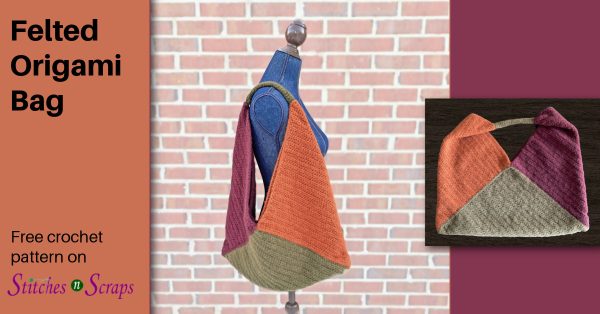
Turn a crocheted rectangle into a stylish tote, with just a few simple folds! This felted crochet origami bag is easy to crochet and works up quickly in bulky yarn. A few extra touches give it a professional finish. They’ll never believe you made it yourself!

This content is protected by copyright. See this Terms of Use / Copyright page for more information.
This post contains sponsored content and/or affiliate links. If you click an affiliate link and make a purchase, I may get a commission.
2022 Bag Along CAL
This felted crochet origami bag is the first pattern in the 2022 Bag Along CAL. Crochet along through 6 different bag patterns, with multiple technique tutorials for each. See the main CAL post for the full schedule.
Enter the Giveaway
With each new bag pattern, there will be a new giveaway as well! All the giveaway details and entry forms will be in the first post for each bag, which will also list all the materials needed for that bag. Here is the materials list and giveaway info for bag number 1.
The giveaway prizes for the CAL are all sponsored by WeCrochet. This first giveaway ends on February 25th, 2022 at 11:59pm, central time, so be sure to get your entries in!
Knit Picks Wool of the Andes Bulky Yarn
WeCrochet also provided all of the Knit Picks yarns for the bag designs. For this pattern, I chose Wool of the Andes Bulky. The yarn felts beautifully, and since it’s bulky it works up quickly too. I chose the colors Masala, Thyme, and Currant for a warm and spicy color palette. They have lots of lovely colors to choose from – which ones will you pick?
Wool of the Andes also comes in a superwash variety, but don’t choose that one for this project. You need a yarn that will felt, and superwash wool is specifically made to not felt.
Bag Along CAL Tutorials
For each bag in the crochet along, I will be posting several technique tutorials. As the tutorials become available, I’ll add the links into the “Recommended Resources” section of the pattern. See the main CAL post for the full schedule of patterns and tutorials.
Materials
- Yarn: Wool of the Andes Bulky 100% wool, bulky weight yarn (54 yds / 25 g per skein), 2 skeins each of:
- #28217 Masala
- #28223 Thyme
- #28211 Currant
- Hook: Size J-10 / 6 mm hook or size needed to match gauge
- Notions:
- 4 stitch markers
- Yarn needle
Project Level
Intermediate: Mostly hdc. Folding, seaming, felting, and some surface crochet.
Gauge
11 hdc x 9 rows = 4 inches square.
Abbreviations used
(Pattern is written in US terms)
ch = chain
hdc = half double crochet
hdc2tog = half double crochet 2 together
RS = right side
sc = single crochet
sl st = slip stitch
st(s) = stitch(es)
WS = wrong side
Instructions
Bag Body
The bag body is a rectangle made up of 3 square sections, starting with color A, then B, then C. At 2 opposite corners of this rectangle, increases or decreases create an angled or “clipped” corner. These corners are where you will later attach the handle. Stitch markers indicate exactly where each angled corner starts and ends, which will help for folding and seaming later.
The exact gauge is not particularly important, but it is important that each of the 3 sections is roughly square. If you need to add or remove rows to achieve this, add or remove an even number of rows in the middle of each section, so that the angled corners end up in the right places.

Section A
With A, ch 47
Row 1 (RS): Sk first 2 chs (counts as first hdc), place a stitch marker in the 3rd ch from hook, hdc in marked ch and in each remaining ch across. (46 hdc)
Row 2: Ch 1, turn, hdc in first st and in each st across to last st, 2 hdc in last st. (47 hdc)
Row 3: Ch 2 (counts as first hdc), turn, hdc in first st and in each st across. (48 hdc)
Row 4-5: Repeat rows 2-3. (50 hdc)
Place a stitch marker in the top of the first st of row 5 (this is the ch-2 at the beginning of the row).
Rows 6-40: Ch 1, turn, hdc in first st and in each st across. (50 hdc)
Remove hook from working loop and secure it with a stitch marker.
Turn, join B with sl st in first st (this is the same stitch you just finished working on row 40).

Section B
Row 41: With B, hdc in first st and in each st across. (50 hdc)
Surface Crochet Trim Over Color Change – Video tutorial for this section coming soon!
- Do not turn. Remove hook from working loop and secure it with a stitch marker. Place the working loop of color A back on your hook and remove that stitch marker.

- Holding the yarn behind your work, sl st with color A in each st across row 40. (You will be putting your hook into the same spots where you worked the stitches from row 41.) At the end of the row, ch 1 and then fasten off A.

- Place the working loop of color B back on your hook and remove that stitch marker.
Rows 42-80: With B, ch 1, turn, hdc in first st and in each st across. (50 hdc)
Remove hook from working loop and secure it with a stitch marker.
Turn, join C with sl st in first st (this is the same stitch you just finished working on row 80).
Section C
Row 81: Hdc in first st and in each st across. (50 hdc)
Surface Crochet Trim Over Color Change – Video tutorial for this section coming soon!
- Do not turn. Remove hook from working loop and secure it with a stitch marker. Place working loop of color B back on your hook and remove that stitch marker.
- Holding the yarn behind your work, sl st with color B in each st across row 80. (You will be putting your hook into the same spots where you worked the stitches from row 81.) At the end of the row, ch 1 and then fasten off B.
- Place working loop of color C back on your hook and remove that stitch marker, to continue with section C.
Rows 82-115: Ch 1, turn, hdc in each st across. (50 hdc)
Place a stitch marker in the top of the last stitch on row 115.
Row 116: Ch 2 (does not count as a st), turn, sk first st, hdc in each remaining st across. (49 hdc)
Row 117: Ch 1, turn, hdc in each st across to last 2 sts, hdc2tog. (48 hdc)
Rows 118-120: Repeat rows 116-117, then repeat row 116 once more. (45 hdc)
Place a stitch marker in the top of the last stitch on row 117
Fasten off and weave in all ends.

Bag Handle
The handle is worked in continuous rounds. Do not join or turn. There is no need to mark the first stitch of the round, and it doesn’t matter where you end.
Ch 6, leaving a 14-inch tail. Join with sl st to first ch to form a circle.
Rnd 1: Sc in each ch around. (6 sc)
Remaining Rnds: Sc in each st around, in a continuous spiral, until handle measures about 6 inches long, sl st in next st.
Fasten off, leaving a 14-inch tail.
Do not weave in tails. Set bag handle aside.

Folding
Video tutorial for this section coming soon!
Arrange bag flat in front of you, with right side up, as shown in the folding diagram below. Color A should be on the left, with the clipped corner at the bottom. Color C should be on the right, with the clipped corner at the top.
Folding Diagram:
First fold:
Take the pointed (normal) corner of color A and fold it down diagonally to meet the opposite corner of color A.

This makes the clipped corner fold in half so that the two stitch markers meet. Remove one of the stitch markers, and place the other through both layers so that it holds them together.

Second Fold
Take the pointed (normal) corner of color C and fold it up diagonally to meet the opposite corner of color C.
Once again, the clipped corner folds in half so that the two stitch markers meet. Remove one of the stitch markers, and place the other through both layers so that it holds them together.

You should now have a parallelogram shape, with triangles at each side and a square in the center. At this point you may find it helpful to clip or pin your folds together in a few spots. You don’t absolutely need to, but it can help keep everything together as you make the 3rd fold.
Third fold
Picture a diagonal line from the top left corner of section B to the bottom right corner of section B. Fold along this line, bringing section A up and to the right. The bottom left corner of section b should fold up to meet the top right corner of section B.
Rotate your work so that this last fold line is at the bottom, and you should have a bag shape made up of 3 triangle sections. Right sides should be together, and wrong sides facing out.

Seaming
First Seam
On the side of the bag that is facing you, one edge of section C should be resting against one edge of section B. Sew these edges together with a whipstitch.

Second Seam
Turn the bag over, being careful not to unfold section A. Now, one edge of section A should be resting against one edge of section B. Sew these edges together with a whipstitch.

Attach Handle
Turn bag right side out. Each of the marked, folded corners at the top of the bag create a small open circle. Insert one end of the handle into one of these circles so that the edges overlap by about 1 stitch. Use the tail from the handle to sew it in place. Remove the stitch marker from the corner of the bag.

Flatten out the handle so that it isn’t twisting at all, and then attach the other end of the handle to the other corner circle of the bag in the same way.

Surface Crochet Trim Over Seams
Video tutorial for this section coming soon!
First Seam
Position your bag so that the bag is upright and color A is on your left. Note that where color B meets color C, you already have the surface crochet trim in color B over the color change.
Where color A meets color B, you have a whipstitch seam instead. We’re going to surface crochet over that seam, so that it matches the look of the other side.

Holding the working yarn inside the bag (i.e. under the surface of your work), pull up a loop of color B at the bottom corner of the seam. Slip stitch along the seam line, making one slip stitch over each whipstitch in the seam. Take care to keep your tension even so the seam doesn’t pucker. At the end of the seam, ch 1 and fasten off.

Second Seam
Flip the bag over. On this side, you already have surface crochet in color A where colors A and B meet.
Place a loop of color C on your hook. Holding the working yarn inside the bag, slip stitch along the seam where colors B and C meet. This time you will be ending at the bottom corner of the bag, so just fasten off without the extra slip stitch.

Top Edging
Throughout the edging round, use the same color as the edge you are working into.
With right side facing, start at the lowest point in the center, where all 3 colors meet. Choose the color that matches the next stitch (either A or C) and join with a sl st.

Edging Rnd: [45 sc evenly spaced across edge to handle, skip handle, 45 sc evenly spaced across edge to center point where color changes], change to new matching color, repeat between [ ], join with a sl st to first st of the rnd.

Fasten off
Weave in all remaining ends and remove any remaining stitch markers.
Felting
Option 1 – Felting by hand:
This can be hard on your hands, and you may want to wear gloves. Take care not to use water that is so hot or so cold that it burns or damages your hands.
- Wash the bag in hot, soapy water. Don’t use a delicate or gentle wool soap, as those are designed to prevent felting. I find dish soap works well. Rub, squeeze, and agitate the yarn while washing it, but try not to twist or wring it as that can pull it out of shape.
- Shock the yarn by rinsing in cold water.
- Repeat the wash and rinse cycles until you have a texture and size you are happy with.
- Squeeze out as much water as you can without wringing. Rolling your project tightly in a towel will help get out more water.
- Run your hand between the layers to make sure they aren’t sticking together, and if they are, pull them apart. Lay it flat to dry, shaping it into the final, square shape. Don’t be afraid to tug on it a bit to get stubborn areas into shape as needed.
Option 2 – Felting by machine:
- Place the finished bag inside a pillowcase and tie it shut (this keeps any fuzz out of your washer).
- Wash the yarn on a normal wash cycle. Adding jeans or other heavy items can help create more agitation so that it felts faster, but make sure your yarn is colorfast so you don’t ruin your clothes!
- Check the bag after about 10 minutes, and then every few minutes after that. When it’s felted as much as you would like, turn off the washer and allow it to drain.
- You can toss it in the dryer for a few minutes if you like, but don’t let it dry completely in the dryer. Otherwise, remove it from the pillowcase and squeeze out as much water as you can without wringing. Rolling your project tightly in a towel will help get out more water.
- Run your hand between the layers to make sure they aren’t sticking together, and if they are, pull them apart. Lay it flat to dry, shaping it into the final, square shape. Don’t be afraid to tug on it a bit to get stubborn areas into shape as needed.

Rate this Felted Crochet Origami Bag Pattern!
I hope you enjoyed this felted crochet origami bag pattern.
A downloadable pdf of this pattern is available on Ravelry for a small fee. The fee for the pdf format is to offset the advertising revenue lost when you print or download the pattern rather than viewing it online.
Do you want the best of Stitches n Scraps delivered right to your inbox? Don’t miss a stitch – Subscribe now!

Tunisian Shells Crochet Blanket Square Pattern
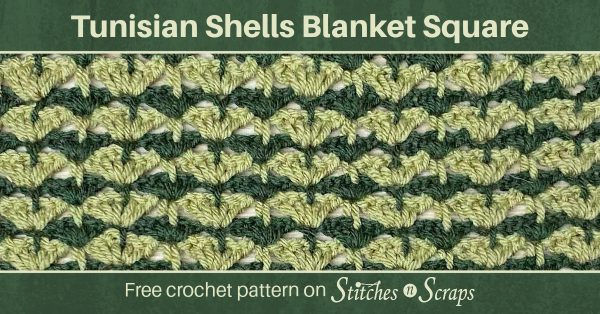
Layer Tunisian shells in alternating colors for a squishably soft blanket square. With a slightly different design on each side, this 12-inch square is totally reversible!

This content is protected by copyright. See this Terms of Use / Copyright page for more information.
This post contains sponsored content and/or affiliate links. If you click an affiliate link and make a purchase, I may get a commission.
2022 Tunisian Blanket CAL with the Knitter Knotter
This Tunisian shells blanket square design is part of the 2022 Tunisian Blanket Crochet Along, hosted by the Knitter Knotter. See the full schedule and all the patterns in the main CAL post.
Get the Bundle
You can buy a printable, pdf version of my individual pattern on Ravelry. If you want the other CAL patterns, PDF versions of many of the patterns in the CAL are being offered together as one, affordable bundle!
Get all 24 patterns for one low price! The patterns are being released every 2 weeks through 2021, so you won’t get them all at once right now. Each time a new pattern is released for the CAL, Knitter Knotter will be sending an update to everyone who has purchased the bundle.
The bundle is available through November 30th, 2022. If you buy the bundle before the CAL is over, you will get all the patterns that have been released so far, and then get all the remaining patterns as they come out.
Materials
- Yarn: Knit Picks Brava Worsted weight yarn – 100% acrylic, 218yds / 100gm per skein.
- 75 yds #28432 Fig (A)
- 75 yds #28429 Dublin (B)
- Hook: Size L / 8mm hook or size needed to match gauge (see note below)
- Notions: Yarn Needle
All squares in this CAL are designed to the same gauge. If you are making other squares in the CAL, you should be able to use the same hook for all of them.
Project Level
Intermediate: Tunisian crochet in 2 colors, with a short, repeating stitch pattern.
Size
12 inches square
Gauge
8 Tunisian simple stitches x 6 rows = 2 inches square (unblocked). In the stitch pattern, 2 full shells should be about 3.5 inches.
If you’re not familiar with the Tunisian simple stitch, see this tss tutorial.
Abbreviations used
ch = chain
Fp = forward pass
Rp = return pass
sk = skip
st(s) = stich(es)
yo = yarn over
Recommended Resources
Special Stitches
Shell: On return pass, yo and pull through 6 loops on hook.

Half shell: On return pass, yo and pull through 3 loops on hook

For shells and half shells, the next chain or stitch will create a horizontal bar on top of the shell. When working into the shell on the forward pass of the next row, work into this horizontal bar.

Instructions
With A, chain 43 (multiple of 6 + 1). If you want to adjust the size, add or remove chains in groups of 6.
Carry unused colors up along the side edge. When changing colors, always pick up the new color from in front of the old color. This will cause the yarns to twist, and create a neat, braided edge.

Row 1:
Fp: With A, and working into the back bumps of the chain, sk first ch, (insert hook, yo and pull up a loop) in each remaining ch across. (43 loops on hook)
Rp: With B, ch 3, shell (see Special Stitches), [ch 2, yo and pull through 2 loops on hook, ch 2, shell] until 2 loops remain, ch 2, yo and pull through last 2 loops on hook. (7 shells)
Row 2:
Fp: With B, sk first st, [(insert hook, yo and pull up a loop) in each of the next 2 chs, insert hook in next shell, yo and pull up a loop, (insert hook, yo and pull up a loop) in each of the next 2 chs, insert hook in vertical bar of next st, yo and pull up a loop] 6 times, (insert hook, yo and pull up a loop) in each of the next 2 chs, insert hook in next shell, yo and pull up a loop, (insert hook, yo and pull up a loop) in each of the last 3 chs (43 loops on hook)

Rp: With A, half shell (see Special Stitches), ch 2, [yo and pull through 2 loops on hook, ch 2, shell, ch2 ] until 5 loops remain, yo and pull through 2 loops on hook, ch 2, yo and pull through last 4 loops on hook. (6 shells)

Row 3:
Fp: With A, sk first st, [(insert hook, yo and pull up a loop) in each of the next 2 chs, insert hook in vertical bar of next st, yo and pull up a loop, (insert hook, yo and pull up a loop) in each of the next 2 chs, insert hook in next shell or half shell, yo and pull up a loop] across. (43 loops on hook)
Rp: With B, ch 3, shell, [ch 2, yo and pull through 2 loops on hook, ch 2, shell] until 2 loops remain, ch 2, yo and pull through last 2 loops on hook. (7 shells)
Rows 4-24: Repeat rows 2-3 10 times, then repeat row 2 once more.
Bind Off: With A, sk first st, (sl st in each of the next 2 chs, sl st in vertical bar of next st, sl st in each of the next 2 chs, sl st in next shell or half shell) across. (42 sl sts)
Fasten off both colors. Weave in ends. Wash and block.

I hope you enjoyed this Tunisian shells pattern. A downloadable pdf of this pattern is available on Ravelry for a small fee. The fee for the pdf format is to offset the advertising revenue lost when you print or download the pattern rather than viewing it online.
If you will want pdf versions of other patterns in this CAL, consider buying the whole bundle. You’ll save money versus buying them all individually, and you’ll get updates when each pattern is released!
Do you want the best of Stitches n Scraps delivered right to your inbox? The Stitches n Scraps email newsletter includes highlights from the blog as well as special features not available elsewhere. Don’t miss a stitch – Subscribe now!

Snowman Fridge Magnet Crochet Pattern
I LOVE the snow! Does it snow in the winter where you live? Make this cheerful snowman fridge magnet for your fridge or magnet board. They’re great for stuffing stockings and decorating gift wrap too!

This content is protected by copyright. See this Terms of Use / Copyright page for more information.
This post contains sponsored content and/or affiliate links. If you click an affiliate link and make a purchase, I may get a commission.
2021 Fridgies CAL
This snowman fridge magnet is the final pattern in the 2021 Fridiges CAL! If you’ve been crocheting along through all 12 magnet patterns, you should now have an adorable set of fridgies for yourself or for a gift!

Did you miss any of them? They work up quickly so you can still catch up!
Enter the Giveaway
There have been several giveaways throughout the Fridgies CAL. We’re now on our 4th and final giveaway. You could win this amazing Mosaic Wood Crochet Hook Set provided by WeCrochet!

The giveaway ends on December 31st, at 11:59pm central time. Find all the giveaway details and learn more about the Fridgies Crochet Along here. You can also read my review of these lovely hooks here.
Lion Brand DIY Yarn
Lion Brand provided all the yarn for this crochet along. Their DIY yarn comes in small balls, which is just perfect for the small amounts needed for each magnet. The elf fridge magnet is mostly camel (brown), with some red and white for the hat, and a bit of hot pink and black for embroidery.

If you’re not able to get this yarn or the colors you need, Lion Brand Vanna’s Choice or Basic Stitch are also good options. You can also substitute embroidery thread for the pink and black yarns.
Xyron Glue Gun
The easiest way to attach your magnet to your crochet is with hot glue. For my magnets, I’m using this mini hot glue gun that Xyron gave me to try out.

I used it on this spider fridge magnet and on the previous magnets as well. I’ve been very happy with it. It heats up quickly and produced a nice steady bead of glue. Watch it in action in the tutorial video below!
Materials
- Yarn: Lion Brand DIY Yarn (100% acrylic, worsted weight, 65 yds / 30g per ball)
- 30 yds White
- 10 yds Sky (lt blue)
- 5 yds Royal (dk blue)
- 1/2 yd each Black and Orange, or Black and Orange embroidery floss
- Hook: Size H / 5 mm crochet hook or size needed to match gauge.
- Notions:
- Yarn Needle
- Strong, flat magnet that will fit inside the snowman (sample shown is 1 inch diameter)
- Xyron hot glue gun and glue stick
- Stitch marker (optional)
- 1/4 – 1/2 inch pom pom (store bought, or made with the Royal yarn)
Project Level
Easy: Worked in the round, increases, some embroidery and seaming.
Size
About 2.5 inches in diameter, not counting hat.
Gauge
12 sc x 13 rounds = 4 inches
Use pattern as gauge swatch – After rnd 4, back circle should measure about 2.25 inches in diameter. Exact gauge is not critical. Your fabric should be tight enough that the magnet won’t show through.
Abbreviations used
(Pattern is written in US terms)
ch = chain
inc = increase (see Special Stitches)
RS = right side
sc = single crochet
sl st = slip stitch
st(s) = stitch(es)
WS = wrong side
Special Stitches
Increase (inc): Sc in back loop only of indicated st, then sc in both loops of same st. This counts as two stitches in the end of round stitch counts.
See this tutorial for a more detailed look.

Instructions
Join rounds where indicated with a slip stitch in the first stitch of the round. Slip stitches are not included in stitch counts unless otherwise specified. Mark first stitch of rounds if desired. Do not turn your work unless indicated.
Back
Back Circle
With white, ch 2.
Rnd 1 (RS): 6 sc in 2nd ch from hook, join. (6 sts)
Rnd 2: Ch 1, inc in each st around, join. (12 sts)
Rnd 3: Ch 1, inc in first st, sc in next st, (inc in next st, sc in next st) around, join. (18 sts)
Rnd 4 (ears): Ch 1, inc in first st, sc in each of next 2 sts, (inc in next st, sc in each of next 2 sts) around, join. (24 sts)
Fasten off, leaving a 24 inch tail for sewing. Weave in starting end.
Work should now measure about 2.25 inches in diameter.

Magnet
Using hot glue gun, glue magnet to center of back circle, on the WS of work.

Set back piece aside.
Front
Front Circle
Rnds 1-4: Repeat rnds 1-4 of back circle.

Fasten off and weave in ends.
Face
Using the picture as a guide, embroider black eyes and mouth and an orange nose. I made the eyes and mouth with french knots.

Weave in all ends except for the long tail for sewing.
Hat
Row 1 (WS): With Sky, ch 3, 2 sc in 2nd ch from hook, 2 sc in last ch. (4 sts)
Row 2: Ch 1, turn, inc in first st, sc in each of next 2 sts, inc in last st. (6 sts)
Row 3: Ch 1, turn, inc in first st, sc in each of next 4 sts, inc in last st. (8 sts)
Edging Rnd: Ch 1, do not turn, sc in each st across, ch 1, working in sides of rows: 3 sc across to bottom of foundation ch, ch 1, sc in each of the 2 foundation chs, ch 1, working in sides of rows, 3 sc across to start of round, join with sl st in starting ch and change to dk blue. (16 sc)
Bottom Band: Ch 1, do not turn, sc in each of first 8 sts. (8 sts)
Fasten off, leaving a 12 inch tail of dk blue for sewing.
Weave in all ends except the long tail of dk blue.

Assembly
Join Front and Back
Place the front and back together so that wrong sides are together. The magnet should be hidden between them.

Use the long tail from the front to sew the front and back together. Weave in the end.

Attach Hat
Use the long tail from the hat to sew the hat into place. At the corners, curve the edge of the hat slightly over the edge of the face so that the hat covers the edge.

Attach pom pom to top of hat and trim if necessary.
Weave in any remaining ends.
Snowman Fridge Magnet Video Tutorial
Watch This Video on YouTube

Rate this Snowman Fridge Magnet Pattern!
I hope you enjoyed this snowman fridge magnet pattern. Big thanks to Karen Navoy for testing it!
A downloadable pdf of this pattern is available on Ravelry for a small fee. The fee for the pdf format is to offset the advertising revenue lost when you print or download the pattern rather than viewing it online.
Do you want the best of Stitches n Scraps delivered right to your inbox? Don’t miss a stitch – Subscribe now!

Crochet Blanket Square – Steampunk Cyanide
If your crochet blanket square smells like almonds…run.

This content is protected by copyright. See this Terms of Use / Copyright page for more information.
This post contains sponsored content and/or affiliate links. If you click an affiliate link and make a purchase, I may get a commission.
Moogly Afghan CAL
I designed this crochet blanket square for the Moogly 2021 afghan CAL. In fact, it’s the last pattern of this year’s CAL! If you haven’t been crocheting along, go check out all the other squares. There are 24 in total, enough to make a beautiful blanket.
Be sure to take a look at the block 24 post to see how Moogly’s version of this square turned out.
Red Heart With Love Yarn
Yarnspirations was kind enough to send me the Red Heart With Love yarn for free for this design. I love how soft this yarn is to work with! I went for fun jewel tones, with a neutral shade to tie them together. My color choices were Boysenberry, Jadeite, and Tan.

Working into the Third Loop of HDC
In round 15 of this pattern, the stitches are largely worked into the 3rd loop of half double crochets. This third loop is from the yarn over and is hidden behind the top of the stitch.
Working into this loop does 2 things. It pushes the top of the stitch forward, creating a decorative, raised ridge. It also leaves those top loops exposed, so you can work into them later!
For a more detailed look, check out this third loop tutorial.

To Carry or Cut
I did not specify in the pattern whether to carry your yarns as you change colors, or to cut them with each color change. Either way is fine, and what you choose will depend on your tolerance for carried yarns showing along the back of your work or creating a bulky ridge.
On my blanket square, I did a combination of the two. Where the colors changed back and forth with every round, I carried them. Where there was a gap of more than a few rounds, I cut them and joined again later.
Materials
- Yarn: Red Heart With Love Yarn (100% acrylic, 370 yds / 198 g per skein). 60 yds each of:
- 1652 Jadeite (A)
- 1308 Tan (B)
- 1907 Boysenberry (C)
- Hook: Size J / 6 mm hook or size needed to match gauge
- Notions: Tapestry Needle
Project Level
Complex: Puff stitches, front post stitches, working into the third loop of hdc, working into rows below, changing colors.
Size
12 inch square
Gauge
13 dc x 8 rows = 4 inches after blocking.
Use pattern as gauge swatch – after rnd 8, work should measure about 5 inches in diameter.
Abbreviations used
blo = back loop only
ch = chain
csdc = chainless starting double crochet (see Special Stitches)
dc = double crochet
NV = nested V stitch (see Special Stitches)
puff = puff stitch (see Special Stitches)
rnd = round
RS = right side
sc = single crochet
sk = skip
sl st = slip stitch
st(s) = stich(es)
tr = treble crochet
WS = wrong side
yo = yarn over
Special Stitches
Chainless Starting Double Crochet (csdc)
Pull working loop up to the height of a dc. Hold the loop in place, and in a counterclockwise motion, twist your hook around the loop, creating a “yarn over”. Holding both loops in place, insert your hook into the specified stitch, yo and pull up a loop.

(YO and pull through 2 loops on your hook) twice, just as you would finish a normal double crochet. For a more detailed look, see this csdc tutorial.
If you prefer, you can replace the csdc wherever it appears with a chain 3, or with stacked single crochets.
Puff
(Yo, insert hook into indicated st, yo and pull up a loop to the height of the working row) 5 times, yo and pull through all 11 loops on hook, ch 1 to close.

When working into a puff stitch, work into the closing chain. For a more detailed look, see this puff stitch tutorial.

Nested V (NV)
Behind the indicated ch-1 sp, there is a skipped chain (ch-3 or ch-1) from the row below. Pull that chain forward, through the ch-1 sp so that it is at the front of your work. Working into that ch sp from the row below, dc, ch 1, dc.

If you’re following the colors per the pattern, the NV stitches will always be worked into chain spaces of the same color that you are currently working with. In the stitch counts, the NV counts as 2 dc stitches and a ch-1 sp.
Instructions
See the full video tutorial here.
Center Bearings
All rounds are worked on the RS, do not turn your work. Join rnds as indicated with a sl st in the first st of the rnd. To change colors after a join or other sl st, use the new color to complete the sl st. See this changing colors tutorial for more details.
With color A, ch 2 or make a magic loop.
Rnd 1: 6 sc in 2nd ch from hook or in magic loop, do not join. (6 sc)
Rnd 2: 2 sc in blo of each st around, join and change to color B. (12 sc)

Rnd 3: With B, ch 2, puff in first sc, ch 3, sk next sc, [puff in next sc, ch 3, sk next sc] 5 times, join with sl st in top of first puff and change to color A. (6 puffs, 6 ch-3 sps)

Main Gear
When working a stitch into a row below, always work in front of any sts or chains that are above it, unless otherwise specified.
Rnd 4: With A, ch 1, sc in first puff, (dc, ch 1, dc) in the skipped st below the next ch-3 sp, [sc in next puff, (dc, ch 1, dc) in the skipped st below the next ch-3 sp] 5 times, join and change to color B. (6 sc, 12 dc, 6 ch-1 sps).

Rnd 5: With B, ch 1, sc in first sc, ch 1, sk next dc, NV in next ch-1 sp, ch 1, sk next dc, [sc in next sc, ch 1, sk next dc, NV in next ch-1 sp, ch 1, sk next dc] 5 times, join and change to color A. (6 sc, 12 dc, 18 ch-1 sps).

Rnd 6: With A, ch 1, sc in first sc, fpdc around the skipped dc below the next ch-1 sp, ch 1, sk next dc, NV in next ch-1 sp, ch 1, sk next dc, fpdc around the skipped dc below the next ch-1 sp, [sc in next sc, fpdc around the skipped dc below the next ch-1 sp, ch 1, sk next dc, NV in next ch-1 sp, ch 1, sk next dc, fpdc around the skipped dc below the next ch-1 sp] 5 times, join and change to color B. (6 sc, 12 fpdc, 12 dc, 18 ch-1 sps)

Rnd 7: With B, ch 1, 3 sc in first sc, sk next fpdc, fpdc around the skipped dc below the next ch-1 sp, ch 1, sk next dc, NV in next ch-1 sp, ch 1, sk next dc, fpdc around the skipped dc below the next ch-1 sp, sk next fpdc, [3 sc in next sc, sk next fpdc, fpdc around the skipped dc below the next ch-1 sp, ch 1, sk next dc, NV in next ch-1 sp, ch 1, sk next dc, fpdc around the skipped dc below the next ch-1 sp, sk next fpdc] 5 times, join and change to color A. (18 sc, 12 fpdc, 12 dc, 18 ch-1 sps)

Rnd 8: With A, ch 1, 2 sc in each of first 3 sc, sk next fpdc, fpdc around the skipped dc below the next ch-1 sp, sk next dc, 3 sc in next ch-1 sp, sk next dc, fpdc around the skipped dc below the next ch-1 sp, sk next fpdc, [2 sc in each of next 3 sc, sk next fpdc, fpdc around the skipped dc below the next ch-1 sp, sk next dc, 3 sc in next ch-1 sp, sk next dc, fpdc around the skipped dc below the next ch-1 sp, sk next fpdc] 5 times, join with sl st in blo of first st, and change to color B. (54 sc, 12 fpdc)

Cyanide Bath
Rnd 9: With B, ch 1, sc in blo of each of first 8 sts, 2 sc in blo of next st, (sc in blo of next 10 sts, 2 sc in blo of next st) 5 times, sc in blo of last 2 sts, join and change to color C. (72 sc)

Rnd 10: With C, ch 2, puff in first sc, ch 5, sk next 3 sc, [puff in next sc, ch 5, sk next 3 sc) 17 times, join and change to color B. (18 puffs, 18 ch-5 sps)

In rnd 11, when working into the row below, work around the chains so that they are completely hidden within the dc stitches.

Rnd 11: With B, sc in first puff, working around the chains, 3 dc into the 2nd (center) skipped stitch below the next ch-5 sp, [sc in next puff, working around the chains, 3 dc into the 2nd skipped stitch below the next ch-5 sp] 17 times, join. (18 sc, 54 dc)

Shape Changing Section
Rnd 12: With B, csdc in first sc, [ch 3, sk next dc, dc in each of next 3 sts, hdc in each of next 3 sts, sc in each of next 5 sts, hdc in each of next 3 sts, dc in each of next 3 sts] 3 times, ch 3, sk next dc, dc in each of next 3 sts, hdc in each of next 3 sts, sc in each of next 5 sts, hdc in each of next 3 sts, dc in each of last 2 sts, join and change to color C. (24 dc, 24 hdc, 20 sc, 4 ch-3 sps)

In rnd 13, when working into the row below, work around the chains so that they are completely hidden within the tr stitches.
Rnd 13: With C, csdc in first dc, [working around the chain, (2 tr, ch 1, 2 tr) in the skipped dc below the next ch-3 sp, dc in next st, hdc in each of next 3 sts, sc in each of next 9 sts, hdc in each of next 3 sts, dc in next st] 3 times, working around the chain, (2 tr, ch 1, 2 tr) in the skipped dc below the next ch-3 sp, dc in next st, hdc in each of next 3 sts, sc in each of next 9 sts, hdc in each of last 3 sts, join, sl st in each of the next 2 sts of this rnd, sl st in first ch-1 sp of this rnd and change to color A. (16 tr, 8 dc, 24 hdc, 36 sc, 4 ch-1 sps)

Containment Area
Inner retaining wall
Rnd 14: With A, ch-1, (hdc, ch 1, 2 hdc) in first ch-1 sp, [hdc in each st across to next ch-1 sp, (2 hdc, ch 1, 2 hdc) in next ch-1 sp] 3 times, hdc in each remaining st, hdc in same sp as first st of rnd, join, sl st in first ch-2 sp and change to color C. (100 hdc, 4 ch-2 sps)

Rnd 15: With C, ch 1, (sc, ch 2, sc) in first ch-1 sp, [sc in third loop of each st across to next ch-1 sp, (sc, ch 2, sc) in next ch-1 sp] 3 times, sc in third loop of each remaining st, join, sl st in first ch-2 sp and change to color B. (108 sc, 4 ch-2 sps)

Support posts
Working in the third loops leaves the top 2 loops of each stitch exposed. Use these loops in rnd 16 and 17, when working into the rnd(s) below.

Rnd 16: With B, ch 1, (sc, ch 2, sc) in first ch-2 sp, {sc in each of next 3 sts, [dc in the st 1 row below the next st, sc in each of the next 3 sts] 6 times, (sc, ch 2, sc) in next ch-2 sp} 3 times, sc in each of next 3 sts, dc in the st 1 row below the next st, sc in each of the next 3 sts] 6 times, join, sl st in first ch-2 sp and change to C. (92 sc, 24 dc, 4 ch-2 sps)

Rnd 17: With C, ch 1, (sc, ch 2, sc) in first ch-2 sp, {sc in each of the next 6 sts, tr in the st 2 rows below the next st, [sc in each of next 3 sts, tr in the st 2 rows below the next st] 4 times, sc in each of the next 6 sts, (sc, ch 2, sc) in the next ch-2 sp} 3 times, sc in each of the next 6 sts, tr in the st 2 rows below the next st, [sc in each of next 3 sts, tr in the st 2 rows below the next st] 4 times, sc in each of the last 6 sts, join, sl st in first ch-2 sp and change to B. (104 sc, 20 tr, 4 ch-2 sps)

Rnd 18: With B, ch 1 (sc, ch 2, sc) in first ch-2 sp, {sc in each of next 5 sts, fpdc around the dc 2 rows below the next st, [sc in each of next 3 sts, fpdc around the dc 2 rows below the next st] 5 times, sc in each of the next 5 sts, (sc, ch 2, sc) in next ch-2 sp} 3 times, sc in each of next 5 sts, fpdc around the dc 2 rows below the next st, [sc in each of next 3 sts, fpdc around the dc 2 rows below the next st] 5 times, sc in each of the next 5 sts, join, sl st in first ch-2 sp and change to A. (108 sc, 24 fpdc, 4 ch-2 sps)

Outer Perimeter
Rnd 19: With A, (csdc, ch 1, 2 dc) in first ch-2 sp, [dc in each st across to next ch-2 sp, (2 dc, ch 2, 2 dc) in next ch-2 sp] 3 times, dc in each remaining st, dc in same ch-2 sp as beginning of rnd, join, sl st in first ch-2 sp and change to B. (148 sc, 4 ch-2 sps)

Rnd 20: With B, ch 1, (sc, ch 2, sc) in first ch-1 sp, sc in each st across to next ch-1 sp, (sc, ch 2, sc) in next ch-1 sp] 3 times, sc in each remaining st, sc in same ch-1 sp as beginning of rnd, join, fasten off. (156 sc, 4 ch-2 sps).
Weave in all ends. Wash and block.

Rate this Crochet Blanket Square Pattern!
I hope you enjoyed this crochet blanket square pattern. A downloadable pdf of this pattern is available on Ravelry for a small fee. The fee for the pdf format is to offset the advertising revenue lost when you print or download the pattern rather than viewing it online.
Do you want the best of Stitches n Scraps delivered right to your inbox? The Stitches n Scraps email newsletter includes highlights from the blog as well as special features not available elsewhere. Don’t miss a stitch – Subscribe now!

Elf Fridge Magnet Crochet Pattern
Need a holiday helper? Make this adorable elf fridge magnet for your fridge or magnet board. They’ll happily hang on to your notes and pictures for you. They’re great for stuffing stockings and decorating gifts too!

This content is protected by copyright. See this Terms of Use / Copyright page for more information.
This post contains sponsored content and/or affiliate links. If you click an affiliate link and make a purchase, I may get a commission.
2021 Fridgies CAL
This elf fridge magnet is the November pattern in the 2021 Fridiges CAL! Crochet along through 12 magnet patterns. At the end of the year, you’ll have an adorable set of fridgies for yourself or for a gift! You may want to make 2 sets, so you don’t have to decide.

Enter the Giveaway
There have been several giveaways throughout the Fridgies CAL. We’re now on our 4th and final giveaway. You could win this amazing Mosaic Wood Crochet Hook Set provided by WeCrochet!

Find all the giveaway details and learn more about the Fridgies Crochet Along here! You can also read my review of these lovely hooks here.
Lion Brand DIY Yarn
Lion Brand provided all the yarn for this crochet along. Their DIY yarn comes in small balls, which is just perfect for the small amounts needed for each magnet. The elf fridge magnet is mostly camel (brown), with some red and white for the hat, and a bit of hot pink and black for embroidery.

If you’re not able to get this yarn or the colors you need, Lion Brand Vanna’s Choice or Basic Stitch are also good options. You can also substitute embroidery thread for the pink and black yarns.
Xyron Glue Gun
The easiest way to attach your magnet to your crochet is with hot glue. For my magnets, I’m using this mini hot glue gun that Xyron gave me to try out.

I used it on this spider fridge magnet and on the previous magnets as well. I’ve been very happy with it. It heats up quickly and produced a nice steady bead of glue. Watch it in action in the tutorial video below!
Materials
- Yarn: Lion Brand DIY Yarn (100% acrylic, worsted weight, 65 yds / 30g per ball)
- 30 yds camel (brown)
- 15 yds red
- 5 yds white
- 1/2 yd each black and hot pink, or black and pink embroidery floss
- Hook: Size H / 5 mm crochet hook or size needed to match gauge.
- Notions:
- Yarn Needle
- Strong, flat magnet that will fit inside the spider (sample shown is 1 inch diameter)
- Xyron hot glue gun and glue stick
- Stitch marker (optional)
- 1/4 – 1/2 inch pom pom (store bought, or made with the white yarn)
Project Level
Easy: Worked in the round, increases, picots, some embroidery.
Size
About 2.5 inches in diameter, not counting ears and hat.
Gauge
12 sc x 13 rounds = 4 inches
Use pattern as gauge swatch – After rnd 4, back circle should measure about 2.25 inches in diameter not counting ears. Exact gauge is not critical. Your fabric should be tight enough that the magnet won’t show through.
Abbreviations used
(Pattern is written in US terms)
ch = chain
inc = increase (see Special Stitches)
RS = right side
sc = single crochet
sl st = slip stitch
st(s) = stitch(es)
WS = wrong side
Special Stitches
Increase (inc): Sc in back loop only of indicated st, then sc in both loops of same st. This counts as two stitches in the end of round stitch counts.
See this tutorial for a more detailed look.

Picot: Ch 3, then sl st in the last stitch you made before the chains.
See this tutorial for a more detailed look.
Instructions
Join rounds where indicated with a slip stitch in the first stitch of the round. Slip stitches are not included in stitch counts unless otherwise specified. Mark first stitch of rounds if desired. Do not turn your work unless indicated.
Back
Back Circle
With brown, ch 2.
Rnd 1 (RS): 6 sc in 2nd ch from hook, join. (6 sts)
Rnd 2: Ch 1, inc in each st around, join. (12 sts)
Rnd 3: Ch 1, inc in first st, sc in next st, (inc in next st, sc in next st) around, join. (18 sts)
Rnd 4 (ears): Ch 1, inc in first st, sc in next 2 sts, inc in next st, sc in next 2 sts, picot, (inc in next st, sc in next 2 sts) twice, inc in next st, picot, sc in next 2 sts, inc in next st, sc in last 2 sts, join. (24 sc, 2 picot ears)
Fasten off and weave in ends.
Work should now measure about 2.25 inches in diameter, not counting the picot ears.

Magnet
Using hot glue gun, glue magnet to center of back circle, on the WS of work.

Set back piece aside.
Front
Front Circle
Rnds 1-3: Repeat rnds 1-3 of back circle.
Rnd 4: Ch 1, inc in first st, sc in next 2 sts, (inc in next st, sc in next 2 sts) around, join. (24 sts)

Fasten off, leaving a 24 inch tail for sewing. Weave in starting end.
Face
Using the picture as a guide, embroider black eyes, red mouth, pink cheeks, and brown nose.

I didn’t actually decide to add the nose until the end, so several of the following pictures have the nose missing.
Weave in all ends except for the long tail for sewing.
Hat
Row 1 (WS): With red, ch 2, sc in 2nd ch from hook. (1 st)
Row 2: Ch 1, turn, sc in first st. (1 st)
Row 3: Ch 1, turn, inc in first st. (2 sts)
Row 4: Ch 1, turn, inc in first st, sc in last st. (3 sts)
Row 5: Ch 1, turn, sc in first 2 sts, inc in last st. (4 sts)
Row 6: Ch 1, turn, inc in first st, sc in last 3 sts. (5 sts).
Row 7: Ch 1, turn, sc in each st across. (5 sts)
Row 8: Ch 1, turn, inc in first st, sc in next 3 sts, inc in last st. (7 sts)

Edging Rnd: Do not turn. Working in sides of rows, ch 1, work 6 sc evenly spaced to point of hat (bottom of row 1), ch 3, work 8 sc evenly spaced to bottom of hat (beginning of row 8), join with sl st to first st of row 8 and change to white.
Hat trim: Do not turn, with white, ch 1, (sl st, ch 2) in each st across to last st, sl st in last st.
Fasten off, leaving a 12 inch white tail for sewing later.
Sew or glue pompom onto the top point of the hat.
Weave in all ends except for the long white tail.

Assembly
Join Front and Back
Place the front and back together so that wrong sides are together and the heads line up. The magnet should be hidden between them.

Use the long tail from the front to sew the front and back together, working just under the tops of the stitches along the outside edge of the front and back circles. Be careful not to sew over the ears. Weave in the end.

Attach Hat
Use the long tail from the hat to sew the hat into place. At the corners, curve the edge of the hat slightly over the edge of the face so that the hat covers the edge.

Weave in any remaining ends.
Elf Fridge Magnet Video Tutorial
Watch This Video on YouTube

Rate this Elf Fridge Magnet Pattern!
I hope you enjoyed this elf fridge magnet pattern. Big thanks to Karen Navoy for testing it!
A downloadable pdf of this pattern is available on Ravelry for a small fee. The fee for the pdf format is to offset the advertising revenue lost when you print or download the pattern rather than viewing it online.
Do you want the best of Stitches n Scraps delivered right to your inbox? Don’t miss a stitch – Subscribe now!

Sideways Crochet Top – Hyde Park Tee
Whether you’re hitting the books, or hitting the beach, the Hyde Park Tee has you covered! Wear it on its own, or layer it with a jacket for chillier weather. This sideways crochet top is worked from sleeve to sleeve, with lacy shoulder seams for a flattering fit.

This content is protected by copyright. See this Terms of Use / Copyright page for more information.
This post contains sponsored content and/or affiliate links. If you click an affiliate link and make a purchase, I may get a commission.
Laid Back Layers
The only thing predictable about Chicago weather is that it’s unpredictable, particularly in the fall! A frosty morning can quickly turn into a sunny, summerlike afternoon. With the ever-changing temperatures, indoor areas often end up feeling overheated. This time of year, versatile layering pieces like this top are a must-have.
Wear it all by itself to stay comfortably cool indoors, and then toss on a jacket when the temperature drops. It also looks nice layered on top of a long sleeve shirt for extra warmth.

King Cole Drifter Dk Yarn
The folks at King Cole generously provided me with the Drifter DK yarn for this design. It’s a unique blend of cotton, acrylic, and wool. It has the warmth of wool, the breathability of cotton, and the softness of acrylic.

Each self-striping colorway is inspired by and named for a different state in the US. Of course I chose Illinois for this top! The shifting colors, paired with the sideways crochet construction, create a waterfall of vertical stripes.
I loved this yarn so much, I decided to sell it in my shop. When you purchase this yarn from the Stitches n Scraps Shop, you’ll get the printable, pdf version of this pattern for free!
Materials
- Yarn: 1050 [1150, 1300, 1450, 1550, 1675, 1775, 1900, 2025] yds King Cole Drifter DK yarn (69% acrylic, 25% cotton, 6% wool, 328 yd / 100 g per skein). Sample shown in color 3259 – Illinois
- Hook: Size 7 / 4.5 mm hook or size needed to match gauge
- Notions:
- Tapestry Needle
- 6 locking stitch markers
Project Level
Easy: Single and double crochet in rows with minimal shaping and some seaming. Join-as-you-go style shoulder seam.
Sizes
XS [S, M, L, 1X, 2X, 3X, 4X, 5X]
| Size | To fit bust (inches) | Yardage needed |
|---|---|---|
| XS | 30 | 1050 |
| S | 34 | 1150 |
| M | 38 | 1300 |
| L | 42 | 1450 |
| 1X | 46 | 1550 |
| 2X | 50 | 1675 |
| 3X | 54 | 1775 |
| 4X | 58 | 1900 |
| 5X | 62 | 2025 |

Gauge
14 dc x 8 rows = 4 inches after blocking.
Gauge is important for a good fit. Measure gauge after blocking. Preferably, hang your swatch to dry, with a light weight (like a binder clip) on the bottom of it, to simulate the weight of the sweater pulling on itself.
Abbreviations used
ch = chain
dc = double crochet
rnd = round
RS = right side
sc = single crochet
sl st = slip stitch
st(s) = stich(es)
WS = wrong side
Recommended Resources
Instructions
Back
Back Right Sleeve
Ch 24 [25, 26, 27, 29, 33, 36, 39, 40]
Row 1 (RS): Sc in 2nd ch from hook and in each ch across. (23 [24, 25, 26, 28, 32, 35, 38, 39] sts)
Row 2: Ch 3, turn, dc in next st and in each st across.
Row 3: Ch 1, turn, sc in each st across to last 2 sts, 2 sc in next st, sc in last st. (24 [25, 26, 27, 29, 33, 36, 39, 40] dc)
Repeat last 2 rows 5 [5, 6, 6, 6, 4, 4, 2, 2] more times (29 [30, 32, 33, 35, 37, 40, 41, 42] sts)
Sizes 2x [3x, 4x, 5x] only:
Next Row: Rep row 2
Next Row: Ch 1, turn, sc in each st across.
Repeat last 2 rows 2 [2, 4, 4] more times.
You should have worked a total of 13 [13, 15, 15, 15, 17, 17, 17, 17] rows for back right sleeve.

Back Right Shoulder
Continuing from right sleeve:
Row 1 (WS): Ch 63 [63, 63, 64, 62, 61, 58, 58, 58], turn, dc in 4th ch from hook and in next 57 [57, 57, 58, 56, 55, 52, 52, 52] chs, sc in next 2 chs, sc in next 2 sts, dc in each remaining st across. (90 [91, 93, 95, 95, 96, 96, 97, 98] sts)
These single crochets draw the fabric in slightly at the underarm for a smoother fit.

Row 2: Ch 1, turn, sc in each st across.
Row 3: Ch 3, turn, dc in next st and in each st across.
Repeat last 2 rows 8 [9, 10, 11, 13, 14, 15, 16, 18] more times.
You should have worked 19 [21, 23, 25, 29, 31, 33, 35, 39] rows for back right shoulder.
Back Neckline
Decreasing
Row 1 (RS): Turn, sl st in each of first 2 sts, sc in each remaining st across. (88 [89, 91, 93, 93, 94, 94, 95, 96] sts)
Row 2: Ch 3, turn, dc in next st and in each st across to last 3 sts, dc2tog, dc in last st. (87 [88, 90, 92, 92, 93, 93, 94, 95] sts)
Even
Row 1 (RS): Ch 1, turn, sc in each st across.
Row 2: Ch 3, turn, dc in next st and in each st across.
Repeat last 2 rows 5 [6, 7, 8, 8, 9, 9, 10, 10] more times.
Increasing
Row 1 (RS): Ch 1, turn, sc in first st, 2 sc in next st, sc in each remaining st across. (88 [89, 91, 93, 93, 94, 94, 95, 96] sts)
You should have worked 15 [17, 19, 21, 21, 23, 23, 25, 25] rows total in the back neckline section.

Back Left Shoulder
Row 1 (WS): Ch 3, turn, dc in next st and in each st across to last st, (2 dc, tr) in last st. (90 [91, 93, 95, 95, 96, 96, 97, 98] sts)
The bottom portion of this last treble forms the top corner of the neckline, as shown below. When working the neckline edging later, stop at that point.

Row 2: Ch 1, turn, sc in each st across.
Row 3: Ch 3, turn, dc in next st and in each st across.
Repeat last 2 rows 7 [8, 9, 10, 12, 13, 14, 15, 17] more times.
Repeat row 2 once more.
Next row: Ch 3, turn, dc in each of next 58 [58, 58, 59, 57, 56, 53, 53, 53] sts, sc in each of next 4 sts, dc in each remaining st across.
You should have worked 19 [21, 23, 25, 29, 31, 33, 35, 39] rows for back left shoulder.
Back Left Sleeve
Row 1 (RS): Ch 1, turn, sc in each of first 29 [30, 32, 33, 35, 37, 40, 41, 42] sts, leaving remaining sts unworked. (29 [30, 32, 33, 35, 37, 40, 41, 42] sts)
Sizes 2x [3x, 4x, 5x] only:
Row 2: Ch 3, turn, dc in next st and in each st across.
Row 3: Ch 1, turn, Sc in each st across
Repeat last 2 rows 2 [2, 4, 4] more times
All Sizes:
Next Row: Ch 2 (does not count as a st), turn, sk first st, dc in next st and in each st across. (28 [29, 31, 32, 34, 36, 39, 40, 41] sts)
Next Row: Ch 1, turn, sc in each st across.
Repeat last 2 rows 5 [5, 6, 6, 6, 4, 4, 2, 2] more times. (23 [24, 25, 26, 28, 32, 35, 38, 39] sts)
You should have worked 13 [13, 15, 15, 15, 17, 17, 17, 17] rows for back left sleeve.
Fasten off.
Back Edging
Wind a separate ball of about 25 yds of yarn to use for this section.
With RS facing, join yarn with sl st in top corner of right sleeve. This should be the first stitch of row 1 of the sleeve.

Row 1 (RS):
- Ch 1, working into sides of rows, work 36 [39, 42, 45, 51, 54, 57, 60, 66] sc evenly spaced across right sleeve and shoulder, to the edge of the neckline.

- Ch 1, place marker on the chain you just made, work 21 [23, 25, 28, 28, 30, 30, 32, 32] sc evenly spaced around neckline, ending in the bottom of the tr at the start of the left shoulder.

- Ch 1, work 36 [39, 42, 45, 51, 54, 57, 60, 66] sc evenly spaced across left shoulder and sleeve.
(93 [101, 109, 118, 130, 138, 144, 152, 164] total sts, 2 ch-1 sps)
Row 2: Ch 1, turn, sc in first st, (ch 5, sk next 2 sts, sc in next st) 11 [12, 13, 14, 16, 17, 18, 19, 21] times, ch 5, sk next 2 sts, sc in next ch-1 sp. Leave remaining stitches unworked. (12 [13, 14, 15, 17, 18, 19, 20, 22] ch-5 loops)

Secure working yarn with a stitch marker, do not fasten off.
Front
Front Left Sleeve
Work as for back right sleeve.
Front Left Shoulder
Work as for back right shoulder.
Front Neckline
Decreasing
Row 1 (RS): Turn, sl st in each of first 2 sts, sc in each remaining st across. (88 [89, 91, 93, 93, 94, 94, 95, 96] sts)
Row 2: Ch 3, turn, dc in next st and in each st across to last 3 sts, dc2tog, dc in last st. (87 [88, 90, 92, 92, 93, 93, 94, 95] sts)
Row 3: Ch 1, turn, sk first st, sc in each remaining st across. (86 [87, 89, 91, 91, 92, 92, 93, 94] sts)
Repeat last 2 rows 1 [1, 1, 2, 2, 2, 2, 2, 2] more times. (84 [85, 87, 87, 87, 88, 88, 89, 90] sts)
Sizes 2X [3X, 4X, 5X] only
Next Row: Ch 3, turn, dc in next st and in each st across.
Next Row: Repeat row 3. (87 [87, 88, 89] sts)
You should have worked 5 [5, 5, 7, 7, 9, 9, 9, 9] so far in the front neckline section.
Even
Row 1 (WS): Ch 3, turn, dc in next st and in each st across.
Row 2: Ch 1, turn, sc in each st across.
Repeat last 2 rows 2 [3, 4, 3, 3, 2, 2, 3, 3] more times.
You should have worked 11 [13, 15, 15, 15, 15, 15, 17, 17] rows so far in the front neckline section.
Increasing
Sizes 2X [3X, 4X, 5X] only
Next Row: Ch 3, turn, dc in next st and in each st across to last 2 sts, 2 dc in next st, dc in last st. (88 [88, 89, 90] sts)
Next Row: Ch 1, turn, sc in each st across.
All Sizes
Row 1 (WS): Ch 3, turn, dc in next st and in each st across to last 2 sts, 2 dc in next st, dc in last st. (85 [86, 88, 88, 88, 89, 89, 90, 91] sts)
Row 2: Ch 1, turn, sc in first st, 2 sc in next st, sc in each remaining st across. (86 [87, 89, 89, 89, 90, 90, 91, 92] sts)
Repeat last 2 rows 1 [1, 1, 2, 2, 2, 2, 2, 2] more times. (88 [89, 91, 93, 93, 94, 94, 95
, 96] sts)
You should have worked 15 [17, 19, 21, 21, 23, 23, 25, 25] rows total in the front neckline section.
Front Right Shoulder
Work as for back left shoulder.
Front Right Sleeve
Work as for back left sleeve.
Fasten off.
Front Edging
With RS facing, join yarn with sl st in top corner of left sleeve. This should be the first stitch of row 1 of the sleeve.

Row 1 (RS):
- Ch 1, working into sides of rows, work 36 [39, 42, 45, 51, 54, 57, 60, 66] sc evenly spaced across left sleeve and shoulder, to the edge of the neckline.
- Ch 1, place marker on the chain you just made, work 27 [30, 33, 36, 36, 39, 39, 42, 42] sc evenly spaced around neckline, ending in the bottom of the tr at the start of the right shoulder.
- Ch 1, work 36 [39, 42, 45, 51, 54, 57, 60, 66] sc evenly spaced across right shoulder and sleeve.
(99 [108, 117, 126, 138, 147, 153, 162, 174] total sts)
Row 2: Ch 1, turn, sc in first st, (ch 5, sk next 2 sts, sc in next st) 11 [12, 13, 14, 16, 17, 18, 19, 21] times, ch 5, sk next 2 sts, sc in next ch-1 sp. Leave remaining stitches unworked. (12 [13, 14, 15, 17, 18, 19, 20, 22] ch-5 loops)
Do not fasten off.

Assembly
Right shoulder seam
Continuing from front edging:
Row 3: Ch 5, with WS facing, sc in marked st on back right shoulder,

(ch 2, sl st in next ch-5 loop on front, sk next 2 sts on back, sc in next st on back) across to end of sleeve, ch 3, sl st in first st on row 2 of front edging.

Fasten off.
Left shoulder seam
Pick up working loop from back edging. Continuing from back edging:
Row 3: Ch 3, with WS facing, sc in marked st on front right shoulder, (ch 2, sl st in next ch-5 loop on back, sk next 2 sts on front, sc in next st on front) across to end of sleeve, ch 3, sl st in first st from row 2 of back edging.

Side seams
Fold at shoulder seams so that right sides of front and back are together.

Using stitch markers, tack corners together at edge of sleeve, underarm, and bottom hem.

Sew side seam along this edge, from sleeve to hem. You can use any type of seam you prefer, I used a mattress stitch.
Repeat for the other side seam.
Finishing
Collar Edging
With RS facing, join yarn with sl st in any st on neckline.
Rnd 1: Ch 1, sc in each st and ch around, join with sl st to first st. Fasten off. (58 [63, 68, 74, 74, 79, 79, 84, 84] sts)
Sleeve Edging
With RS facing, join yarn with sl st on sleeve edge, at the seam.
Rnd 1: Ch 1, sc in each st around, join with sl st to first st. Fasten off. (44 [46, 48, 52, 54, 64, 70, 76, 78] sts)
Repeat for the other sleeve.
Hem Edging
For the hem edging, the exact stitch count is not important, as long as your work does not either pucker or ruffle at the edge.
With RS facing, join yarn with sl st on bottom edge at either side seam.
Rnd 1: Ch 1, working into sides of rows, work 128 [142, 156, 170, 188, 202, 214, 228, 246] sc evenly spaced around bottom edge, join with sl st to first st. Fasten off. (128 [142, 156, 170, 188, 202, 214, 228, 246] sts)
Weave in all ends.
Wash and block.

I hope you enjoyed this sideways crochet top pattern. A downloadable pdf of this pattern is available on Ravelry for a small fee. The fee for the pdf format is to offset the advertising revenue lost when you print or download the pattern rather than viewing it online.
Do you want the best of Stitches n Scraps delivered right to your inbox? The Stitches n Scraps email newsletter includes highlights from the blog as well as special features not available elsewhere. Don’t miss a stitch – Subscribe now!

Hand Warmer Coffee Cup Cozy Knitting Pattern
Keep your hands toasty warm, without burning them on hot drinks. This hand warmer coffee cup cozy protects your hand from the hot coffee cup, while also covering it to keep it warm! Festive, ribbon candy stripes make this a perfect holiday gift.

This content is protected by copyright. See this Terms of Use / Copyright page for more information.
This post contains sponsored content and/or affiliate links. If you click an affiliate link and make a purchase, I may get a commission.
Holiday Stashbusting KAL
This hand warmer cup cozy is my pattern in the Holiday Stashbusting KAL at KAL Corner. You can find all the other KAL patterns, and giveaway details too, in this main KAL post!
Materials
- Yarn: Worsted weight yarn
- 20 yds cream
- 10 yds each red and green
- Needles: Size 8 / 5 mm needles, or size needed to match gauge, for knitting in the round. Use a set of double pointed needles, or a circular needle long enough for the magic loop method.
- Notions: Tapestry Needle
Project Level
Easy: Ribbing, stockinette and garter stitch, color changes, some increases, and some seaming.
Size
About 4 x 3 inches when flat. Designed to fit tapered, take-out-style coffee cups.
Gauge
16 sts x 24 rnds = 4 inches in stockinette
Abbreviations used
k = knit
kfb = knit front and back
p = purl
rnd = round
RS = right side
st(s) = stich(es)
WS = wrong side
Recommended Resources
Instructions
Cozy
With red, cast on 28 sts. Use an alternating cable cast on or another stretchy cast on for ribbing.
Distribute stitches evenly on double-pointed needles or magic loop, to knit in the round.
Rnds 1-5: With red, (k1, p1) around.
Carry unused colors up along the WS as you go. Don’t worry about the extra bulk, or the jog from the color changes, this “seam” will be covered by the hand warmer.
Rnd 6: With cream, k around.
Rnd 7: With green, k around.
Rnd 8: With green, (kfb, k13) twice. (30 sts)
Rnds 9-11: With green, k around.
Rnd 12: With cream, k around.
Rnds 13-15: With green, k around.
Rnd 16: With green, (kfb, k14) twice. (32 sts)
Rnd 17: With green, k around. Cut green yarn, leaving a tail to weave in later.
Rnd 18: With cream, k around. Cut cream yarn, leaving a tail to weave in later.
Rnd 19: With red, k around.
Rnds 21-23: With red, (k1, p1) around.
Bind off using a sewn tubular bind off or another stretchy bind off for ribbing.
Weave in all ends.

Hand Warmer
With cream, cast on 12 stitches using any low profile cast on you prefer, and leaving a 16-inch starting tail for sewing.
Rows 1-35: K across.
Bind off using any low profile bind off you prefer, and leaving a 16-inch ending tail for sewing.
The hand warmer has no right or wrong side.

Assembly
Turn cozy wrong side out. Align one short edge (cast on or bind off) of the hand warmer just under the top edge of the cozy, so that it is centered over the “seam” at the beginning of the rounds.

When sewing the hand warmer on, be sure you are only ever sewing through 1 layer of hand warmer and 1 layer of cozy. It can be helpful to place a piece of paper or cardboard between the layers, to separate the ones you want to sew through from the ones you don’t want to sew through.
Sew top edge of hand warmer into place using the long tail, then weave in the end.
Fold hand warmer down so it goes through the cup cozy and out the bottom. The bottom edge of the hand warmer should stick out a bit.

Fold this bottom edge up and align it along the bottom of the cup cozy, again centered over the “seam.” Sew bottom edge of hand warmer in place using the long tail, then weave in the end.

Weave in any remaining ends and turn the hand warmer coffee cup cozy right side out.

I hope you enjoyed this hand warmer coffee cup cozy pattern. A downloadable pdf of this pattern is available on Ravelry for a small fee. The fee for the pdf format is to offset the advertising revenue lost when you print or download the pattern rather than viewing it online.
Do you want the best of Stitches n Scraps delivered right to your inbox? The Stitches n Scraps email newsletter includes highlights from the blog as well as special features not available elsewhere. Don’t miss a stitch – Subscribe now!