Free Crochet Patterns
Find the perfect, free crochet pattern for your next project! Browse them all, or select a category from the dropdown menu. Where will your creativity take you today?

Cherry Blossom Beret Crochet Pattern
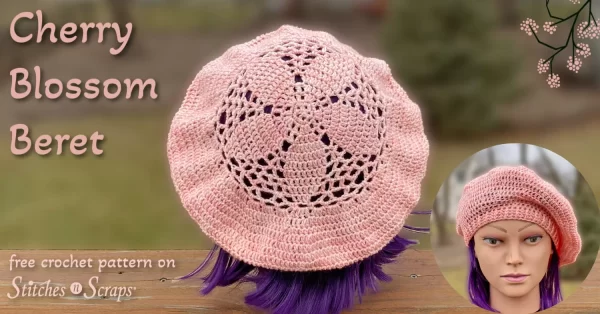
Welcome spring with pretty pink petals in the Cherry Blossom Beret! Delicate, floral lace and the classic style combine for a timeless look. This lovely beret crochet pattern includes 4 sizes from toddler to adult.

This content is protected by copyright. See this Terms of Use / Copyright page for more information.
This post contains sponsored content and/or affiliate links. If you click an affiliate link and make a purchase, I may get a commission.
Cherry Blossom Sock Yarn from Global Backyard Industries
Global Backyard Industries provided the Cherry Blossom Sock Yarn for this design. The blend of extrafine superwash merino wool and nylon is both squishy and strong. Varying shades of pink give the hand-dyed colorway a lovely tonal effect.
January Product of the Month
The Cherry Blossom Sock yarn is our January Product of the Month. Learn more about it in episode 120 of Lunchtime Live, plus get a coupon code good through the end of January 2023!

Crochet Flower Circle Tutorial
This crochet beret pattern starts with a central flower in a lacy circle. Watch the Crochet Flower Circle video tutorial for help with this section!
Make the flower circle as part of the beret, or all by itself! It’s lovely as a doily, wall hanging, or anywhere else you need a lacy crocheted circle.
Materials
- Yarn: 90 [100, 115, 110] yds Cherry Blossom Sock Yarn from Global Backyard Industries – 85% superwash extrafine merino / 15% nylon, fingering weight yarn (437yds / 100g per skein)
- Hooks:
- US size F (3.75 mm) hook or size needed to match gauge
- US size E (3.5 mm) hook or one size smaller than the larger hook
- Notions:
- Scissors
- Tapestry needle
Project Level
Intermediate: Lace pattern in the round, front and back post ribbing.
Sizes
Toddler [Child, Small, Large]
To fit head circumference: 16-18 [18-20, 20-22, 22-24] inches
Diameter at widest point: 9.5 [10.5, 12, 12] inches
Gauge
20 dc x 11 rnds= 4 inches.
Use pattern as gauge swatch: After rnd 7, work should measure approximately 4.25 inches in diameter
Abbreviations used
(Pattern is written in US terms)
bpdc = back post double crochet
ch = chain
dc2tog = double crochet 2 stitches together
fpdc = front post double crochet
hdc = half double crochet
rnd = round
sc = single crochet
sk = skip
sl st = slip stitch
sp = space
st(s) = stitch(es)
Instructions
Center Flower
(Scroll down for chart)
A video tutorial for this section is available here.
Join rounds where indicated with a sl st in the first st of the round.
Ch 5
Rnd 1: Sk first 4 chs (first 2 skipped chs count as an hdc, remaining 2 skipped chs count as a ch-2 sp), (hdc, ch 2) 4 times in 5th ch from hook, join with sl st in first st (this is the 2nd skipped ch), sl st in first ch-2 sp. (5 hdc, 5 ch-2 sps)
Rnd 2: Ch 1 (does not count as a st throughout), sc in same ch-2 sp, ch 3, sk next st, [sc in next ch-2 sp, ch 3, sk next st] 4 times, join. (5 sc, 5 ch-3 sps)
Rnd 3: Ch 3 (counts as dc throughout), 2 dc in first st, ch 1, dc in next ch-3 sp, ch 1, (3 dc in next st, ch 1, dc in next ch-3 sp, ch 1) 4 times, join. (20 dc, 10 ch-1 sps)
Rnd 4: Ch 3, dc in first st, dc in next st, 2 dc in next st, ch 1, sk next ch-1 sp, dc in next st, ch 1, sk next ch-1 sp, [2 dc in next st, dc in next st, 2 dc in next st, ch 1, sk next ch-1 sp, dc in next st, ch 1, sk next ch-1 sp] 4 times, join. (30 dc, 10 ch-1 sps)
Rnd 5: Ch 3, dc in first st, 2 dc in next st, dc in next st, 2 dc in each of next 2 sts, ch 3, sk next ch-1 sp, sk next st, sk next ch-1 sp, [2 dc in each of next 2 sts, dc in next st, 2 dc in each of next 2 sts, ch 3, sk next ch-1 sp, sk next st, sk next ch-1 sp] 4 times, join. (45 dc, 5 ch-3 sps)
Rnd 6: Ch 3, dc in each of next 8 sts, ch 2, sc in next ch-3 sp, ch 2, [dc in each of next 9 sts, ch 2, sc in next ch-3 sp, ch 2] 4 times, join. (45 dc, 5 sc, 10 ch-2 sps)
Rnd 7: Ch 3, dc in each of next 8 dc, ch 2, sk next ch-2 sp, (dc, ch 1, dc) in next sc, ch 2, sk next ch-2 sp, [dc in each of next 9 dc, ch 2, sk next ch-2 sp, (dc, ch 1, dc) in next sc, ch 2, sk next ch-2 sp] 4 times, join. (55 dc, 10 ch-2 sps, 5 ch-1 sps)
Rnd 8: Ch 2 (does not count as a st for the remainder of this section) sk first st, dc in each of next 6 sts, dc2tog, ch 3, sk next ch-2 sp, sk next st, (dc, ch 3, dc) in next ch-1 sp, ch 3, sk next st, sk next ch-2 sp, [dc2tog, dc in each of next 5 sts, dc2tog, ch 3, sk next ch-2 sp, sk next st, (dc, ch 3, dc) in next ch-1 sp, ch 3, sk next st, sk next ch-2 sp] 4 times, join. (36 dc, 9 dc2tog, 15 ch-3 sps)
Rnd 9: Ch 2, sk first st, dc in each of next 6 sts, ch 2, sc in next ch-3 sp, ch 2, sk next st, (dc, ch 3, dc) in next ch-3 sp, sk next st, ch 2, sc in next ch-3 sp, ch 2, [dc2tog, dc in each of next 5 sts, ch 2, sc in next ch-3 sp, ch 2, sk next st, (dc, ch 3, dc) in next ch-3 sp, sk next st, ch 2, sc in next ch-3 sp, ch 2] 4 times, join. (36 dc, 5 dc2tog, 20 ch-2 sps, 5 ch-3 sps)
Rnd 10: Ch 2, sk first st, dc in each of next 3 dc, dc2tog, ch 2, dc in next ch-2 sp, ch 1, sk next sc, dc in next ch-2 sp, ch 2, sk next dc, (dc, ch 3, dc) in next ch-3 sp, sk next dc, ch 2, dc in next ch-2 sp, ch 1, sk next sc, dc in next ch-2 sp, ch 2, [dc2tog, dc in each of next 2 dc, dc2tog, ch 2, dc in next ch-2 sp, ch 1, sk next sc, dc in next ch-2 sp, ch 2, sk next dc, (dc, ch 3, dc) in next ch-3 sp, sk next dc, ch 2, dc in next ch-2 sp, ch 1, sk next sc, dc in next ch-2 sp, ch 2] 4 times, join. (41 dc, 9 dc2tog, 10 ch-1 sps, 20 ch-2 sps, 5 ch-3 sps)
Rnd 11: Ch 2, sk first st, dc2tog, ch 2, sk next ch-2 sp, sk next dc, (dc, ch 3, dc) in next ch-1 sp, ch 2, sk next dc, sk next ch-2 sp, sk next dc, (dc, ch 3, dc) in next ch-3 sp, ch 2, sk next dc, sk next ch-2 sp, sk next dc, (dc, ch 3, dc) in next ch-1 sp, ch 2, sk next dc, sk next ch-2 sp, [dc2tog twice, ch 2, sk next ch-2 sp, sk next dc, (dc, ch 3, dc) in next ch-1 sp, ch 2, sk next dc, sk next ch-2 sp, sk next dc, (dc, ch 3, dc) in next ch-3 sp, ch 2, sk next dc, sk next ch-2 sp, sk next dc, (dc, ch 3, dc) in next ch-1 sp, ch 2, sk next dc, sk next ch-2 sp] 4 times, join. (31 dc, 9 dc2tog, 20 ch-2 sps, 15 ch-3 sps)
Rnd 12: Skipping all sts and working only into ch-sps, ch 4 (counts as ch-3 sp), sc in next ch sp, (ch 3, sc in next ch sp) around, join with sl st in first ch-3 sp. (35 sc, 35 ch-3 sps)
Rnd 13: Ch 3, 3 dc in same ch-3 sp, sk next st, [4 dc in next ch-3 sp, sk next st] around. (140 dc)
Rnd 14: Ch 3, dc in each of next 2 sts, [2 dc in next st, dc in each of next 13 sts] 9 times, 2 dc in next st, dc in each of last 10 sts. (150 dc)

Hat
Rnd 15: Ch 2 (counts as hdc), hdc in same st, hdc in each of next 24 sts, (2 hdc in next st, hdc in each of next 24 sts) around. (156 hdc)
Size Child only
Rnd 16: Ch 3, dc in each of next 5 sts, (2 dc in next st, dc in each of next 12 sts) 11 times, 2 dc in next st, dc in each of last 6 sts, join. (168 dc)
Rnd 17: Ch 3, dc in each of next 5 sts, (dc2tog, dc in each of next 12 sts) 11 times, dc2tog, dc in each of last 6 sts, join. (156 sts)
Size Small [Large] only
Rnd 16: Ch 3, dc in each of next 5 sts, (2 dc in next st, dc in each of next 12 sts) 11 times, 2 dc in next st, dc in each of last 6 sts, join. (168 dc)
Rnd 17: Ch 3, hdc in same st, hdc in each of next 13 sts, (2 hdc in next st, hdc in each of next 13 sts) around. (180 dc)
Rnd 18: Ch 3, dc in each of next 6 sts, (2 dc in next st, dc in each of next 14 sts) 11 times, 2 dc in next st, dc in each of last 7 sts, join. (192 dc)
Rnd 19: Ch 3, dc in each of next 6 sts, (dc2tog, dc in each of next 14 sts) 11 times, dc2tog, dc in each of last 7 sts, join. (180 sts)
Rnd 20: Ch 2, sk first st, dc in each of next 14 sts, (dc2tog, dc in each of next 13 sts) around. (168 dc)
Rnd 21: Ch 3, dc in each of next 5 sts, (dc2tog, dc in each of next 12 sts) 11 times, dc2tog, dc in each of last 6 sts, join. (156 sts)
All Sizes
Rnd 16 [18, 22, 22]: Ch 2, sk first st, dc in each of next 12 sts, (dc2tog, dc in each of next 11 sts) around. (144 dc)
Rnd 17 [19, 23, 23]: Ch 3, dc in each of next 4 sts, (dc2tog, dc in each of next 10 sts) 11 times, dc2tog, dc in each of last 5 sts, join. (132 sts)
Rnd 18 [20, 24, 24]: Ch 2, sk first st, dc in each of next 10 sts, (dc2tog, dc in each of next 9 sts) around. (120 dc)
Rnd 19 [21, 25, 25]: Ch 3, dc in each of next 3 sts, (dc2tog, dc in each of next 8 sts) 11 times, dc2tog, dc in each of last 4 sts, join. (108 sts)
Rnd 20 [22, 26, 26]: Ch 2, sk first st, dc in each of next 8 sts, (dc2tog, dc in each of next 7 sts) around. (96 dc)
Rnd 21 [23, 27, 27]: Ch 3, dc in each of next 2 sts, (dc2tog, dc in each of next 6 sts) 11 times, dc2tog, dc in each of last 3 sts, join. (84 sts)
Size Toddler only
Rnd 22: Ch 2, sk first st, dc in each of next 6 sts, (dc2tog, dc in each of next 5 sts) around. (72 dc)
Rnd 23: Ch 3, dc in each of next 2 sts, (dc2tog, dc in each of next 10 sts) 5 times, dc2tog, dc in each of next 8 sts. (66 dc)
Size Child only
Rnd 24: Ch 2, sk first st, dc in each of next 6 sts, (dc2tog, dc in each of next 5 sts) around. (72 dc)
Size Small only
Rnd 28: Ch 2, sk first st, dc in each of next 13 sts, (dc2tog, dc in each of next 12 sts) around. (78 dc)
All Sizes
Rnd 24 [25, 29, 28]: Ch 3, dc in next st and in each st around, join.
Ribbing
Change to smaller hook.
Rnd 25-27 [26-28, 30-32, 29-32]: Ch 2 (counts as bpdc), fpdc around next st, [bpdc around next st, fpdc around next st] around, join. (33 [36, 39, 42] bpdc, 33 [36, 39, 42] fpdc)

Fasten off.
Weave in all ends.
Wash and block flat.
Share this beret crochet pattern on Pinterest!
Here’s an image perfect for pinning.

Rate this beret crochet pattern!
I hope you enjoyed this beret crochet pattern. A downloadable pdf of this pattern is available on Ravelry for a small fee. The fee for the pdf format is to offset the advertising revenue lost when you print or download the pattern rather than viewing it online.
Do you want the best of Stitches n Scraps delivered right to your inbox? Don’t miss a stitch – Subscribe now!

String of Pearls Crochet Table Scarf
Bobble “pearls” dance in intertwining lines over a plain background, forming circles to cradle a centerpiece or other table decorations. The simple, tone-on-tone elegance of the String of Pearls crochet table scarf is perfect for holidays, weddings, or any time your table needs a special touch.

This content is protected by copyright. See this Terms of Use / Copyright page for more information.
This post contains sponsored content and/or affiliate links. If you click an affiliate link and make a purchase, I may get a commission.
King Cole Big Value Recycled Dischloth Cotton
King Cole yarns provided the Big Value Recycled Dishcloth Cotton yarn for this design. A little bit of polyester mixed in makes this softer than other cotton yarns I’ve used. I also love that it’s made with recycled materials.

It comes in 2 colors, white and cream. Both would make an excellent base for dyeing, and both are equally lovely as-is.
Changing Colors
For neat color changes, always switch to the new color in the last “pull through” step of the previous stitch. So if you’re going to change to cream for a bobble, finish the stitch before the bobble with the cream yarn. See this Changing Colors Tutorial for a closer look.
Carrying Colors
Between each bobble row on this crochet table scarf, there are 3 plain rows. You can think of this in terms of 4-row blocks, with one bobble row followed by 3 plain rows.
Carry yarn across for 2 rows
To make cream-colored bobbles on a white background, you will need to use both colors on the bobble rows. Just like for tapestry crochet, make each stitch in one color while carrying/working over the other color so it’s hidden inside the stitch.
In the next row after the bobble row, you don’t need to make any cream-colored stitches, but you will need to get the cream color yarn back across to the other side. Carry the cream yarn through every stitch, in the same way as before.

Carry yarn up for 2 rows
For the next 2 rows, you don’t need to move the cream yarn across the row at all. Instead, carry it up the side edge, so it’s ready for the next bobble row.
Carrying the yarn in 2 rows and then not carrying it in the other 2 rows creates a very subtle, striped effect behind the bobbles.
If you prefer, you can carry the unused yarn across every row. This will use almost twice as much of the cream yarn and will make your fabric thicker.
Dye Your Crochet Table Scarf!
If cream-on-white isn’t your thing, you can dye it! The two shades should take dye slightly differently, so you will still get the tone-on-tone look. You can dye the yarn before you start, or dye the crochet table scarf when it’s finished. Just be sure to test it on a small swatch first!
Here are a few yarn dyeing tutorials you might enjoy:
- How to Dye Cotton Yarn Beautifully from Nicki’s Homemade Crafts
- How to Hand Dye Yarn at Home from Dora Does
- Adventures in Yarn Dyeing from Jessie at Home
- How to Dye Yarn with Avocado Skins from Thoresby Cottage
Materials
- Yarn: King Cole Big Value Recycled Dishcloth Cotton – 85% cotton / 15% polyester, worsted weight yarn (175 yds / 100g per skein)
- 410 yds #5061 white
- 175 yds #5060 cream
- Hook: US size H (5 mm) hook or size needed to match gauge
- Notions:
- Scissors
- Yarn needle
Project Level
Intermediate: Bobbles, working with 2 colors, working in sides of rows.
Size
11″ x 45″ not including fringe
Gauge
15 sc x 16 rows = 4 inches.
Use pattern as gauge swatch: After row 16, work should measure 8.75″ wide x 4″ tall.
Abbreviations used
(Pattern is written in US terms)
ch = chain
hdc = half double crochet
RS = right side(s)
sc = single crochet
sc2tog = single crochet 2 stitches together
sk = skip
sl st = slip stitch
sp = space
st(s) = stitch(es)
WS = wrong side(s)
yo = yarn over
Special Stitch
Bobble (bo): With cream yarn, [yo, insert hook in indicated st and pull up a loop, yo and pull through 2 loops on hook] 5 times, yo and pull through all 6 loops on hook. Ch-1 to close.

When working into a bobble, work into the ch-1.
Instructions
Color Management:
Work bobbles in cream. Work all other stitches in white.
Change colors as indicated in the last “pull through” step of the previous stitch.

On bobble rows and the row immediately after a bobble row, carry/work over the unused color in each st so that it is hidden in the st.

On the remaining rows, work only with white and carry the cream yarn up the side edge.
Section 1
(Scroll down for chart)
Angled Portion:
With white, ch 2.
Row 1 (WS): (Hdc, sc, hdc) in 2nd ch from hook. (3 sts)
Your total stitch count will increase by 2 sts on each row through row 19.
Rows 2-4: Ch 1, turn, (hdc, sc) in first st, sc in each st across to last st, (sc, hdc) in last st. (9 sts)
Begin carrying/working over cream yarn in row 5.
Row 5: Working over unused color in every st, ch 1, turn, (hdc, sc) in first st, sc in each of next 3 sts, bo in next st, sc in each of next 3 sts, (sc, hdc) in last st. (2 hdc, 8 sc, 1 bo)
Row 6: Working over cream yarn in every st, ch 1, turn, (hdc, sc) in first st, sc in each st across to last st, (sc, hdc) in last st. (13 sts)
Rows 7-8: Carrying cream yarn up sides of rows and working only with white yarn, ch 1, turn, (hdc, sc) in first st, sc in each st across to last st, (sc, hdc) in last st. (17 sts)
Row 9: Working over unused color in every st, ch 1, turn, (hdc, sc) in first st, sc in each of next 3 sts, [bo in next st, sc in each of next 3 sts] 3 times, (sc, hdc) in last st. (2 hdc, 14 sc, 3 bo)
Rows 10-12: Repeat rows 6-8. (25 sts)
Row 13: Working over unused color in every st, ch 1, turn, (hdc, sc) in first st, sc in each of next 3 sts, [bo in next st, sc in each of next 5 sts, bo in next st, sc in each of next 3 sts] twice, (sc, hdc) in last st. (2 hdc, 21 sc, 4 bo)
Rows 14-16: Repeat rows 6-8. (33 sts)
Row 17: Working over unused color in every st, ch 1, turn, (hdc, sc) in first st, sc in each of next 3 sts, bo in next st, sc in each of next 5 sts, bo in next st, sc in each of next 11 sts, bo in next st, sc in each of next 5 sts, bo in next st, sc in each of next 3 sts, (sc, hdc) in last st. (2 hdc, 29 sc, 4 bo)
Rows 18-19: Repeat rows 6-7. (39 sts)

Straight portion
The overall stitch count will now remain the same until the end of section 5.
Row 20: Carrying cream yarn up sides of rows and working only with white yarn, ch 1, turn, sc in each st across.
Row 21: Working over unused color in every st, ch 1, turn, sc in each of first 5 sts, bo in next st, sc in each of next 5 sts, bo in next st, sc in each of next 15 sts, [bo in next st, sc in each of next 5 sts] twice. (35 sc, 4 bo)
Row 22: Working over cream yarn in every st, ch 1, turn, sc in each st across.
Rows 23-24: Carrying cream yarn up sides of rows and working only with white yarn, ch 1, turn, sc in each st across.
Rows 25-32: Repeat rows 21-24 twice.
Row 33: Working over unused color in every st, ch 1, turn, sc in each of first 7 sts, bo in next st, sc in each of next 5 sts, bo in next st, sc in each of next 11 sts, bo in next st, sc in each of next 5 sts, bo in next st, sc in each of last 7 sts. (35 sc, 4 bo)
Rows 34-36: Repeat rows 22-24.
Row 37: Working over unused color in every st, ch 1, turn, sc in each of first 11 sts, bo in next st, sc in each of next 5 sts, bo in next st, sc in each of next 3 sts, bo in next st, sc in each of next 5 sts, bo in next st, sc in each of last 11 sts. (35 sc, 4 bo)
Rows 38-40: Repeat rows 22-24.
Row 41: Working over unused color in every st, ch 1, turn, sc in each of first 15 sts, [bo in next st, sc in each of next 3 sts] twice, bo in next st, sc in each of last 15 sts. (36 sc, 3 bo)
Section 2:
(Scroll down for chart)
Rows 42-44: Repeat rows 22-24.
Row 45: Repeat row 37.
Rows 46-48: Repeat rows 22-24.
Row 49: Repeat row 33.
Rows 50-52: Repeat rows 22-24.
Rows 53-64: Repeat rows 21-24 three times.
Rows 65-73: Repeat rows 33-41.

Section 3:
(Scroll down for chart)
Rows 74-84: Repeat rows 42-52.
Row 85: Working over unused color in every st, ch 1, turn, sc in each of first 5 sts, bo in next st, sc in each of next 3 sts, bo in next st, sc in each of next 19 sts, bo in next st, sc in each of next 3 sts, bo in next st, sc in each of last 5 sts. (35 sc, 4 bo)
Rows 86-88: Repeat rows 21-24 three times.
Rows 89-96: Repeat rows 85-88 twice.
Rows 97-105: Repeat rows 33-41.

Section 4:
Use same chart as Section 2.
Rows 106-137: Repeat rows 42-73. (Section 2)
Section 5:
(Scroll down for chart)
Straight Portion:
Rows 138-145: Repeat rows 42-49.
Rows 146-148: Repeat rows 22-24.
Row 149: Repeat row 21.
Rows 150-157: Repeat rows 146-149 twice.
Row 158: Working over cream yarn in every st, ch 1, turn, sc in each st across.

Angled Portion
Total stitch count will now decrease by 2 sts in every row.
Rows 159-160: Carrying cream yarn up sides of rows and working only with white yarn, ch 1, turn, sc2tog in first 2 sts, sc in each st across to last 2 sts, sc2tog in last 2 sts. (37 sts)
Row 161: Working over unused color in every st, ch 1, turn, sc2tog in first 2 sts, sc in each of next 3 sts, bo in next st, sc in each of next 5 sts, bo in next st, sc in each of next 11 sts, bo in next st, sc in each of next 5 sts, bo in next st, sc in each of next 3 sts, sc2tog in last st. (2 sc2tog, 29 sc, 4 bo)
Row 162: Working over cream yarn in every st, ch 1, turn, sc2tog in first 2 sts, sc in each st across to last 2 sts, sc2tog in last 2 sts. (33 sts)
Rows 163-164: Repeat rows 159-160. (29 sts)
Row 165: Working over unused color in every st, ch 1, turn, sc2tog in first 2 sts, sc in each of next 3 sts, [bo in next st, sc in each of next 5 sts, bo in next st, sc in each of next 3 sts] twice, sc2tog in last 2 sts. (2 sc2tog, 21 sc, 4 bo)
Row 166: Repeat row 162. (25 sts)
Rows 167-168: Repeat rows 159-160. (21 sts)
Row 169: Working over unused color in every st, ch 1, turn, sc2tog in first 2 sts, sc in each of next 3 sts, [bo in next st, sc in each of next 3 sts] 3 times, sc2tog in last 2 sts. (2 sc2tog, 14 sc, 3 bo)
Row 170: Repeat row 162. (17 sts)
Rows 171-172: Repeat rows 159-160. (13 sts)
Row 173: Working over unused color in every st, ch 1, turn, sc2tog in first 2 sts, sc in each of next 3 sts, bo in next st, sc in each of next 3 sts, sc2tog in last 2 sts. (2 sc2tog, 6 sc, 1 bo)
Fasten off cream. Continue with white only.
Rows 174-176: Ch 1, turn, sc2tog in first 2 sts, sc in each st across to last 2 sts, sc2tog in last 2 sts. (3 sts)
Row 177: Ch 1, turn, sk first st, sc2tog in last 2 sts. (1 st)
Do not fasten off.
Edging:
With white, and continuing from section 5:
Ch 1, turn, working in sides of rows, sc in each row across angled edge to corner, ch 1, sc in each row along straight edge to next corner, ch 1, sc in each row along angled edge to point, ch 3, sc in each row across angled edge to next corner, ch 1, sc in each row along straight edge to next corner, ch 1, sc in each row along angled edge to starting point, ch 3, join with sl st to first st. (354 sc, 1 ch-3 sp)

Fasten off. Weave in all ends.
Fringe:
Cut 16 10-inch pieces of yarn.
Hold 8 pieces together and fold them in half to form a loop, matching the cut ends.
Locate the ch-3 sp at either point of the table scarf. Using your crochet hook, pull the loop about halfway through the ch-3 sp, from RS to WS.

Pull the tails of the fringe through the loop, so that they wrap over the chains of the ch-3 sp, then pull the ends to tighten the knot.

Attach the remaining 8 strands of yarn to the opposite point of the table scarf in the same manner.
Trim the fringe evenly to the same length on both points.

Share this crochet table scarf pattern on Pinterest!
Here’s an image perfect for pinning.

Rate this Crochet Table Scarf Pattern!
I hope you enjoyed this crochet table scarf pattern.
A downloadable pdf of this pattern is available on Ravelry for a small fee. The fee for the pdf format is to offset the advertising revenue lost when you print or download the pattern rather than viewing it online.
Do you want the best of Stitches n Scraps delivered right to your inbox? Don’t miss a stitch – Subscribe now!

Forest Walk Twisted Cowl Crochet Pattern
Take a magical, winter walk on wooded trails. Bare branches sparkle overhead with fresh snow, while frozen leaves crunch under your feet. Stay cozy and warm in the crisp winter air with the Forest Walk twisted cowl crochet pattern!

A twisted seam pulls the cowl in close, wrapping your neck in clouds of dense, squishy fabric. The pattern is fast and easy, with a 1-row repeat. It makes a great, last-minute gift!
This content is protected by copyright. See this Terms of Use / Copyright page for more information.
This post contains sponsored content and/or affiliate links. If you click an affiliate link and make a purchase, I may get a commission.
Giftstravaganza Crochet Along
I designed this twisted cowl crochet pattern for the 2022 Giftstravaganza CAL, hosted by Underground Crafter.

See the full schedule in the main CAL post, and check out all the great gift ideas for everyone on your list!
King Cole Forest Aran Recycled Yarn
King Cole gave me the Forest Aran yarn for this design. This truly unique yarn is made from 100% recycled materials! It’s a blend of wool, acrylic, polyamide, and viscose fibers. The overall mix ends up feeling something like a soft cotton.

With so many different types of fibers, the color has a lot of depth to it as well. Each fiber takes dye slightly differently, resulting in a subtle, tonal effect with tiny flecks.
The lovely colors take their names from forests and wooded areas in the UK. The color I chose for this project, #1924 Red Brae Wood, is brand new. It’s a deep, woody red with a bit of plum in it.
See all the lovely colors on the King Cole website, and then use the “Find a Stockist” tool to find this yarn near you!
Materials
- Yarn: 220 yds King Cole Forest Aran worsted weight yarn (35% wool, 20% acrylic, 20% polyamide, 25% viscose. 100 g / 328 yds per skein)
- Hook: US size J (6 mm) crochet hook or size needed to match gauge
- Notions:
- Yarn needle
- Stitch markers, pins, or clips (for seaming)
Project Level
Easy – Basic stitches, crocheting across sides of rows, twisted seaming.
Size
8″ x 24.5″ before seaming
8″ x 12″ after seaming
Gauge
In pattern, 14 sts x 9 rows = 4″
Use pattern as gauge swatch: After row 9, work should measure approximately 7″ x 4″.
Exact gauge is not critical but will affect yardage needed.
Abbreviations
This pattern uses US crochet terms
ch = chain
dc = double crochet
RS = right side(s)
sc = single crochet
sk = skip
sl st = slip stitch
st(s) = stitch(es)
WS = wrong side(s)
Recommended Resource
- Tunisian Twist Ear Warmer Video Tutorial (shows the same twisted seam, starting at 08:15)
Instructions
Scroll down for chart.
Cowl
Foundation: Ch 26 (multiple of 3 + 2)
Row 1 (RS): (Sc, 2 dc) in 2nd ch from hook, sk next 2 chs, [(sc, 2 dc) in next ch, sk next 2 chs] across to last ch, sc in last ch. (9 sc, 16 dc)
Row 2: Ch 1, turn, (sc, 2 dc) in first sc, sk next 2 dc, [(sc, 2 dc) in next sc, sk next 2 dc] across to last sc, sc in last sc. (9 sc, 16 dc)
Rows 3-54: Repeat row 2.
Cowl should now measure approximately 24 inches in length. To adjust length, work more or fewer repeats of row 2 as desired, ending after a WS (even numbered) row.

Edging
First short edge: Ch 1, turn, sc in each st across. (25 sc)
First long edge: Ch 1, working in sides of rows, skip the short edge row you just worked, [(sc, 2 dc) in next row, sk next row] across. (27 sc, 54 dc)

For 2nd short edge, treat each pair of skipped chains as a ch-2 sp.
2nd short edge: Ch 1, working in bottom of foundation ch, sc in first ch, (2 sc in next ch 2 sp, sc in next ch) across. (25 sc).
2nd long edge: Ch 1, working in sides of rows, skip the short edge row you just worked, [(sc, 2 dc) in next row, sk next row] across to first short edge, ch 1, join with a sl st to first st of edging. (27 sc, 54 dc)
Fasten off leaving a long tail for sewing.
Weave in starting end.
Cowl and Edging Chart

Twisted Seam
Lay work flat with RS up. On each short edge, pinch the ends together so that the short edge folds in the middle.

Bring the two folded ends together and insert them into each other so that the layers alternate as shown. Make sure the ends are lined up evenly. Secure in place with stitch markers, pins or clips.

Sew across short edge, working through all 4 layers. It is important to make sure the ends of each layer are caught up in the seam, otherwise they will stick out later.

Finishing
Weave in all ends
Turn cowl right side out and pull on the sides of the seam to make it lay nicely.

Share this pattern on Pinterest! Here’s an image perfect for pinning:

Rate this twisted cowl crochet pattern!
I hope you enjoyed this twisted cowl crochet pattern. A downloadable pdf of this pattern is available on Ravelry for a small fee.
Do you want the best of Stitches n Scraps delivered right to your inbox? Don’t miss a stitch – Subscribe now!

Snowflake Crochet Coin Purse Pattern
Sometimes smaller is better. This snowflake crochet coin purse is just the right size for a few essentials. White embroidery adds a festive, finishing touch on the solid red background.

This content is protected by copyright. See this Terms of Use / Copyright page for more information.
This post contains sponsored content and/or affiliate links. If you click an affiliate link and make a purchase, I may get a commission.
2022 Bag Along CAL
This snowflake crochet coin purse is the final pattern in the 2022 Bag Along CAL. With this bag, we will have crocheted along through 6 different patterns, with multiple technique tutorials for each. See the main CAL post for the full schedule and links to previous patterns.
Enter the Giveaway
There was a giveaway to go along with each new bag pattern, which means this will be our final giveaway as well. All the giveaway details and entry forms are in the first post for the bag, which also lists all the materials needed

The giveaway prizes for the CAL are all sponsored by WeCrochet. This final giveaway ends on December 26th, 2022 at 11:59pm, central time, so be sure to get your entries in!
Knit Picks Shine Sport
WeCrochet also provided all of the Knit Picks yarns for the bag designs. For this cabled crochet tote bag pattern, I chose Shine Sport. This cotton/modal blend is not only shiny, it’s also super soft and strong!

In comes in rich, saturated tones, as well as a few pastel colors and neutrals. I chose #24488 serrano for my bag, with #24486 white for the embroidery. Other wintery or festive combinations that would work well are white embroidery on #25336 Sailor, #25345 Currant, #24487 Serenade, or #24485 Black.
Bag Along CAL Tutorials
For each bag in the crochet along, there are 2 or more associated technique tutorials. For this snowflake crochet coin purse, there will be three. As they are posted, I will update the links here.
- Split Single Crochet Stitch in Rounds and Rows
- Embroidered Snowflakes and Surface Crochet
- Attaching the purse frame (coming soon)
See the main CAL post for the full schedule of patterns and tutorials.
Materials
- Yarn: Knit Picks Shine Sport – 60% Pima Cotton / 40% Modal natural beech wood fiber, sport weight yarn (110 yds / 50g per skein)
- 90 yds #24488 Serrano
- 5 yds #24486 White
- Hook: US size F (3.75 mm) hook or size needed to match gauge
- Notions:
- Scissors
- Yarn needle
- Stitch marker
- 3 – 3.5″ Metal purse frame (see note)
- Sewing needle
- Sewing thread to match the Serrano yarn (or clear nylon thread)
Note: The frame I used is nearly square and measures about 3.25″ on each side, for a total perimeter of 13″. The width of the frame is less important than the total perimeter when open. If your frame is not quite square, it may be slightly wider or narrower but have the same total perimeter. The total perimeter of your purse frame should be 12.5-13.5″ when open.

Project Level
Intermediate: Split stitches in the round, embroidery and sewing to metal frame.
Size
Bottom: 3.25″ x 3.25″
Height: 4″
Gauge
16 ssc x 22 rnds = 4 inches.
Use pattern as gauge swatch – Bottom should measure approximately 3.25″ square.
Abbreviations used
(Pattern is written in US terms)
blo = back loop only
ch = chain
rnd = round
RS = right side(s)
sc = single crochet
sk = skip
sl st = slip stitch
sp = space
ssc = split single crochet
st(s) = stitch(es)
Recommended Resources
- Split / Center Stitches in the Round
- Split Single Crochet Tutorial (coming soon)
- Embroidery for Snowflake Coin Purse (coming soon)
- Attaching a Metal Purse Frame (coming soon)
Special Stitch
Split single crochet (ssc): Insert hook between the legs of indicated st, draw up a loop, yarn over and draw through both loops on hook.

This stitch is also known as waistcoat stitch or centered single crochet.
Instructions
Join rnds where indicated with a sl st in the first st of the rnd.
Bottom
With serrano, ch 2.
Rnd 1 (RS): [Sc, ch 1] 4 times in 2nd ch from hook, join, sl st in first ch-1 sp. (4 sc, 4 ch-1 sps)
Rnd 2: Ch 1, (sc, ch 1, sc) in first ch-1 sp, ssc in next st, [(sc, ch 1, sc) in next ch-1 sp, ssc in next st] around, join. (8 sc, 4 ssc, 4 ch-1 sps).
Rnd 3: Ch 1, ssc in first st, ch 1, sk next ch-1 sp, [ssc in each st across to next ch-1 sp, ch 1, sk next ch-1 sp] three times, ssc in each remaining st across, join, sl st in first ch-1 sp. (12 ssc, 4 ch-1 sps)
Rnd 4: Ch 1, (sc, ch 1, sc) in first ch-1 sp, ssc in each st across to next ch-1 sp, [(sc, ch 1, sc) in next ch-1 sp, ssc in each st across to next ch-1 sp] around, join, sl st in first ch-1 sp. (8 sc, 12 ssc, 4 ch-1 sps)
Rnd 5: Ch 1, (sc, ch 1, sc) in first ch-1 sp, ssc in each st across to next ch-1 sp, [(sc, ch 1, sc) in next ch-1 sp, ssc in each st across to next ch-1 sp] around, join. (8 sc, 20 ssc, 4 ch-1 sps)
Rnd 6-7: Repeat rnds 3-4. (8 sc, 28 ssc, 4 ch-1 sps)
Rnd 8: Repeat rnd 4. (8 sc, 36 ssc, 4 ch-1 sps)
Bottom should measure approximately 3.25 inches square. The perimeter (13 inches) should be approximately the same as the perimeter of your frame.

Body
Rnd 9: Ch 1, sc in first ch-1 sp, ssc in each of next 11 sts, [sc in next ch-1 sp, ssc in each of next 11 sts,] around, join with sl st in blo of first sc. (4 sc, 44 ssc)
Rnds 10-34: Ch 1, sc in blo of first st, ssc in each of next 11 sts, [sc in blo of next st, ssc in each of next 11 sts] around, join with sl st in blo of first sc.
Fasten off. Weave in all ends.

Surface Crochet
Video tutorial for this section coming soon!
Working in back loop only has left a “ladder” of unused front loops in each corner.
Starting in any corner, insert hook into bag just underneath the bottom-most front loop (closest to the base).

Holding white yarn inside bag, draw up a loop of white.
Working towards the top of the bag, insert hook into bag just underneath next unworked front loop, draw up a loop, draw this loop through loop on hook (surface sl st made).

Surface sl st in this manner under each front loop to top of bag.

Fasten off.
Repeat for each of the other 3 corners.
Embroidered Snowflake
Video tutorial for this section coming soon!
With white yarn and yarn needle, embroider snowflakes as desired on 2 sides (front and back) of bag. Use the ssc sts as a grid to make 3 lines that cross each other in the middle. These are the spokes of the snowflake.

For larger snowflakes, embroider a small V shape near the tip of each spoke.

Use the tails to tack down any long “floats” on the inside of the bag. Weave in all ends.
Attach Purse Frame
Video tutorial for this section coming soon!
Stand bag up so base is flat and top opening forms a square.
Open purse frame flat. Match up the corners of the frame with the corners (surface crochet columns) of the bag.

If your purse frame is not perfectly square, you may need to adjust the top opening of the bag to fit the frame shape. In this case, your surface crochet columns may not be precisely in the corner. Just make sure that the front and back of the frame are centered. Mark the sts that will be the corners.
Using sewing thread and starting in right-front corner, sew frame to bag securely across front. I used a back stitch and went over each stitch twice. Make sure the next bag corner lines up with the next corner of the frame.

On the side edge, mark the center st. Sew frame to bag along the side edge so that the marked st is centered under the hinge. When you get to the hinge, where there are no holes to work into, skip 3 sts (or an odd number of sts that fits your frame), centered on the marked center st. Carry your thread through the skipped sts and continue sewing on the other side of the hinge.

Continue sewing bag to frame in the same manner for the other two sides of the bag.
Weave in the ends of your sewing thread and any other remaining ends.
From the inside of the bag, use yarn needle to push the top edge of the sts under the lip of the frame so that no sts are sticking out.

Share this crochet coin purse pattern on Pinterest! Here’s an image perfect for pinning.

Rate this Snowflake Crochet Coin Purse Pattern!
I hope you enjoyed this cabled crochet tote bag pattern.
A downloadable pdf of this pattern is available on Ravelry for a small fee. The fee for the pdf format is to offset the advertising revenue lost when you print or download the pattern rather than viewing it online.
Do you want the best of Stitches n Scraps delivered right to your inbox? Don’t miss a stitch – Subscribe now!

Crochet Cocoa Coaster Set Pattern
Winter means steaming mugs of rich hot chocolate, full of floating mini marshmallows. Cradle your cocoa and protect your tables with this crochet cocoa coaster set! It makes a great gift too.

4 coasters nestle inside the oversized mug, with squishy marshmallows in every layer. Even when all the coasters are in use, the mug is still half full!
This content is protected by copyright. See this Terms of Use / Copyright page for more information.
This post contains sponsored content and/or affiliate links. If you click an affiliate link and make a purchase, I may get a commission.
Holiday Stashdown Crochet Along
I designed this crochet cocoa coaster set for the 2022 Holiday Stashdown CAL, hosted by CAL Central Crochet. This is our 8th annual holiday stashdown, and it’s always our most popular CAL of the year.

See the full schedule in the main CAL post. While you’re there, be sure to enter the giveaway for a chance at some fabulous prizes! Then crochet along and join in the fun on the CAL Central Facebook group.
Cocoa Colors
Except for the marshmallows, this entire pattern is made holding 2 strands of yarn together as one. Using 2 similar shades of brown, with 1 strand of each shade, can add a bit of depth and dimension to your cocoa.

It’s a great way to use up small amounts of mismatched yarns or different dye lots. If you don’t have 2 similar browns though, it’s absolutely fine to use 2 strands of the same shade.
Materials
- Yarn: Worsted weight yarn
- 110 yds each of 2 shades of brown (or 220 yds of one shade)
- 150 yds blue
- 25 yds white
- Hooks:
- US size L (8 mm) crochet hook or size needed to match gauge
- Us size H (5 mm) crochet hook
- Notions:
- Stitch marker or scrap of yarn to use as a running stitch marker
- Yarn needle
- 4-inch diameter plastic mesh circle, or a larger circle that can be trimmed down.
- Fiber Fill
Project Level
Intermediate – Working in the round, some post stitches, some assembly.
Size
Coasters: 4″ diameter
Mug: 4.25″ diameter x 5″ height, not including handle.
Gauge
With larger hook and 2 strands of yarn held together: 9.5 sc x 10 rnds = 4″
Use pattern as gauge swatch. Each coaster should measure 4″ in diameter.
Exact gauge is not critical for this pattern, but will affect yardage.
Abbreviations used
bpsc = back post single crochet
ch = chain
hdc = half double crochet
RS = right side(s)
sc = single crochet
sk = skip
sl st = slip stitch
st(s) = stitch(es)
Recommended Resources
Instructions
Cocoa Coaster (make 5)
1 of the 5 coasters will be fixed inside the mug later, leaving you with 4 removable coasters.
Do not join rnds unless indicated, mark first st of each rnd.
With 1 strand each of the 2 shades of brown yarn together and using larger hook, ch 2, leaving a slightly longer tail than usual.
Rnd 1 (RS): 6 sc in 2nd ch from hook. (6 sc)
Rnd 2: 2 sc in each st around. (12 sc)
Rnd 3: [2 sc in next st, sc in next st] around. (18 sc)
Rnd 4: Sc in next st, 2 sc in next st, [sc in each of next 2 sts, 2 sc in next st] around to last st, sc in last st. (24 sc)
Rnd 5: [2 sc in next st, sc in each of next 3 sts] around. (30 sc)
Fasten off leaving a slightly longer tail than usual. Do not weave in ends.

Marshmallows (Make 15)
Pattern shows 3 marshmallows per coaster, but you can make as many or as few as you like.
With one strand of white and using smaller hook, ch 2.
Row 1: 3 sc in 2nd ch from hook. (3 sc)
Row 2: Ch 1, turn, sk first st, sc2tog in next 2 sts. (1 st)
Fasten off, leaving a long tail for sewing.

Sew marshmallows to coasters as desired, using long tail. Weave in white ends

Weave in brown ends, working over any white yarn that shows on the back to hide it.
Mug
Do not join rnds unless indicated, mark first st of each rnd.
Base
If your plastic mesh circle is larger than your coasters, trim plastic mesh circle to the same size as one of the coasters and set it aside.

If the mesh doesn’t work out exactly, err on the side of slightly smaller rather than larger.
With 2 strands of blue held together and using larger hook, ch 2.
Rnds 1-4: Repeat rnds 1-4 of coaster.
Rnd 5: (Hdc, sc) in next st, sc in each of next 3 sts, [2 sc in next st, sc in each of next 3 sts] around, join with sl st in first st. (1 hdc, 29 sc)
Rnd 6: Ch 1, bpsc around each st around, join with sl st in first st. (30 bpsc)
Rnds 7-10 Do not ch, sc in each st around. (30 sc)
Rnd 11: Hold 1 coaster against the sts of rnd 10, with WS together. Working through both layers, sc in each of first 20 sc.
Insert plastic mesh circle so that it lays flat along the bottom of mug.

Stuff base lightly with fiber fill – it should be firm enough to hold its shape, but not so stuffed that it bulges out. The coaster top should be flat.

Sc in each of remaining 10 sts around. (30 sc)

Sides
Rnd 12: [2 sc in next st, sc in each of next 14 sts] twice. (32 sc)
Rnds 13-16: Sc in each st around.
Rnd 17: Sc in each st around, join with a sl st to first st, fasten off.

Fasten off. Weave in ends
Handle
With 2 strands of blue held together and using larger hook, ch 16, leaving a long tail for sewing.
Rnd 1: Working in back bumps of ch, sc in 2nd ch from hook and each ch across, ch 1, working in opposite side of ch, sc in each ch across, do not join. (30 sc)
Fasten off, leaving a long tail for sewing.
Place either end of handle against mug with RS together. Line up end of handle with bottom of rnd 14 of sides (i.e about 4 rnds down from top), so that remainder of handle extends up above the top of the mug. This may look backwards, but you’ll be folding the handle back down after sewing it.

Separate the two strands of the tail at this end of the handle. Using each strand separately, sew handle to mug across rnds 14-15 only. Do not sew into top 2 rnds. Weave in ends separately.
Fold handle down, and align the other edge with top of rnd 7 (i.e. 2 rnds above the ridge on the bottom created by the fpsc stitches).

Separate the two strands of the tail at bottom of handle. Using each strand separately, sew handle to mug across bottom edge only.

Finishing
Weave in any remaining ends.
Remove any remaining stitch markers.
Place remaining 4 coasters inside mug.
Share this pattern on Pinterest! Here’s an image perfect for pinning:

Rate this crochet cocoa coaster set!
I hope you enjoyed this crochet cocoa coaster set pattern. A downloadable pdf of this pattern is available on Ravelry for a small fee.
Do you want the best of Stitches n Scraps delivered right to your inbox? Don’t miss a stitch – Subscribe now!

Chunky Crochet Hat – Clustered Columns
Columns of clusters give a lovely, all-over texture to this chunky crochet hat. With bulky weight yarn, the top-down pattern works up super fast. It’s great for gifting too! The pattern includes 6 roomy sizes, with written and charted instructions.

This content is protected by copyright. See this Terms of Use / Copyright page for more information.
This post contains sponsored content and/or affiliate links. If you click an affiliate link and make a purchase, I may get a commission.
Hat of the Month Crochet Along
I designed this hat for the 2022 Hat of the Month CAL. This year-long event is hosted by Rhondda from Oombawka Designs and Amy from The Stitchin Mommy. Follow along for 3 new hat patterns every month! The other two patterns this month are the Bright Blue Alpine Hat by Rhondda and the Dara Beanie by Amy.

Scarf of the Month Crochet Along
Rhondda and Amy also run a Scarf of the Month CAL. It works the same way as the hats, and I was the guest designer for October for that CAL as well. Get the Clustered Columns Scarf pattern, and make a matching set!
Don’t Miss the Coupon Codes!
As part of the CAL, each of the patterns is available free with a coupon code for one day only. The offer on this one has now expired. Visit the main Hat of the Month CAL and Scarf of the Month CAL posts and sign up for the monthly reminder emails so you don’t miss the next one!
King Cole Chunky Tweed Yarn
For this chunky crochet hat and scarf, I used King Cole Chunky Tweed Yarn in color #3486 Islay. The blend of acrylic, wool, and viscose is super fluffy and warm. Multi-colored flecks give it an overall tweedy effect.

Get yours right here in the Stitches n Scraps yarn shop! I’ve extended the sale for one more week – save 10% on Chunky Tweed through the end of October! (Sale ends at 11:59pm central time, Oct 31st). There are 5 vivid colors to choose from – which one will you pick?
Materials
- Yarn: 60 [80, 105, 150, 180, 200] yds King Cole Chunky Tweed bulky weight yarn (72% acrylic, 25% wool, 3% viscose)
- Hook: US size K (6.5 mm) crochet hook or size needed to match gauge
- Notions: Yarn needle
Project Level
Intermediate – Basic stitches and clusters, worked in the round. Multiple sizes. Crown increases in pattern.
Sizes
Newborn [Baby, Toddler, Child, S/M, L/XL]
To fit head circumference: 14 [16, 18, 20, 22, 24] inches
Gauge
10 dc x 6 rnds = 4″
Use pattern as gauge swatch. After rnd 2, work should measure 2.5 inches in diameter for all sizes.
Abbreviations used
ch = chain
cl = cluster
csdc = chainless starting double crochet
dc = double crochet
RS = right side
sc = single crochet
sp = space
st(s) = stitch(es)
yo = yarn over
Special Stitches
Cluster (cl): (Yo, insert hook in indicated sp, pull up a loop, yo, pull through 2 loops on hook) 4 times, yo and pull through all 5 loops on hook, ch 1 to close.

Chainless starting double crochet (csdc): Pull up a loop slightly taller than the height of a double crochet. Holding the top of the loop in place on your hook, wrap your hook around the loop counterclockwise. This wrap acts as a yarn over. Insert your hook into the first stitch and pull up a loop. [Yarn over and pull through 2 loops on your hook] twice.
The csdc counts as a dc in the stitch counts at the end of the row. See this csdc tutorial for a closer look.
Recommended Resources
Instructions
The pattern is split into two completely separate sets of instructions. One for newborn and baby sizes, and the other for all the other sizes.
If you prefer not to use the csdc stitch, you can replace “Csdc” with “Ch 3 (counts as dc)” wherever it appears throughout the pattern. You can replace “Csdc, ch 1” with “Ch 4 (counts as dc and ch 1)” wherever it appears.
Chart Symbol Key
There are several charts throughout this pattern – this is the symbol key for all of them.
In all the charts below, work only the black stitches. The greyed-out symbols show stitches from the previous section, and connecting stitches at the beginning/end of the round.
Newborn [Baby] hat
Crown
Scroll down for charts in each size
Rnd 1: Ch 2, 6 sc in 2nd ch from hook, join. (6 sc)
Rnd 2: Ch 2 (counts as ch-1 sp), sc in first st, (ch 1, sc) in each rem st around, join in first ch-1 sp. (6 sc, 6 ch-1 sps)
Rnd 3: (Csdc, ch 1, cl) in first ch-1 sp, ch 1, sk next sc, *(dc, ch 1, cl) in next ch-1 sp, ch 1, sk next sc, rep from * around, join. (6 dc, 6 cls, 12 ch-1 sps)
Rnd 4: Csdc in first st, ch 1, cl in next ch-1 sp, ch 1, sk next cl, cl in next ch-1 sp, ch 1, *dc in next dc, ch 1, cl in next ch-1 sp, ch 1, sk next cl, cl in next ch-1 sp, ch 1, rep from * around, join. (12 cl, 6 dc, 18 ch-1 sps)
Rnd 5: Ch 3 (counts as ch-2 sp), sk first st, [sc in next ch-1 sp, ch 1, sk next cl] twice, sc in next ch-1 sp, *ch 2, sk next dc, [sc in next ch-1 sp, ch 1, sk next cl] twice, sc in next ch-1 sp, rep from * around, join. (18 sc, 12 ch-1 sps, 6 ch-2 sps)
Rnd 6: Csdc, in first ch-2 sp, 1 [2] dc in same sp, [ch 1, sk next sc, cl in next ch-1 sp] twice, ch 1, sk next sc, *2 [3] dc in next ch-2 sp, [ch 1, sk next sc, cl in next ch-1 sp] twice, ch 1, sk next sc, rep from * around, join. (12 cl, 12 [18] dc, 18 ch-1 sps)
Newborn Crown Chart

Baby Crown Chart

Sides
Scroll down for charts in each size
Rnd 7: Ch 1, sc in each st across to first ch-1 sp, sc in first ch-1 sp, [ch 1, sk next cl, sc in next ch-1 sp] twice, *sc in each st to next ch-1 sp, sc in next ch-1 sp, [ch 1, sk next cl, sc in next ch-1 sp] twice, rep from * around, join. (30 [36] sc, 12 ch-1 sps)
Rnd 8: Csdc in first st, dc in next 1 [2] sts, [ch 1, sk next st, cl in next ch-1 sp] twice, ch 1, sk next st, *dc in each of next 2[3] sts, [ch 1, sk next st, cl in next ch-1 sp] twice, ch 1, sk next st, rep from * around, join. (12 cl, 12 [18] dc, 18 ch-1 sps)
Newborn size only: Rep rnd 7.
Baby size only: Rep rnds 7-8, then repeat rnd 7 once more.
Rnd 10 [12]: Ch 2 (does not count as a st), sk first st, dc in each st across to first ch-1 sp, dc in first ch-1 sp, dc in next st, dc in next ch-1 sp, dc in next st, *dc2tog, dc in each st across to next ch-1 sp, [dc in next ch-1 sp, dc in next st] twice, rep from * around, join. (36 [42] dc)
Rnds 11-12 [13-14]: Ch 1, sc in each st around, join.
Fasten off. Weave in ends
Toddler [Child, S/M, L/XL] Hat:
Crown
Scroll down for charts in each size
Rnd 1: Ch 2, 6 sc in 2nd ch from hook, join. (6 sc)
Rnd 2: Ch 2 (counts as ch-1 sp), sc in first st, (ch 1, sc) in each rem st around, join in first ch-1 sp. (6 sc, 6 ch-1 sps)
Rnd 3: (Csdc, ch 1, cl) in first ch-1 sp, ch 1, sk next sc, *(dc, ch 1, cl) in next ch-1 sp, ch 1, sk next sc, rep from * around, join. (6 dc, 6 cls, 12 ch-1 sps)
Rnd 4: Ch 1, sc in first st, ch 1, sc in next ch-1 sp, ch 1, sk next cl, sc in next ch-1 sp, ch 1, *sc in next dc, ch 1, sc in next ch-1 sp, ch 1, sk next cl, sc in next ch-1 sp, ch 1, rep from * around, join, sl st in first ch-1 sp. (18 sc, 18 ch-1 sps)
Rnd 5: Ch 2 (does not count as a st), cl in first ch-1 sp, [ch 1, sk next sc, cl in next ch-1 sp] twice, ch 2, sk next sc, *cl in next ch-1 sp, [ch 1, cl in next ch-1 sp] twice, ch 2, sk next sc, rep from * around, join. (18 cl, 12 ch-1 sps, 6 ch-2 sps)
Rnd 6: Ch 2 (counts as ch-1 sp), sk first cl, [sc in next ch-1 sp, ch 1, sk next cl] twice, 3 sc in next ch-2 sp, *ch 1, sk next cl, [sc in next ch-1 sp, ch 1, sk next cl] twice, 3 sc in next ch-2 sp, rep from * around, join. (30 sc, 18 ch-1 sps)
Rnd 7: Ch 2 (does not count as a st), cl in first ch-1 sp, [ch 1, sk next sc, cl in next ch-1 sp] twice, ch 1, sk next sc, 2 [2, 3, 2] dc in next sc, ch 1, sk next sc, *[cl in next ch-1 sp, ch 1, sk next sc] 3 times, ch 1, sk next sc, 2 [2, 3, 2] dc in next sc, ch 1, sk next sc, rep from * around, join. (18 cl, 12 [12, 18, 12] dc, 24 ch-1 sps)
Rnd 8: Ch 2 (counts as ch-1 sp), sk first cl, sc in next ch-1 sp, [ch 1, sk next cl, sc in next ch-1 sp] twice, 1 [1, 1, 2] sc in each dc to next ch-1 sp, sc in next ch-1 sp, *[ch 1, sk next cl, sc in next ch-1 sp] 3 times, 1 [1, 1, 2] sc in each dc to next ch-1 sp, sc in next ch-1 sp, rep from * around, join. (36 [36, 42, 48] sc, 18 ch-1 sps)
Toddler / Child Crown Chart

S/M Crown Chart

L/XL Crown Chart

Sides
Rnd 9: Ch 2 (does not count as a st), cl in first ch-1 sp, [ch 1, sk next st, cl in next ch-1 sp] twice, ch 1, sk next st, dc in each of next 2 [2, 3, 4] sts, ch 1, sk next st, *[cl in next ch-1 sp, ch 1, sk next st] 3 times, dc in each of next 2 [2, 3, 4] sts, ch 1, sk next st, rep from * around, join. (18 cl, 12 [12, 18, 24] dc, 24 ch-1 sps)
Rnd 10: Ch 2 (counts as ch-1 sp), sk first cl, sc in next ch-1 sp, [ch 1, sk next cl, sc in next ch-1 sp] twice, sc in each dc to next ch-1 sp, sc in next ch-1 sp, *[ch 1, sk next cl, sc in next ch-1 sp] 3 times, sc in each dc to next ch-1 sp, sc in next ch-1 sp, rep from * around, join. (36 [36, 42, 48] sc, 18 ch-1 sps)
Rep rnds 9-10 an additional 2 [3, 4, 4] times.
Rnd 15 [17, 19, 19]: Csdc in first ch-1 sp, [dc in next st, dc in next ch-1 sp] twice, dc in next 1[1, 2, 2] st(s), dc2tog, dc in each st across to next ch-1 sp, *dc in next ch-1 sp, [dc in next st, dc in next ch-1 sp] twice, dc in next 1 [1, 2, 2] st(s), dc2tog, dc in each st across to next ch-1 sp, rep from * around, join. (48 [48, 54, 54] dc)
Toddler size only:
Rnd 16: Ch 1, sc in each of first 14 sts, [sc2tog, sc in each of next 14 sts] twice, join. (45 sc)
Child [S/M] sizes only:
Rnds 18-19 [20-21]: Ch 1, sc in each st around, join.
L/XL size only:
Rnd 20: Csdc in first st, dc in each st around, join.
Rnd 21: Ch 1, sc in each st around, join.
All sizes: Fasten off. Weave in ends
Share this pattern on Pinterest! Here’s an image perfect for pinning:

Rate this chunky crochet hat!
I hope you enjoyed this chunky crochet hat pattern. A downloadable pdf of this pattern is available on Ravelry for a small fee.
Do you want the best of Stitches n Scraps delivered right to your inbox? Don’t miss a stitch – Subscribe now!

Chunky Crochet Scarf – Clustered Columns
Columns of clusters add a lovely texture to this chunky crochet scarf. With bulky weight yarn and a simple, 2-row repeat, you’ll have a fluffy and cozy scarf in no time! It’s great for gifts or charity projects too.

This content is protected by copyright. See this Terms of Use / Copyright page for more information.
This post contains sponsored content and/or affiliate links. If you click an affiliate link and make a purchase, I may get a commission.
Scarf of the Month Crochet Along
I designed this scarf for the 2022 Scarf of the Month CAL. This year-long event is hosted by Rhondda from Oombawka Designs and Amy from The Stitchin Mommy. Follow along for 3 new scarf patterns every month! The other two patterns this month are the Easy Crochet Pocket Scoodie by Rhondda and the Dara Infinity Scarf by Amy.

Hat of the Month Crochet Along
Rhondda and Amy also run a Hat of the Month CAL. It works the same way as the scarves, and I was the guest designer for October for that CAL as well. Get the Clustered Columns Hat pattern, and make a matching set!

Don’t Miss the Coupon Codes!
As part of the CAL, each of the patterns is available free with a coupon code for one day only. The offer on this one has now expired. Visit the main Hat of the Month CAL and Scarf of the Month CAL posts and sign up for the monthly reminder emails so you don’t miss the next one!
King Cole Chunky Tweed Yarn
For this chunky crochet scarf design, I used King Cole Chunky Tweed Yarn in color #3486 Islay. The blend of acrylic, wool, and viscose is super fluffy and warm. Multi-colored flecks give it an overall tweedy effect.

Get yours right here in the Stitches n Scraps yarn shop! This week only, it’s on sale for 10% off. There are 5 vivid colors to choose from – which one will you pick?
Materials
- Yarn: 400 yds King Cole Chunky Tweed bulky weight yarn (72% acrylic, 25% wool, 3% viscose)
- Hook: US size K (6.5 mm) crochet hook or size needed to match gauge
- Notions: Yarn needle
Project Level
Easy – Basic stitches and clusters.
Size
Approximately 7″ x 70″
Gauge
10 dc x 6 rows = 4″
Use pattern as gauge swatch – after row 8, works should measure approximately 7″ x 4″.
Abbreviations used.
Pattern uses US crochet terms.
ch = chain
cl = cluster
csdc = chainless starting double crochet
dc = double crochet
RS = right side
sc = single crochet
sp = space
st(s) = stitch(es)
WS = wrong side(s)
yo = yarn over
Recommended Resources
Special Stitches
Cluster (cl): (Yo, insert hook in indicated sp, pull up a loop, yo, pull through 2 loops on hook) 4 times, yo and pull through all 5 loops on hook, ch 1 to close.

Chainless starting double crochet (csdc): Pull up a loop slightly taller than the height of a double crochet. Holding the top of the loop in place on your hook, wrap your hook around the loop counterclockwise. This wrap acts as a yarn over. Insert your hook into the first stitch and pull up a loop. [Yarn over and pull through 2 loops on your hook] twice.
The csdc counts as a dc in the stitch counts at the end of the row. See this csdc tutorial for a closer look.
Instructions
If you prefer not to use the csdc stitch, you can replace “Csdc” with “Ch 3 (counts as dc)” wherever it appears throughout the pattern. You can replace “Csdc, ch 1” with “Ch 4 (counts as dc and ch 1)” wherever it appears.
Scroll down for chart.
Ch 19
Row 1 (RS): Ch 1, turn, sc in each ch across. (19 sc)
Row 2: Ch 1, turn, sc in each st across.
Row 3: Turn, csdc in first st, dc in next st and in each st across. (19 dc)
Row 4: Ch 1, turn, sc in each of first 2 sts, ch 1, sk next st, sc in each of next 4 sts, [ch 1, sk next st, sc in next st] 3 times, sc in each of next 3 sts, ch 1, sk next st, sc in each of last 2 sts. (14 sc, 5 ch-1 sps)
Row 5: Turn, csdc in first st, ch 1, sk next st, cl in next ch-1 sp, ch 1, sk next st, dc in each of next 2 sts, [ch 1, sk next st, cl in next ch-1 sp] 3 times, ch 1, sk next st, dc in each of next 2 sts, ch 1, sk next st, cl in next ch-1 sp, ch 1, sk next st, dc in last st. (6 dc, 5 cls, 8 ch-1 sps)
Repeat rows 4-5 an additional 55 times, then repeat row 4 once more.
Row 117: Turn, csdc in first st, dc in each remaining st and sp across. (19 dc)
Rows 118-119: Repeat row 2.
Fasten off. Weave in all ends
Share this pattern on Pinterest! Here’s an image perfect for pinning:

Rate this chunky crochet scarf!
I hope you enjoyed this chunky crochet scarf pattern. A downloadable pdf of this pattern is available on Ravelry for a small fee.
Do you want the best of Stitches n Scraps delivered right to your inbox? Don’t miss a stitch – Subscribe now!

Convergence 12-inch crochet square
Layers of texture converge in the center of this 12-inch crochet square. The shifting stitch patterns and unique construction are as fun to make as they are to look at. Make it all in one color for a more subtle effect, or go bold with multiple colors!

This content is protected by copyright. See this Terms of Use / Copyright page for more information.
This post contains sponsored content and/or affiliate links. If you click an affiliate link and make a purchase, I may get a commission.
Moogly Afghan Crochet Along
This 12-inch crochet square is my design for the 2022 Moogly Afghan Crochet Along. Crochet along with Tamara through 24 fantastic afghan squares. Check out the main post for the full schedule, ideas for projects to make with your squares, and giveaway details too!
Tamara used 6 different colors to make this square. See her version, along with her notes and tips.
Red Heart With Love Yarn
Yarnspirations provided the Red Heart With Love yarn for this design. I’ve participated in this CAL for several years, and never use up all the yarn they send. So this year, I used some of the leftovers!

I love how soft this yarn is, and it’s available in a wide variety of colors. My color choices this year were Pewter, Boysenberry, and Tan. Which ones will you choose for your square?
Video Tutorial
Need a little help? Check out the full video tutorial for this 12-inch crochet square pattern!
Previous 12-inch Crochet Squares
It’s hard to believe, but this is my 8th year designing for this crochet along! Here are all of my previous 7 squares.
Horizontal Puff Stitches
This pattern uses horizontal puff stitches, which can be made in many different ways. The ones in this square are essentially traditional puff stitches worked around the posts of 3 double crochets. Check out this Lunchtime Live Episode for a deeper dive into the topic of horizontal puff stitches, including several other variations.
Materials
- Yarn: Red Heart With Love worsted weight, 100% acrylic yarn – 50 yds each of
- #1401 Pewter (A)
- #1907 Boysenberry (B)
- #1308 Tan (C)
- Hook: US size J (6 mm) crochet hook or size needed to match gauge
- Notions: Yarn needle
Project Level
Intermediate – unique construction, front and back post stitches, working in back loop only, shells, puffs, and horizontal puffs.
Size
12 inches square
Gauge
13 sc x 15 rows = 4 inches
Abbreviations used
blo = back loop only
bpdc = back post double crochet
ch = chain
dc = double crochet
fpdc = front post double crochet
hdc = half double crochet
h-puff = horizontal puff (see Special Stitches)
puff = puff stitch (see Special Stitches)
rnd = round
RS = right side
sc = single crochet
sl st = slip stitch
sp = space
st(s) = stitch(es)
WS = wrong side(s)
yo = yarn over
Recommended Resources
Special Stitches
Puff Stitch (puff): (Yo, insert hook in indicated st, pull up a loop) 5 times, yo and pull through all 11 loops on hook, ch 1.

Horizontal Puff (h-puff): This is essentially a puff stitch worked around a group of 3 dc stitches. You may find it helpful to rotate your work 90 degrees while making the puff portion of the stitch.
Dc in each of next 3 sts, (yo, insert hook from front to back and out the front again (like for a front post stitch) around all 3 dc just made, pull up a loop to the height of your hook) 5 times, yo and pull through all 11 loops on hook, ch 1.

Notice at the top of the h-puff stitch, you will see 5 “v” shapes. 3 of these come from the dc stitches, 1 is the top of the actual puff stitch, and 1 is from the closing chain.

On the next row, you will be making 3 stitches into the puff. Work these into the center 3 of the 5 vs. I.e., into the top of the puff, and the first 2 dcs.
Instructions
The main portion of the square is made with 2 triangles, joined together along the center diagonal line. Starting ch-3 counts as a dc throughout – feel free to replace this with a chainless starting double crochet (csdc) or any other method you prefer for starting dc rows.
Triangle (make 2)
Scroll down for charted version of this section.
Shells
With A, ch 4.
Row 1: 2 dc in 4th ch from hook (skipped chs count as additional dc). (3 dc)
Row 2: Ch 3 (counts as dc throughout), turn, dc in first st, ch 1, puff in next st, ch 1, 2 dc in last st. (4 dc, 1 puff, 2 ch-1 sps)
Row 3: Ch 3, turn, (dc, ch 1, 2 dc) in first st, sk next st, sk next ch-1 sp, sc in next st, sk next ch 1 sp, sk next st, (2 dc, ch 1, 2 dc) in last st. (1 sc, 8 dc, 2 ch-1 sps)
Row 4: Ch 4 (counts as dc and ch 1), turn, 2 dc in first st, sk next st, sc in next ch-1 sp, sk next 2 sts, (2 dc, ch 1, 2 dc) in next st, sk next 2 sts, sc in next ch-1 sp, sk next st, (2 dc, ch 1, dc) in last st. (2 sc, 10 dc, 3 ch-1 sps
Row 5: Ch 3, turn, 2 dc in first st, sc in next ch-1 sp, [sk next 2 sts, (2 dc, ch 1, 2 dc) in next st, sk next 2 sts, sc in next ch-1 sp] twice, 3 dc in last st, change to B.
Row 6: With B, ch 1 (does not count as a st throughout), turn, working in blo of all sts and working as normal into ch sps, 2 sc first st, [sc in next st, hdc in next st, dc in next st, hdc in next st, sc in next st, sc in next ch-1 sp] twice, sc in next st, hdc in next st, dc in next st, hdc in next st, sc in next st, 2 sc in last st. (12 sc, 6 hdc, 3 dc)

Rice Stitch
Row 7: Ch 1, turn, 2 hdc in first st, hdc in each st across to last st, 2 hdc in last st. (23 hdc)
Row 8: Ch 1, turn, 2 hdc in first st, (fpdc around next st, bpdc around next st) across to last 2 sts, fpdc around next st, 2 hdc in last st. (4 hdc, 11 fpdc, 10 bpdc)
Row 9: Ch 1, turn, 2 hdc in first st, (bpdc around next st, fpdc around next st) across to last 2 sts, bpdc around next st, 2 hdc in last st. (4 hdc, 11 fpdc, 12 bpdc)
Row 10: Repeat row 8, change to C. (4 hdc, 13 fpdc, 12 bpdc)

Horizontal Puffs
Row 11: With C, ch 1, turn, 2 hdc in first st, fpdc around each st across to last st, 2 hdc in last st. (4 hdc, 27 fpdc)
Row 12: Ch 3, turn, dc in first st, dc in next st, h-puff 9 times, dc in next st, 2 dc in last st. (9 h-puffs, 6 dc)
Row 13: Ch 1, turn, 2 sc in first st, sc in each of next 2 sts, 3 sc in each h-puff across to last 3 sts, sc in each of next 2 sts, 2 sc in last st. (35 sc)
For 1st triangle, fasten off.
For 2nd triangle, do not fasten off.

Joining Triangles
Hold both triangles with WS together and the last row on top.
With C, and working through both layers, (sl st, ch 1) in each st across to last st, sl st in last st. (35 sl sts, 34 chs)
You should now have a square with your working yarn at 1 corner, and RS facing. Do not fasten off.

Border
Scroll down for charted version of this section.
Border is worked in rounds. Do not turn your work unless indicated.
Color changes in this section are made by fastening off one color and joining the next color in any ch-1 sp. If you are working in only one color, do not fasten off. Instead, just sl st across to the next ch-1 sp.
With C and with RS facing, continue from the corner where you ended the joining.
Rnd 1: Ch 2 (counts as ch-1 sp), [work 25 hdc evenly spaced across to next corner, ch 1] 3 times, work 25 hdc evenly spaced to starting corner, join with sl st in starting ch-1 sp. (100 hdc, 4 corner ch-1 sps)
Rnd 2: Ch 1, [(hdc, ch 1, hdc) in ch-1 sp, bpdc around each st across to next ch-1 sp] 4 times, join with sl st to first hdc. (8 hdc, 100 bpdc, 4 corner ch-1 sps)
Fasten off C, join B with sl st in any corner ch-1 sp.
Working around the posts from rnd 1 has left the tops of those sts unused. When working “below” the indicated st on rnd 3, work into those unused tops of the sts.
Rnd 3: With B, (2 sc, ch 1, 2 sc) in ch-1 sp, *sc in each of next 3 sts, [dc in hdc below next st, sc in each of next 3 sts] across to next ch-1 sp, (2 sc, ch 1, 2 sc) in next ch-1 sp, rep from * twice more, sc in each of next sts, [dc in hdc below next st, sc in each of next 3 sts] across, join with sl st to first sc. (100 sc, 24 dc, 4 corner ch-1 sps)
Fasten off B, join A with sl st in any corner ch-1 sp.
Rnd 4: With A, Repeat rnd 2. (8 hdc, 124 bpdc, 4 corner ch-1 sps)
Rnd 5: Ch 1, [(hdc, ch 1, hdc) in ch-1 sp, hdc in each st across to next ch-1 sp] 4 times, join with sl st to first hdc, fasten off. (140 hdc, 4 corner ch-1 sps)
If needed, you can repeat rnd 5 until your square reaches 12 inches.
Finishing
Fasten off
Weave in ends
Wash and block.
Share this pattern on Pinterest! Here’s an image perfect for pinning:

Rate this 12-inch crochet square!
I hope you enjoyed this 12-inch crochet square pattern. A downloadable pdf of this pattern is available on Ravelry for a small fee.
Do you want the best of Stitches n Scraps delivered right to your inbox? Don’t miss a stitch – Subscribe now!

Cabled Crochet Tote Bag Pattern
Back to school or back to work, carry what you need in the Classic Cables Tote Bag! Columns of cables create a classic look that’s fabulous for fall. This cabled crochet tote bag pattern includes an optional lining and pocket for the strength to carry all your essentials.

This content is protected by copyright. See this Terms of Use / Copyright page for more information.
This post contains sponsored content and/or affiliate links. If you click an affiliate link and make a purchase, I may get a commission.
2022 Bag Along CAL
The Classic Cables Tote Bag is the fourth pattern in the 2022 Bag Along CAL. Crochet along through 6 different bag patterns, with multiple technique tutorials for each. See the main CAL post for the full schedule.
Enter the Giveaway
With each new bag pattern, there will be a new giveaway as well! All the giveaway details and entry forms will be in the first post for each bag, which will also list all the materials needed for that bag. Here is the materials list and giveaway info for bag number 5.
The giveaway prizes for the CAL are all sponsored by WeCrochet. This fifth giveaway ends on October 28th, 2022 at 11:59pm, central time, so be sure to get your entries in!
Knit Picks Mighty Stitch Worsted
WeCrochet also provided all of the Knit Picks yarns for the bag designs. For this cabled crochet tote bag pattern, I chose Mighty Stitch Worsted. This blend of acrylic and superwash wool is strong and squishy, with a subtle sheen.

It comes in a wide palette of rich colors. When it comes to cables though, I’m a sucker for the traditional natural or off-white shades. The lighter tones really show off the cables. I chose color 26811 – Oyster for my bag.
Bag Along CAL Tutorials
For each bag in the crochet along, I will be posting 2 or more technique tutorials. Here are the 3 tutorials for bag 5:
See the main CAL post for the full schedule of patterns and tutorials.
Materials
- Yarn: 550 yds Knit Picks Mighty Stitch – 80% acrylic / 20% superwash wool, worsted weight yarn. Shown in color #26811 – Oyster.
- Hook: US size H / 5mm hook or size needed to match gauge
- Coton Lining Fabric (optional):
- 1/2 yd if fabric width is at least 43″
- 1 yd if fabric width is less than 43″
- Notions:
- Scissors
- Yarn needle
- 4 stitch markers
- Basic sewing supplies for lining (optional)
Project Level
Intermediate: Crossed post stitch cables, working in the round, working around a circular handle.
Size
14 inches x 14 inches, not including handles.
Gauge
14 hdc x 10 rows = 4 inches.
Abbreviations used
(Pattern is written in US terms)
bpdc = back post double crochetch = chain
dc = double crochet
fpdc = front post double crochet
fptr = front post treble crochet
hdc = half double crochet
sc = single crochet
sk = skip
sl st = slip stitch
st(s) = stitch(es)
Instructions
Front/Back Panel (Make 2)
Video tutorial for this section coming soon!
Scroll down for charted version of this section.
Ch 51
Row 1 (RS): Hdc in 2nd ch from hook and in each ch across. (50 hdc)
Row 2: Ch 1, turn, hdc in each of first 6 sts, *bpdc around next st, hdc in next st, bpdc around each of next 2 sts, hdc in next st, bpdc around next st**, hdc in each of next 26 sts, repeat from * to **, hdc in each of last 6 sts.
Row 3: Ch 1, turn, hdc in each of first 6 sts, *fpdc around next st, hdc in next st, sk next st, fptr around next st, working in front of st just made, fptr around skipped st, hdc in next st, fpdc around next st**, hdc in each of next 26 sts, repeat from * to **, hdc in each of last 6 sts.
Row 4: Repeat row 2
Rows 5-34: Repeat rows 3-4 an additional 16 times.
Row 35: Ch 1, turn, hdc in each st across. Fasten off.
Front/Back Panel should measure 14 x14 inches

Straps (Make 2)
Ch 6
Row 1 (RS): Hdc in 2nd ch from hook and in each ch across. (5 hdc)
Rows 2-74: Ch 1, turn, hdc in each st across.
Edging: Ch 1, turn, *2 sc in first st, sc in each of next 3 sts, 2 sc in last st**, working in sides of rows sc in each row across, working in bottom of row 1 repeat from * to **, working in sides of rows, sc in each row across, join with sl st to first st. Fasten off.

Bottom / Side Strip
Ch 11
Place a stitch marker in the top of the stitch at each end of row 18 on each side.
Side 1
Row 1: Sc in 2nd ch from hook and in each ch across. (10 sc)
Rows 2-53: Ch 1, turn, hdc in each st across. Fasten off.
Side 2
With RS facing and working into the bottom of row 1, join yarn with a sl st in first st.
Row 1: Ch 1, sc in each st across. (10 sc)
Rows 2-53: Ch 1, turn, hdc in each st across. Fasten off.
The section between the stitch markers is the bottom, the rest is the two sides.

Assembly
Weave in all ends and wash and block all pieces before assembling.
Attach straps
With right sides up, place the right end of a strap behind the rightmost cable on either front/back panel, overlapping by about an inch. Sew the two pieces together all around the overlapping section and then make a few stitches in the middle for added strength.

Being careful not to twist, sew the left end of the same strap behind the leftmost cable on the same panel. If you want to do the optional edging later, then do not sew through the very tops of the stitches on the panel.
Repeat for 2nd strap, attaching it to the other panel.
Attach bottom/side strip
Line up the bottom edge of a front/back panel with one side edge of the bottom/side strip, between the stitch markers. The stitch markers should line up with the corners of the panel. Make sure the right sides of the panel and strip are facing the same direction.
Sew the two pieces together along this edge, between the stitch markers. (Video tutorial coming soon for invisible seam)

Sew the other panel to the opposite side of the bottom/side strip in the same way.

Sew the remaining side strip to the side edges of the panel using a mattress stitch and matching the rows as you go. The top edges of all pieces should match up.
Weave in any remaining ends.

Top Edging (optional):
Join yarn with sl st in any st on top edge. Sc in each st around, join with a sl st to first st. (72 sc)
Fasten off, weave in ends.
Box Bottom Lining (optional)
Video tutorial for this section coming soon!
Use a 1/2-inch seam allowance throughout, unless otherwise indicated.
Cut Fabric
Using the cutting diagram below as a guide, cut the following three fabric pieces.
- Front/Back Panel: 18” wide x 16.5” tall – cut 2.
- Pocket: 7” wide x 14” tall – cut 1.


Make pocket square
With right sides together, fold pocket in half widthwise to make a 7”x7” square. The folded edge is the top of the pocket square.
Sew the side edges together, and about 2 inches in on each side of the bottom, leaving about a 2-inch opening for turning the fabric.

Push the pocket through the gap to turn it right side out.
Fold the edges of the gap in to match the seam, and press pocket flat.
You should now have a 6”x6” square with no wrong side.
Attach pocket to lining
Pin the pocket square into place on the right side of one of the front/back panels with the open gap at the bottom. The pocket should be 6 inches in from each side of the panel, and about 2.5 inches down from the top edge.

Pay attention that you have the panel aligned correctly. The longer edges are the top and bottom, and the shorter edges are the sides.
Topstitch around the sides and bottom of the pocket, making your seam as close to the edges as you comfortably can. To give the pocket more strength, sew a small triangle at each top corner.

Sew Front to Back
Place front and back panels with right sides together so that all edges line up.
Sew panels together along the side and bottom edges.
Press lining flat.
Boxed Corners
Cut the corners
With wrong side out, draw a 1” square at each bottom corner, measuring from the seams.

Be sure to measure from the seams, not from the edge of the fabric. Do not include any of the seam allowances in your measurement.

Double-check your measurements and then cut the squares out of each corner. It is ok that you are cutting through the seams.
Sew the corner seam
Flatten the seams at one corner, then fold the cut edges so that the side and bottom seams match up. Pin or clip them together.

The corner of the lining should now form a triangle, with the point cut off and the seams running through the middle.

Sew the ends together with a 1/2” seam allowance. Your corner seam should be about 3” long from end to end.

Repeat this seam with the other bottom corner.
Top hem:
Press side and bottom seams flat.
Fold top edge of lining over by 1/2 inch and clip in place, then sew/hem around the edge with a 3/8-inch seam allowance.

Sew lining to bag.
Insert lining into bag, with wrong sides together. The side seams of the lining should line up with the middle of the side strips on the bag.

Sew the lining to the bag around the top edge. I prefer to do this seam by hand rather than on a machine, so that there’s less risk of damaging the yarn.
Share this cabled crochet tote bag pattern on Pinterest! Here’s an image perfect for pinning.

Rate this Cabled Crochet Tote Bag Pattern!
I hope you enjoyed this cabled crochet tote bag pattern.
A downloadable pdf of this pattern is available on Ravelry for a small fee. The fee for the pdf format is to offset the advertising revenue lost when you print or download the pattern rather than viewing it online.
Do you want the best of Stitches n Scraps delivered right to your inbox? Don’t miss a stitch – Subscribe now!

Crochet Rat Amigurumi Pattern
Cute or creepy, this crochet rat amigurumi pattern can go either way! Add an ink black rat with glowing red eyes to your Halloween decor, or change up the colors for a fuzzy new friend.

This content is protected by copyright. See this Terms of Use / Copyright page for more information.
This post contains sponsored content and/or affiliate links. If you click an affiliate link and make a purchase, I may get a commission.
CAL Central Halloween Crochet Along
This crochet amigurumi rat pattern is my design for the 2022 CAL Central Halloween Crochet Along. Join in the fun on the CAL Central Crochet Facebook group, and check out the main post for all the other fun patterns. While you’re there, be sure to enter the giveaway. There are some really great prizes!
Use the hashtag #CALCentralCrochet when sharing pictures of your rat on social media.
Make a Mischief
A group of rats is known as a mischief. If you’ve ever had a pet rat, you know just how accurate that term is! Rats are social creatures, so make yourself a whole mischief of them!

My amigurumi rat got up to some mischief right away. She waited patiently on this ledge for my husband to come in the door and see her. He was not necessarily amused (but I was!)
Wild Vs. Fancy Rats
Wild rats and domesticated rats (also called fancy rats) are very different. Wild rats can carry diseases and cause all sorts of damage in their search for food. Pet rats, cared for by humans, tend to be very clean and…well ok they still like to eat a lot and tear stuff up.
I kept pet rats many years ago. They can be very loving, are fairly easy to train, and are fun to play with. This little albino troublemaker was named Angel. The picture is from 2005, so is a bit fuzzy.

My sweetest rat ever was a fawn-colored cutie named Chester, who mostly just loved to snuggle and eat yogurt-covered blueberries.
Fairfield Poly-Fil and Poly Pellets
Fairfield provided the Poly-Fil stuffing that I used in this project. I chose Ultra Plush Poly-Fil for a super squishy and smooth finish.

I’ve also included Fairfield Poly Pellets as an optional add-in. I did not use these in the sample I made, but it is a great option if you want to add more weight for stability. They are small though, so I would avoid using them in anything made for young children.

Materials
- Yarn: Worsted weight yarn
- 75 yds black
- 5 yds pink
- 1 yd red
- Hook: US size H (5 mm) crochet hook or size needed to match gauge
- Notions:
- Yarn needle
- Stitch marker or scrap of yarn to use as running stitch marker
- Fairfield PolyFil fiber fill
- Stuffing tool or chopstick
- Fairfield Poly Pellets and a nylon stocking (optional, for added weight)
Project Level
Intermediate – uneven shaping, working in the round on small pieces, some joining of pieces.
Size
About 13 inches from tip of nose to tip of tail.
Gauge
13 sc x 16 rounds = 4 inches
Abbreviations used
ch = chain
dec = decrease (See Special Stitches)
inc = increase (See Special Stitches)
rnd = round
RS = right side
sc = single crochet
sl st = slip stitch
st(s) = stitch(es)
Special Stitches
Decrease (dec): Insert hook into front loop only of both of next 2 stitches, yarn over and draw up a loop, yarn over and draw through both loops on hook. This is an alternative to a single crochet 2 together (sc2tog) stitch. If you prefer, you can use the standard sc2tog instead.


Increase (inc): Sc in back loop only of indicated st, then sc in both loops of same st. This counts as two stitches in the end of round stitch counts.
See this tutorial for a more detailed look.
Instructions:
Most of the pattern is worked in continuous rounds. Do not join or turn your work unless specifically indicated.
Head
With black, ch 2.
Rnd 1: 4 sc in 2nd ch from hook. (4 sts)
Rnd 2: Inc in each st around. (8 sts)
Rnd 3: Sc in each st around.
Rnd 4: [Inc in next st, sc in next st] around. (12 sts)
Rnd 5: Sc in each st around.
Rnd 6: Sc in next st, [Inc in next st, sc in each of next 2 sts] 3 times, inc in next st, sc in last st. (16 sts)
Rnd 7: Sc in each st around.
Rnd 8: [Inc in next st, sc in each of next 7 sts] twice. (18 sts)
Rnd 9: Sc in each st around.
Rnd 10: Sc in each of next 4 sts, Inc in next st, sc in each of next 8 sts, inc in next st, sc in each of last 4 sts. (20 sc)
Rnd 11: Sc in each st around.
Neck:
Rnd 12: [Dec, sc in each of next 3 sts] twice, [inc, sc in each of next 4 sts] twice.
Rnd 13: Dec, sc in next st, dec, sc in each of next 4 sts, inc, sc in each of next 5 sts, inc, sc in each of next 4 sts.
Rnd 14: Sc in each of next 3 sts, dec, sc in each of next 4 sts, inc, sc in each of next 3 sts, inc, sc in each of next 4 sts, dec.
Rnd 15: Sc in each of next 9 sts, [inc, sc in each of next 2 sts] 3 times, inc, sc in last st. (24 sts)
Rnds 16-19: Sc in each st around.
Body:
Rnd 20: Inc in next st, sc in each of next 6 sts, inc in next st, sc in each of last 16 sts. (26 sts)
Rnd 21: Sc in each st around.
Rnd 22: Sc in each of next 2 sts, inc in next st, sc in each of next 6 sts, inc in next st, sc in each of last 16 sts. (28 sts)
Rnd 23: Sc in each of next 3 sts, inc in next st, sc in each of next 6 sts, inc in next st, sc in each of last 17 sts. (30 sts)
Rnds 24-29: Sc in each st around
Rnd 30: Sc in next st, dec, [sc in each of next 3 sts, dec] 3 times, sc in each of last 12 sts. (26 sts)
Rnd 31: [Dec, sc in each of net 2 sts] 3 times, dec, sc in each of last 12 sts. (22 sts)
Rnd 32: [Sc in each of next 3 sts, dec] 3 times, sc in each of next 5 sts, dec. (18 sts)
Rnd 33: Sc in each st around
Rnd 34: [Dec, sc in next st] around. (12 sts)
Stuff head and body firmly.

If you would like more stability, you can add extra weight to the body with Poly Pellets. Put some pellets into the toe of a nylon stocking and tie it closed. Trim off the excess stocking, and put the remaining bundle near the bottom of the body. Pack all around the beads with stuffing so they don’t show. Poly pellets can be a choking hazard, so don’t use them if you are making this for a small child.

Tail
Rnd 35: Dec around. (6 sts)
Rnds 36-45: Sc in each st around.
Rnd 46: Dec, sc in each of last 4 sts. (5 sts)
Rnds 47-51: Sc in each st around.
Rnd 52: Dec, sc in each of last 3 sts. (4 sts)
Rnds 53-56: Sc in each st around.
Use stuffing tool to stuff tail lightly
Rnd 57: Dec, sc in each of last 2 sts. (3 sts)
Fasten off.
Sew tail through each of the 3 sts and pull to close.
Weave in ends.

Thigh (make 2)
With black, ch 2.
Rnd 1: 6 sc in 2nd ch from hook. (6 sts)
Rnd 2: Inc in each st around. (12 sts)
Rnd 3: [Inc in next st, sc in next st] 3 times, inc in next st, sc in each of last 6 sts. (16 sts)
Rnd 4: [Inc in next st, sc in each of next 2 sts] 3 times, inc in next st, sc in each of last 6 sts. (20 sts)
Fasten off, leaving a long tail for sewing.
Weave in starting tail.

Ear (make 2)
With black, ch 2.
Rnd 1 (RS): 4 sc in 2nd ch from hook, change to pink, 2 sc in same ch, join with sl st to first st. (4 black sc, 2 pink sc)
Rnd 2: Ch 1, turn, inc in each of first 2 sts, change to black, inc in each of last 4 sts, join with sl st to first st. (8 black sc, 2 pink sc)
Row 3: Ch 1, turn, sl st in each of first 2 sts, sc in each of next 4 sts, sl st in each of next 2 sts, leaving pink sts unworked. (4 black sc, 4 black sl sts)
Fasten off leaving a long tail for sewing.
Fold ear in half with RS together, so that pink portion rests inside of black portion.
Weave in pink ends.

With shorter black tail, sew the two bottom corners of ear together so that it curls into a teardrop shape, then weave in the end. You should now only have one long tail remaining on each ear.

Front leg and foot (make 2)
Leg:
With black, ch 2.
Rnd 1: 4 sc in 2nd ch from hook. (4 sts)
Rnds 2-3: Sc in each st around.
Fasten off, leaving a long tail for sewing.
Use stuffing tool to stuff lightly.
Weave ending tail through all 4 sts and pull tight to close.
Foot:
Insert hook into the end of the leg, right under where you closed it. Your hook should basically be going through two of the four stitches from the last round. Pull up a loop of pink.
Row 1: [Ch 3, sl st in same place where you pulled up the loop] 3 times. (3 toes)
Fasten off.
Weave in pink ends and starting black end, leaving the longer black tail for sewing.
Back leg and foot (make 2)
Leg:
With black, ch 2.
Rnd 1: 6 sc in 2nd ch from hook. (6 sts)
Rnds 2-3: Sc in each st around.
Rnd 4: [Dec, sc in next st] twice. (4 sts)
Rnd 5: Sc in each st around.
Fasten off, leaving a long tail for sewing.
Use stuffing tool to stuff lightly.
Weave ending tail through all 4 sts and pull tight to close.
Foot:
Work as for front foot.

Assembly
Use the long tails to sew pieces together as indicated.
Feet and legs:
Using the image as a guide, sew legs to the bottom of the body. Sew only the back half of each leg so that the foot can move freely.

The back legs should be just set slightly further apart than the front legs, with the outside edge of the leg sticking out slightly past the body.

Thighs:
The flatter portion of the thigh is the bottom. Align thigh on side of body, just above back leg. The bottom edge of the thigh should rest on top of the back leg.
Sew thigh to body almost all the way around, attaching it to the back end of the leg where they meet.

When you have just a few stitches left, stuff thigh lightly, then finish sewing all the way around.

Ears and Face
Sew ears to top of head.

With pink yarn, embroider a nose by making 2 or 3 stitches at the starting tip of the head.

With red yarn, embroider eyes with either French knots, or 2 or 3 small stitches.
Remove any remaining stitch markers and weave in all ends.
Share this pattern on Pinterest! Here’s an image perfect for pinning:

Rate this crochet rat amigurumi pattern!
I hope you enjoyed this crochet rat amigurumi pattern. A downloadable pdf of this pattern is available on Ravelry for a small fee.
Do you want the best of Stitches n Scraps delivered right to your inbox? Don’t miss a stitch – Subscribe now!