Free Crochet Patterns

Find the perfect, free crochet pattern for your next project! Browse them all, or select a category from the dropdown menu. Where will your creativity take you today?


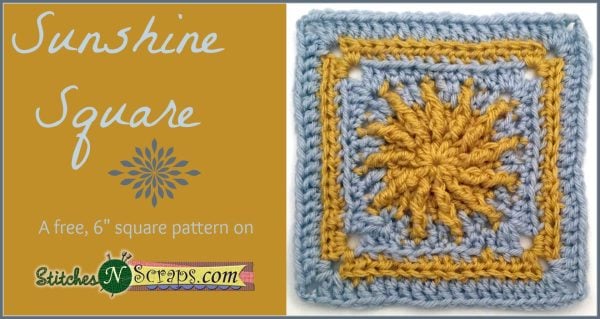
Sunshine square - a free 6" square pattern on StitchesNScraps.com

Free Pattern – Sunshine Square

Soak in the sunshine while you can with this fun, sunny square! The sun in the middle really pops out thanks to front post stitches. This pattern was designed for the 2015 Mystery Lapghan CAL (#MysteryLapghanCAL2015). If this is the first you’ve heard about it, don’t worry – we’ve only just started, so there’s plenty of time to catch up! You can read more about it here, and you may also want to check out the official Mystery Lapghan FAQ on Crochet Memories.

Sunshine square


This pattern is protected by copyright. Please do not distribute or share this pattern in any way other than by sharing a link to this page or to the pattern page on Ravelry. Click here for copyright information.

This pattern contains affiliate links (click for more info). If you click one of these links and then make a purchase, I may be compensated. You get the same great prices, and you will be helping to support this site!

Sunshine Square


Add this to your Ravelry Queue

Materials:

  • Worsted weight yarn – I used Lion Brand Vanna’s Choice
    • 20 yds main color (A) – I used Mustard
    • 20 yds background color (B) – I used Silver Blue
  • Size I / 9 (5.5 mm) hook or size needed to obtain gauge
  • Yarn or tapestry needle


Difficulty:

Intermediate – Worked in the round, post / cable stitches, working into front loop or back loop only.

Size:

6″ square.

Gauge:

First 3 rounds (the sun) should measure 3.5″ in diameter.

Abbreviations used:

  • ch = chain
  • sc = single crochet
  • hdc = half double crochet
  • dc = double crochet
  • csdc = chainless starting double crochet
  • fptr = front post treble
  • sl st = slip stitch
  • st(s) = stitch(es)
  • sp(s) = space(s)
  • sk = skip
  • rnd = round
  • RS = right side
  • WS = wrong side

Notes:

  • The magic circle technique is recommended, for a more solid center with no gap. If you prefer, you can chain 4 and join with a sl st to form a loop instead.
  • The chainless starting double crochet (csdc) is recommended for a less visible join. If you prefer, you can chain 3 (counts as a dc) instead.
  • For cleaner color changes, change colors in the last step of the previous stitch (i.e. when pulling through the last 2 loops to finish the stitch)
  • For some rounds you will need to turn your work, and for others you won’t. Do not turn unless specifically specified in the instructions.

Recommended Resources:


 Instructions:

Rnd 1 (RS): With A, inside a magic circle, work (csdc, 11 dc), join with sl st in 1st st. (12 dc)

Sunshine Square - Round 1

Rnd 2: Do not turn. Csdc in first st, fptr around same st, (dc in next st, fptr around post of same st) 11 times, join with sl st in 1st st, changing to B. (24 sts)

Note: Do not fasten off A. For Rnd 3 you will be switching back and forth between colors. Carry the non-working color along as you go.  

Sunshine Square - Round 2

Rnd 3: Do not turn. With B, ch 1, csdc in first st, dc in next st, switching to A. *With A, fptr around post of same st, switching to B.** With B, dc in next 2 sts, switching to A.  Repeat from * 11 more times, ending at ** on last repeat. With B, join with sl st to first st. Fasten off  A. (36 sts)

Sunshine Square - Round 3

Rnd 4: Do not turn. With B, csdc in first st, dc in same st, *hdc in next 3 sts, sc in next 2 sts, hdc in next 3 sts,** (2 dc, ch 2, 2 dc) in next st, repeat from * 3 more times, ending at ** on last repeat, (2 dc, ch 2) in same st as first st, join with sl st to first st. (48 sts, 4 ch 2 sps)

Sunshine Square - Round 4

Rnd 5 (WS): Turn, sl st into ch sp, changing to A. Fasten off B. With A,  ch 1, 2 hdc in same sp, *hdc in front loop only of each st across to next corner ch sp,** (2 hdc, ch 2, 2 hdc) in ch sp, repeat from * 3 more times, ending at ** on last repeat, (2 hdc, ch 2) in starting ch sp, join with sl st to 1st st. (64 sts, 4 ch 2 sps)

Sunshine Square - Round 5

Rnd 6 (RS): Turn, sl st into ch sp, changing to B. Fasten off A. With B, ch 1, csdc in ch sp, dc in same ch sp, *dc in back loop only of each st to corner,** (2 dc, ch 2, 2dc) in ch sp, repeat from * 3 times more, ending at ** on last repeat,  (2dc, ch 2) in starting corner sp, join with sl st to 1st st. (80 sts, 4 ch 2 sps)

Sunshine Square - Round 6

Fasten off and weave in all ends.


I hope you enjoy the pattern! A downloadable pdf of this pattern is also available in my Craftsy store for a $1 fee. The fee for the pdf format is to offset the advertising revenue lost when you print or download the pattern rather than viewing it online.

If you would like to receive notifications of new posts and patterns as they become available, please follow this blog. You can follow by e-mail (look at the sidebar on the right for the follow by email option), or via RSS feed, or via your WordPress.com reader: Follow Stitches ‘N’ Scraps on WordPress.com

Fun Striped Booties - A free pattern on StitchesNscraps.com

Free Pattern – Striped booties

I made these fun, striped booties to match my Dreaming of Pinwheels blanket. They’re made with the same Anne Geddes Baby yarn by Red Heart. I love the colors, and the acrylic / nylon blend means it’s strong and machine washable too. This pattern has instructions for sizes 0-6 months and 6-12 months

Fun Striped Booties - A free pattern on StitchesNscraps.com


This pattern is protected by copyright. Please do not distribute or share this pattern in any way other than by sharing a link to this page or to the pattern page on Ravelry. Click here for copyright information.

This pattern contains affiliate links (click for more info). If you click one of these links and then make a purchase, I may be compensated. You get the same great prices, and you will be helping to support this site!

Striped Booties

3-light

Add this to your Ravelry Queue

Materials:


Difficulty:

Intermediate – Mostly worked in the round, front post/back post stitches, hdc decreases.

Size:

Pattern is written for 0-6 months with changes for 6-12 months in ( )

Gauge:

15 sc x 18 rows = 4″ square.  After Rnd 4, sole should measure 3.5″ x 2″

Abbreviations used:

  • ch = chain
  • sc = single crochet
  • hdc = half double crochet
  • dc = double crochet
  • fphdc = front post half double crochet
  • bphdc = back post half double crochet
  • hdc2tog = half double crochet two stitches together
  • dc2tog = double crochet two stitches together
  • sl st = slip stitch
  • st(s) = stitch(es)
  • sp(s) = space(s)
  • rnd = round
  • RS = right side
  • WS = wrong side

Notes:

  • If you prefer, you can substitute “ch 8, sc in 2nd ch and each ch across” for the 7 fsc in row 1.
  • If you prefer, you can substitute “ch 3 (counts as dc)” for csdc wherever it appears.
  • Progress / tutorial pictures show the larger size booties.

Recommended Resources:


Sole:

Rnd 1 (RS):  With C, work 7 fsc, 2 sc in base of last st. Working across bottom of row, sc in next 5 sts, 2 sc in last st, join with sl st to first sc. [16 sts]

Rnd 2: Ch 1, turn, 2sc in next 2 sts, sc in next 5 sts, 2sc in next 3 sts, sc in next 5 sts, 2sc in next st, join with sl st to first st. [22 sts]

Rnd 3: Ch 1, turn, 2sc in next st, sc in next 7 sts, 2sc in next 4 sts, sc in next 7 sts, 2sc in next 3 sts, join with sl st to first sc [30 sts]

Rnd 4: Ch 1, turn, (2sc in next 4 sts, sc in next 11 sts) twice, join with sl st to first st [38 sts].

0-6 months only:  Mark last st of round 4 for later joining. Fasten off C.

6-12 months only:

Rnd 5: Ch 1, turn, sc in next 12 sts, 2sc in next 6 sts, sc in next 14 sts, 2sc in next 4 sts, sc in next 2 sts, join with sl st to first sc [48 sts]. Mark first st of round for later joining. Fasten off C.

Finished sole

Instep:

Rnd 1 (WS): With WS of sole facing you, join A around post of marked st, as if to work a front post st. Ch 1, fphdc in same st and in each st around, join with sl st to first st. [38 (48) sts]

Joining A around post

Rnd 2: Ch 1, turn, hdc in next 32 (39) sts, hdc2tog once (twice), hdc in next 4 (5) sts, join with sl st to first st, changing to C.  Fasten off A.  [37, (46) sts]

Yellow stripe done

Rnd 3: With C, turn, csdc in first st, dc in next 12 (16) sts, dc2tog 10 (12) times, dc in next 4 (5) sts, join with sl st to first st. [27 (34) sts]

Rnd 4: Turn, csdc in first st, dc in next 3 (4) sts, dc2tog 5 (6) times, dc in next 13 (17) sts, join with sl st to first st. [22 (28) sts]

0-6 months only:  

Rnd 5: With C, turn, csdc in first st, dc in next 12 sts, dc2tog, dc in next dc, dc2tog, dc in next 4 sts, join with sl st to first st. [20 sts]

Rnd 6: Turn, csdc in first st, dc in each st around, join with sl st to first st [20 sts]

6-12 months only:

Rnd 5: With C, turn, csdc in first st, dc in next 16 sts, dc2tog 3 times, dc in next 5 sts, join with sl st to first st. [25 sts]

Rnd 6: Turn, csdc in first st, dc in next 4 sts, dc2tog, dc in next 18 sts, join with sl st to first st. [24 sts]

Instep done

Cuff:

Rnd 7-15 (17): (RS): Do NOT turn, ch 1, (fphdc around next st, bphdc around next st) around, join with sl st to first st, changing to B at the end of last rnd. Fasten off C.

Rnd 16 (18): Ch 1, turn, sc in each st around, join with sl st to first st, fasten off.

Completed cuff

Edging:

With RS facing, hold bootie upside down so sole is on top. Insert hook into any heel stitch from the last round of the sole, and draw up a loop with B as shown here:

Joining B for edging

With B, sl st in next st and in each st around. Fasten off and use yarn needle to form final st as shown:

Finishing edging

Weave in any remaining tails and fold cuff down.


I hope you enjoy the pattern! Thank you to Red Heart, for supplying the lovely yarn. A downloadable pdf of this pattern is also available in my Craftsy store for a $1 fee. The fee for the pdf format is to offset the advertising revenue lost when you print or download the pattern rather than viewing it online.

If you would like to receive notifications of new posts and patterns as they become available, please follow this blog. You can follow by e-mail (look at the sidebar on the right for the follow by email option), or via RSS feed, or via your WordPress.com reader: Follow Stitches ‘N’ Scraps on WordPress.com

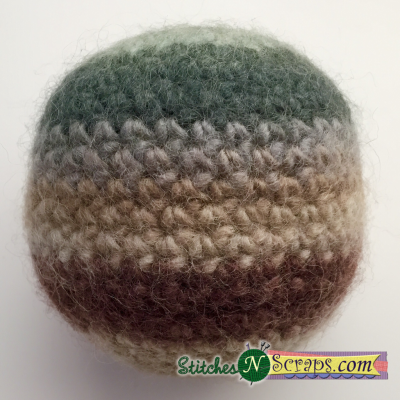
A basic felted ball

Free Pattern – Simple crochet balls

A basic felted ballI ran out of dryer sheets the other day, so I decided to try making felted dryer balls instead. I only made it through one ball before other projects (and life in general) got in the way. One day I’ll make more, and then I’ll let you know how they work!  Meanwhile, I thought I would share with you a general recipe for making crocheted balls.

This is a great starting point for buttons, dolls heads, ornaments, toys, and more! Depending on the yarn you use and your gauge, you can make lots of different sizes. Really large balls may look a little misshapen (more like a capsule than a ball). I wouldn’t recommend making anything more than about 6-8 inches in diameter using these instructions.  I made my ball about 4 inches in diameter, and stuffed it with leftover yarn scraps. I also felted my ball by hand and then ran it through the dryer a couple of times, which makes it soft and fuzzy.


This pattern is protected by copyright. Please do not distribute or share this pattern in any way other than by sharing a link to this page or to the pattern page on Ravelry. Click here for copyright information.

This pattern contains affiliate links (click for more info). If you click one of these links and then make a purchase, I may be compensated. You get the same great prices, and you will be helping to support this site!

Simple Crocheted Balls

Add this to your Ravelry Queue

Materials:

  • Any yarn or thread desired. If you want to felt it, be sure to use a felting wool (NOT superwash!). Yardage will vary depending on gauge – I used about 75 yds of a bulky yarn for a 4″ ball.
  • Appropriate size crochet hook for your yarn. I used size I/9 (5.5 mm)
  • A locking stitch marker (or safety pins, or scrap yarn) to mark beginning of rounds
  • Yarn or tapestry needle

Difficulty:

Beginner – just single crochet (with increases and decreases), worked in the round.

Size:

Size will vary based on materials used. Mine came out to about 3 inches diameter after felting. I do not recommend using this pattern for balls larger than 8 or 9 inches.

Gauge:

Gauge is not important, but pay careful attention to the notes for each section.

Abbreviations used:

  • ch = chain
  • sc = single crochet

Notes:

  • This pattern is worked in continuous rounds. Do not join or turn unless specifically indicated.
  • Use a stitch marker, safety pin, or loop of yarn to mark the first stitch of each round.

Recommended Resources:

Bottom:

NOTE: These instructions include extra rounds for lighter weight yarns or larger balls. Measure your piece periodically, and stop when you reach your desired diameter at the end of a round. If felting, remember it will shrink a bit. Make a note of the last round you completed, and then skip ahead to the “Middle” section. 

Rnd 1: In magic loop, work 6sc.
OR
Ch 6, join with sl st to form a ring. Ch 1, 6 sc in ring.

Rnd 2: 2 sc in each st around (12 sc)

Rnd 3: (2 sc in next st, sc in next st) 6 times. (18 sc)

Rnd 4: (2 sc in next st, sc in next 2 sts) 6 times. (24 sts)

Rnd 5: (2 sc in next st, sc in next 3 sts) 6 times. (30 sts)

Rnd 6: (2 sc in next st, sc in next 4 sts) 6 times. (36 sts)

Rnd 7: (2 sc in next st, sc in next 5 sts) 6 times. (42 sts)

Rnd 8: (2 sc in next st, sc in next 6 sts) 6 times. (48 sts)

Rnd 9: (2 sc in next st, sc in next 7 sts) 6 times. (54 sts)

Rnd 10: (2 sc in next st, sc in next 8 sts) 6 times. (60 sts)

Rnd 11: (2 sc in next st, sc in next 9 sts) 6 times. (66 sts)

Rnd 12: (2 sc in next st, sc in next 10 sts) 6 times. (72 sts)

Rnd 13: (2 sc in next st, sc in next 11 sts) 6 times. (78 sts)

Rnd 14: (2 sc in next st, sc in next 12 sts) 6 times. (84 sts)

Rnd 15: (2 sc in next st, sc in next 13 sts) 6 times. (90 sts)

Middle:

NOTE: On the table below, look up the number of rows you completed in the beginning section to see how many rounds to work in this section. For example, I worked through Rnd 6 in the beginning section, so for the middle section I worked the middle rnd a total of 9 times.

Middle rnd: Sc in each st around.

If you stopped after: Work middle rnd a total of: Then start bottom at:
Rnd 2 3 times Rnd 14
Rnd 3 5 times Rnd 13
Rnd 4 6 times Rnd 12
Rnd 5 8 times Rnd 11
Rnd 6 9 times Rnd 10
Rnd 7 11 times Rnd 9
Rnd 8 12 times Rnd 8
Rnd 9 14 times Rnd 7
Rnd 10 15 times Rnd 6
Rnd 11 17 times Rnd 5
Rnd 12 18 times Rnd 4
Rnd 13 20 times Rnd 3
Rnd 14 21 times Rnd 2
Rnd 15 23 times Rnd 1

Bottom:

NOTES:

  • On the table above, look up the number of rows you completed in the beginning section to see what round to start on this section. For example, I worked through Rnd 6 in the beginning section, so for this section I would start on rnd 10.
  • Start stuffing your ball as you go, before it gets too tight. 

Rnd 1: (Sc in next 13 sts, sc2tog over next 2 sts) 6 times (84 sts)

Rnd 2: (Sc in next 12 sts, sc2tog over next 2 sts) 6 times (78 sts)

Rnd 3: (Sc in next 11 sts, sc2tog over next 2 sts) 6 times (72 sts)

Rnd 4: (Sc in next 10 sts, sc2tog over next 2 sts) 6 times (66 sts)

Rnd 5: (Sc in next 9 sts, sc2tog over next 2 sts) 6 times (60 sts)

Rnd 6: (Sc in next 8 sts, sc2tog over next 2 sts) 6 times (54 sts)

Rnd 7: (Sc in next 7 sts, sc2tog over next 2 sts) 6 times (48 sts)

Rnd 8: (Sc in next 6 sts, sc2tog over next 2 sts) 6 times (42 sts)

Rnd 9: (Sc in next 5 sts, sc2tog over next 2 sts) 6 times (36 sts)

Rnd 10: (Sc in next 4 sts, sc2tog over next 2 sts) 6 times (30 sts)

Rnd 11: (Sc in next 3 sts, sc2tog over next 2 sts) 6 times (24 sts)

Rnd 12: (Sc in next 2 sts, sc2tog over next 2 sts) 6 times (18 sts)

Rnd 13: (Sc in next st, sc2tog over next 2 sts) 6 times (12 sts)

Rnd 14: (sc2tog over next 2 sts) 6 times (6 sts), sl st in first st. Fasten off.

Finish stuffing if necessary, then sew top and bottom closed with tails. Weave tails in a little and then tuck the ends right into the ball.

Felting (optional):

NOTE: If you’re not sure about the colorfastness of your materials, felt by hand first and make sure no color bleeds out.  

To felt by hand: Place ball(s) in hot water with a little bit of soap. Rub vigorously until desired texture is achieved (depending on your yarn, this may take a while).

To felt by machine: First place ball(s) inside something to keep fuzz from getting out. If felting multiple balls at once, try using a stocking and tying the stocking shut above and below each ball (use a non-felting yarn to tie stocking shut). Once secure, run through a hot cycle, preferably with other clothes, and then run through the dryer. May take a couple of cycles to felt completely.


I hope you enjoy the pattern!

If you would like to receive notifications of new posts and patterns as they become available, please follow this blog. You can follow by e-mail (look at the sidebar on the right for the follow by email option), or via RSS feed, or via your WordPress.com reader: Follow Stitches ‘N’ Scraps on WordPress.com

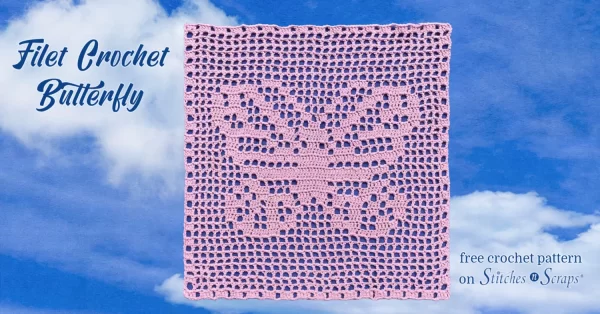
Filet Crochet Butterfly Square

Filet Crochet Butterfly Square

A pretty butterfly dances on a field of mesh in this filet crochet butterfly square. Learn filet crochet with this fun and easy pattern! Make it with any yarn or thread, with solid wings or lacy wings, and as a stand-alone square or as part of a larger project. So many possibilities!

Filet Crochet Butterfly Square

This content is protected by copyright. See this Terms of Use / Copyright page for more information.

This post contains sponsored content and/or affiliate links. If you click an affiliate link and make a purchase, I may get a commission.


Updated in 2023

I first designed this in 2015. 8 years later, I felt like it needed a makeover. The new charts are clearer and, by request, I also added written instructions for both versions of the pattern.

The butterfly design itself hasn’t changed, but the overall motif used to be more of a rectangle. There are now 4 extra rows of mesh (2 above and 2 below the butterfly) to make it square.

Learn Filet Crochet

This filet crochet butterfly square is a great way to learn filet crochet! It uses only basic blocks and mesh, with no advanced stitches. Learn the basics in this basic filet crochet tutorial, then try out your skills on the butterfly square!

Small filet crochet motif

Make it your way!

There are 2 versions of this filet crochet butterfly square. The main pictures show the lacy version. Here is a sample of the solid version.

Solid filet crochet butterfly in 3 colors - green on the bottom mesh, purple for the butterfly. and variegated blue for the top mesh.

I did this one in 3 colors, using about 42 yds each for the bottom and top mesh, and about 90 yds for the butterfly.

Choosing a yarn or thread

You can make this square in any yarn or thread. I used worsted weight yarn for the lacy sample, and fingering weight yarn for the solid sample.

The size will vary based on the yarn you use. Try it with thread for a coaster or doily! Use a hook 1 size smaller than you normally would with your chosen yarn or thread.

You can calculate how big your finished project will be by making a small swatch of either plain double crochet or the open mesh pattern to measure your gauge.

Gauge calculations

The butterfly square is worked over 33 blocks (100 stitches), and 39 rows. To calculate the width of your motif, divide 33 by the number of blocks you get in 1 inch, or divide 100 by the number of stitches you get in one inch. To calculate the height, divide 39 by the number of rows you get per inch.

You could also just make the first few rows and measure the width. Since the butterfly is a square, the finished height will be the same as the width.

What to make with your filet crochet butterfly square

Your square doesn’t have to stay square! Just like any square motif, it can be incorporated into a wide variety of projects. For my lacy sample, I threaded a dowel rod in and out of the mesh on the top row to make a wall hanging.

Lacy butterfly square as a wall hanging

Layer your square on top of solid fabric for a decorative pillow. Add a border to make a tablecloth. Use it as part of an heirloom blanket. It can be a focal point surrounded by granny squares, or make the whole blanket out of butterfly squares!

I even used the same butterfly design to make a sarong-style swimsuit cover-up. It’s available in 9 sizes from xs to 5x.

Crochet butterfly sarong, shown on a dress form against a watery background

The top that didn’t work out

I originally designed this butterfly chart as part of a swimsuit cover-up shirt. This is what the back piece looked like.

Filet crochet shirt back

I didn’t particularly love the actual shirt when it was done. The filet crochet butterfly turned out great, but the shaping and fit of the shirt was just OK. I never did publish the pattern.

Butterfly Coasters

I loved this butterfly design so much, that I even used it for coasters! I traced the chart to draw the outline of a butterfly, then filled it in with special, thermal transfer markers. Check out this fun project!

Butterfly Coaster with Artesprix markers on Stitches n Scraps

Filet Crochet Butterfly Square

Project-Level-Basic - Craft Yarn Council Standards

Add this to your Ravelry queue

Note: The yardage, sizes, and gauges shown here are all for the 2 samples pictured. You can use any size yarn or thread for this pattern. Use a hook about 1 size smaller than you normally would with your chosen yarn or thread. Size and yardage will vary based on your yarn and hook.

Materials

  • Yarn: Any size yarn (see note). Samples shown in:
    • Worsted weight yarn (pink, lacy sample)
      • 275 yds for lacy butterfly square
      • 325 yds for solid butterfly square
    • Fingering weight yarn (multi-colored, solid sample)
      • 150 yds for lacy butterfly square
      • 175 yds for solid butterfly square
  • Hook: Crochet hook about 1 size smaller than you normally would use with your chosen yarn or thread. For samples shown:
    • Worsted weight: Size H (5mm) crochet hook or size needed to match gauge
    • Fingering weight: Size C (2.75mm) crochet hook or size needed to match gauge
  • Notions: Tapestry Needle

Project Level

Basic: Double crochets and chains.

Size

Size will depend on the yarn/thread and hook you choose.

Worsted weight sample: 25 inches x 25 inches after blocking

Fingering weight sample: 14 inches x 14 inches after blocking

Gauge

Gauge will depend on the yarn/thread and hook you choose.

Worsted weight sample

  • 16 dc x 6.25 rows = 4 inches after blocking
  • (5 mesh + 1 dc) x 6.25 rows = 4 inches after blocking

Fingering weight sample

  • 29 dc x 11 rows = 4 inches after blocking
  • 9.5 mesh x 11 rows = 4 inches after blocking

Abbreviations used

This pattern uses US terms.

  • ch = chain
  • dc = double crochet
  • sk = skip
  • st(s) = stich(es)

Special Stitches

Beginning Mesh (beg mesh):

Ch 5 (counts as dc and ch-2 sp), turn, sk next 2 sts, dc in next st.

This is used to start a row with a mesh. Beg mesh counts as 1dc and 1 mesh in stitch counts at the end of the row.

Mesh:

Ch 2, sk next 2 sts or chs, dc in next st.

Block:

If worked on top of a block (3 dc): Dc in each of next 3 sts.

If worked on top of a mesh (a ch-2 sp and 1 dc): 2 dc in next ch-2 sp, dc in next st.

Instructions

Lacy Butterfly:

Scroll down for chart

Bottom mesh

Ch 102

Row 1: Dc in 4th ch from hook (skipped chs count as first dc), dc in next 2 chs, [ch 2, sk next 2 chs, dc in next 4 chs] across. (68 dc, 16 ch-2 sps)

Row 2: Beg mesh, mesh across. (1 dc, 33 mesh)

Row 3: Ch 3 (counts as dc throughout), block, mesh across to last ch-2 sp, block. (1 dc, 2 blocks, 31 mesh)

Rows 4-9: Repeat rows 2-3 twice more.

Butterfly

Row 10: Beg mesh, 7 mesh, 4 blocks, 9 mesh, 4 blocks, 8 mesh. (1 dc, 8 blocks, 25 mesh)

Row 11: Ch 3, block, 6 mesh, 2 blocks, 2 mesh, 3 blocks, 5 mesh, 3 blocks, 2 mesh, 2 blocks, 6 mesh, block. (1 dc, 12 blocks, 21 mesh)

Row 12: Beg mesh, 5 mesh, block, mesh, block, 2 mesh, block, mesh, block, 5 mesh, block, mesh, block, 2 mesh, block, mesh, block, 6 mesh. (1 dc, 8 blocks, 25 mesh)

Row 13: Ch 3, block, 5 mesh, block, 2 mesh, block, mesh, block, 2 mesh, block, 3 mesh, block, 2 mesh, block, mesh, block, 2 mesh, block, 5 mesh, block. (1 dc, 10 blocks, 23 mesh)

Row 14: Beg mesh, 5 mesh, 2 blocks, [mesh, block] 8 times, mesh, 2 blocks, 6 mesh. (1 dc, 12 blocks, 21 mesh)

Row 15: Ch 3, block, 5 mesh, [block, mesh] twice, 4 blocks, mesh, 3 blocks, mesh, 4 blocks, [mesh, block] twice, 5 mesh, block. (1 dc, 17 blocks, 16 mesh)

Row 16: Beg mesh, 6 mesh, block, mesh, 2 blocks, 3 mesh, 5 blocks, 3 mesh, 2 blocks, mesh, block, 7 mesh. (1 dc, 11 blocks, 22 mesh)

Row 17: Ch 3, block, 7 mesh, 2 blocks, 5 mesh, 3 blocks, 5 mesh, 2 blocks, 7 mesh, block. (1 dc, 9 blocks, 24 mesh)

Row 18: Beg mesh, 9 mesh, 13 blocks, 10 mesh. (1 dc, 13 blocks, 20 mesh)

Row 19: Ch 3, block, 7 mesh, 17 blocks, 7 mesh, block. (1 dc, 19 blocks, 14 mesh)

Row 20: Beg mesh, 6 mesh, block, 7 mesh, 3 blocks, 7 mesh, block, 7 mesh. (1 dc, 5 blocks, 28 mesh)

Row 21: Ch 3, block, 5 mesh, 21 blocks, 5 mesh, block. (1 dc, 23 blocks, 10 mesh)

Row 22: Beg mesh, 5 mesh, block, 5 mesh, 2 blocks, mesh, 3 blocks, mesh, 2 blocks, 5 mesh, block, 6 mesh. (1 dc, 9 blocks, 24 mesh)

Row 23: Ch 3, block, 5 mesh, block, 4 mesh, block, 2 mesh, [block, mesh] twice, block, 2 mesh, block, 4 mesh, block, 5 mesh, block. (1 dc, 9 blocks, 24 mesh)

Row 24: Beg mesh, 4 mesh, 6 blocks, 2 mesh, block, mesh, 3 blocks, mesh, block, 2 mesh, 6 blocks, 5 mesh. (1 dc, 17 blocks, 16 mesh)

Row 25: Ch 3, block, 3 mesh, 2 blocks, 2 mesh, block, 3 mesh, 2 blocks, mesh, 3 blocks, mesh, 2 blocks, 3 mesh, block, 2 mesh, 2 blocks, 3 mesh, block. (1 dc, 15 blocks, 18 mesh)

Row 26: Beg mesh, 3 mesh, block, 2 mesh, block, 3 mesh, 2 blocks, 3 mesh, block, 3 mesh, 2 blocks, 3 mesh, block, 2 mesh, block, 4 mesh. (1 dc, 9 blocks, 24 mesh)

Row 27: Ch 3, block, 3 mesh, 4 blocks, 2 mesh, 2 blocks, 3 mesh, block, mesh, block, 3 mesh, 2 blocks, 2 mesh, 4 blocks, 3 mesh, block. (1 dc, 16 blocks, 17 mesh)

Row 28: Beg mesh, 3 mesh, block, mesh, block, 2 mesh, 2 blocks, [3 mesh, block] twice, 3 mesh, 2 blocks, 2 mesh, block, mesh, block, 4 mesh. (1 dc, 10 blocks, 23 mesh)

Row 29: Ch 3, block, 3 mesh, [block, mesh] twice, 2 blocks, 3 mesh, block, 5 mesh, block, 3 mesh, 2 blocks, [mesh, block] twice, 3 mesh, block. (1 dc, 12 blocks, 21 mesh)

Row 30: Beg mesh, 4 mesh, 4 blocks, 3 mesh, block, 7 mesh, block, 3 mesh, 4 blocks, 5 mesh. (1 dc, 10 blocks, 23 mesh)

Top mesh

Row 31: Ch 3, block, [9 mesh, 2 blocks] twice, 9 mesh, block. (1 dc, 6 blocks, 27 mesh)

Rows 32-38: Repeat rows 2-3 twice, then repeat row 2 once more.

Row 39: Ch 3, block, [mesh, block] across. (1 dc, 17 blocks, 16 mesh)

Finishing

Weave in all ends.

Wash and block. As with most lace, blocking is very important to open up the mesh.

Lacy Butterfly Chart

Lacy filet crochet butterfly chart
Click image to expand

Solid Butterfly

Scroll down for chart

Bottom mesh

Ch 102

Row 1: Dc in 4th ch from hook (skipped chs count as first dc), dc in next 2 chs, [ch 2, sk next 2 chs, dc in next 4 chs] across. (68 dc, 16 ch-2 sps)

Row 2: Beg mesh, mesh across. (1 dc, 33 mesh)

Row 3: Ch 3 (counts as dc throughout), block, mesh across to last ch-2 sp, block. (1 dc, 2 blocks, 31 mesh)

Rows 4-9: Repeat rows 2-3 twice more.

Butterfly

Row 10: Beg mesh, 7 mesh, 5 blocks, 7 mesh, 5 blocks, 8 mesh. (1 dc, 10 blocks, 23 mesh)

Row 11: Ch 3, block, 6 mesh, 7 blocks, 5 mesh, 7 blocks, 6 mesh, block. (1 dc, 16 blocks, 17 mesh)

Row 12: Beg mesh, 5 mesh, 9 blocks, 3 mesh, 9 blocks, 6 mesh. (1 dc, 18 blocks, 15 mesh)

Row 13: Ch 3, block, 5 mesh, 3 blocks, 2 mesh, 4 blocks, 3 mesh, 4 blocks, 2 mesh, 3 blocks, 5 mesh, block. (1 dc, 16 blocks, 17 mesh)

Row 14: Beg mesh, 5 mesh, 3 blocks, 2 mesh, 5 blocks, mesh, 5 blocks, 2 mesh, 3 blocks, 6 mesh. (1 dc, 16 blocks, 17 mesh)

Row 15: Ch 3, block, 5 mesh, 21 blocks, 5 mesh, block. (1 dc, 23 blocks, 10 mesh)

Row 16: Beg mesh, 6 mesh, 19 blocks, 7 mesh. (1 dc, 19 blocks, 14 mesh)

Row 17: Ch 3, block, 7 mesh, 17 blocks, 7 mesh, block. (1 dc, 19 blocks, 14 mesh)

Row 18: Beg mesh, 10 mesh, 11 blocks, 11 mesh. (1 dc, 11 blocks, 22 mesh)

Row 19: Repeat row 17.

Row 20: Repeat row 16.

Row 21: Repeat row 15.

Row 22: Beg mesh, 4 mesh, 23 blocks, 5 mesh. (1 dc, 23 blocks, 10 mesh)

Row 23: Ch 3, block, 4 mesh, 10 blocks, mesh, block, mesh, 10 blocks, 4 mesh, block. (1 dc, 23 blocks, 10 mesh)

Row 24: Beg mesh, 3 mesh, 10 blocks, mesh, 3 blocks, mesh, 10 blocks, 4 mesh. (1 dc, 23 blocks, 10 mesh)

Row 25: Ch 3, block, 3 mesh, 10 blocks, mesh, 3 blocks, mesh, 10 blocks, 3 mesh, block. (1 dc, 25 blocks, 8 mesh)

Row 26: Beg mesh, 3 mesh, 3 blocks, 2 mesh, 4 blocks, 3 mesh, block, 3 mesh, 4 blocks, 2 mesh, 3 blocks, 4 mesh. (1 dc, 15 blocks, 18 mesh)

Row 27: Ch 3, block, 3 mesh, 2 blocks, 2 mesh, 4 blocks, 3 mesh, block, mesh, block, 3 mesh, 4 blocks, 2 mesh, 2 blocks, 3 mesh, block. (1 dc, 16 blocks, 17 mesh)

Row 28: Beg mesh, 3 mesh, 7 blocks, [3 mesh, block] twice, 3 mesh, 7 blocks, 4 mesh. (1 dc, 16 blocks, 17 mesh)

Row 29: Ch 3, block, 3 mesh, 6 blocks, 3 mesh, block, 5 mesh, block, 3 mesh, 6 blocks, 3 mesh, block. (1 dc, 16 blocks, 17 mesh)

Row 30: Beg mesh, 4 mesh, 4 blocks, 3 mesh, block, 7 mesh, block, 3 mesh, 4 blocks, 5 mesh. (1 dc, 10 blocks, 23 mesh)

Top Mesh

Row 31: Ch 3, block, [9 mesh, 2 blocks] twice, 9 mesh, block. (1 dc, 6 blocks, 27 mesh)

Rows 32-38: Repeat rows 2-3 twice, then repeat row 2 once more.

Row 39: Ch 3, block, [mesh, block] across. (1 dc, 17 blocks, 16 mesh)

Finishing

Weave in all ends.

Wash and block. As with most lace, blocking is very important to open up the mesh.

Solid Butterfly Chart

Solid filet crochet butterfly chart
Click image to expand

Share this Filet Crochet Butterfly Square on Pinterest!

Here’s an image perfect for pinning.

Filet Crochet Butterfly Square

Rate this Filet Crochet Butterfly Square!


I hope you enjoyed this filet crochet butterfly pattern. A downloadable pdf of this pattern is available on Ravelry for a small fee. The fee for the pdf format is to offset the advertising revenue lost when you print or download the pattern rather than viewing it online.

Do you want the best of Stitches n Scraps delivered right to your inbox? The Stitches n Scraps email newsletter includes highlights from the blog as well as special features not available elsewhere. Don’t miss a stitch – Subscribe now!

4th of July headband collage

Free Pattern – Last Minute 4th of July Headband

Do you need a last minute accessory for tonight’s festivities?  There’s still time! I waited until the last minute too, and this headband is what I came up with.

4th of July headband collage


This design combines 2 of my previous patterns with a simple red chain. It only uses basic stitches, but combines knitting and crochet. This is a great project for a beginning knitter with a little bit of crochet experience.


This pattern is protected by copyright. Please do not distribute or share this pattern in any way other than by sharing a link to this page or to the pattern page on Ravelry. Click here for copyright information.

This pattern contains affiliate links (click for more info). If you click one of these links and then make a purchase, I may be compensated. You get the same great prices, and you will be helping to support this site!


Last Minute 4th of July Headband

Add this to your Ravelry Queue

Materials:

  • Worsted weight yarn – 20-30 yds
  • US Size 8 (5 mm) knitting needles
  • Small amount of red yarn in desired weight for stripe (sample shown uses DK)
  • Small amount of white yarn in desired weight for star (samlple shown uses Worsted)
  • Appropriately sized crochet hooks for the red and white yarns chosen (sample shown uses size F for red stripe, and size G for white star)
  • Yarn needle

Difficulty:

Easy – Combines basic knitting and crochet techniques.

Recommended Resources:

Instructions:

Start by making my Super Simple Garter Stitch Headband pattern in blue.

With red, make a chain about 1″ longer than the headband (all the way around). Starting at the back and using a yarn needle, weave the chain in and out of the stitches on the headband loosely so the headband can still stretch. Stretch it out once to check it, then sew in the ends at the back.

Finally, make a white star, using my Twinkle Twinkle 2 Round Star pattern, and sew it onto the headband as desired. I used red yarn to sew it on, just for fun.


I hope you enjoy the pattern! If you would like to receive notifications of new posts and patterns as they become available, please follow this blog. You can follow by e-mail (look at the sidebar on the right for the follow by email option), or via RSS feed, or via your WordPress.com reader: Follow Stitches ‘N’ Scraps on WordPress.com

Happy 4th of July! Have fun, and stay safe!


Criss Cross Applesauce collage

Free Pattern – Criss cross apple sauce

The back and forth, crossed post stitches (cables) at the center of this square form a lattice like texture. There is a Jacob’s ladder / braid stitch in each corner, tucked under smaller chain spaces for a more criss-crossed look. The back of the square has a completely different, but also interesting texture, which looks a bit like layered shell stitches. The pattern is written with color changes, but works equally well in one color.

Criss Cross Applesauce - a free crochet pattern on Stitches n Scraps


This is a more advanced pattern that uses a lot of different stitch techniques, but with the recommended tutorials by Moogly, they shouldn’t be too hard to learn. It could be a great learning tool for a more adventurous beginner or intermediate crocheter. This pattern was designed for the Moogly 2015 afghan CAL. If this is the first you’ve heard about it, go check it out! Also be sure to take a look at the block 12 post to see how Moogly’s version of this square turned out (spoiler, it’s gorgeous!). The squares are amazing and we’re only about halfway through, so there’s still plenty of time to catch up.

Big thanks to gtcmom (check out her square) and Tamara for both tech editing this pattern, and to Elke for translating it into Dutch:

Dit patroon is (door HET HAAKBEEST) in het Nederlands vertaald. Je vindt de Nederlandstalige versie mét fotos hier


This pattern is protected by copyright. Please do not distribute or share this pattern in any way other than by sharing a link to this page or to the pattern page on Ravelry. Click here for copyright information.

This pattern contains affiliate links (click for more info). If you click one of these links and then make a purchase, I may be compensated. You get the same great prices, and you will be helping to support this site!

Criss Cross Applesauce

Add this to your Ravelry Queue

Materials:

  • Worsted weight yarn: 150 yds total
  • Size I / 9 (5.5 mm) hook or size needed to obtain gauge
  • 5 locking stitch markers or pieces of scrap yarn
  • Yarn or tapestry needle

Difficulty:

Experienced – Worked in the round, post / cable stitches crossing over each other in both directions, spike stitches, Jacob’s ladders / braided loops, working into back loops only.

Size:

12″ square.

Gauge:

First 4 rounds should measure 4″ square.

Abbreviations used:

  • ch = chain
  • sc = single crochet
  • hdc = half double crochet
  • dc = double crochet
  • fptr = front post treble
  • spdc = spike double crochet
  • sptr = spike treble
  • sl st = slip stitch
  • st(s) = stitch(es)
  • sp(s) = space(s)
  • sk = skip
  • rnd = round
  • RS = right side
  • WS = wrong side

Notes:

  • Click on any pattern image to enlarge it.
  • If working with multiple colors, fasten off each time you change colors – do not try to carry one color behind another.
  • The pattern is provided in chart and written format – both are the same pattern.
  • The magic circle technique is recommended, for a more solid center with no gap. If you prefer, you can chain 6 and join with a sl st to form a loop instead.


Recommended tutorials from Moogly:

Criss-Cross Applesauce chart
Charted version of pattern. Click for larger image.

Center:

Rnd 1 (RS): Inside a magic circle, ch 3 (counts as dc), 2 dc, ch 10, (3 dc, ch 10) 3 times, pull circle closed, join with sl st to top of starting chain. (3 dc on each side, 4 corner ch 10 loops).

Rnd 2: Ch 3 (starting ch sp), turn, *sk next ch sp, 2 sc in next st, sc in next st, 2 sc in next st,** ch 2, repeat from * 3 times more, ending at ** on last repeat, join with sl st in starting ch sp, changing colors if desired. (5 sc on each side, 4 corner ch sps)

Rnd 3: Ch 3 (counts as dc), turn, dc in next st, *sk next 2 dc from round 1, fptr around the next dc from rnd 1, ch 1, working in front of the fptr just made, fptr around the 1st of the 2 dc you just skipped, sk 3 sts on Rnd 2 (behind the crossed post stitches), dc in next st on rnd 2**, (dc, ch 10, dc) in corner ch sp, dc in next sc, repeat from * 3 times more, ending at ** on last repeat, (dc, ch 10) in corner ch sp, join with sl st in first st. (4 dc and one cross on each side, 4 corner ch 10 loops).

Rnd 3

Rnd 4: Ch 3 (starting ch sp), turn, *sk ch sp, 2 sc in next st, sc in each st and each ch 1 sp across to last st before corner, 2 sc in next st**, ch 2, repeat from * 3 times more, ending at ** on last repeat, sl st in starting ch sp, changing colors if desired. (9 sc on each side, 4 corner ch sps)

Square should now measure 4″

Rnd 5: Ch 3 (counts as dc), turn, *dc in next st, sk 2 dc from rnd 3, fptr around next post st from rnd 3, ch 1, working behind the fptr just made, fptr around the first of the 2 dc you just skipped, sk 3 sc on rnd 4, dc in next sc from rnd 4, sk 1 post st and 1 dc from rnd 3, fptr around next dc on rnd 3 (should be the last st before the corner), ch 1, working behind the fptr just made, fptr around the post st you just skipped, sk 3 sc on rnd 4, dc in next sc,** (dc, ch 10, dc) in next ch sp, repeat from * 3 times more, ending at ** on last repeat, (dc, ch 10) in corner ch sp, join with sl st in first st. (5 dc and 2 crosses on each side, 4 corner ch 10 loops).

Rnd 5

Rnd 6: Repeat rnd 4 (13 sc on each side, 4 corner ch sps)

Rnd 7: Ch 3 (counts as dc), turn, *dc in next st, sk 2 dc from rnd 5, fptr around next post st from rnd 5, ch 1, working in front of the fptr just made, fptr around the first of the 2 dc you just skipped, sk 3 sc on rnd 6, dc in next sc from rnd 6, sk 1 post st and 1 dc from rnd 5, fptr around next post st on rnd 5, ch 1, working in front of the fptr just made, fptr around the post st you just skipped, sk 3 sc on rnd 6, dc in next sc from rnd 6, sk 1 post st and 1 dc from rnd 5, fptr around next dc on rnd 5 (should be the last st before the corner), ch 1, working in front of the fptr just made, fptr around the post st you just skipped, sk 3 sc on rnd 6, dc in next sc,** (dc, ch 10, dc) in next ch sp, repeat 3 times more, ending at ** on last repeat, (dc, ch 10) in corner ch sp, join with sl st in first st. (6 dc and 3 crosses on each side, 4 corner ch 10 loops).

Rnd 7

Rnd 8: Repeat rnd 4 (17 sc on each side, 4 corner ch sps)

Rnd 9: Ch 3 (counts as dc), turn, *dc in next st, sk 2 dc from rnd 7, fptr around next post st from rnd 7, ch 1, working behind the fptr just made, fptr around the first of the 2 dc you just skipped, (sk 3 sc on rnd 8, dc in next sc from rnd 8, sk 1 post st and 1 dc from rnd 7, fptr around next post st on rnd 7, ch 1, working behind the fptr just made, fptr around the post st you just skipped) twice, sk 3 sc on rnd 8, dc in next sc from rnd 8, sk 1 post st and 1 dc from rnd 7, fptr around next dc on rnd 7 (should be the last st before the corner), ch 1, working behind the fptr just made, fptr around the post st you just skipped, sk 3 sc on rnd 8, dc in next sc,** (dc, ch 10, dc) in next ch sp, repeat from * 3 times more, ending at ** on last repeat, (dc, ch 10) in corner ch sp, join with sl st in first st. (7 dc and 4 crosses on each side, 4 corner ch 10 loops).

Rnd 9

Rnd 10: Repeat rnd 4 (21 sc on each side, 4 corner ch sps). Secure working loop temporarily with a stitch marker.

Form corner ladders / braids: 

With RS facing, pick up the ch 10 loop from any corner of rnd 1 and twist it once.

twist first loop

Tuck this loop under the ch 2 space from Rnd 2.

Tuck under ch 2 sp

Take the loop from the next rnd and, without twisting, pull it through the current loop.

pull 2nd loop through first

Tuck this loop under the ch 2 sp from the next rnd

Tuck under next ch 2 sp

Continue in this manner, pulling each ch 10 loop through the one before it, without twisting, and then tucking it under the ch 2 sp from the following rnd

One finished ladder / braid

Secure last loop temporarily with a stitch marker if desired, and repeat for other three corners

Continuing lattice pattern: 

Rnd 11 (RS): Ch 3 (counts as dc), turn, *dc in next st, sk 2 dc from rnd 9, fptr around next post st from rnd 9, ch 1, working in front of the fptr just made, fptr around the first of the 2 dc you just skipped, (sk 3 sc on rnd 10, dc in next sc from rnd 10, sk 1 post st and 1 dc from rnd 9, fptr around next post st on rnd 9, ch 1, working in front of the fptr just made, fptr around the post st you just skipped) 3 times, sk 3 sc on rnd 10, dc in next sc from rnd 10, sk 1 post st and 1 dc from rnd 9, fptr around next dc on rnd 9 (should be the last st before the corner), ch 1, working in front of the fptr just made, fptr around the post st you just skipped, sk 3 sc on rnd 10, dc in next sc,** dc in next ch sp, ch 1, sl st in top of ladder/braid, ch 1, dc in same ch sp, repeat from * 3 times more, ending at ** on last repeat, dc in next ch sp, ch 1, sl st in top of ladder / braid, ch 1, join with sl st in first st. (8 dc and 5 crosses on each side, with 2 ch sps in each corner)

  Rnd 11 corner Rnd 11

Rnd 12: Ch 4 (starting ch sp), turn, sk the 2 ch sps in the corner, *2 sc in next st, sc in each st and each ch 1 sp across to last st before corner, 2 sc in next st**, ch 3, repeat from * 3 times more, ending at ** on last repeat, sl st in starting ch sp. (25 sc on each side, 4 corner ch sps)

Border:

Note: When working the spike stitches in round 13, work over/around the ch 3 sps from rnd 12, so they get hidden inside the spike stitches.

Rnd 13: Turn, sl st in back loop only of first st, changing colors if desired, ch 1, *dc in back loop only of each st across to next corner, (spdc, sptr) in next ch 1 sp from round 11, ch 3, (sptr, spdc) in next ch 1 sp from round 11), repeat from * 3 more times, join with sl st in top of first st, changing colors if desired. (25 dc and  4 spike sts on each side, 4 corner ch sps).

Rnd 13

Square should now measure 10 1/4″. If it’s a little big, skip rnd 14 and work rnd 15 twice instead. If it’s a little small, skip Rnd 15 and work Rnd 14 twice instead. The stitch counts will not change. 

Rnd 14: Turn, sl st in each st across to corner, sl st in corner sp, changing colors if desired. Ch 1, 2 hdc in same sp, *hdc in each st across to next corner**, (2 hdc, ch 3, 2 hdc) in next corner, repeat from * 3 times more, ending at ** on last repeat, (2 hdc, ch 3) in next corner, join with sl st to first st. (33 hdc on each side, 4 corner ch sps).

Rnd 15: Turn, sl st in each st across to corner, sl st in corner sp, changing colors if desired. Ch 1, 2 sc in same sp, *sc in each st across to next corner**, (2 sc, ch 2, 2sc) in next corner, repeat from * 3 times more, ending at ** on last repeat, (2 sc, ch 2) in next corner, join with sl st to first sc. (37 sc on each side, 4 corner ch sps).

Fasten off and weave in all ends.


I hope you enjoy the pattern! A downloadable pdf of this pattern is also available in my Craftsy store or on Ravelry, for a small fee. The fee for the pdf format is to offset the advertising revenue lost when you print or download the pattern rather than viewing it online.

Do you want the best of Stitches n Scraps delivered right to your inbox? The Stitches n Scraps email newsletter includes highlights from the blog as well as special features not available elsewhere. Don’t miss a stitch – Subscribe now!

Dreaming of Pinwheels

Free Pattern – Dreaming of Pinwheels

This whimsical blanket combines my Windy Square and Pinwheel Square patterns. It uses a couple of different joining techniques and a simple striped border. It is made with Anne Geddes Baby yarn by Red Heart, and it has come out really soft and squishy. I had to resist the urge to cuddle up in it myself! At the end of the pattern, I have included a couple of suggestions for alternate color combinations.

Dreaming of Pinwheels

I have quite a bit of extra yarn left over, so I plan to make another coordinating item – maybe a sweater. I don’t have anything in mind yet so it may be some time before I have a pattern ready, but you can follow this blog so you don’t miss it whenever it’s done!  See the “follow this blog” options on the sidebar (desktop) or below (mobile).

Update: Here are the links to the rest of the set!


This pattern is protected by copyright. Please do not distribute or share this pattern in any way other than by sharing a link to this page or to the pattern page on Ravelry. Click here for copyright information.

This pattern contains affiliate links (click for more info). If you click one of these links and then make a purchase, I may be compensated. You get the same great prices, and you will be helping to support this site!

Dreaming of Pinwheels

3-light

Add this to your Ravelry Queue

Materials:

  • Anne Geddes Baby Yarn:
    • 2 skeins of Bumble (A)
    • 1 skein of Grass (B)
    • 3-4 skeins of Bluebell (C) (see notes)
  • Size G / 6 (4.25 mm) hook
  • Yarn or tapestry needle

A few other potential color combinations (Click image to enlarge):

bluebell bluejay spearmint       ladybug lily bluejay       rosie posy grass       tangerine coral robin

Difficulty:

Intermediate – Whipstitch seaming, Jacob’s ladder / braided loops, working into front loop only.

Size:

36″ square.

Gauge:

15 sc x 18 rows = 4″ square.

Abbreviations used:

  • ch = chain
  • sc = single crochet
  • hdc = half double crochet
  • sl st = slip stitch
  • st(s) = stitch(es)
  • sp(s) = space(s)
  • sk = skip
  • rnd = round
  • RS = right side
  • WS = wrong side

Notes:

  • I only ended up using 3 skeins of bluebell, but I used every last bit of those 3 skeins – I think I had less than 1 yard left. I recommend getting 4 skeins, just to be on the safe side.
  • If you leave a long tail at the end of each of your squares, you can use those tails for seaming later.

Recommended Resources:


Squares:

Joining:

All joining is done with color C.

Whipstitch into sections:

To join the following sections, hold squares with right sides together. Whipstitch through wrong side loops only. See recommended tutorial here.

  • Join 4 pinwheel squares together to form one larger square (center of blanket) as shown below. Leave the other 4 pinwheel squares aside (4 corners of blanket).
  • Join all 8 windy squares into 4 sets of 2 as shown below, making sure that each pair has the wind blowing in the same direction (4 sides of blanket).

You should now have these sections:

all sections

Jacob’s ladder joining: 

Hold center section and one of the windy square sections together, with wrong sides facing, as shown here. Note the wind should be facing you, and should be blowing to the right.

Position pieces for joining

Working through both pieces, join C with sl st in top right corner.

Join color A with slip stitch in corner

*Sl st into next st on front (windy) piece only, ch 10, sl st into next st on back (pinwheel piece) only. This creates a loop.

making a loop
Making a loop (note – this set of pictures actually shows the 2nd loop because it was clearer to photograph)

First loop
First loop

Working through both pieces, sl st into next 2 sts. **

sl st in next 2

Repeat from * 9 more times, sl st into next ch sp on front (windy) piece only, ch 10, sl st into next ch sp on back (pinwheel) piece only, working through both pieces, sl st into next ch sp

Repeat from * to ** 10 more times, pull working loop up (or secure with stitch marker) so that it won’t slip out, and set hook aside (do not fasten off).

You should now have the two pieces joined, with a series of loops across the seam, like this:

full row of loops

Re-position your work in front of you as shown in the above picture. Note that the windy squares should be on the left, and your working yarn should be up at the top.  Take the first (bottom) loop, and twist it a half twist. You will only be twisting the first loop – do not twist any of the later loops.

twist first loop

Pull the next loop through the first loop

pull next loop through first loop

Continue with each loop, forming the ladder or braid across the seam. You will now be left with one loop at the end.

finished ladder

Pull the working yarn (that you took off the hook earlier) through this last loop, and put it back on your hook. This will secure the ladder / braid in place. Working through both pieces, sl st into the last corner sp. Do not fasten off.

securing the ladder

Turn work 90 degrees (to next side of pinwheel section), position next windy section in the same way that you did the first, and repeat from * to join. (wind should always be facing you and blowing to the right). Do the same for each of the remaining windy square sections, until all 4 are joined, then fasten off. Your piece should now look like this:

after jacob's ladder joining is done

Joining Corners:

Sew each of the remaining 4 pinwheels into the 4 corners by whipstitching through the wrong side loops only.

All joining finished

Edging:

Rnd 1: Join A with sl st in any corner ch sp, ch 1, *hdc in each st and ch sp across to next corner,** (hdc, ch 2, hdc) in next corner ch sp, repeat from * 3 times, ending at ** on last repeat, (hdc, ch 2) in corner ch sp, join with sl st to first hdc. (128 hdc)

Note: on Rnd 2, when working into front loop only, be careful to work in the actual front loop – not the extra / 3rd loop. See tutorial for correct placement.

Rnd 2: Turn, sl st in next ch sp, changing to B. Working in front loops only, ch 1, sc in same sp, *sc in each st across to next ch sp,** (sc, ch 2, sc) in next ch sp, repeat from * 3 more times, ending at ** on last repeat, (sc, ch 2) in ch sp, join with sl st to first sc. (136 sc)

Rnd 3: Turn, sl st in next ch sp, changing to A. Working in both loops, ch 1, 2 hdc in same sp, *hdc in each st across to next ch sp,** (2 hdc, ch 2, 2 hdc) in next ch sp, repeat from * 3 more times, ending at ** on last repeat, (2 hdc, ch 2) in ch sp, join with sl st to first hdc. (152 hdc)

Rnd 4: Turn, sl st in next ch sp, changing to B, ch 1, sc in same sp, *sc in each st across to next ch sp,** (sc, ch 2, sc) in next ch sp, repeat from * 3 more times, ending at ** on last repeat, (sc, ch 2) in ch sp, join with sl st to first sc. (160 sc)

Rnd 5: Turn, sl st in next ch sp, changing to C, ch 1, 2 hdc in same sp, *hdc in each st across to next ch sp,** (2 hdc, ch 2, 2 hdc) in next ch sp, repeat from * 3 more times, ending at ** on last repeat, (2 hdc, ch 2) in ch sp, join with sl st to first hdc. (176 hdc)

Rnd 6: Turn, sl st in next ch sp, changing to B, ch 1, sc in same sp, *sc in each st across to next ch sp, ** 3 sc in ch sp, repeat from * 3 times more, ending at ** on last repeat, 2 sc in next ch sp, join with sl st to first sc, fasten off. (184 sc)

Sew in any remaining tails


I hope you enjoy the pattern! Thank you to Red Heart too, for supplying the lovely yarn! A downloadable pdf of this pattern is also available in my Craftsy store for a $2 fee. The download includes both the Windy Square and Pinwheel Square patterns as well. The fee for the pdf format is to offset the advertising revenue lost when you print or download the patterns rather than viewing it online.

If you would like to receive notifications of new posts and patterns as they become available, please follow this blog. You can follow by e-mail (look at the sidebar on the right for the follow by email option), via RSS feed, or via your WordPress.com reader: Follow Stitches ‘N’ Scraps on WordPress.com

Pinwheel square

Free Pattern – Pinwheel square

I love to watch pinwheels spinning in a warm summer breeze. Because of the color selection, Anne Geddes Baby yarn by Red Heart was an obvious choice for this project. It comes in a wide array of colors, including those vibrant, bright shades that can be so hard to find in a baby yarn. It’s also a great weight for a baby blanket, and the acrylic / nylon blend means it’s strong and machine washable too.

This square was designed to coordinate with the Windy Square pattern I released earlier. The two squares are used together in my Dreaming of Pinwheels blanket.

Pinwheel square


This pattern is protected by copyright. Please do not distribute or share this pattern in any way other than by sharing a link to this page or to the pattern page on Ravelry. Click here for copyright information.

This pattern contains affiliate links (click for more info). If you click one of these links and then make a purchase, I may be compensated. You get the same great prices, and you will be helping to support this site!

Pinwheel blanket square

3-light

Add this to your Ravelry Queue

Materials:

  • Anne Geddes Baby Yarn:
    • 35-40 yds Bumble (A)
    • 10-15 yds Grass (B)
    • 40-45 yds Bluebell (C)
  • Size G / 6 (4.25 mm) hook
  • Yarn or tapestry needle

Difficulty:

Intermediate – Mostly worked in the round, working in front or back loops only, working in sides of rows for edging. Because of the front and back loops, I’m calling it intermediate…but this would be a great project for an advanced beginner as well.

Size:

8″ square.

Gauge:

15 sc x 18 rows = 4″ square.

Abbreviations used:

  • ch = chain
  • sc = single crochet
  • hdc = half double crochet
  • sl st = slip stitch
  • st(s) = stitch(es)
  • sp(s) = space(s)
  • sk = skip
  • rnd = round
  • RS = right side
  • WS = wrong side

Notes:

  • The magic circle technique is recommended for the first round and for the button, however an alternative is provided.
  • If you make sure your starting tail is hanging at the back (wrong side) of the work, you can use that as a marker to know which is the wrong side.
  • In place of the button, you can use any small button or flower pattern you like – just be sure to secure it fully around the edges and be careful not to use anything that can be grabbed / torn off and cause a choking hazard.
  • When finishing, pay attention to how your stitching will look on the reverse side of the fabric. It’s important the pieces be sewn securely, but try to make it look neat on the back side as well.

Recommended Resources:

Pinwheel:

Center:

Leave a 8-10 inch starting tail for sewing later.

Rnd 1 (RS):  With A, inside a magic circle, work ch 1, (2 hdc, ch 2) 4 times, pull circle closed, join with sl st to first hdc. (8 hdc, 4 ch sps).

OR

Alternate Rnd 1 (RS): With A, ch 2. In 2nd ch from hook, work ch 1, (2 hdc, ch 2) 4 times, join with sl st to first hdc. (8 hdc, 4 ch 2 sps)

Rnd 2: Turn, sl st in first ch sp, ch 1, hdc in same ch sp, *hdc in each st across to next ch sp, (hdc, ch 2, hdc) in next ch sp, repeat from * twice more, hdc in each st across to next (starting) ch sp, (hdc, ch 2) in ch sp, join with sl st to first hdc. (16 hdc)

Rnds 3-5: Repeat rnd 2. Do not fasten off. (40 hdc in rnd 5)

rounds 1-5

Blades:

Now each side of the square is worked independently, in rows, to form the blades of the pinwheel.

Row 6: Turn, sl st in first ch sp, working in back loops only for the remainder of the row, sl st in first hdc, *ch 1, 2 hdc in same st, hdc in next 8 sts, 2 hdc in next st. (12 hdc)

Row 7: Working in both loops, ch 1, turn, 2 hdc in first st, hdc in each st across to last st, 2 hdc in last st. (14 hdc)

Rows 8- 9: Repeat Row 7 (18 hdc at end of row 9)

Row 10: Ch 1, turn, 3 hdc in first st, hdc in each st across to last st, 3 hdc in last st, fasten off. (22 hdc)

first blade of pinwheel

Other 3 blades: With wrong side facing, join A with sl st in back loop only of the first st on the next side of the square. Working in back loops only for this row, repeat from the * on row 6, all the way through row 10. Do this 2 more times, so all 4 sides of the square are done.

This is a good time to sew in all yellow tails, except for the starting tail.

Edging:

With RS facing, join B with sl st in the base of the first hdc of row 6, on any blade.

Join here for edging

Ch 1, work 8 sc evenly spaced along side of blade.

* Working in front loops only, 3 sc in first st at top of blade (corner st), sc in next 9 sts,

Now working in both loops, sc in next 11 sts, 3 sc in next st

Work 8 sc evenly spaced along side of blade, **

Ch 1, work 8 sc evenly spaced along side of next blade.

space between blades

Repeat from * 3 more times, ending at ** on the last repeat. ch 1, join with sl st to first sc of edging. Do not fasten off.

Personalized Mother's Day Gifts

Background:

Rnd 6 (WS): Turn, sl st in ch sp from row 5 of pinwheel, ch 1, hdc in same sp, * working in front loops only (unused loops from row 6 of blades), hdc in each st across to next ch sp, (hdc, ch 2, hdc) in next sp, repeat from * twice more, hdc in front loop of each st across to next ch sp, hdc in next ch sp, ch 3, join with sl st to back loop only of first hdc of round, changing to C. Fasten off B. (48 hdc)

starting background
Round 6 of background


Rnd 7: Working in front loop only: Turn, sl st in first ch sp, ch 1, hdc in same sp, *hdc in each st across to next sp, (hdc, ch 2, hdc) in next sp, repeat from * twice more, hdc in each st across to next sp, (hdc, ch 2) in next sp, join with sl st to first hdc.  (56 hdc)

Rnds 8-9: Working on both loops, repeat rnd 7. (72 hdc at end of rnd 9)

Rnd 10: Turn, sl st in first ch sp, ch 1, 2 hdc in same sp, *hdc in each st across to next sp, (2 hdc, ch 2, 2 hdc) in next sp, repeat from * twice more, hdc in in each st across to next sp, (2 hdc, ch 2) in next sp, join with sl st to first hdc. (88 hdc)

Rnd 11 (joining): Turn, sl st in first ch sp, ch 1, 2 hdc in same sp, *working through unused loop from row 10 of pinwheel blade and both loops from row 10 of background, hdc in next 10 sts, now working only into background, hdc in next 12 sts, ** (2 hdc, ch 2, 2 hdc) in next sp, repeat from * 3 more times, ending at ** on last repeat, (2 hdc, ch 2) in next sp, join with sl st to first hdc. (104 hdc)

Joining Round

Rnd 12 – 13: Turn, sl st in first sp, ch 1, sc in same sp, *sc in each st across to next sp, (sc, ch 2, sc) in next sp, repeat from * twice more, sc in each st across to next sp, (sc, ch 2) in next sp, join with sl st to first sc. Fasten off at end of Rnd 13. (120 sts at end of Rnd 13).

Button:

With B, make a magic circle, ch 3, 11 dc inside the magic loop, join with sl st to top of starting ch, fasten off and close magic circle.

OR ch 4, work 11 dc in 4th ch, join with sl st to form a circle, fasten off.

Finishing:

Fold loose corners of pinwheel in to the center and sew them in place using the starting tail. If they don’t quite reach the very middle it’s ok. The blades should not overlap each other.

fold in blades

Sew button into the center of the square so that it covers the folded in corners. Be sure to sew all around the edge of the button so it can’t be grabbed and torn off by little hands or mouths. If you make sure the blades are very secure, you can then sew the button to just the blades, not all the way through – that way the green (B) stitches won’t show on the back of the square.

Sew in any remaining tails


I hope you enjoy this Pinwheel Square pattern. A downloadable pdf of this pattern is available on Ravelry for a small fee. The fee for the pdf format offsets the advertising revenue lost when you print or download the pattern rather than viewing it online.

Do you want the best of Stitches n Scraps delivered right to your inbox? Don’t miss a stitch – Subscribe now!

Sections 7 & 8

#DIW2 – Last section….or is it?

How are you coming along with your DIW2 mystery CAL blog hop scarf? I’m still a couple of sections behind, but plan to catch up tonight. Here are sections 7 & 8 on my scarf:Sections 7 & 8If you do finish section 10, remember NOT to start your repeats yet until you hear tomorrow’s special announcement.  Don’t worry about finishing on time, we’ll be going through May 15th to finish the scarves, so there’s still plenty of time!

All I can tell you right now about the surprise is that it will be an activity, happening on the Ravelry group only, and there may even be a prize for participating. Check the group tomorrow morning (Chicago time) for all the info! (yes, I know, I’m horrible for not telling you right now) 😉


The following are affiliate advertisements. If you click the ad and sign up or make a purchase, I may be compensated.

Spring Spruce Up Sale

Windy Square

Free Pattern – Windy Square

This “windy” blanket square makes me think of a gentle, warm breeze on a bright spring day. I wanted the design to be solid, but still feel light and airy. The yarn that immediately came to mind is Anne Geddes Baby yarn by Red Heart. It’s soft and squishy like a billowy cloud, with a subtle hint of sheen. It’s a great weight for a baby blanket, and the acrylic / nylon blend means it’s strong and machine washable too.

I’m working on another square that will coordinate with this one, and should have that for you soon – be sure to follow this blog so you don’t miss it! See the “follow this blog” options on the sidebar (desktop) or below (mobile).

Windy Square


This pattern is protected by copyright. Please do not distribute or share this pattern in any way other than by sharing a link to this page or to the pattern page on Ravelry. Click here for copyright information.

This pattern contains affiliate links (click for more info). If you click one of these links and then make a purchase, I may be compensated. You get the same great prices, and you will be helping to support this site!

Windy blanket square

3-light

Add this to your Ravelry Queue

Materials:

Difficulty:

Intermediate – puff stitches, front post stitches (cables), and working in the sides of rows for edging.

Size:

8″ square.

Gauge:

15 sc x 18 rows = 4″ square.

Abbreviations used:

  • ch = chain
  • fsc = foundation single crochet
  • sc = single crochet
  • sc2tog = single crochet 2 stitches together
  • fpdc = front post double crochet
  • fptr = front post treble crochet
  • puff = puff stitch (see special stitches)
  • yo = yarn over
  • sl st = slip stitch
  • st(s) = stitch(es)
  • sp(s) = space(s)
  • sk = skip
  • rnd = round
  • RS = right side

Special Stitch:

Puff stitch (puff):

Yo, insert hook from front to back around post of the stitch BELOW the next st, as though to work a front post stitch,

Puff stitch step 1

draw up a loop to the height of the current row. Repeat 2 more times, so there are a total of 7 loops on hook.

Puff stitch 2 & 3 4

Make sure all loops are even and at the height of the current row, yo and pull through 6 loops (leaving 2 loops on the hook), then yo and pull through the last 2 loops.

Puff stitch 5  Puff stitch 6

Skip the stitch directly behind the puff.

Notes:

  • Foundation stitches are recommended for the first row, however an alternate first row is provided for those who prefer a starting chain.
  • The cables (front post stitches) are done in such a way that they lay on top of the fabric, so the back comes out smooth. Generally speaking, the fp stitches are worked as extra stitches on the right side, (added between two other stitches, without skipping any stitches behind them) and are skipped on the wrong side (except once at the top of each curve). Please pay close attention in the pattern to when stitches should be skipped and when they should not be.
  • The written instructions may seem complicated in some spots, but it’s really all about where to place those post stitches, so referring to the cable diagram should help. The cable diagram provided is NOT a crochet pattern chart. It is just a diagram to help with placement of the puff and post stitches and should be used as a visual aid WITH the written instructions, not instead of them.

back of square
Back of square

Recommended Resources:

Square:

Windy square cable diagram
Click for a larger image

Row 1 (RS): 28 fsc OR ch 29, sc in 2nd ch from hook and each ch across. (28 sts)

Row 2: Ch 1, turn, sc in each st across.

Row 3: Ch 1, turn, sc in first 3 sts, (puff, sc in next st) 12 times, sc in last st.

Row 4: Ch 1, turn, sc in each sc and in top of each puff across (28 sc)

Row 5: Ch 1, turn, sc in first 2 sts, (puff, sc in next st) 13 times.

Row 6: Repeat row 4.

Rows 7-8: Repeat rows 3 – 4.

Row 9: Ch 1, turn, sc in first 6 sts, (puff, sc in next st) 9 times, sc in last 4 sts.

Row 10: Repeat Row 4.

Row 11: Ch 1, turn, sc in first 5 sts, (puff, sc in next st) 4 times, sc in next 2 sts, (puff, sc in next st) 3 times, sc in next 7 sts.

Row 12: repeat Row 4

Reminder – When working the front post stitches (right side rows), do NOT skip a stitch behind the post stitch unless specifically told to do so.

Row 13: Ch 1, turn, sc in first 6 sts, (puff, sc in next st) 3 times, sc in next 2 sts, fpdc around post of stitch 2 rows below the stitch you just made (this should be the sc that’s right in the middle between the two sets of puff stitches on row 11 – see cable diagram), sc in next 14 sts.

Row 14: Ch 1, turn, sc in first 14 sts, sk next st (this is the fpdc from the previous row), sc in each sc and each puff across. (28 sc)

Row 15: Ch 1, turn, sc in first 14 sts, fpdc around fpdc from row 13, sc in next 3 sts, fpdc around post of stitch 2 rows below the stitch you just made, sc in next 11 sts.

Row 16: Ch 1, turn, sc in first 11 sts, sk next st, sc in next 3 sts, sk next st, sc in last 14 sts. (28 sc)

Row 17: Ch 1, turn, sc in first 12 sts, fpdc around post of stitch 2 rows below the stitch you just made, sc in next 2 sts, fpdc around first fpdc from row 15, sc in next 3 sts, fpdc around next fpdc from row 15, sc in last 11 sts.

Row 18: Ch 1, turn, sc in next 11 sts, sk next st, sc in next 3 sts, sk next st, sc in next 2 sts, sk next st, sc in last 12 sts. (28 sc)

Row 19: Ch 1, turn, sc in next 11 sts, fpdc around first post st from row 17, sc in next 3 sts, fpdc around next post st from row 17, sc in next 4 sts, fpdc around next post st from row 17, sc in next 3 sts, fptr around the stitch that is 2 rows below and 2 stitches to the left (ahead) of the stitch you just worked, sc in next 4 sts, fptr around the same st that you used for the last fptr, sc in last 3 sts.

Row 19

Row 20: Ch 1, turn, sc in next 3 sts, sk next st, sc in next 4 sts, sk next st, sc in next 3 sts, sk next st, sc in next 4 sts, sk next st, sc in next 3 sts, sk next st, sc in next 11 sts. (28 sc)

Row 21: Ch 1, turn, sc in next 3 sts, fptr around the stitch that is 2 rows below and 2 stitches to the left (ahead) of the stitch you just worked, sc in next 4 sts, fptr around the same st that you used for the last fptr, sc in next 3 sts, fpdc around first post st from row 19, sc in next 4 sts, fpdc around next post st from row 19, sc in next 6 sts, fptr around next post st from row 19, sc in next 5 sts, ignore next post st from row 17 and fpdc around the last post st from row 17, sc in last 3 sts.

Row 21

Row 22: Ch 1, turn, sc in next 3 sts, sk next st, sc in next 5 sts, sk next st, sc in next 6 sts, sk next st, sc in next 4 sts, sk next st, sc in next 3 sts, sk next st, sc in next 4 sts, sk next st, sc in last 3 sts. (28 sc)

Row 23: Ch 1, turn, sc in first 3 sts, fpdc around first post st from row 21, sc in next 6 sts, fpdc around 3rd post st from row 21 (ignoring 2nd post st – see cable diagram), sc in next 5 sts, fpdc around next post st from row 21, sc in next 9 sts, work fptr around next post st from row 21 only up to the last step, where there are 2 loops remaining on the hook, then do the same around the next post st from row 21, so there should now be 3 loops left on the hook, yo and draw through all three loops, sc in last 5 sts.

Row 23

Row 24: Ch 1, turn, sc in first 4 sts, sc2tog, sc in next 9 sts, sk next st, sc in next 5 sts, sk next st, sc in next 6 sts, sk next st, sc in last 3 sts. (28 sts)

Row 25: Ch 1, turn, sc in first 6 sts, work fptr around first post st from row 23 only up to the last step, where there are 2 loops remaining on the hook, then do the same around the next post st from row 23, so there should now be 3 loops left on the hook, yo and draw through all three loops, sc in next 8 sts, fpdc around next post st from row 23, sc in next 14 sts.

Row 25

Row 26: Ch 1, turn, sc in first 14 sts, sk next st, sc in next 7 sts, sc2tog, sc in next 6 sts. (28 sts)

Row 27: Ch 1, turn, sc in first 14 sts, fpdc around last post st from row 25, sc in next 14 sts.

Row 28: Ch 1, turn, sc in first 14 sts, sk next st, sc in next 14 sts. (28 sc)

Row 29: Ch 1, turn, sc in first 11 sts, fpdc around post of stitch 2 rows below the stitch you just made, sc in next 4 sts, fpdc around post st from row 27, sc in next 3 sts, fptr around the stitch that is 2 rows below and 2 stitches to the left (ahead) of the stitch you just worked, sc in next 5 sts, fptr around the same st that you used for the last fptr, sc in next 5 sts.

Row 30: Ch 1, turn, sc in first 5 sts, sk next st, sc in next 5 sts, sk next st, sc in next 3 sts, sk next st, sc in next 4 sts, sk next st, sc in next 11 sts. (28 sc)

Row 31: Ch 1, turn, sc in next 5 sts, fptr around the stitch that is 2 rows below and 2 stitches to the left (ahead) of the stitch you just worked, sc in next 3 sts, fpdc around the same st that you used for the last fptr, sc in next 2 sts, fpdc around first post st from row 29, sc in next 7 sts, fptr around next post st from Row 29, sc in next 6 sts, fpdc around last post st from row 29, sc in last 5 sts.

Row 32: Ch 1, turn, sc in first 5 sts, sk next st, sc in next 6 sts, sk next st, sc in next 7 sts, sk next st, sc in next 2 sts, sk next st, sc in next 3 sts, sk next st, sc in last 5 sts. (28 sc)

Row 33: Ch 1, turn, sc in first 7 sts, work fptr around first post st from row 31 only up to the last step, where there are 2 loops remaining on the hook, then do the same around the third post st from row 31, so there should now be 3 loops left on the hook, yo and draw through all three loops, sc in next 13 sts, work fptr around next post st from row 31 only up to the last step, where there are 2 loops remaining on the hook, then do the same around the last post st from row 31, so there should now be 3 loops left on the hook, yo and draw through all three loops, sc in next 8 sts.

Row 34: Ch 1, turn, sc in first 7 sts, sc2tog, sc in next 12 sts, sc2tog, sc in next 7 sts. Do not fasten off. (28 sts)

Edging:

  • Ch 1, turn, 2 sc in first sc, sc in next 26 sc, (2 sc, ch 2, 2 sc) in last sc,
  • Working along side of rows, work 26 sc evenly spaced across to next corner,
  • Working along bottom of row 1, (2 sc, ch 2, 2 sc) in first st, sc in next 26 sts, (2sc, ch 2, 2sc) in last st
  • Working along side of rows, work 26 sc evenly spaced across to next corner. In corner st, work 2 sc, ch 2, join with sl st to first st of edging. Fasten off and weave in ends.

I hope you enjoy the pattern! Thank you to my friend Annie for getting me on the right track. Thanks to Red Heart too, for supplying the lovely yarn! A downloadable pdf of this pattern is also available in my Craftsy store for a $1 fee. The fee for the pdf format is to offset the advertising revenue lost when you print or download the pattern rather than viewing it online.

If you would like to receive notifications of new posts and patterns as they become available, please follow this blog. You can follow by e-mail (look at the sidebar on the right for the follow by email option), or via RSS feed, or via your WordPress.com reader: Follow Stitches ‘N’ Scraps on WordPress.com