Free Knitting Patterns

Knit Flat Fingerless Gloves – Flying Fingers
Make fingerless gloves fast, on 2 straight needles! With simple stitches and minimal shaping, your fingers will fly through these knit flat, fingerless gloves. Leave the row of eyelets open at the wrist, or add your favorite ribbon for a personal touch.

This content is protected by copyright. See this Terms of Use / Copyright page for more information.
This post contains sponsored content and/or affiliate links. If you click an affiliate link and make a purchase, I may get a commission.
Christmas in July Make Along
This pattern was designed for the Christmas in July Make Along hosted by Underground Crafter. Come join the fun with a month full of daily, free patterns perfect for holiday gifting. There’s something new to make every day in July!

The make along includes crochet, knitting, sewing, and other crafting projects. Each week has a theme:
- Week 1 (July 1-7): Babies, Kids, and Teens
- Week 2 (July 8-14): Women
- Week 3 (July 15-21): Gifts for Anyone
- Week 4 (July 22-28): Home
- Week 5 (July 29-31): Pets
How To Join the 2020 Christmas in July Make Along
- Make the projects – Make just a few, or make them all. By the end of the make along, you’ll have up to 31 projects ready for gifting!
- Share pictures of your progress and your finished projects. Be sure to use the hashtag #CIJMakeAlong2020 when sharing on social media.
- Join the conversation on the Underground Crafters Facebook group
Enter the Giveaway
There’s also a giveaway with some great prizes! See the full schedule, participating designers, and giveaway details on Underground Crafter. Hurry – the giveaway entry deadline is Tuesday, August 4, 2020 at 11:59 p.m. Eastern.
Paintbox Simply Aran yarn
I made my gloves with Paintbox Simply Aran yarn in #224 Pistachio Green. This is one of my go-tos for a soft, affordable, worsted weight yarn. I love that it comes in such a wide array of colors too!

Knitting increases
The thumb shaping in this pattern uses 2 different variations of the make 1 (m1) knit increase. A make 1 is done by picking up the bar (strand of yarn) between two stitches and knitting it. Depending on which direction you place that strand on your needle, and how you knit into it, your stitch will lean either to the left or to the right.
Make 1 Right (m1r)
For a right leaning, m1r increase, pick up the bar by inserting your needle from back to front, then knit it through the front leg.

Make 1 Left (m1l)
For a left leaning, m1l increase, pick up the bar by inserting your needle from front to back. Then knit it through the back leg.

Either way, you should end up with a brand new, twisted stitch. For more information on the m1 increases, check out this tutorial from Purl Soho.
Materials
- Yarn: 100 yds worsted weight yarn
- Needles: Size 8 / 5 mm knitting needles or size needed to match gauge.
- Notions:
- Yarn Needle
- Optional: 48” of ribbon
Project Level
Easy: Mostly knits and purls, with a few basic increases and decreases.
Size
Adult – one size fits most.
Gauge
15 sts x 24 rows = 4 inches in stockinette.
Abbreviations used
k = knit
p = purl
m1r = make 1 right
m1l = make 1 left
k2tog = knit 2 together
yo = yarn over
co = cast on
bo = bind off
RS = right side
Instructions
Cuff
Co 29 sts using an alternating cable / seed stitch cast on.
Row 1 (RS): K1, (p1, k1) across.
Row 2: P1, (k1, p1) across.
Rows 3-11: Repeat rows 1-2 4 times, then repeat row 1 once more.

This is a good time to check your sizing – place all stitches on waste yarn and wrap the cuff around your wrist. It should stretch to fit comfortably. If it does not, try a different needle size.
Hand (below thumb)
Row 12: K1, (yo, k2tog) across.
Row 13: K across.
Row 14: P across.
Rows 15-22: Repeat rows 13-14 4 times.

Thumb
Row 23: K14, m1r, k1, m1l, k14. (31 sts)
Row 24: P across.
Row 25: K15, m1r, k1, m1l, k15. (33 sts)
Row 26: P across.
Row 27: K across.
Row 28: P14, bo5, p14. (28 sts).

Row 29: K13, m1r, k2, m1l, k13. (30 sts)
Row 30: P across.
Row 31: K14, k2tog, k14. (29 sts)

Hand (above thumb)
Row 32: P across.
Row 33: K across.
Rows 34-42: Repeat rows 32-33 4 times, then repeat row 32 once more.
Row 43: K1, (p1, k1) across.
Row 44: P1, (k1, p1) across.
Rows 45-46: Repeat rows 43-44
Cut yarn leaving a 48 inch tail for bind off and seaming.
Bind off all stitches using a sewn / tubular bind off.

Finishing
Fold glove in half and sew the sides together using a mattress stitch.
Weave in all ends.

Repeat instructions for second glove.
Optional – weave a ribbon into the eyelets at the wrist and tie in a bow.

Rate this Knit Flat Fingerless Gloves Pattern!
I hope you enjoyed this knit flat fingerless gloves pattern. A downloadable pdf of this pattern is available on Ravelry for a small fee. The fee for the pdf format is to offset the advertising revenue lost when you print or download the pattern rather than viewing it online.
Do you want the best of Stitches n Scraps delivered right to your inbox? The Stitches n Scraps email newsletter includes highlights from the blog as well as special features not available elsewhere. Don’t miss a stitch – Subscribe now!

Knit Triangle Shawl – Polyantha Rose Garden
Lacy leaves, dotted with clusters of rosebuds and bordered by spectacular blooms. Step into the rose garden with the Polyantha Rose Garden triangle knit shawl. Wrap yourself in the generous layers of lace, perfect for a breezy, summer evening.

This content is protected by copyright. See this Terms of Use / Copyright page for more information.
This post contains sponsored content and/or affiliate links. If you click an affiliate link and make a purchase, I may get a commission.
Nurturing Fibres
At a conference last year, I met the wonderful folks from Good Loops Yarn. They gave me some of their Nurturing Fibres Supertwist Sock yarn for free to design this shawl. It’s a lusciously soft and smooth merino yarn that was a joy to work with. It was strong enough to handle being knit and ripped out at least 5 or 6 times as I changed my mind about the design. It’s also available in a wide variety of rich colors so you can find just the right shade! Both colors I chose have a lovely, subtle, tonal quality to them.
Step into the Garden
Polyantha roses are small plants with tight clusters of blooms. Check out this great article on how to grow these fragrant roses!
The mesh stripes in this shawl reminded me of these types of roses. I picture a fragrant garden with clusters of miniature roses, bordered by a few larger blooms just around the edge.

Materials
- Yarn: Nurturing Fibres SuperTwist Sock yarn – 100% merino wool, 350 yds / 100g per skein. (See gauge for note on quantity). 1 skein each of:
- Cedar (green)
- Odette (pink)
- Needles: Size 4 / 3.5 mm circular knitting needles at least 32 inches long.
- Notions:
- 2 Stitch markers
- Tapestry Needle
- 12 inches waste yarn for cast on
Project Level
Complex: 2 lace patterns plus mesh, sideways border with 1 small short row section at the point.
Size
60 inches wide at top x 36 inches tall at center
Gauge
Before Blocking: 22 sts x 40 rows = 4 inches in stockinette stitch.
After Blocking: 18 sts x 36 rows = 4 inches in stockinette stitch.
This pattern uses nearly the entire skein of both colors – if your gauge is larger, you will need more yarn.
Abbreviations used
k = knit
p = purl
yo = yarn over
ssk = slip slip knit
k2tog = knit next 2 stitches together
sk2p = slip one, knit 2 together, pass slipped stitch over
st(s) = stitch(es)
RS = right side
WS = wrong side
Instructions
Garter Tab Cast on
With waste yarn, cast on 3
Rows 1-6: With green, k across
Row 7: K 3, pick up and knit 3 sts along side of rows, remove waste yarn from cast on and knit the 3 live stitches along along bottom of cast on. (9 sts)
Row 8: K5, place marker, k4.
Cast on completed – row count starts over for remainder of shawl. Slip markers as you come to them. On RS rows, center stitch is shown in bold. On rows 1 and 55, the center stitch is in the 2nd of the 3 repeats.

Shawl
Scroll down for charts
Section 1
Row 1 (RS): k3, (yo, k1) 3 times, yo, place marker, k3. (13 sts)
All WS rows from 2-54: K3, p to last 3 sts, k3.
Row 3: (K3, yo) twice, k1, (yo, k3) twice. (17 sts)
Row 5: K3, [yo, k1, yo, sk2p, yo, k1, yo], k1, rep [ ], k 3. (21 sts)
Row 7: K3, [yo, k1, k2tog, yo, k1, yo, ssk, k1, yo], k1, rep [ ], k 3. (25 sts)
Row 9: K3, [yo, k1, k2tog, yo, k3, yo, ssk, k1, yo], k1, rep [ ], k 3. (29 sts)
Row 11: K3, [yo, k1, k2tog, yo, k5, yo, ssk, k1, yo], k1, rep [ ], k 3. (33 sts)
Row 13: K3, [yo, k2tog, yo, k1, yo, ssk, k3, k2tog, yo, k 1, yo, ssk, yo], k1, rep [ ], k 3. (37 sts)
Row 15: K3, [yo, k2tog, yo, k3, yo, ssk, k1, k2tog, yo, k 3, yo, ssk, yo], k1, rep [ ], k 3. (41 sts)
Row 17: K3, [yo, k2tog, yo, k5, (yo, sk2p, yo, k 5) to 2 sts before marker, yo, ssk, yo], k1, rep [ ], k 3. (45 sts)
Row 19: K3, [yo, k2, (yo, ssk, k3, k2tog, yo, k1) to 1 st before marker, k1, yo], k1, rep [ ], k 3. (49 sts)
Row 21: K3, [yo, k4, (yo, ssk, k1, k2tog, yo, k3) to 1 st before marker, k1, yo], k1, rep [ ], k 3. (53 sts)
Row 23: K3, [yo, k6, (yo, sk2p, yo, k5) to 1 st before marker, k1, yo], k1, rep [ ], k 3. (57 sts)
Row 25: K3, [yo, k1, (yo, ssk, k3, k2tog, yo, k1) to marker, yo], k1, rep [ ], k 3. (61 sts)
Row 27: K3, [yo, k3, (yo, ssk, k1, k2tog, yo, k3) to marker, yo], k1, rep [ ], k 3. (65 sts)
Row 29: K3, [yo, k5, (yo, sk2p yo, k5) to marker, yo], k1, rep [ ], k 3. (69 sts)
Row 31: K3, [yo, k5, (k2tog, yo, k1, yo, ssk, k3) to 2 sts before marker, k2, yo], k1, rep [ ], k 3. (73 sts)
Row 33: K3, [yo, k2, (yo, ssk, k1, k2tog, yo, k3) to 7 sts before marker, yo, ssk, k1, k2tog, yo, k2, yo], k1, rep [ ], k 3. (77 sts)
Row 35: K3, [yo, k4, (yo, sk2p, yo, k5) to 7 sts before marker, yo, sk2p, yo, k4, yo], k1, rep [ ], k 3. (81 sts)
Row 37: K3, [yo, k4, (k2tog, yo, k1, yo, ssk, k3) to 1 st before marker, k1, yo], k1, rep [ ], k 3. (85 sts)
Row 39: K3, [yo, k1, (yo, ssk, k1, k2tog, yo, k3) to 6 sts before marker, yo, ssk, k1, k2tog, yo, k1, yo], k1, rep [ ], k 3. (89 sts)
Row 41: K3, [yo, k3, (yo, sk2p yo, k5) to 6 sts before marker, yo, sk2p yo, k3, yo], k1, rep [ ], k 3. (93 sts)
Row 43: K3, [yo, k3, (k2tog, yo, k1, yo, ssk, k3) to marker, yo], k1, rep [ ], k 3. (97 sts)
Row 45: K3, [yo, k3, (k2tog, yo, k3, yo, ssk, k1) to 2 sts before marker, k2, yo], k1, rep [ ], k 3. (101 sts)
Row 47: K3, [yo, k2, (yo, sk2p, yo, k5) to 5 sts before marker, yo, sk2p, yo, k2, yo], k1, rep [ ], k 3. (105 sts)
Row 49: K3, [yo, k2, (k2tog, yo, k1, yo, ssk, k3) to 7 sts before marker, k2tog, yo, k1, yo, ssk, k2, yo], k1, rep [ ], k 3. (109 sts)
Row 51: K3, [yo, k2, (k2tog, yo, k3, yo, ssk, k1) to 1 st before marker, k1, yo], k1, rep [ ], k 3. (113 sts)
Row 53: K3, [yo, k1 (yo, sk2p, yo, k5) to 4 sts before marker, yo, sk2p, yo, k1, yo], k1, rep [ ], k 3. (117 sts)
On row 55, the center stitch is in the 2nd of the 3 repeats.
Row 55: With pink, K3, (yo, k2tog) to 1 st before marker, (yo, k1) 3 times (yo, k2tog) to last 3 sts, yo, k 3. (121 sts)
Row 56: K.
Rows 57-64: Repeat rows 55-56 4 times. (137 sts)

Section 2:
Rows 65-102: With green, rep rows 17-54 (213 sts)
Rows 103-112: With pink, rep rows 55-64 (233 sts)
Section 3:
Rows 113 -138: With green, rep rows 17-42 (285 sts)
Border:
Row 139: With pink, k3, yo, k to marker, yo, k1, yo, k to marker, yo, k3. (289 sts)
All WS rows from 140-168: K3, p to last 3 sts, k3.
Row 141: K3, yo, [k12, k2tog, yo, k1, (yo, ssk) twice, k8] 5 times, k6, yo, k1, yo, k6, [k8, (k2tog, yo) twice, k1, yo, ssk, k12] 5 times, yo, k3. (293 sts)
Row 143: K3, yo, [k11, k2tog, yo, k7, (yo, ssk, k1) twice, k1] 5 times, k 8, yo, k1, yo, k8, [k2, (k2tog, yo, k1) twice, k6, yo, ssk, k11] 5 times, yo, k3. (297 sts)
Row 145: K3, yo, [k10, k2tog, yo, k9, (k1, yo, ssk) twice] 5 times, k10, yo, k1, yo, k10, [(k2tog, yo, k1) twice, k9, yo, ssk, k10] 5 times, yo, k3. (301 sts)
Row 147: K3, yo, k2, [k11, k2tog, yo, k2, k2tog, yo, k1, yo, ssk, k5, yo, ssk] 5 times, k10, yo, k1, yo, k10, [k2tog, yo, k5, k2tog, yo, k1, yo, ssk, k2, yo, ssk, k11] 5 times, k2, yo, k3. (305 sts)
Row 149: K3, yo, k4, [k8, k2tog, yo, k3, k2tog, yo, k3, yo, ssk, k5, yo, ssk] 5 times, k10, yo, k1, yo, k10, [k2tog, yo, k5, k2tog, yo, k3, yo, ssk, k3, yo, ssk, k8] 5 times, k4, yo, k3. (309 sts)
Row 151: K3, yo, k5, [k7, k2tog, yo, k2, (k2tog, yo, k1, yo, ssk, k1) twice, k2, yo, ssk] 5 times, k11, yo, k1, yo, k11, [k2tog, yo, k2, (k1, k2tog, yo, k1, yo, ssk) twice, k2, yo, ssk, k7] 5 times, k5, yo, k3. (313 sts)
Row 153: K3, yo, k5, [k7, k2tog, yo, k2, k2tog, yo, k3, yo, sk2p, yo, k3, yo, ssk, k1, k2tog, yo] 5 times, k13, yo, k1, yo, k13, [yo, ssk, k1, k2tog, yo, k3, yo, sk2p, yo, k3, yo, ssk, k2, yo, ssk, k7] 5 times, k5, yo, k3. (317 sts)
Row 155: K3, yo, k6, [k7, k2tog, yo, k3, (yo, ssk, k1, k2tog, yo, k1) twice, k1, k2tog, yo] 5 times, k14, yo, k1, yo, k14, [yo, ssk, k1, (k1, yo, ssk, k1, k2tog, yo) twice, k3, yo, ssk, k7] 5 times, k6, yo, k3. (321 sts)
Row 157: K3, yo, k7, [k8, yo, ssk, k3, (yo, sk2p, yo, k3) twice, k2tog, yo] 5 times, k15, yo, k1, yo, k15, [yo, ssk, (k3, yo, sk2p, yo) twice, k3, k2tog, yo, k8] 5 times, k7, yo, k3. (325 sts)
Row 159: K3, yo, k7, [k10, yo, ssk, k4, yo, ssk, k1, k2tog, yo, k4, k2tog, yo] 5 times, k17, yo, k1, yo, k17, [yo, ssk, k4, yo, ssk, k1, k2tog, yo, k4, k2tog, yo, k10] 5 times, k7, yo, k3. (329 sts)
Row 161: K3, yo, k7, [k12, (yo, ssk) twice, k2, yo, sk2p, yo, k2, (k2tog, yo) twice] 5 times, k19, yo, k1, yo, k19, [(yo, ssk) twice, k2, yo, sk2p, yo, k2, (k2tog, yo) twice, k12] 5 times, k7, yo, k3. (333 sts)
Row 163: K3, yo, k7, [k14, yo, ssk, k7, (k2tog, yo) twice] 5 times, k21, yo, k1, yo, k21, [(yo, ssk) twice, k7, k2tog, yo, k14] 5 times, k7, yo, k3. (337 sts)
Row 165: K3, yo, k5, [k19, yo, ssk, k4, k2tog, yo] 5 times, k25, yo, k1, yo, k25, [yo, ssk, k4, k2tog, yo, k19] 5 times, k5, yo, k3. (341 sts)
Row 167: K3, yo, k5, [k21, (ssk, yo) twice, k2tog, yo] 5 times, k27, yo, k1, yo, k27, [yo, ssk, (yo, k2tog) twice, k21] 5 times, k5, yo, k3. (345 sts)
Remember to work Row 168
Edging
Edging is worked sideways and connected to the shawl by a decrease on every RS row. Leave any remaining sts unworked at the end of every RS row. Remove markers as you come to them. When casting on and binding off, use a cable cast on and a basic knit bind off.
First half
Row 1 (RS): Cast on 3, k2, k2tog.
All WS rows from 2-338: K3.
Row 3: Cast on 8, bind off 8, k2, k2tog. (loop created)
Rows 5-11: K2, k2tog.
Row 13: Pick up 2 strands from end of loop and place it on your right needle. K1, pass the picked up strands over, k1, k2tog. (loop attached)
Rows 15-338: Rep rows 3-14 27 times.
There should now be 3 sts remaining before the center marker. Rows 343-346 are short rows – simply leave any remaining stitches unworked, there is no need to wrap and turn.
Center loop
Row 339: Cast on 12, bind off 12, k2, k2tog. (center loop created)
Row 340: K3
Row 341: K2, k2tog
Row 343-344: K1
Row 345-346: K2
Row 347: K2, k2tog
Row 348: K3
Row 349: K2, k2tog (this should connect to the center stitch of the shawl)
Row 350: K3
Rows 351-358: Rep rows 343-350
Row 359: Rep row 13.
Row 360: K3
2nd half
Rows 361-696: Rep rows 3-14 28 times.
Row 697: K2, k2tog (this should connect to the last stitch of the shawl)
Bind off remaining 3 sts.

Finishing
Weave in all ends.
Wash and block. Blocking is critical to open up the lace.
Rate this Triangle Knit Shawl Pattern!
I hope you enjoyed this knit triangle shawl pattern. A downloadable pdf of this pattern is available on Ravelry for a small fee. The fee for the pdf format is to offset the advertising revenue lost when you print or download the pattern rather than viewing it online.
Do you want the best of Stitches n Scraps delivered right to your inbox? The Stitches n Scraps email newsletter includes highlights from the blog as well as special features not available elsewhere. Don’t miss a stitch – Subscribe now!

Double Knit Coaster – Lucky Hearts
Create a reversible, 2-color design with double knitting! With two layers of fabric, this double knit coaster is thick and absorbent. Make a whole set to keep or as a gift!

DK weight yarn
Did you know the “DK” in dk weight yarn stands for double knitting? Because double knitting produces a 2-layer fabric, the lighter weight yarn is a good choice for it. For my coaster, I used up some stash yarn which is now discontinued. It was Caron Simply Soft Light in coral and cream. Any DK weight yarn will work – try it in cotton for super absorbency!
KAL Corner 2020 Knit Along
This design is part of the 2020 Knit Along at KAL Corner Knitting. Join us in knitting a new design every month, using DK weight yarn! You can find all the info on the main post, and join in the fun on the Facebook group. Don’t forget to enter the giveaway too!

How double knitting works
The basic concept is that you are knitting two pieces of fabric at the same time, one in front and one in back. Each pair of stitches represents one “front” stitch and one “back” stitch.
To get stockinette stitch on both sides, you knit the stitches on the front fabric, and purl the stitches on the back fabric. Whatever color you knit with will show on the side you are currently working on, and whatever color you purl with will show on the other side.

If you always use one color for the knits and other color for the purls, you will get two, solid color layers. Keeping the layers separate has it’s uses, but the real fun is in switching the colors to create reversible patterns.
Lucky Hearts Coaster


Add this to your Ravelry queue
Materials
- Yarn: DK weight yarn – 20 yds each in 2 colors.
- Needles: Size 8 / 5 mm knitting needles
- Notions: Yarn Needle
Project Level
Complex: 2 color double knitting
Size
4 inches square.
Gauge
Use pattern as swatch – coaster should be 4″ square.
Abbreviations used
k = knit
p = purl
BC = background color of the side you are working on
AC = accent color of the side you are working on
KBC = Knit background color (see Special Stitches)
KAC = Knit accent color (see Special Stitches)
Sel = Selvage stitch (see Special Stitches)
sl = slip purlwise
st(s) = stitch(es)
Because the pattern is reversible, the background and accent colors will be different for the two sides. In the sample shown, on one side the background color is coral and the accent color is cream, while on the other side it is reversed. BC and AC always refer to the side you are currently working on.
Recommended Resources
- 2-Color, Long Tail Cast On for Double Knitting
- Slip Stitch Edges for Double Knitting from Sockmatition
- 2-Color, Simple Bind Off for Double Knitting
Special Stitches
- Knit background color (KBC): K 1 in BC, bring both yarns to the front, p 1 in AC, bring both yarns to the back.
- Knit accent color (KAC): K 1 in AC, bring both yarns to the front, p 1 in BC, bring both yarns to the back.
- Selvage stitch (Sel): With both yarns at the back, sl 1, bring only AC to the front, sl 1.
Alternate (easier) methods
As written, the pattern makes smooth edges at the cast on, bind off, and sides. Working these edge stitches in pairs, instead of separately, makes chunkier edges but is easier to do. Here are some alternate, easier methods for the edges if you are new to double knitting .
- Cast on: Hold both yarns together and cast on 19 stitches with both yarns together, using your preferred cast on method. Arrange the stitches so they are alternating in color on the needle.
- Side edge: Sl the last pair of stitches on each row with both yarns held in front. On the next row, k both stitches together, using both yarns held together. It does not matter what order the yarns end up in on the needle since you are always working them together.
- Bind off: Bind off the stitches in pairs, using both yarns held together and a simple bind off.
Instructions
Cast on 19 pairs of stitches, using a 2-color, long tail cast on (see Recommended Resources). (38 sts total)
The color that is first on your needle when you start the next row is the BC for that side.
Scroll down for chart – written instructions are the same pattern as the chart.
Rows 1-2: KBC across to last pair of sts, Sel.
Row 3: KBC 1, KAC across to last pair of sts, Sel.
Rows 4-5: KBC 1, KAC 1, KBC across to last 2 pairs of sts, KAC 1, Sel.
Row 6: KBC 1, KAC 1, KBC 5, KAC 2, KBC 1, KAC 2, KBC 5, KAC 1, Sel.
Rows 7-10: KBC 1, KAC 1, KBC 4, KAC 7, KBC 4, KAC 1, Sel.
Row 11: KBC 1, KAC 1, KBC 2, KAC 2, KBC 1, KAC 5, KBC 1, KAC 2, KBC 2, KAC 1, Sel.
Row 12: KBC 1, KAC 1, KBC 1, KAC 4, KBC 1, KAC 3, KBC 1, KAC 4, KBC 1, KAC 1, Sel.
Row 13: KBC 1, KAC 1, KBC 1, KAC 4, KBC 2, KAC 1, KBC 2, KAC 4, KBC 1, KAC 1, Sel.
Row 14: KBC 1, KAC 1, KBC 1, KAC 5, KBC 1, KAC 1, KBC 1, KAC 5, KBC 1, KAC 1, Sel.
Row 15: KBC 1, KAC 1, KBC 2, KAC 11, KBC 2, KAC 1, Sel.
Row 16: Rep row 14
Row 17: Rep row 13
Row 18: Rep row 12
Row 19: Rep row 11
Rows 20-23: Rep rows 7-10
Row 24: Rep row 6
Rows 25-26: Rep rows 4-5
Row 27: Rep row 3
Row 28: Rep row 2
Row 29: Rep row 1
Bind off: KBC, pass 1st st over 2nd st, (k 1 with BC, pass previous st over last st, bring both yarns to front, p 1 with AC, bring both yarns to the back, pass previous st over last st) across.
Fasten off and weave in ends.
Rate this Double Knit Coaster Pattern!
I hope you enjoyed this washcloth pattern. A downloadable pdf of this pattern is available on Ravelry for a small fee. The fee for the pdf format is to offset the advertising revenue lost when you print or download the pattern rather than viewing it online.
Do you want the best of Stitches n Scraps delivered right to your inbox? The Stitches n Scraps email newsletter includes highlights from the blog as well as special features not available elsewhere. Don’t miss a stitch – Subscribe now!

Slip Stitch Knit Washcloth – Fabulous Floats
Show off your floats! This slip stitch knit washcloth takes advantage of the carried strands of yarn (or floats) to create the striking design. The garter stitch pattern uses ony one color at a time, and only knit and slipped stitches!

Slip Stitches, Mosaic, and Intermeshing Crochet
I was playing around with mosaic knitting, but didn’t really care for how it looked at the back. For something like a washcloth, I really prefer when both sides are pretty. Eventually, my playing led me to try garter stitch, with the floats on both sides of the work instead of always at the back. I loved how the floats became the focal point of the design.

As I worked on it, I realized that what I was doing was very similar to intermeshing crochet! First, you work one color for two rows, then the other color for two rows. In this way, each color is really creating its own separate fabric, with the floats and edges holding the two fabrics together. This is very much like intermeshing crochet, where 2 layers of crochet mesh are intertwined. If you’re not familiar with that technique, learn more in this Intermeshing Crochet Basics tutorial!
This post contains sponsored content and/or affiliate links. If you click an affiliate link and make a purchase, I may get a commission.
Optical Illusion
This design contains both vertical and horizontal stripes. From some angles, the horizontal stripes are more prevalent. From other angles, the vertical stripes pop out instead!

Lion Brand Re-Up Yarn
I used Lion Brand Re-Up yarn for my washcloth. This 85% cotton / 15% polyester yarn is eco friendly with recycled cotton content. It’s also soft, absorbent, and comes in loads of pretty colors!

Fabulous Floats Washcloth


Add this to your Ravelry queue
Materials
- Yarn: Lion Brand Re-Up Yarn
- 40 yds grey (#149)
- 35 yds red (#113)
- Needles: Size 9 / 5.5 mm knitting needles
- Notions: Yarn Needle
Project Level
Easy: 2 colors, slip stitches and knit stitches.
Size
8 inches square.
Gauge
19 sts x 24 rows = 4 inches in garter stitch. Exact gauge is not critical.
Abbreviations used
k = knit
sl = slip purlwise, with yarn at back.
st(s) = stitch(es)
Recommended Resources
Instructions
With grey, cast on 38 sts. (multiple of 4 + 2)
When slipping stitches, it is important to keep even tension on the carried yarn (the floats). If these are too loose they will look messy, and if too tight they will scrunch up the stitches in front of them.
Row 1: K across
Rows 2-3: With red, sl 2 (k 2, sl 2) across.
Rows 4-5: With grey, k 2, (sl 2, k 2) across.
Repeat rows 2-5 21 more times, or until work measures about 7.5 inches.
Last Row: With grey, k across
Bind off all stitches.
Weave in ends.
For best results, wash and block.

Rate this Slip Stitch Knit Washcloth Pattern!
I hope you enjoyed this washcloth pattern. A downloadable pdf of this pattern is available on Ravelry for a small fee. The fee for the pdf format is to offset the advertising revenue lost when you print or download the pattern rather than viewing it online.
Do you want the best of Stitches n Scraps delivered right to your inbox? The Stitches n Scraps email newsletter includes highlights from the blog as well as special features not available elsewhere. Don’t miss a stitch – Subscribe now!

Knit Scrunchie Pattern – Rosette Stitch
It’s official, scrunchies are back! My inner pre-teen is so excited. Try this knit scrunchie pattern for a quick holiday gift, and learn how to make the rosette stitch. The short pattern repeat is easy to learn and creates a beautiful texture.

Finishing Touches KAL
I designed this pattern for the Finishing Touches KAL. This year long event is broken into 4 sections, and this pattern is for the last section: Small Gifts. We have great prizes for each of the 4 sections, thanks to our generous sponsors. See all the details, including the giveaway entry information and links to the other patterns, in the main KAL post on Underground Crafter. Be sure to join in all the fun on the KAL Corner Knitting Facebook group too.

This post contains sponsored content and/or affiliate links. If you click an affiliate link and make a purchase, I may get a commission.
Lion Brand Vanna’s Choice yarn
I made my scrunchie with some Lion Brand Vanna’s Choice yarn. Lion Brand originally sent me this yarn for free for another design, and I have quite a bit left over. This pattern is perfect for using up those smaller, leftover bits in your stash!
Rosette Stitch Scrunchie


Add this to your Ravelry queue
Materials
- Yarn: Worsted weight yarn
- 50 yds for scrunchie
- 5 yds waste yarn for cast on.
- Needle: Size 9 / 5.5 mm knitting needles
- Notions:
- Yarn Needle
- Hair elastic or 6 inches of 1/2 inch wide elastic
Project Level
Intermediate: Special pattern stitch, provisional cast on, kitchener stitch / grafting.
Size
20 x 3 inches before seaming.
Gauge
15 sts x 20 rows = 4 inches in stockinette. Exact gauge is not critical.
Abbreviations used
k = knit
p = purl
k2tog = knit 2 together
p2tog = purl 2 together
r = rosette (see Special Stitch)
st(s) = stitch(es)
RS = right side
Recommended Resources
- Provisional Cast On from Jessie at Home (check out the shortcut!)
- Rosette Stitch
- Kitchener Stitch from Purl Soho
Special Stitch
Rosette (r): P2tog, leaving the stitches on the left needle. K2tog through same 2 stitches and take them off the left needle.


Each rosette counts as 2 stitches.
Instructions
Scrunchie
With waste yarn, cast on 75 sts.
Row 1 (RS): K across.
Row 2: K 1, r across.
Row 3: K
Row 4: R across to last st, k 1.
Rows 5-7: Repeat rows 1-3.
Repeat rows 4-7 twice more, or until work measures about 3 inches. End after a repeat of row 7.
Cut yarn, leaving a 30 inch tail for seaming.

Finishing:
- Carefully remove waste yarn from cast on, placing the live stitches onto empty needle.
- Fold work so that long edges are together and right side is facing out.
- If using a hair elastic, slide it onto one needle so that it rests within the fold.

- Seam long edges together using a kitchener stitch (grafting). This will create a tube – if you used a hair elastic, it will be inside.

- If using regular elastic, feed the elastic through the tube. Being careful not to twist the elastic, sew the ends together.
- Seam short edges together, working in a circle around the elastic.
- Weave in all ends.
Replacing Elastic
If the elastic breaks, you can replace it with a piece of 1/2 inch elastic. Open up the seam on the short edge enough to remove the broken elastic. Feed a 6 inch piece of 1/2 inch wide elastic through the tube and sew the ends together. Sew the seam closed again.
Rate this Knit Scrunchie Pattern!
I hope you enjoyed this scrunchie pattern. A downloadable pdf of this pattern is available on Ravelry for a small fee. The fee for the pdf format is to offset the advertising revenue lost when you print or download the pattern rather than viewing it online.
Do you want the best of Stitches n Scraps delivered right to your inbox? The Stitches n Scraps email newsletter includes highlights from the blog as well as special features not available elsewhere. Don’t miss a stitch – Subscribe now!

Finger Knit Snow Blanket with Loop Yarn
Show off your holiday decor on a finger knit snow blanket! Twisted stitches create a puffy, snowy texture that’s a perfect backdrop for Christmas and winter decorations. You can make any size you need with this customizable pattern. The preformed loops mean it works up super quickly – no needles needed!

IMPORTANT Safety Notice!
Yarn is typically not treated to be fire resistant. Do NOT use a yarn snow blanket under or near any objects with lights, flames, batteries, electrical cords, or other potential fire hazards.
This post contains sponsored content and/or affiliate links. If you click an affiliate link and make a purchase, I may get a commission.
Bernat Alize Blanket EZ Yarn
Yarnspirations sent me some Bernat Alize Blanket EZ yarn for free for this pattern. It’s the same soft, fluffy feel of Bernat Blanket, but in a loop yarn format. A loop yarn is a yarn that already has the loops sewn into it. It’s perfect for finger knitting – no needles needed!
Any Size You Need!
This simple pattern can be easily adjusted to fit whatever surface you’d like to cover. One skein covers approximately 3.5 sq ft (504 sq inches). To figure out how many skeins you need, find the square footage of your surface and divide by 3.5. For example, I made a 14″ x 72″ snow blanket, which works out to 1008 sq inches, or 7 sq ft. 7 / 3.5 means I needed 2 skeins.
Finger Knit Snow Blanket


Add this to your Ravelry Queue
Materials
- Yarn: 2 skeins Bernat Alize Blanket EZ
- Notions:
- Jumbo yarn Needle
- 2 stitch markers (optional)
Project Level
Intermediate: Twisted stitches in loop yarn
Size
14 x 72 inches. Size can be adjusted – yarn usage will vary accordingly.
Gauge
Because the loops are a fixed size, no gauge measurement is needed.
Abbreviations used
(Pattern is written in US terms)
k = knit (see Special Stitches)
lt = left twist (see Special Stitches)
rt = right twist (see Special Stitches)
st(s) = stitch(es)
Recommended Resources
- Twisted Knit Stitches in Loop Yarn
- EZ Knitting: Stocking Stitch from Bernat (shows how to work back and forth in rows, plus bind off and finishing).
Special Stitches
For the sake of clarity, I will be calling unworked loops that are on the working yarn “loops” and loops that have already been worked “stitches”. See the full tutorial for these stitches here.
Knit (k): Without twisting the stitch, pull the next loop on the working yarn through the indicated stitch, from back to front.

Left Twist (lt): Twist the indicated stitch clockwise, then pull the next loop through as to knit.

Right Twist (rt): Twist the indicated stitch counterclockwise, then pull the next loop through as to knit.

Instructions
This entire piece is worked from the right side, working back and forth in rows. Do not turn your work.
Row 1: Count out 22 loops for a tail, then 20 loops for row 1. Use stitch markers to mark the start and end of row 1 if desired. (20 sts)

You can change the width of your piece by changing the number of loops you use. Leave a starting tail that is the same number of loops as your first row, plus 2. This tail will be used for an edging row later.
Row 2: K1, lt across to last st, k1.
Row 3: K1, rt across to last st, k1.
Repeat rows 2-3 until you reach your desired length. Cut yarn, leaving a tail of 2 loops.
To start a new skein, leave a tail of 2 loops on both the old skein and the new skein, and start working with the next loop on the new skein.
Bind Off
Starting at the beginning of the previous row (opposite end from your working yarn), pull the 2nd st through the 1st st, pull the next st through the current st across until only 1 st remains. Pull tail through remaining st to secure.

Bottom Edging
Using the starting tail, pull one loop up in the bottom of each st across. This will leave 2 loops unused. Bind off the same way as you did the other end.
Finishing
Every loop has a thread sewn through it that holds it together. For each tail, cut that thread to open all the loops, then weave in the tail.

IMPORTANT Safety Notice!
Yarn is typically not treated to be fire resistant. Do NOT use a yarn snow blanket under or near any objects with lights, flames, batteries, electrical cords, or other potential fire hazards.
Rate this Snow Blanket pattern!
I hope you enjoyed this pattern. A downloadable pdf of this pattern is available on Ravelry for a small fee. The fee for the pdf format is to offset the advertising revenue lost when you print or download the pattern rather than viewing it online.
Do you want the best of Stitches n Scraps delivered right to your inbox? The Stitches n Scraps email newsletter includes highlights from the blog as well as special features not available elsewhere. Don’t miss a stitch – Subscribe now!

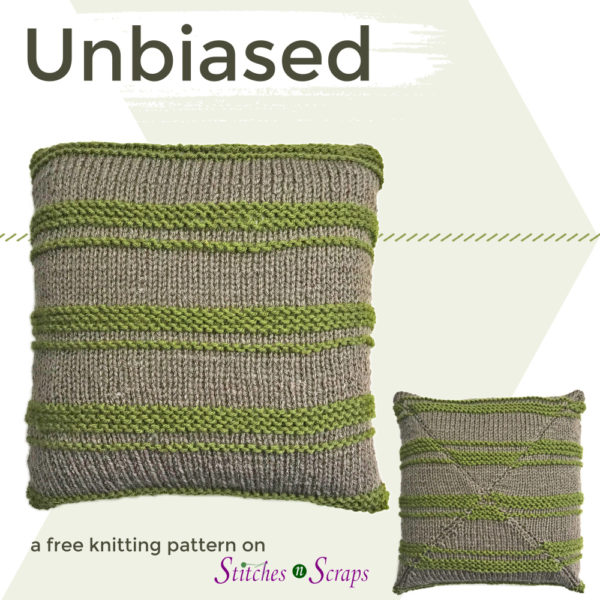
Knit Diagonal Stripes Pillow Pattern – Unbiased
This seemingly simple, striped pillow has a secret – it’s knit on the bias! Knit diagonal stripes, then seam them together to make them straight again. The only indication of the unique construction is the diagonal seams and offset stripes at the back.

This post contains affiliate advertisements (click for more info). If you click one of these advertisements and then make a purchase, I may be compensated. You get the same great prices, and you will be helping to support this site!
Finishing Touches KAL
I designed this pattern for the Finishing Touches KAL. This year long event is broken into 4 sections, and this is my 2nd pattern is for the 3rd section: Home. We have great prizes for each of the 4 sections, thanks to our generous sponsors. See all the details, including the giveaway entry information and links to the other patterns, in the main KAL post on Underground Crafter. Be sure to join in all the fun on the KAL Corner Knitting Facebook group too.

Lion Brand Vanna’s Choice yarn
Lion Brand originally sent me this Vanna’s Choice yarn for another project. I actually have quite the stash of leftover bits of Vanna’s Choice! With a soft feel and wide range of colors, it’s one of my go-to yarns when I want a good, everyday acrylic. My favorites are the earthy, neutral colors, like the ones I used in this pillow.
Why Unbiased?
This design came about as an experiment in bias knitting. Bias knitting, or knitting on the bias, simply means knitting diagonally. For a square like this pillow, that means working from corner to corner to knit diagonal stripes. But what happens when you take that bias knit fabric and seam it on the bias (along the diagonal edges)?
Folding the corners in makes those diagonal stripes line up straight again. In other words, they become “un-biased”! From the front, it looks like this pillow is just knit straight up in stripes. At the back though, the folded in corners create diagonal seams and an interesting reversal of the striping pattern.

Seaming Tutorial
The visible seams are an important part of this design. So I added a photo and video tutorial just for those! See the seaming tutorial for some great tips on getting a neat and pretty seam.
This pattern is protected by copyright. Please do not distribute or share this pattern in any way other than by sharing a link to this page or to the pattern page on Ravelry. Click here for copyright information.
Unbiased Pillow


Add this to your Ravelry Queue
Materials
- Lion Brand Vanna’s Choice Yarn (100% acrylic, 170 yds / 100 g per skein)
- 175 yds #125 Taupe (A)
- 100 yds #174 Olive (B)
- Size 8 / 5mm knitting needles, or size needed to obtain gauge.
- Tapestry Needle
- 14 inch, square pillow form
- 1 or 2 buttons of any desired size (optional)
Project Level
Intermediate: Basic increases, decreases, and stripes. The seaming requires a little concentration.
Size
To fit a 14 inch, square pillow form
Gauge
15 sts x 23 rows = 4 inches in stockinette
Abbreviations used
k = knit
p = purl
m1r = make one right
m1l = make one left
ssk = slip, slip, knit
k2tog = knit 2 together
RS = right side
WS = wrong side
Recommended Resources
- Selvedges from Vogue Knitting (shows the garter selvedge used in this pattern)
- Long Tail Cast On from Purl Soho
- Knitting Increases from Knitting Help
- Knitting Decreases from Knitting Help
- Knitting Seams – How to Seam the Unbiased Pillow

Instructions
Increasing
Wide Stockinette Stripe
With A, cast on 3, using a long tail cast on.
Row 1 (RS): With A, k 1, m1r, k across to last st, m1l, k 1. (5 sts)
Row 2: K 1, p across to last st, k 1.
Rows 3-10: Repeat rows 1-2 four times more. (13 sts)
Wide Garter Stripe
Carry unused colors up along side edge.
Row 11: With B, k 1, m1r, k across to last st, m1l, k 1. (15 sts)
Row 12: K across.
Rows 13-16: Repeat rows 11-12 twice more. (19 sts)
Narrow Stockinette Stripe
Row 17-18: With A, repeat rows 1-2. (21 sts)
Narrow Garter Stripe:
Rows 19-20: With B, repeat rows 11-12. (23 sts)
Rows 21-90: Repeat rows 1-20 three times more, then repeat rows 1-10 once more. (93 sts)

Decreasing
Wide Garter Stripe:
Row 91: With B, k 1, ssk, k across to last 3 sts, k2tog, k 1. (91 sts)
Row 92: K across.
Rows 93-96: Repeat rows 91-92 twice more. (87 sts)
Narrow Stockinette Stripe:
Row 97: With A, k 1, ssk, k across to last 3 sts, k2tog, k 1. ( 85 sts)
Row 98: K 1, p across to last st, k 1.
Narrow Garter Stripe:
Rows 99 – 100: With B, repeat rows 91-92. (83 sts)
Wide Stockinette Stripe:
Rows 101 – 110: With A, repeat rows 97-98 five times. (73 sts)
Rows 111 – 180: Repeat rows 91-110 three times more, then repeat rows 91-99 once more. (5 sts)
Row 180: Ssk, k 1, k2tog. (3 sts)
Bind off: Slip first st knitwise, k2tog, pass slipped stitch over. Cut yarn leaving a 24 inch tail for seaming, and fasten off.
Block your fabric before seaming. It should measure approximately 18 inches square.
Seaming
The seams are part of the design and should be visible but neat. Take your time with the seaming to make sure everything lines up. Seaming tutorial coming soon!
Lay square flat with wrong side up. Fold 2 corners in so that they meet in the center with RS up.
Line up striped sections and seam adjoining edges using the following rules:

- Always seam into the stitch that is one stitch in from the edge. This will be just behind the garter stitch selvedge.
- Each garter ridge has 2 lines of bumps – top and bottom. When working into garter stitch, on one side of the seam work into the top bump of the ridge, and on the other side work into the bottom bump of the ridge. In both cases, insert needle from top to bottom.

- When working into stockinette, work into one loop of the increase or decrease stitch at the edge. Choose the loop furthest from the edge, and insert needle so that it points towards the seam.
- Where stockinette meets garter in the striped section, one garter ridge should line up with 1 row of stockinette. The garter ridge is 2 rows, but it is more compact, so it works out evenly this way.
- After each section, pull the seaming thread snug. The seam should come together firmly, but not pucker.

Repeat for remaining corners, leaving only one seam unworked.
Sew in all tails except for the one you plan to use for the last seam.
Insert pillow form, then seam remaining edge and weave in end. .
Optional Button(s)
If desired, either sew a button over the center of the pillow only on the side where the seams meet, OR place one button in the center of each side of the pillow and sew them together, going through the center of the pillow.

I hope you enjoy making this Unbiased pillow pattern. A downloadable pdf of this pattern is also available on Ravelry, for a small fee. The fee for the pdf format is to offset the advertising revenue lost when you print or download the pattern rather than viewing it online.
Do you want the best of Stitches n Scraps delivered right to your inbox? The Stitches n Scraps email newsletter includes highlights from the blog as well as special features not available elsewhere. Don’t miss a stitch – Subscribe now!
Rate this pattern!

Knit Without Needles – Finger Knit Basket Pattern
Learn how to knit without needles! This bright, finger knit basket pattern is fast and easy to make. It stands up tall with the help of some plastic canvas hidden between the layers. There’s a video tutorial below as well.

This post contains affiliate advertisements (click for more info). If you click one of these advertisements and then make a purchase, I may be compensated. You get the same great prices, and you will be helping to support this site!
Finishing Touches KAL
I designed this pattern for the Finishing Touches KAL. This year long event is broken into 4 sections. This pattern is for the 3rd section: Home. We have great prizes for each of the 4 sections, thanks to our generous sponsors. See all the details, including the giveaway entry information and links to the other patterns, in the main KAL post on Underground Crafter. Be sure to join in all the fun on the KAL Corner Knitting Facebook group too.

Crayola, Off The Hook
Lion Brand sent me some of their new Crayola Off the Hook yarn for free to use for this design. I first saw this yarn earlier this year at a conference and couldn’t wait for it to become available! Lion Brand has teamed up with Crayola to make several of their yarns in bright, bold, crayon colors. How fun is that?

Knit Without Needles
Off the Hook yarn is a loop yarn, meaning that all the loops are already formed for you and held in place with a thread. It’s fuzzy and soft, so stitches don’t pull out easily on their own. This means you don’t need a needle to hold your stitches in place!
Working with loop yarn is fun and fast, and a great introduction to knitting. By pulling loops through other loops with just your fingers, you can create many knitting stitches. But you don’t actually have to know how to knit in order to do it.
Plastic Canvas Frame
Loop yarn is soft and fluffy, so without some sort of frame, the basket wouldn’t hold it’s shape very well at all. Adding a stiff frame fixes that, but would make the basket hard to wash. To solve this problem, I added a plastic canvas frame in such a way that it can easily be removed! Now the basket can be washed easily and then the frame can be reinserted. The plastic canvas is also flexible, so the basket can easily be squeezed into tighter spaces, while still standing upright.

This pattern is protected by copyright. Please do not distribute or share this pattern in any way other than by sharing a link to this page or to the pattern page on Ravelry. Click here for copyright information.
Finger Knit Basket


Add this to your Ravelry Queue
Materials
- Lion Brand Crayola Off the Hook yarn (100% polyester, 100g per skein)
- 12 x 18 inch sheet of stiff plastic canvas
- 2-3 yds scrap white yarn or crochet thread (to sew canvas together)
- Jumbo darning needle or crochet hook to weave in ends
Project Level
Easy: Working in the round, with some increases.
Size
12 inches diameter x 7 inches tall.
Gauge
Because the loops are a set size in this yarn, gauge will not vary and no swatch is needed.
Abbreviations used
k = knit (see Special Stitches)
inc = increase (see Special Stitches)
st(s) = stitch(es)
Recommended Resources
Special Stitches
For clarity I will be calling loops that are on the working yarn “loops” and loops that have already been worked “stitches” throughout the pattern.
Knit (k): Pull next loop through indicated stitch, from the back to the front.

Increase (inc): Pull the next 2 loops through indicated stitch, from the back to the front.

Bind off: Pull next st through current st.

Instructions
Bottom
Entire piece is worked from the right side. It does not matter which direction you work, as long as you work the same way throughout.
Ensure you have enough of a tail to weave in later (about 4 inches is enough). If you do not, cut open the first one or two loops until you do. At the bottom of each loop there is a string holding the loop together – cut that string to open the loop.

Mark the first stitch of each round with a stitch marker. Move the marker with each round.
Rnd 1: Arrange the first 4 loops in a circle. (4 sts)
Rnds 2-3: Inc in each st. (16 sts)
Rnd 4: [Inc in next st, k next st] around. (24 sts)
Rnd 5: [Inc in next st, k next 2 sts] around. (32 sts)
Rnd 6: [Inc in next st, k next 3 sts] around. (40 sts)
Rnd 7: [Inc in next st, k next 4 sts] around. (48 sts)

Do not cut yarn. Bind off around, until there is only 1 st left.
Work should now measure approximately 12 inches in diameter. This is the bottom circle of the basket. The right side will show on the outside of the basket. The lumpier wrong side will be on the inside of the basket.
We are now going to pull loops up behind the bind off edge to start working up the sides.
Sides (Blue)
Rnd 1: Bring the working yarn to the front of your work. Working under the bind off edge, push remaining st from bind of through the first bind off stitch, from front to back. [Push next loop up through next bound off st, from front to back] around. (48 sts)
Flip work over so wrong side of bottom circle is facing up.
Rnds 2-8: Being sure to stay on the right side of the work, bring working yarn to the back and k each st around. (48 sts)
Cut open next 2 loops on working yarn to create a tail, and cut blue yarn leaving the tail to weave in later.
Sides (Green)
We are now going to create a round of extra, unused loops. Later, we will be using those loops to form the top edging.
Leave a starting tail of green yarn, cutting open 1 or 2 loops if necessary.
Rnd 9: With green yarn, [k next st, pull next loop forward between st just worked and next st] around. (48 sts, 48 free loops).

Rnd 10: Working only into the sts and ignoring the extra loops that were pulled forward, k around. (48 sts)
Rnds 11 – 15: K
Bind off around, until there is only 1 st. Cut open next 2 loops on working yarn to create a tail, and cut the yarn. Pull tail through last st to secure it.
Top Edging
Cut a scrap of green yarn that is 4 loops long and open up all 4 loops.
Using the free loops from rnd 9, bind off until only 1 loop remains.
Pull the scrap of green yarn through the remaining loop and pull both ends through to wrong side of work.

Plastic Canvas Frame:
Cut the sheet of plastic canvas in half lengthwise and trim any rough edges.
Overlap the ends by an inch of two, and sew them together with scrap of yarn or thread to form a long strip.
Overlap the ends of the long strip to forms a cylinder, so that it fits tightly inside the basket, and sew them together.

Finishing
Weave in all ends
Insert plastic mesh frame into basket.
Fold green side down to cover the plastic mesh, so that top edging rests on the top.

Additional options:
- For a sturdier basket, add a circle of plastic mesh to the bottom.
- For a more padded bottom (or to cover a plastic mesh circle), make another bottom circle out of the green yarn and place it on the inside of the basket. You will need a 2nd skein of green yarn to do this.
- You can make a smaller basket by stopping the bottom circle earlier. The stitch count won’t matter to the rest of the pattern. For a larger basket, make a bigger bottom circle, increasing 8 sts with each extra rnd.
Video Tutorial
I hope you enjoyed knitting without needles. A downloadable pdf of this pattern is also available on Ravelry, for a small fee. The fee for the pdf format is to offset the advertising revenue lost when you print or download the pattern rather than viewing it online.
Do you want the best of Stitches n Scraps delivered right to your inbox? The Stitches n Scraps email newsletter includes highlights from the blog as well as special features not available elsewhere. Don’t miss a stitch – Subscribe now!
Rate this finger knit basket pattern!

Free Pattern – Reversible Cables Headband
Get 2 looks from one headband! Wear it one way for 2 cables with a decorative edge. Turn it round the other way and you have 3 cables. Which side is your favorite?

The reversible effect is created by working cables on both sides of the work, but the actual cables are simple and work up quickly. This headband can be made to any length.
Finishing Touches KAL
I designed this pattern for the Finishing Touches KAL. This year long event is broken into 4 sections and this pattern is for the 2nd section, which is headwear. There are some great prizes for each of the 4 sections, thanks to our generous sponsors. See all the details, including the giveaway entry information and links to the other patterns, in the main KAL post on Underground Crafter. Be sure to join in all the fun on the KAL Corner Knitting Facebook group too.

This post contains affiliate links (click for more info). If you click an affiliate link and then make a purchase, I may be compensated. You get the same great prices, and you will be helping to support this site!
Lion Brand Vanna’s Choice Yarn
Lion Brand had sent me some free Vanna’s Choice Yarn for our Harmony Blanket KAL last year. I used some of the leftovers from that to make this headband.
Vanna’s Choice is a worsted, acrylic yarn that comes in an amazing array of colors. It’s soft, and easy to work with too. I’ve used it a lot, so I have little balls of leftovers in about 15 or 16 different colors now. They’re great for small projects like this one.
This pattern is protected by copyright. Please do not distribute or share this pattern in any way other than by sharing a link to this page or to the pattern page on Ravelry. Click here for copyright information.
Reversible Cables Headband


Add this to your Ravelry Queue
Materials:
- 50 yds of Lion Brand Vanna’s Choice Yarn – #108 Dusty Blue
- Small amount of waste yarn in another color for cast on.
- Size 10 (6mm) knitting needles or size needed to obtain gauge
- Yarn needle
Project Level:
Intermediate – Basic cables worked on both sides of the fabric. Slip stitch selvedge.
Size:
About 20 inches circumference. Can be adjusted to any length / circumference.
Gauge:
13 sts x 24 rows = 4 inches in garter stitch. Exact gauge is not critical. Use pattern as gauge – after row 20, work should measure about 3 inches long.
Abbreviations used:
- k = knit
- p = purl
- sl = slip purlwise with yarn in front
- m1 = make 1 (increase)
- k2tog = knit 2 together
- RT = right twist (see special stitches)
- st(s) = stitch(es)
Recommended Resources:
- How to Work a Provisional Cast On (Zipper Method) from Hands Occupied
- Three Ways to Make Provisional Cast on Without a Crochet Hook from 10 Rows a Day
- Provisional Cast On Videos – with a shortcut! from Jessie at Home
- Make One Right Increase (M1R or M1) from New Stitch A Day
- How to Knit the Right Twist Stitch (RT) from New Stitch a Day
- How to sew a kitchener (grafting) stitch from Hands Occupied
Special Stitch:
Right Twist (RT): Knit the 2nd stitch, then knit the first stitch, then remove both stitches from the left needle (right needle, if you’re left handed).
This stitch is also referred to as 1/1 RC (1 over 1, right crossing cable).
Instructions:
(scroll down for chart)
Cast on 8 stitches with a provisional cast on, using waste yarn.
There are many ways to do a provisional cast on with waste yarn. I’ve linked to several options in the Recommended Resources section, and any of those are fine. I usually just do a knitted cast on entirely with waste yarn as that’s easy enough to unpick later.
Whichever method you use, you will be removing the waste yarn at the end so that the live stitches are exposed.
Garter Stitch
Rows 1-10: K
Cables
Row 11: (increase row): K 1, (k 1, m 1) 6 times, sl 1. (14 sts)
Row 12: K 4, (p2, k 2) twice, k 1, sl 1.
Row 13 (cable row): K 2, (p 2, RT) twice, p 2, k 1, sl 1.
Row 14 (cable row): K 2, (RT, p 2) twice, RT, k 1, sl 1.
Row 15: (K 2, p 2) 3 times, k 1, sl 1.
Row 16: K 4, (p2, k 2) twice, k 1, sl 1.
Rows 17-18: Repeat rows 15-16.
Repeat rows 13-18 until you reach about 17 inches from beginning (or 3 inches less than desired length).
Repeat rows 13-15 once more.
Decrease row: K 1, k2tog 6 times, sl 1. (8 sts)

Garter Stitch
Rows 1-10: K
Joining / Finishing
Check size before joining, add or remove rows in garter stitch section as needed.
Remove provisional cast on and place live stitches onto empty needle.
Graft the two ends together using the kitchener stitch.
Weave in all ends.
Wash and block.
Chart

I hope you enjoy the pattern!
A downloadable pdf of this pattern is also available on Ravelry for a small fee. The fee for the pdf format is to offset the advertising revenue lost when you print or download the pattern rather than viewing it online.
Do you want the best of Stitches n Scraps delivered right to your inbox? The Stitches n Scraps email newsletter includes highlights from the blog as well as special features not available elsewhere. Don’t miss a stitch – Subscribe now!

Free Pattern – Cobblestone Lane
Take a stroll down a winding, cobblestone lane on a crisp spring day, and see what adventures you can find. There’s still a bit of a chill in the air, so don’t forget your scarf!

A chunky, diagonal rib stitch meanders back and forth, broken by bumpy rows of seed stitch. Bold stripes in neutral shades make this a great, unisex design.
Finishing Touches KAL
I designed this pattern for the Finishing Touches KAL. This year long event is broken into 4 sections, the first of which is neckwear. We have great prizes for each of the 4 sections, thanks to our generous sponsors. See all the details, including the giveaway entry information and links to the other patterns, in the main KAL post on Underground Crafter. Be sure to join in all the fun on the KAL Corner Knitting Facebook group too.

Color Made Easy
Lion Brand sent me some of their new Color Made Easy yarn for free, to make this design. It’s a superbly soft, squishy, cozy yarn. The bulky weight means it knits up fast too. If neutrals aren’t your thing, Lion Brand has you covered. Color Made Easy comes in lots of bright, bold shades as well!
This post contains affiliate links (click for more info). If you click an affiliate link and then make a purchase, I may be compensated. You get the same great prices, and you will be helping to support this site!
This pattern is protected by copyright. Please do not distribute or share this pattern in any way other than by sharing a link to this page or to the pattern page on Ravelry. Click here for copyright information.
Cobblestone Lane


Add this to your Ravelry Queue
Materials:
- Lion Brand Color Made Easy Yarn
- 240 yds of #150 Basalt (A)
- 75 yds of #151 Smoky Quartz (B)
- Size 10.5 (6.5mm) knitting needles or size needed to obtain gauge
- Yarn needle
Skill Level:
Easy – All knits and purls, with some color changes.
Sizes:
9.5 inches x 58 inches. The stitch pattern will curl at the edges, and the scarf is extra wide to accommodate that curling.
Gauge:
13 sts x 16 rows = 4 inches in seed stitch. Use pattern as gauge – after row scarf should measure 9.5 x 5 inches.
Abbreviations used:
- k = knit
- p = purl
- sl = slip purlwise with yarn in front
- st(s) = stitch(es)
- RS = Right Side
Recommended Resources:

Instructions:
(scroll down for chart)
Cast on 32 stitches with B. (Multiple of 6 + 2).
I recommend the alternating cable cast on (also called a seed stitch cast on).
Seed Stitch
Row 1 (RS): (P 1, k 1) across.
Row 2: Sl 1, (p 1, k 1) across to last st, k 1.
Row 3: Sl 1, (k 1, p 1) across to last st, k 1.
Row 4: Repeat Row 2. Change to A. Cut B, leaving a tail to weave in later.
Right Diagonal Rib
Row 5: With A, sl 1, k across.
Row 6: Sl 1, (k 2, p 4) across to last st, k 1.
Row 7: Sl 1, (k 4, p 2) across to last st, k 1.
Rows 8-10: Repeat rows 6 & 7, then repeat row 6 once more.
Row 11: Sl 1, k 2, (p 2, k 4) across to last 5 sts, p 2, k 3.
Row 12: Sl 1, p 2, (k 2, p 4) across to last 5 sts, k 2, p 2, k 1.
Rows 13-15: Repeat rows 11 & 12, then repeat row 11 once more.
Row 16: Sl 1, (p 4, k 2) across to last st, k 1.
Row 17: Sl 1, (p 2, k 4) across to last st, k 1.
Rows 18-20: Repeat rows 16 & 17, then repeat row 16 once more. Change to B. Cut A, leaving a tail to weave in later.
Seed Stitch
Row 21: With B, sl 1, k across.
Row 22-24: Repeat rows 2-4
Left Diagonal Rib
Rows 25-30: Repeat rows 5-10.
Row 31: Sl 1, (p 2, k 4) across to last st, k 1.
Row 32: Sl 1, (p 4, k 2) across to last st, k 1.
Rows 33-35: Repeat rows 31-32, then repeat row 31 once more.
Row 36: Sl 1, p 2, (k 2, p 4) across to last 5 sts, k 2, p 2, k 1.
Row 37: Sl 1, k 2, (p 2, k 4) across to last 5 sts, p 2, k 3.
Rows 38-40: Repeat rows 36-37, then repeat row 36 once more. Change to B. Cut A, leaving a tail to weave in later.
Remainder of Scarf
Row 41: With B, sl 1, k across.
Rows 42-281: Repeat rows 2-41 six times,
Rows 282-284: Repeat rows 2-4 but do not cut or change yarn.
Bind off all stitches.
Finishing
Weave in all ends.
Wash and block – blocking is important to open up the ribbing pattern.

Chart

I hope you enjoy the pattern. Thanks to Carie Carolyn for helping me name it!
A downloadable pdf of this pattern is also available on Ravelry for a small fee. The fee for the pdf format is to offset the advertising revenue lost when you print or download the pattern rather than viewing it online.
Do you want the best of Stitches n Scraps delivered right to your inbox? The Stitches n Scraps email newsletter includes highlights from the blog as well as special features not available elsewhere. Don’t miss a stitch – Subscribe now!