Free Knitting Patterns

Rust and Shadow Brioche Knit Scarf
Vines creep along stone walls, their shadows dancing in the frosted glow of streetlights. Stay snug, wrapped in the meandering lines of the Rust and Shadows Brioche Knit Scarf. Knit it from end to end or mirror the pattern across the back for a more symmetrical look.

This content is protected by copyright. See this Terms of Use / Copyright page for more information.
This post contains sponsored content and/or affiliate links. If you click an affiliate link and make a purchase, I may get a commission.
Cascade Eco+ Yarn
Cascade provided the bulky, Eco+ yarn for this brioche knit scarf design. The Peruvian highland wool is luxuriously soft and smushy, perfect for brioche knitting!

The palette is mostly neutrals and rich earth tones, including several heathered shades, with a few lighter and brighter colors in the mix. For this scarf I chose 9654 Campfire Heather and 9450 Smoke Heather.
2025 Two of a Kind Hat and Scarf KAL
This brioche knit scarf pattern is part of the Two of a Kind Hat and Scarf Knit Along, which I am co-hosting with Marie from Underground Crafter. This is number 10 of 12 patterns, 6 hats and 6 scarves, throughout the year. Each hat and scarf pair uses the same yarn, but I will design one, and Marie will design the other. Get all the details, other patterns, and the full schedule in the main KAL post.
Due to unforeseen circumstances, Marie’s coordinating hat design has been delayed (potentially for quite a while). When it becomes available, I will share it here.
2-Color Brioche Knitting
While it looks intimidating, there’s a comfortable rhythm to 2-color brioche knitting.
2-part rows
Each row is worked twice, once in each color. Work a right side row in color A, then shift all the stitches back to the other end of the needle and work another RS row, this time in color B. Then turn your work and repeat the process with color A and color B wrong side rows. In order to slide the stitches to the other end of the needle, you will need either a circular needle or double-pointed needles.
Each time you work across a row, work every alternate stitch, slipping the ones you don’t work. When you come back across with the other color, work the stitches you slipped earlier, and slip the stitches you worked earlier. That way each stitch is worked once on each row.
Yarn over slip stitches
The key to brioche is the yarn overs. When you slip a stitch, you also make a yarn over at the same time, which makes the yarn over wrap over the slipped stitch. The yarn over does not create another stitch, it moves along with the slipped stitch and they are worked together later.
Brioche abbreviations
Brioche stitches have funny abbreviations like “bark” (brk – brioche knit) and “burp” (brp-brioche purl). These just mean to work the knit and purl stitches you already know, but through both the slipped stitch and its associated yarn over at the same time.
Increases and Decreases
The movement in this brioche knit scarf pattern comes from paired increases and decreases. Just like with the knit and purl stitches, these are similar to the increases and decreases you already know. The only difference is that you always work the yarn overs with their associated slipped stitches wherever they appear.
Rust and Shadows Brioche Knit Scarf Tutorial
Need a little help with the pattern? Follow along step by step with this full video tutorial!

Materials
- Yarn: Cascade Eco+ – 100% Peruvian Highland wool, bulky weight yarn (478 yds / 8.82 oz / 250 g per skein)
- 175 yds 9654 Campfire Heather (A)
- 150 yds 9450 Smoke Heather (B)
- Needles: US size 10 / 6 mm knitting needles or size needed to match gauge
- Notions:
- Scissors
- Tapestry needle
- Waste yarn for provisional cast-on (for Mirrored Pattern Option only)
Project Level
Intermediate: 2-color brioche knitting with increases and decreases
Size
9.75 x 66 inches / 24.5 x 165 cm
Gauge
In 2-Color Pattern: 11.5 sts x 13 rows = 4″ / 10 cm after blocking
Note: In 2-color pattern, part a and b together count as 1 row. This pattern grows significantly when blocked. Block swatch before measuring gauge. Exact gauge is not critical but will affect yardage needed.
Abbreviations used
- BO = bind off / bind-off
- br4st inc = brioche 4 stitch increase
- brk = brioche knit
- brkyobrk = brioche knit, yarn over, brioche knit
- brLsl dec = brioche left slanting decrease
- brp = brioche purl
- brRsl dec = brioche right slanting decrease
- CO = cast on / cast-on
- k = knit
- p = purl
- rep = repeat
- RS = right side
- sl = slip purlwise
- sl1yo = slip 1 with yarn over
- st(s) = stitch(es)
- WS = wrong side
- yo = yarn over
Recommended Resources
Pattern Notes
Working needle is right-hand needle if knitting right-handed, and left-hand needle if knitting left-handed. Non-working needle is other needle.
This brioche knit scarf is worked continuously from one end to the other, with the 2 ends being different. If you would prefer the 2 ends to be the same (mirrored across center back), see Mirrored Pattern Option below for adjustments before beginning.
Special Stitches
Brioche knit (brk): K next st together with its associated yo.
Brioche purl (brp): P next st together with its associated yo.
Brioche knit 2 stitch increase (brkyobrk): Brk in next st without removing it from non-working needle, yo, brk again in same st, remove st from non-working needle. 2 sts inc.
Brioche knit 4 stitch increase (br4st inc): Brk in next st without removing it from non-working needle, [yo, brk again in same st] twice, remove st from non-working needle. 2 sts inc.
Brioche right slanting decrease (brRsl dec): Sl next st together with its associated yo knitwise, k next st (center st), pass slipped st and yo over center st, sl center st back to non-working needle, pass next st together with its associated yo over center st, slip center st back to working needle. (2 sts dec)
Brioche left slanting decrease (brLsl dec): Sl next st together with its associated yo knitwise, k next 2 sts and associated yo together, pass slipped st and yo over st just k. (2 sts dec)
Slide work: Slide all sts to opposite end of needle to work another row in same direction with other yarn color.
Slip 1 with yarn over (sl1yo): Bring yarn to front of work if not already there. Sl1, bring yarn to back of work over needle, creating a yo. This yo is not a separate st and is not counted separate in st counts (no sts are increased). The yo will be worked together with the slipped st on the next row.
After completing sl1yo, if next st is a k, leave working yarn at back, ready to k. If next st is a p, bring yarn to front again between needles, ready to p.
Instructions
Scroll down for Chart and Mirrored Pattern Option.
Starting Single Color Hem
With A, CO 29 sts with long tail cast-on or preferred cast-on method.
Row 1 (RS): K1, [sl1yo, k1] across.
Row 2 (WS): K1, brk, [sl1yo, brk] to last st, k1.
2-Color Pattern
In 2-color brioche, each row has 2 parts: Part a is worked with A, and part b is worked in the same direction with B.
Row 3a (RS): With A, k1, sl1yo, [brk, sl1yo] to last st, k1, slide work.
Row 3b (RS): Sl1, with B, brp, [sl1yo, brp] to last st, drop B at RS of work, sl1.
Row 4a (WS): With A, k1, sl1yo, [brp, sl1yo] to last st, k1, slide work.
Row 4b (WS): Sl1, with B, brk, [sl1yo, brk] to last st, drop B at RS of work, sl1.
Row 5a: With A, k1, sl1yo, [brRsl dec, sl1yo, brkyobrk, sl1yo] twice, brk, sl1yo, [brkyobrk, sl1yo, brLsl dec, sl1yo] twice, k1, slide work.
Row 5b: Sl1, with B, *[brp, sl1yo] twice, p1, sl1yo; rep from * 3 times more, brp, sl1yo, brp, drop B at RS of work, sl1.
Rows 6a-6b: Repeat Rows 4a-4b.
Rows 7a-14b: [Repeat Rows 3a-6b] twice.
Rows 15a-16b: Repeat Rows 3a-4b.
Row 17a (RS): With A, k1, sl1yo, brk, sl1yo, brRsl dec, sl1yo, brkyobrk, sl1yo, brRsl dec, sl1yo, br4st inc, sl1yo, brLsl dec, sl1yo, brkyobrk, sl1yo, brLsl dec, sl1yo, brk, sl1yo, k1, slide work.
Row 17b (RS): Sl1, with B, [brp, sl1yo] 3 times, p1, sl1yo, [brp, sl1yo] twice, [p1, sl1yo] twice, [brp, sl1yo] twice, p1, [sl1yo, brp] 3 times, drop B at RS of work, sl1.
Rows 18a-18b: Rep Rows 4a-4b.
Rows 19a-210b: [Repeat Rows 3a-18b] 12 times.
To adjust length, work more or fewer repeats, ending after a WS row. Adjusting length will affect yardage needed.
Cut B, leaving a tail to weave in later.
Ending Single Color Hem
Row 211 (RS): With A, k1, sl1yo, [brk, sl1yo] to last st, k1.
Row 212 (WS): K1, brk, [sl1yo, brk] to last st, k1.
Rows 213-214: Rep Rows 211-212.
Bind-Off (RS): K1, *k1, pass 2nd st on working needle over first st, brk, pass 2nd st on working needle over first st; rep from * until all sts are bound off and 1 st remains on working needle. Cut working yarn, pull up on final st (making it bigger) until tail comes all the way out.
Finishing
Weave in ends. Wash and block gently if desired.
Chart
Mirrored Pattern Option
To make the pattern mirrored across the center back so that both ends of the scarf match, make the following adjustments:
With waste yarn, CO 29 sts using preferred provisional cast-on method.
First Half of Scarf
Row 1a (RS): With A, work Row 1 of Starting Single Color Hem.
Row 1b (RS): Work Row 3b of 2-Color Pattern.
Rows 2a-16b: Work Rows 4a-18b of 2-Color Pattern.
Rows 17a-104b: [Work Rows 3a-18b of 2-Color Pattern] 5 times, then work Rows 3a-10b once more.
To adjust length, work more or fewer repeats, ending after a WS row. Adjusting length will affect yardage needed.
Rows 105-106 & Bind-Off: Work Rows 211-212 and Bind-Off of Ending Single Color Hem.
2nd Half of Scarf
Remove waste yarn from CO edge and place live stitches on needles. Since you are picking up between stitches of first row, you will have only 28 sts. Pick up one extra st from either end of CO edge to make 29.
Beginning with a RS row, repeat First Half of Scarf.
Finishing
Weave in ends. Wash and block gently.
Share this brioche knit scarf pattern on Pinterest!
Here’s an image perfect for pinning.

Rate this brioche knit scarf pattern!
I hope you enjoyed this knit bucket hat pattern! A downloadable pdf of this pattern is available on Ravelry for a small fee.
Do you want the best of Stitches n Scraps delivered right to your inbox? Don’t miss a stitch – Subscribe now!

Summer’s Edge Knit Bucket Hat
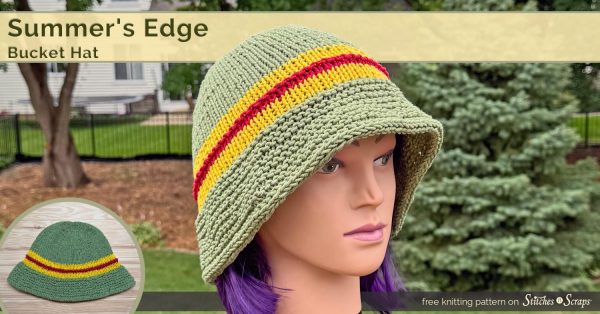
Shade your eyes in effortless comfort with the Summer’s Edge Bucket Hat! This knit bucket hat is worked from the top down in smooth stockinette stitch, flowing into a flared, face-framing, garter stitch brim. Bold stripes add a touch of texture and a playful pop of color. It’s the perfect companion for those lazy days of late summer that whisper of the coming fall.

This content is protected by copyright. See this Terms of Use / Copyright page for more information.
This post contains sponsored content and/or affiliate links. If you click an affiliate link and make a purchase, I may get a commission.
Cascade Sarasota Worsted Yarn
Cascade provided the summery Sarasota Worsted yarn for this knit bucket hat design. The smooth cotton/acrylic blend has beautiful stitch definition and a relaxed drape.

It comes in colors for all seasons, from pastels to brights to neutrals. I combined 202 Jade Green with 209 Yellow and 213 Chilli Pepper.
2025 Two of a Kind Hat and Scarf KAL
This knit bucket hat pattern is part of the Two of a Kind Hat and Scarf Knit Along, which I am co-hosting with Marie from Underground Crafter. This is number 8 of 12 patterns, 6 hats and 6 scarves, throughout the year. Each hat and scarf pair uses the same yarn, but I will design one, and Marie will design the other. Get all the details, other patterns, and the full schedule in the main KAL post.
Due to unforeseen circumstances, Marie’s coordinating scarf design has been delayed (potentially for quite a while). When it becomes available, I will share it here.
Jogless Stripes
Knitting in the round creates a spiral rather than stacked rings of stitches. This means that simple stripes will form a distinct color shift or jog where the first and last stitch of the round meet. Slipping the first stitch of the 2nd round minimizes this jog and creates more seamless or jogless stripes. You’ll see this technique in the striping section of the pattern.
Summer’s Edge Bucket Hat Tutorial
Need a little help with the pattern? Follow along step by step with this full video tutorial!
Materials
- Yarn: Cascade Sarasota Worsted – 60% cotton, 40% acrylic, worsted weight yarn (208 yds / 3.5 oz / 100 g per skein)
- 50 [65, 75, 95, 120] yds 202 Jade Green (A)
- 15 [20, 25, 25, 30] yds 209 Yellow (B)
- 10 yds 213 Chilli Pepper (C)
- Needles: US size 8 / 5 mm knitting needles or size needed to match gauge
- Notions:
- Scissors
- Stitch markers (8)
- Tapestry needle
Project Level
Easy: Working in the round, jogless color changes, basic increases
Sizes
Baby [Toddler, Child, Small, Large]
Circumference before Brim: 13.25 [15, 16.5, 18.25, 19.75]” / 33 [37.5, 41.5, 45.5, 49.5] cm
Brim Circumference: 22 [24.25, 28.75, 31, 33]” / 55 [60.5, 72, 77.5, 82.5] cm
Height (including Brim): 6.25 [7.25, 8.5, 9, 9.75]” / 15.5 [18, 21.5, 22.5, 24.5] cm
To Fit Head Circumference: 14-16 [16-18, 18-20, 20-22, 22-24]” / 35-40 [40-45, 45-50, 50-55, 55-60] cm
Gauge
In Stockinette Stitch: 14.5 sts x 23 rnds = 4″ / 10 cm after blocking
In Garter Stitch: 14.5 sts x 30 rnds = 4″ / 10 cm after blocking
Cotton yarn relaxes a lot with blocking, so take time to block your swatch.
Abbreviations used
- BO = bind off / bind-off
- CO = cast on / cast-on
- k = knit
- k2tog = knit 2 together
- kfb = knit front and back
- m1L = make 1 left
- p = purl
- rep = repeat
- rnd = round
- RS = right side
- sl = slip
- slm = slip marker
- st(s) = stitch(es)
- tbl = through back leg
- WS = wrong side
- yo = yarn over
Instructions
With A and leaving a 6″ / 15 cm tail, CO 8 sts using a long-tail cast-on. Join to work in the round. All rnds are worked on the RS.
Crown
Rnd 1: K1, m1L, [k1, pm, m1L] around. (16 sts)
Rnd 2: K around.
Rnd 3: K1, m1L, [k to m, slm, m1L] 7 times, k to end. (24 sts)
Rnds 4-7 [9, 11, 13, 13]: [Rep Rnds 2 & 3] 2 [3, 4, 5, 5] times more. (40 [48, 56, 64, 64] sts)
Sizes Baby & Large only:
Rnds 8-10 [-, -, -, 14-16]: K around.
Rnds 11 [-, -, -, 17]: Rep Rnd 3, removing markers as you come to them, pm for beginning of rnd. (48 [-, -, -, 72] sts)
Sizes Toddler, Child, & Small only:
Rnd – [10, 12, 14, -]: K around, removing markers as you come to them, pm for beginning of rnd.
Rnd – [11-12, 13-14, 15-16, -]: K around.
Rnd – [13, 15, 17, -]: K1, m1L, [k -[8, 14, 32, -], m1L] – [5, 3, 1, -] time(s), k to end of rnd. (- [54, 60, 66, -] sts)
Body (All Sizes)
Rnd 1: K around. (48 [54, 60, 66, 72] sts)
[Rep Rnd 1] 5 [8, 8, 9, 14] times more, or until hat measures approximately 3.25 [4, 4.5, 5, 5.75]” / 8 [10, 11.5, 12.5, 14.5] cm from top of Crown.
First Color B Stripe
Rnd 1: Change to B, k around.
Rnd 2: Sl1, k around.
Next 1 [1, 2, 2, 2] Rnds: K around.
Color C Stripe
Rnd 1: Change to C, k around.
Rnd 2: Sl1, p around.
Rnd 3: K around.
2nd Color B Stripe
Rep First Color B Stripe.
Last Rnd: Change to A, k around.
Brim
Rnd 1: K1, kfb, (k2, kfb) to last st, k1. (64 [72, 80, 88, 96] sts)
Rnd 2: P around.
Rnd 3: K around.
Rnd 4: P around.
Rnd 5: K1, kfb, (k7 [8, 9, 10, 11], kfb) 7 times, k to end. (72 [80, 88, 96, 104] sts)
Rnds 6-8: Rep Rnds 2-4.
Rnd 9: K1, m1L, (k8 [9, 10, 11, 12], kfb) 7 times, k to end. (80 [88, 96, 104, 112] sts)
Sizes Child, Small & Large only
Rnds 10-12: Rep Rnds 2-4.
Rnd 13: K1, m1L, (k – [-, 11, 12, 13], kfb) 7 times, k to end. (- [-, 104, 112, 120] sts)
All Sizes
Last 2 Rnds: Rep Rnds 2 & 3.
I-Cord Bind-Off
Note: “Working needle” is right-hand needle if knitting right-handed and left-hand needle if knitting left-handed.
Cast-on 3 sts with knitted cast-on, k2, k2tog tbl (1 st BO), *sl all 3 sts from working needle back to other needle, k2, k2tog tbl; rep from * until last st has been BO and 3 sts rem on working needle.
Cut yarn, leaving a long tail for sewing. Using long tail and tapestry needle, sew 3 live sts to first 3 CO sts as follows:
Beginning from inside edge (closest to center of hat), pass tail purlwise through first live st on knitting needle.
Pass tail under both legs of first CO st, pass tail knitwise through first live st and remove from knitting needle, pass tail purlwise through 2nd live st.
Pass tail under both legs of 2nd CO st, pass tail knitwise through second live st and remove from knitting needle, pass tail purlwise through 3rd live st.
Pass tail under both legs of 3rd CO st (this one is harder to find, you may need to roll the edge towards you to see it), pass tail knitwise through 3rd live st and remove from knitting needle.
Finishing
Weave in all ends. Wash and block.
Share this knit bucket hat pattern on Pinterest!
Here’s an image perfect for pinning.

Rate this knit bucket hat pattern!
I hope you enjoyed this knit bucket hat pattern! A downloadable pdf of this pattern is available on Ravelry for a small fee.
Do you want the best of Stitches n Scraps delivered right to your inbox? Don’t miss a stitch – Subscribe now!

Summer’s Edge Knit Bucket Hat Tutorial
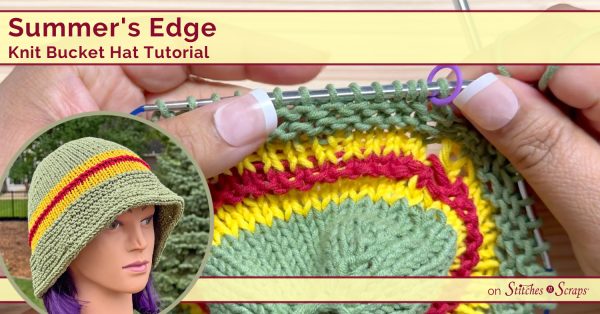
Keep your cool with the Summer’s Edge Bucket Hat! This knit bucket hat tutorial takes you step by step through this top-down hat pattern. Start with a smooth, stockinette body, followed by playful stripes, flared garter stitch brim, and I-cord bind-off. Grab the pattern and follow along!

This content is protected by copyright. See this Terms of Use / Copyright page for more information.
This post contains sponsored content and/or affiliate links. If you click an affiliate link and make a purchase, I may get a commission.
Get the Pattern
Follow along with the written pattern for the Summer’s Edge Bucket Hat. The video references the instructions in the pattern, including stitch counts and number of repeats.

The knit bucket hat pattern starts at the very top with just a few stitches cast-on. From there, increases in stockinette stitch shape the crown. Then, playful stripes flow into a flared, face-framing, garter stitch brim. The hat ends with an I-cord bind-off for a structured edge that doesn’t roll.
Cast-On
The pattern scarf begins with a basic, long tail cast-on, which is not shown in the tutorial. For a refresher on this technique, check out the demo portion of Lunchtime Live episode 61.

Jogless Stripes
Color changes while knitting in the round can create a distinct shift or jog where the first and last stitch of the round meet. Slipping the first stitch of the 2nd round minimizes this jog and creates more seamless or jogless stripes. You’ll see this technique in the striping section of the tutorial.

M1L and Kfb Increases
This pattern uses 2 different types of increases. This tutorial shows both techniques, and there are also full tutorials available for each.
In the crown and body of the hat, make 1 left (m1L) increases blend in with the stockinette stitch.
In the garter stitch brim, easier knit front and back (kfb) increases blend in nicely, though you could substitue m1L increases here as well if preferred.
I-cord Bind-Off
Finally, an I-cord bind-off creates a firm, structured edge for the brim, which prevents curling. This technique combines a 3-stitch I-cord with decreases to attach it to the hat. The knit 2 together (k2tog) decreases join the last stitch of the i-cord with the next stitch on the hat, effectively binding off that stitch.
The video goes through the bind-off in detail, including seaming the ends of the I-cord together. For a closer look at just the decrease, see this knit 2 together decrease tutorial.
Summer’s Edge Knit Bucket Hat Video Tutorial
Embed not working? Watch this video on YouTube.
Want to jump to a specific section? Click on the timestamp below to go directly to that spot in the video! These links open on YouTube, in a new window or tab.
- 00:00 Intro
- 00:13 Get the Pattern
- 00:24 Materials
- 00:38 Cast-On and Magic Loop
- 01:39 Crown – Round 1
- 06:15 Crown – Round 2
- 06:55 Crown – Round 3
- 08:38 Crown – Repeats
- 09:48 Last Increase Round
- 11:41 Body – Before Stripes
- 12:29 First Color B Stripe
- 14:14 Color C Stripe
- 15:57 2nd Color B Stripe
- 16:31 Brim – Round 1
- 18:05 Brim – Rounds 2-4
- 20:11 Brim – Round 5
- 21:27 Brim – Repeats
- 22:40 I-cord Bind-Off
- 26:40 Seaming the Bind-Off
- 30:24 Finishing
Share this Knit Bucket Hat Tutorial on Pinterest!
Here’s an image perfect for pinning:

Rate this Knit Bucket Hat Tutorial!
Do you want the best of Stitches n Scraps delivered right to your inbox? Don’t miss a stitch – Subscribe now!

Beach Day Lace Knit Scarf
Escape to the tropics with the Beach Day Scarf! This light and breezy lace knit scarf captures the feel of a coral reef beneath sparkling waters. Alternating stripes of drop-stitch lace and eyelet rib lace in contrasting colors create a mesmerizing pattern. Knit in a summery, lightweight yarn, it’s the perfect accessory for warm days and ocean breezes.

This content is protected by copyright. See this Terms of Use / Copyright page for more information.
This post contains sponsored content and/or affiliate links. If you click an affiliate link and make a purchase, I may get a commission.
Cascade Hampton Yarn
Cascade provided the beachy Hampton yarn for this lace knit scarf design. The lightweight, summery blend of Pima cotton and linen is lovely in lace and perfect for warm-weather wear.

It comes in lots of rich, saturated colors from brights to neutrals. I used 18 -Chrysanthemum and 23 – Tile Blue for a tropical feel.
2025 Two of a Kind Hat and Scarf KAL
This lace knit scarf pattern is part of the Two of a Kind Hat and Scarf Knit Along, which I am co-hosting with Marie from Underground Crafter. We will release 12 patterns, 6 hats and 6 scarves, throughout the year. Each hat and scarf pair uses the same yarn, but I will design one, and Marie will design the other. Get all the details, other patterns, and the full schedule in the main KAL post.
Marie designed the coordinating hat this month in the same yarn. Make the Festival Slouch to complete the set!
Beach Day Lace Knit Scarf Tutorial
Need a little help with the pattern? Follow along step by step with this full video tutorial!
Materials
- Yarn: Cascade Hampton– 70% Pima cotton, 30% linen, DK/light weight yarn (273 yds / 3.5 oz / 100g per skein)
- 250 yds 18 Chrysanthemum (A)
- 85 yds 23 Tile Blue (B)
- Needles: US size 7 / 4.5 mm knitting needles or size needed to match gauge
- Notions:
- Scissors
- Tapestry Needle
Project Level
Intermediate: Eyelet lace, double decreases, dropped stitches
Size
Width: 9″ / 22.5 cm
Length: 66.5″ / 166 cm
Size Modifications
To change width, cast on more or fewer sts in multiples of 4. To change length, work more or fewer repeats of Rows 5-24. Size modifications will affect the amount of yarn needed.
Gauge
In Pattern: 17.5 sts x 20 rows (1 repeat) = 4″ / 10 cm after blocking
Exact gauge is not critical but will affect finished size and yarn usage.
To use pattern as gauge swatch: After Row 24, work should measure 8″ wide x 5″ long when blocked or stretched slightly to simulate blocking.
Abbreviations used
- BO = bind off / bind-off
- CO = cast on / cast-on
- k = knit
- k2tog = knit 2 together
- p = purl
- rep = repeat
- RS = right side(s)
- s2kp2 = sl 2 knitwise, k1, pass 2 slipped sts over (see Special Stitches).
- sl = slip
- ssk = slip slip knit
- st(s) = stitch(es)
- WS = wrong side
- yo = yarn over
Instructions
Scroll down for chart
With A, CO 35 sts. (Multiple of 4 plus 3).
Use any basic cast-on of choice. Sample shows long tail cast-on.
Bottom Garter Stitch Border
Row 1 (RS): K across (35 sts)
Rows 2-4: Rep Row 1.
Drop Stitch Lace
Throughout pattern, cut yarn when changing colors, leaving a tail to weave in later. Do not carry yarns up the side edge.
Row 5 (RS): Change to color B, k across.
Row 6: [K1, yo twice] across to last st, k1. (35 sts, 68 yos)
Row 7: K1, [drop 2 yos, k1] across. (35 sts)
Row 8: K across.
Eyelet Rib
Row 9 (RS): Change to Color A, k across.
Rows 10-11: K across.
Row 12: K1, [yo, s2kp2, yo, k1] across to last 2 sts, yo, k2tog.
Row 13: P1, [k1, p1] across.
Row 14: Ssk, [yo, k1, yo, s2kp2] across to last st, yo, k1.
Row 15: Rep Row 13.
Rows 16-23: [Rep Rows 12-15] twice more.
Row 24: K across.
Repeats
Rows 25-328: [Rep Rows 5-24] 15 times more, then rep Rows 5-8 once more.
Top Garter Stitch Border
Row 329 (RS): Change to A, k across.
Rows 330-332: K across.
BO all sts.
Use any basic bind off you prefer. Sample shows a decrease bind-off.
Finishing
Wash and block. Weave in all ends.
Beach Day Scarf Chart

Share this lace knit scarf pattern on Pinterest!
Here’s an image perfect for pinning.

Rate this lace knit scarf pattern!
I hope you enjoyed this lace knit scarf pattern! A downloadable pdf of this pattern is available on Ravelry for a small fee.
Do you want the best of Stitches n Scraps delivered right to your inbox? Don’t miss a stitch – Subscribe now!

Resilience Rising – Slip Stitch Lattice Knit Hat
Spring is a season of resilience as brilliant, floral hues rise up from a frosty winter. Knit in a unique, cotton blend yarn, Resilience Rising is the perfect hat for the unpredictable weather that comes with the season. The 2-color slip stitch lattice knit pattern is sure to impress, and is so much easier than it looks!

This content is protected by copyright. See this Terms of Use / Copyright page for more information.
This post contains sponsored content and/or affiliate links. If you click an affiliate link and make a purchase, I may get a commission.
Cascade Yarns Cantata and Cantata Handpaints
Cascade provided the gorgeous Cantata and Cantata Handpaints yarn for this design. It’s a unique yarn made of merino fibers blown into a cotton tube. The combination is soft, smooth, light, lofty, and perfect for transitional weather!

Original Cantata comes in a wide range of tonal/heathered colors. Cantata Handpaints feature the same yarn in handpainted, variegated colorways. I chose color 207 Morning Light Handpaint for a frosty morning feel, and paired it with original Cantata in 38 Maroon for a floral pop of color.
2025 Two of a Kind Hat and Scarf KAL
This slip stitch lattice knit hat pattern is part of the Two of a Kind Hat and Scarf Knit Along, which I am co-hosting with Marie from Underground Crafter. We will release 12 patterns, 6 hats and 6 scarves, throughout the year. Each hat and scarf pair uses the same yarn, but I will design one, and Marie will design the other. Get all the details and the full schedule in the main KAL post.
Marie designed the coordinating scarf this month in the same yarn. Make the Abi Scarf to complete the set!
Resilience Rising Hat Tutorial
Need a little help with the pattern? Follow along step by step with this full video tutorial! There are also separate tutorials for the Alternating Cable Cast-on, Knit 2 Together decrease, and Slip Slip Knit decrease.

Materials
- Yarn: Cascade Cantata / Cantata Handpaint – 70% cotton, 30% merino wool, worsted/medium weight yarn (218 yds / 3.5 oz / 100g per skein)
- 35 [55, 75] yds Cantata in 38 Maroon
- 35 [55, 75] yds Cantata Handpaint in 207 Morning Light
- Needles:
- US size 8 / 5 mm knitting needles for knitting in the round (see note below) or .5mm smaller than larger needles (used for ribbing only)
- US size 9 / 5.5 mm knitting needles for knitting in the round or size needed to match gauge
- Notions:
- Scissors
- Tapestry Needle
- Stitch Marker
Note: Any preferred needle type for working in the round (circular needles, magic loop, double pointed needles, etc) is fine for the ribbing and body of the hat. For the crown decreases, you will need an option that allows you to work around small circumferences.
Project Level
Easy: Slip stitch colorwork in the round, basic decreases to shape top of hat.
Sizes
Baby [Child, Adult]
To fit head circumference: 15-17 [18-20, 21-23]” / 37.5-42.5 [45-50, 52.5-57.5] cm
Finished Measurements
All finished measurements are after blocking.
Circumference at widest point: 16 [18.25, 20.5]” / 40 [45.5, 51.5] cm
Height including ribbing: 5 [6.5, 8.25]” / 12.5 [16.5, 20.5] cm
Gauge
In Slip Stitch Lattice Pattern with larger needles: 18 sts = 5″ / 12.5 cm; 36 rnds = 4″ / 10 cm after blocking
For gauge swatch, CO 24 sts and join to work in the rnd, work rnds 1-24 of body (2 full pattern repeats). BO all sts and block swatch. Swatch should measure 3.25″ / 8 cm wide when laid flat, and 2.75″ / 7 cm tall, not including CO and BO edges.
Abbreviations used
- BO = bind off / bind-off
- CO = cast on / cast-on
- k = knit
- kwf = knit with float (see Special Stitches)
- k2tog-wf = knit 2 together with float (see Special Stitches)
- NWN = non-working needle
- p = purl
- rep = repeat
- RS = right side(s)
- sl = slip (purlwise unless otherwise stated)
- sl1 wyif-wf = slip 1 with yarn in front, with float (see Special Stitches)
- st(s) = stitch(es)
- WN = working needle
- WS = wrong side
- wyib = with yarn in back
- wyif = with yarn in front
- yo = yarn over
Recommended Resources
Special Stitches / Techniques
Alternating Cable Cast-On:
If you are knitting right handed, the right hand needle is your working needle (WN) and the left hand needle is your non-working needle (NWN). If you are knitting left handed, it is the opposite.
To slip a st knitwise for this cast-on, insert NWN from right to left into st if knitting right-handed, and from left to right into st if knitting left-handed.
Place slip knot on NWN (counts as first st), k1, sl st just made back to NWN knitwise, *p1 inserting needle between last 2 sts, sl new st to NWN, k1 inserting needle between last 2 sts, sl new st knitwise to NWN; repeat from * until desired number of sts have been cast-on. See this tutorial for a closer look.
Knit With Float (kwf)
With working yarn at back, insert WN from front to back into float directly below next st, insert WN into next st to knit, yo and pull loop through st and float together.

Knit 2 Together With Float (k2tog-wf)
With working yarn at back, insert WN from front to back into float directly below next 2 sts, insert WN into next 2 sts together to knit, yo and pull loop through both sts and float together.

Slip 1 With Yarn in Front, With Float (sl1 wyif-wf)
With working yarn at front, insert WN from front to back into float directly below next st, sl next st purlwise, pull slipped st through float.

Instructions
With color A and smaller needles, CO 48 [56, 64] sts (multiple of 8) using alternating cable cast-on (see Special Stitches / Techniques) or any other cast-on method you prefer for 1/1 ribbing. Place marker for beginning of round. Being careful not to twist cast-on edge, begin working in rounds, working first st of Rnd 1 into slip knot.
Ribbing
Continue with smaller needles.
Rnds 1-8 [10, 12] (RS): [K1, p1] around (48 [56, 64] sts)
Last Rnd: *K5 [6, 7], kfb; rep from * around. (56 [64, 72] sts)
Body – Slip Stitch Lattice Pattern
Scroll down for Body and Crown chart.
Change to larger needles. Use larger needles for remainder of pattern.
Rnd 1: With A, [k1, sl3 wyif] around. Change to B.
When changing colors, carry unused color up along inside of hat.
Rnds 2-4: With B, [sl1 wyib, k3] around.
Rnd 5: With B, [sl1 wyib, k3] to last 4 sts, sl1 wyib, k2, change to A, k1.
Rnd 6: With A, k2, [k1wf (see Special Stitches), k3] to last 2 sts, k1wf, sl1 wyif.
Rnd 7: With A, sl2 wyif, [k1, sl3 wyif] to last 2 sts, k1, change to B, k1.
Rnds 8-11: With B, k2, [sl1 wyib, k3] to last 2 sts, sl1 wyib, k1.
Rnd 12: Change to A, [k1wf, k3] around.
Rnds 13-36 [48, 60]: [Rep rnds 1-12] 2 [3, 4] times.
Crown
Scroll down for Body and Crown chart
Rnd 1: With A, [k1, sl3 wyif] around. Change to B.
Rnd 2: With B, [sl1 wyib, k3] around.
Rnd 3: With B, [sl1 wyib, k1, k2tog, sl1 wyib, ssk, k1] around. (42 [48, 54] sts)
Rnd 4: With B, [sl1 wyib, k2] around.
Rnd 5: With B, sl1 wyib, k2tog, sl1 wyib, [ssk, sl1 wyib, k2tog, sl1 wyib] to last 2 sts, change to A, ssk. (28 [32, 36] sts)
Rnd 6: With A, [k1, k1wf] to last 2 sts, k1, sl1 wyif-wf (see Special Stitches).
Rnd 7: With A, sl2 wyif, [k1, sl3 wyif] to last 2 sts, k1, change to B, k1.
Rnd 8: With B, k2, sl1 wyib, [k3, sl1 wyib] to last st, k1.
Rnd 9: With B, [k2tog, ssk] around. (14 [16, 18] sts)
Rnd 10: Change to A, [k1wf, k2tog-wf (see Special Stitches)] to last st, k1. (8 [9, 10] sts)
Cut both yarns, leaving an 8″ / 20 cm tail of each color to weave in. Weave both tails through each st on needle to bind off, pull tight to close top of hat, and weave in end to secure.
Finishing
Wash and block. Weave in all remaining ends.
Share this slip stitch lattice pattern on Pinterest!
Here’s an image perfect for pinning.

Rate this slip stitch lattice knit hat pattern!
I hope you enjoyed this slip stitch lattice knit hat pattern! A downloadable pdf of this pattern is available on Ravelry for a small fee.
Do you want the best of Stitches n Scraps delivered right to your inbox? Don’t miss a stitch – Subscribe now!

Favorite Jeans Scarf – Easy Knit Scarf Pattern
Slip on the comfort of a favorite, well-worn pair of jeans with the Favorite Jeans Scarf. Soft panels of different shades come together with faux “seams” of garter stitch in a contrasting color. The diagonal rib texture changes direction with each panel, evoking the classic twill weave of denim. With shifting textures of only knits and purls, this easy knit scarf pattern is fun for beginners and experienced knitters alike. Just like your favorite jeans, you’ll want to wear it with everything!

This content is protected by copyright. See this Terms of Use / Copyright page for more information.
This post contains sponsored content and/or affiliate links. If you click an affiliate link and make a purchase, I may get a commission.
Cascade Yarns Pacific
Cascade provided the gorgeous Pacific yarn for this design. It’s a super soft blend of acrylic and superwash merino wool. Smooth and light, with the versatility of wool, it’s perfect for all kinds of weather!

When it comes to colors, there is a massive pallette to choose from! I used 65 – Denim Heather and 180 -Dusty Blue for the main colors, with 179 Burnt Cinnamon for contrast.
2025 Two of a Kind Hat and Scarf KAL
This easy knit scarf pattern is part of the Two of a Kind Hat and Scarf Knit Along, which I am co-hosting with Marie from Underground Crafter. We will release 12 patterns, 6 hats and 6 scarves, throughout the year. Each hat and scarf pair uses the same yarn, but I will design one, and Marie will design the other. Get all the details and the full schedule in the main KAL post.
Marie designed the coordinating hat this month in the same yarn. Make the Caralinda Knit Beanie to complete the set!
Favorite Jeans Knit Scarf Tutorial
Need a little help with the pattern? Follow along step by step with this full video tutorial! There are also separate tutorials for the German Twisted Cast-on and the Decrease Bind-Off.
Materials
- Yarn: Cascade Pacific – 60% acrylic, 40% superwash merino wool, worsted/medium weight yarn (213 yds / 3.5 oz / 100g per skein)
- 160 yds each of 65 Denim Heather (A) and 180 Dusty Blue (B)
- 25 yds of 179 Burnt Cinnamon (C)
- Needles: US size 8 / 5 mm knitting needles or size needed to match gauge
- Notions:
- Scissors
- Tapestry Needle
Project Level
Basic: All knits and purls. Color changes only at beginning of rows.
Size
Width: 7.5″ / 20 cm
Length: 67.25″ / 168.1 cm
Size Modifications
To change width, cast on more or fewer sts in multiples of 4.
To change length, work more or fewer rows within each Diagonal Rib section being sure to end after a RS row, and/or work more or fewer 4-section repeats for Remainder of Scarf.
Size modifications will affect the amount of yarn needed.
Gauge
In Stockinette Stitch: 17 sts x 22 rows = 4″ / 10 cm after blocking
In Garter Stitch: 17 sts x 32 rows = 4″ / 10 cm after blocking
Exact gauge is not critical but will affect finished size and yarn usage.
To use pattern as gauge swatch: After Row 41, work should measure 7.5″ wide x 7″ long when blocked or stretched slightly to simulate blocking.
Abbreviations used
- BO = bind off / bind-off
- CO = cast on / cast-on
- k = knit
- p = purl
- rep = repeat
- RS = right side(s)
- sl = slip purlwise
- st(s) = stitch(es)
- WS = wrong side
- wyib = with yarn in back
- wyif = with yarn in front
- yo = yarn over
Recommended Resources
Pattern Notes
Cut yarn when changing colors, leaving a tail to weave in later. Do not carry yarns up the side edge.
The scarf will naturally curl at the side edges while you are knitting it. Blocking will reduce the curling, but it still will curl to some extent.
In the Diagonal Rib sections of the pattern, each row starts and ends with a 2-stitch seed stitch border of (k1, p1) at beginning of row, and (p1, k1) at end of row. These borders help control curling. If you prefer less curling, you can repeat these beginning and ending pairs of stitches once more on every row. This will make wider seed stitch borders and a narrower pattern area (1 fewer 4-stitch pattern repeat) in the center.
Instructions
With color A, CO 32 sts. (Multiple of 4).
Use any basic cast-on of choice. Sample shows German Twisted Cast-On.
Bottom Garter Stitch Border
Row 1 (RS): K across (32 sts)
Rows 2-8: Rep Row 1.
Left Diagonal Rib
Scroll down for chart for this section.
In both Diagonal Rib sections, the first 2 and last 2 stitches of each row form a seed stitch edging.
Continue with color A
Row 9 (RS): K1, p1, k2, [p1, k3] across to last 4 sts, [p1, k1] twice.
Row 10: K1, p1, [k1, p3] to last 2 sts, p1, k1.
Row 11: K1, p2, [k3, p1] to last st, k1.
Row 12: [K1, p3] to last 4 sts, k1, p2, k1.
Rows 13-41: [Rep Rows 9-12] 7 times, then rep row 9 once more.
Faux Seam 1
Color changes in Faux Seam sections are intentionally on WS rows, creating overlapping lines that mimic contrast stitching.
Row 42: Change to Color C, k across.
Row 43: K across.
Row 44: Change to color B, k across.
Right Diagonal Rib
Scroll down for chart for this section.
Continue with color B
Row 45 (RS): K1, p1, k2, [p1, k3] across to last 4 sts, [p1, k1] twice.
Row 46: [K1, p3] to last 4 sts, k1, p2, k1.
Row 47: K1, p2, [k3, p1] to last st, k1.
Row 48: K1, p1, [k1, p3] to last 2 sts, p1, k1.
Rows 49-77: [Rep Rows 45-48] 7 times, then Rep Row 45 once more.
Faux Seam 2
Row 78 (WS): Change to color C, k across.
Row 79: K across.
Row 80: Change to color A, k across.
Remainder of Scarf
Rows 81-365: [Rep Rows 9-80] 3 times, then rep rows 9-77 once more.
Rows 366-373: Rep Row 1.
BO all sts.
BO is worked on WS. Use any basic bind off you prefer. Sample shows a decrease bind-off.
Finishing
Wash and block. Weave in all ends.
Share this easy knit scarf pattern on Pinterest!
Here’s an image perfect for pinning.

Rate this easy knit scarf pattern!
I hope you enjoyed this knit scarf pattern! A downloadable pdf of this pattern is available on Ravelry for a small fee.
Do you want the best of Stitches n Scraps delivered right to your inbox? Don’t miss a stitch – Subscribe now!

Knit Muff Hand Warmer
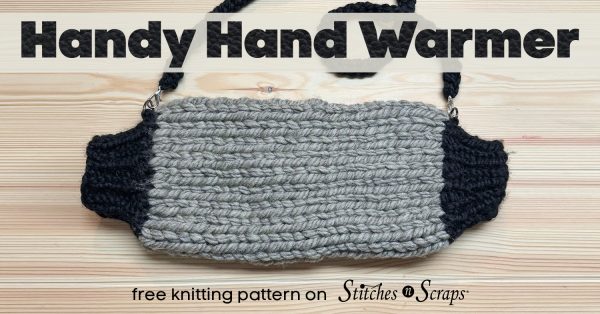
Keep your hands cozy in a Handy Hand Warmer while you cheer for your favorite team! This knit muff hand warmer is the perfect companion for game day, winter walks, or other chilly outdoor activities. The removable strap makes it convenient to carry wherever you need it this winter!

This content is protected by copyright. See this Terms of Use / Copyright page for more information.
This post contains sponsored content and/or affiliate links. If you click an affiliate link and make a purchase, I may get a commission.
Lion Brand Wool Ease Yarns
I received the Wool Ease Wow and Wool Ease Thick and Quick yarns used in this pattern for free in goody bags at a conference. They are both thicker versions of the worsted-weight, classic Wool Ease yarn, with a blend of acrylic and wool. Thick and Quick is a super bulky (#6) weight, and Wow is an even bigger, jumbo (#7) weight.
Optional Strap
Add a removable strap to your knit muff for hands-free carrying when not in use. A couple of small D-rings make it easy to clip on any strap you like.

Use a commercial purse strap that has clips on the ends, or crochet your own!
Wear it 2 Ways
Wear the cuff out for more arm coverage, or push it in for a double layer of warmth inside!

I like my cuffs out, so I can tuck them into my jacket sleeves. How about you?
Alternating Cable Cast-On
This knit muff pattern starts with a ribbed cuff. You can use any cast-on you prefer as long as it’s loose/stretchy enough to match the stretch of the ribbing.
My favorite cast-on for ribbing is the alternating cable cast-on. Also known as a seed stitch cast-on, it’s a simple variation of the traditional cable cast-on that allows you to cast-on the equivalent of knit and purl stitches. See this Alternating Cable Cast-On tutorial for a closer look!

Binding Off
For my muff, I used a simple bind-off in pattern. This means I knit/purled each stitch as it appeared, and then passed the previous stitch over.
Another great bind-off option for ribbing is the tubular bind-off. See this Tubular Bind-Off in the Round tutorial for one method.

There are a few different versions of tubular bind-offs, some of which create a double layer of fabric at the bound-off edge. However, since we’re working with thick yarn already, that extra layer may get too thick. This tutorial is for a sewn version that does not create that extra layer of fabric.
Materials
- Yarn:
- 45 yds Lion Brand Wool-Ease WOW jumbo weight yarn (80% acrylic, 20% wool. 240g / 66 yds per skein) (A)
- Lion Brand Wool-Ease Thick &Quick super bulky weight yarn (80% acrylic, 20% wool. 170g / 106 yds per skein) (B)
- 25 yds for cuffs
- 2-5 yds for crochet strap (optional)
- Needles:
- Size 17 / 12 mm knitting needles for working in the round, or size needed to match gauge.
(16″ circulars, double points, 2 circulars, or 1 long circular for magic loop are all ok). - Size 15 / 10 mm knitting needles for working in small rounds, or 2mm smaller than larger needles.
(Double points, 2 circulars, or 1 long circular for magic loop).
- Size 17 / 12 mm knitting needles for working in the round, or size needed to match gauge.
- Notions:
- Large yarn needle
- Stitch marker
- Scissors
- 1/2 – 1 inch D rings: 2 (optional – for attaching purse strap)
- Purse strap of desired length (optional – you can crochet a purse strap instead)
- Size N/10mm crochet hook or the same size as smaller needles (optional – for crochet purse strap)
- Lobster clasps or swivel hooks that fit your D rings: 2 (optional – for crochet purse strap)

Project Level
Easy: Knit and purl in the round, changing needles. Optional crochet cord.
Size
17 inches length; 16 inches circumference at widest point.
Gauge
With A and larger needles, in stockinette: 5 sts = 4 inches; 7 rounds = 3 inches.
Abbreviations Used
- CO = cast on / cast-on
- k = knit
- p = purl
- st(s) = stich(es)
Recommended Resources
- Alternating Cable / Seed Stitch Cast on
- Long Tail Cast On (Lunchtime Live Demo)
- Sewn Tubular Bind-Off in the Round
Instructions
You can adjust the length of any section by adding or removing rounds. If you adjust the length of one cuff, be sure to adjust the other cuff in the same way. Keep in mind any changes in length will affect yarn usage.
First Cuff
With B and smaller needles, CO 20 sts using an alternating cable (seed stitch) cast-on, long-tail cast-on, or your preferred stretchy cast-on for ribbing.
Join to work in the round and place marker for beginning of round. Slip marker with each round as you come to it.
Rnd 1: [K1, p1] around.
Repeat [Rnd 1] 9 more times or until cuff measures approximately 2.75 inches. Make a note of how many rnds you have worked.
Cut B, leaving a tail to weave in later.

Body
Change to A and larger needles.
Rnd 1: K around.
Repeat [Rnd 1] 26 more times or until body measures approximately 11.5 inches.
Cut A, leaving a tail to weave in.
Use ends to close any gaps at CO edge or at color changes as needed, and then weave in all ends before continuing to Second Cuff. It will be harder to access the WS of Body after working the Second Cuff.
If the yarn is too big for your yarn needle, use a crochet hook to weave it in, or split the strands of yarn and weave them in separately.
Second Cuff
Change to B and smaller needles.
Rnd 1: K around.
Rnd 2: [K1, p1] around.
Repeat [Rnd 2] 8 more times or to the same number of total rnds as First Cuff, not counting CO edge as a rnd.
Bind off all stitches in pattern or with a sewn tubular bind-off.
Weave in all ends.

Crochet Hanging Strap (optional)
With B and crochet hook, ch 76 or to desired length of strap, keeping in mind that strap will stretch with use. Sc in 2nd ch from hook and each ch across. Fasten off. (75 sc)
Sew a swivel hook or lobster clasp to each end of the strap.
Attaching Strap to Muff
With B, sew one D ring to one side of Muff, where the cuff meets the body.

Place the other D ring on the opposite side of the Muff, where the body meets the opposite cuff. Be sure the D rings are in a straight line across from each other (follow the column of stitches from one to the other) and then sew in place with B.

Strap can be attached and removed as desired by clipping or unclipping to the D rings. You can even make multiple straps for different looks!
Share this Knit Muff Hand Warmer pattern on Pinterest!
Here’s an image perfect for pinning.

Rate this Knit Muff Hand Warmer pattern!
I hope you enjoyed this knit muff hand warmer pattern. A downloadable pdf of this pattern is available on Ravelry for a small fee. The fee for the pdf format offsets the advertising revenue lost when you print or download the pattern rather than viewing it online.
Do you want the best of Stitches n Scraps delivered right to your inbox? The Stitches n Scraps email newsletter includes highlights from the blog as well as special features not available elsewhere. Don’t miss a stitch – Subscribe now!

Braided Cable Knit Socks
Treat your feet to classic, cabled comfort! A chunky, 3-part cable climbs the leg of these braided cable knit socks. The toe-up construction with afterthought heels makes them as fun to knit as they are to wear!

This content is protected by copyright. See this Terms of Use / Copyright page for more information.
This post contains sponsored content and/or affiliate links. If you click an affiliate link and make a purchase, I may get a commission.
Decoding Cables
If you’re new to cables, they can be intimidating. But they don’t have to be! This Decoding Cables tutorial uses licorice to talk through how cables and cable abbreviations work.
Once you learn the language and structure of cables, you’ll be able to knit almost any type of cable with ease!
Choosing a Yarn
For any type of socks, it’s important to choose a yarn that will wear well and is easy to clean. Consider the fiber content, texture, and washing instructions of any yarn you choose.
Many yarns are made specifically for socks and are labeled as sock yarns. Wool or cotton sock yarns often have a small amount of nylon or other synthetic material spun into them for added strength. These are always a great option!
If you’re choosing a yarn that is not specifically labeled as a sock yarn, look for one that is smooth and tightly spun, rather than one that is loose or fluffy. For all yarns, check the label to see if they can be washed in a washing machine, or if you need to hand wash them.
Materials
- Yarn:
- 350 [375, 400] yds fingering weight yarn
- 5 – 10 yds waste yarn of similar weight and contrasting color
- Needles: Size 1 / 2.25 mm knitting needles for working in the round, or size needed to match gauge.
(A set of double points, 2 circulars, or 1 long circular for magic loop are all ok). - Notions:
- Cable needle
- Yarn needle
- Stitch marker
- Scissors
Project Level
Intermediate: Increases, decreases, picking up stitches, cables.
Sizes
S [M, L]
To fit women’s shoe sizes: 4-6 [7-9, 10-12]
Gauge
32 sts x 46 rows = 4 inches in stockinette.
Abbreviations Used
- CO = Cast on / cast-on
- cn = cable needle
- k = knit
- k2tog = knit 2 together
- m1l = make 1 left
- m1r = make 1 right
- p = purl
- pm = place marker
- rep = repeat
- ssk = sl sl knit
- st(s) = stich(es)
Recommended Resources
- Judy’s Magic Cast-On from Very Pink Knits
- Figure 8 Cast-On from Knit Picks
- Slip Slip Knit (ssk) Decrease
- Knit 2 Together (k2tog) Decrease
- Make 1 Right (m1r) and Make 1 Left (m1l) Increases
- Decoding Cables (with Licorice)
- Sewn Tubular Bind-Off in the Round
- Kitchener stitch/Grafting from All Free Knitting
Cable Stitches
4 over 4 Right Cross (4/4 RC): Transfer next 4 sts to cn and hold at back of work, k4, k4 from cn.
4 over 4 Left Cross (4/4 LC): Transfer next 4 stitches to cn and hold in front of work, k4, k4 from cn.
Instructions
Left Sock
Toe
Scroll down for Toe chart.
CO 12 [12, 16] sts with Judy’s Magic Cast-On, a Figure 8 Cast-on, or any similar CO that creates 2 layers of sts with a seamless “grafted” edge. Alternatively, you can use a provisional CO with waste yarn, and graft the toe closed later with Kitchener stitch.
Rnd 1: K1, m1l, k4 [4, 6], m1r, pm, k2, m1l, k4 [4, 6], m1r, k1. (16 [18, 20] sts)
Rnd 2: K1, m1l, k to marker, m1r, sm, k2, m1l, k to last st, m1r, k1. (20 [20, 24] sts)
Rnds 3-4: Rep rnd 2. (28 [28, 32] sts)
For remainder of pattern, slip the marker as you come to it, unless otherwise indicated.
Rnd 5: K each st around.
Rnd 6: K1, m1l, k to marker, m1r, sm, k2, m1l, k to last st, m1r, k1. (32 [32, 36] sts)
Rnds 7-10 [7-12, 7-12]: Rep [rnds 5 & 6] 2 [3, 3] times. (40 [44, 48] sts)
Rnd 11 [13, 13]: K each st around.
Rnds 12-13 [14-15, 14-15]: Rep rnds 5 & 6. (44 [48, 52] sts)
Rnd 14-16 [16-21, 16-24]: Rep last 3 rnds 1 [2, 3] times. (48 [56, 64] sts)
Rnds 17-18 [22-23, 25-26]: K each st around, removing marker when you come to it.
Toe Chart
Left Foot
Scroll down for Foot chart.
Rnd 1: K 1, p3, (k1, m1L) 3 times, (k1, m1R) 3 times, p3, k around. (54 [62, 70] sts)
Rnd 2: K1, p3, k12, p3, k around.
Rnd 3: K1, p3, 4/4 RC, k4, p3, k around.
Rnds 4-6: K1, p3, k12, p3, k around.
Rnd 7: K1, p3, k4, 4/4 LC, p3, k around.
Rnds 8-10: K1, p3, k12, p3, k around.
Rep [rnds 3-10] 5 [5, 6] times.
Sizes S & L only: Rep rnds 3-4 once more.
Size M only: Rep rnds 3-8 once more.
Left Heel Placement
If you are knitting right-handed, the “working needle” is the right needle and the “non-working” needle is the left needle. If you are knitting left-handed, this is switched.
Rnd 45 [49, 53]: K1, p3, k12, p3, k11 [15, 19], k24 [28, 32] with waste yarn, cut waste yarn leaving a long tail, place waste yarn sts back onto non-working needle, k all waste yarn sts with working yarn.
Secure waste yarn by tying a knot in each tail or tying the starting and ending tails together.
Left Leg
Scroll down for Leg & Cuff Chart
Sizes S & L only
Rnd 1: K1, p3, k12, p3, k around.
Rnd 2: K1, p3, k4, 4/4 LC, p3, k around.
Rnds 3-4: K1, p3, k12, p3, k around.
All sizes
Rnd 5 [1, 5]: K1, p3, k12, p3, k around.
Rnd 6 [2, 6]: K1, p3, 4/4 RC, k4, p3, k around.
Rnds 7-9 [3-5, 7-9]: K1, p3, k12, p3, k around.
Rnd 10 [6, 10]: K1, p3, k4, 4/4 LC, p3, k around.
Rnd 11-13 [7-9, 11-13]: K1, p3, k12, p3, k around.
Rep [rnds 6-13 [2-9, 6-13]] 7 [8, 8] times more.
Rnd 69 [73, 77]: K1, p3, (k2tog, ssk) 3 times, p3, k around. (48 [56, 64] sts)
Cuff
Rnds 1-6: (K2, p2) around.
Bind off using a tubular bind-off or other stretchy bind-off.

Heel:
With one needle, pick up all stitches under (before) the waste yarn, and one additional stitch at each side (26 [30, 34] sts)
With the other needle, pick up all stitches above (after) the waste yarn, and one additional stitch at each side. (26 [30, 34] sts)

Double check that all stitches are secured, then carefully remove waste yarn.

You should now have an open heel, with (52 [60, 68] sts) stitches on your needles. Arrange stitches on your needles so that you are starting from one side edge – between extra picked up stitches.

Rnd 1: K1, ssk, k20 [24, 28], k2tog, pm, k2, ssk, k to last 3 sts, k2tog, k1. (48 [56, 64] sts)
Rnds 2-3: K each st around.
Rnd 4: (K1, ssk, k to 2 sts before marker, k2tog, sm, k2, ssk, k to last 3 sts, k2tog, k1. (44 [52, 60] sts)
Rnds 5-6: K each st around.
Rnd 7: Rep rnd 4. (40 [48, 56] sts)
Rnds 8-10 [8-13, 8-13]: Rep [rnds 5-7] 1 [2, 2] times. (36 [40, 48] sts)
Rnd 11 [14, 14]: K each st around.
Rnd 12 [15, 15]: Rep rnd 4. (32 [36, 44] sts)
Rnds 13-16 [16-21, 16-23]: Rep last 2 rnds (rnds 11-12 [14-15, 14-15]) 2 [3, 4] times. (24 [24, 28] sts)
Rnd 17-19 [22-23, 24-25]: Rep [rnd 4] 3 times. (12 [12, 16] sts)
With half the sts on the front needle and half on the back needle, sew heel closed using the Kitchener stitch.
Weave in all ends.

Right Sock
Toe
Work as for Left Sock Toe.
Right Foot
See Foot chart above.
Rnd 1: K 35 [43, 51], place marker, p3, (k1, m1r) 3 times, (k1, m1l) 3 times, p3, k1. (54 [62, 70] sts)
Rnd 2: K to marker, p3, k12, p3, k1.
Rnd 3: K to marker, p3, 4/4 RC, k4, p3, k1.
Rnds 4-6: K to marker, p3, k12, p3, k1.
Rnd 7: K to marker, p3, k4, 4/4 LC, p3, k1.
Rnds 8-10: K to marker, p3, k12, p3, k1.
Rep [rnds 3-10] 5 [5, 6] times.
Sizes S & L only: Rep rnds 3-4 once more.
Size M only: Rep rnds 3-8 once more.
Right Heel Placement
Rnd 45 [49, 53]: K24 [28, 32] with waste yarn, cut waste yarn leaving a long tail, place waste yarn sts back onto non-working needle, k all waste yarn sts with working yarn. k to marker, p3, k12, p3, k1.
Secure the ends of the waste yarn by tying a knot at each end or tying the two ends together.
Right Leg:
See Leg & Cuff Chart above.
Sizes S & L only:
Rnd 1: K to marker, p3, k12, p3, k1.
Rnd 2: K to marker, p3, k4, 4/4 LC, p3, k1.
Rnds 3-4: K to marker, p3, k12, p3, k1.
Rnd 5 [1, 5]: K to marker, p3, k12, p3, k1.
Rnd 6 [2, 6]: K to marker, p3, 4/4 RC, k4, p3, k1.
Rnds 7-9 [3-5, 7-9]: K to marker, p3, k12, p3, k1.
Rnd 10 [6, 10]: K to marker, p3, k4, 4/4 LC, p3, k1.
Rnd 11-13 [7-9, 11-13]: K to marker, p3, k12, p3, k1.
Rep [rnds 6-13 [2-9, 6-13]] 7 [8, 8] times more
Rnd 69 [73, 77]: K to marker, p3, (k2tog, ssk) 3 times, p3, k1. (48 [56, 64] sts)
Cuff & Heel
Work as for Left Sock Cuff and Heel.
Share this Braided Cable Knit Socks pattern on Pinterest!
Here’s an image perfect for pinning.

Rate this Braided Cable Knit Socks pattern!
I hope you enjoyed this braided cable knit socks pattern. A downloadable pdf of this pattern is available on Ravelry for a small fee. The fee for the pdf format offsets the advertising revenue lost when you print or download the pattern rather than viewing it online.
Do you want the best of Stitches n Scraps delivered right to your inbox? The Stitches n Scraps email newsletter includes highlights from the blog as well as special features not available elsewhere. Don’t miss a stitch – Subscribe now!

Knit Balaclava Pattern – Wild Winter
Protect your face from wild winter winds with this knit balaclava pattern. Short rows at the opening and decreases under the chin create a smooth, comfortable fit that stays in place. It’s like a hug for your face!

This content is protected by copyright. See this Terms of Use / Copyright page for more information.
This post contains sponsored content and/or affiliate links. If you click an affiliate link and make a purchase, I may get a commission.
King Cole Safari Chunky Yarn
King Cole yarns provided the Safari Chunky Yarn for this design. This unique yarn is warm, lightweight and squishy, perfect for a face-hugging pattern like this one! It works up into stripes that resemble animal prints. For this knit balaclava pattern, I chose the Lagoon colorway.

See all the colors on the King Cole website. Then, find it in a shop near you with the “Find a Stockist” tool!
Wrap and Turn Short Rows
Short rows can be intimidating if you haven’t done them before, but don’t let that stop you from making the Wild Winter Balaclava! Short rows are simply rows where you don’t work all the stitches. These partial rows create the triangle shaped gussets at each side of the opening.

To avoid creating a gap, you wrap the working yarn around the first unworked stitch, then turn around and go back the way you came. This is called the wrap & turn method, and complete instructions are included in the pattern.
In garter stitch, there’s no need to pick up the wraps later like you would in stockinette. If you ignore the wraps completely, they will blend in with the surrounding purl bumps. This way they are actually less visible than if you had picked them up! Check out this Wrap and Turn Short Rows in Garter Stitch tutorial for a closer look.
A Note About Needles
When it comes to knitting in the round, there are so many options! Double-pointed, circular, magic loop, or 2 pairs of needles, all are fine for this project. Choose whichever works best for you!
I used the magic loop method for the top of the hat, then switched back and forth between short and long circular needles. Needles that are just slightly smaller than the circumference of your work make for fast, continuous knitting. But extra long cords with the magic loop method allow you to try on your balaclava as you go.
With interchangeable needles, you could even switch out your cords whenever you want. But I found it easier just to knit the stitches onto a longer needle set when I wanted to try it on.
Materials
- Yarn: 150 yds King Cole Safari Chunky – 100% acrylic, bulky weight yarn (311 yds / 150g per ball) – sample shown in #5006 Lagoon
- Needles: Your choice of needle type for knitting in the round (see note below).
- US size 10 1/2 (6.5 mm) needles, or size needed to match gauge
- US size 10 (6 mm) needles, or one size smaller than larger needles
- Notions:
- Scissors
- Yarn needle
Use your favorite method of knitting in the round, as you would for a hat. Double-pointed, circular, magic loop, or 2 sets of circulars are all fine. If using circular needles, you may need a shorter set for the top portion of the hat, or may need to use one of the other methods for that part.
Project Level
Intermediate: Increases, decreases, and wrap & turn garter stitch short rows.
Size
Child [Adult]
To fit head circumference: 17-20 inches [20-23 inches]
Gauge
13 sts x 22 rnds = 4 inches in stockinette
Special Technique
Wrap and Turn (w&t): With yarn in back, slip next st purlwise. Bring the yarn to the front to “wrap” the stitch you just slipped.

Slip the wrapped stitch back onto the other needle without twisting it.

Turn to start the next row. The wrapped stitch does not count as a stitch in the stitch counts.

When working back into a wrapped stitch, ignore the wrap (this would be different if we were working in stockinette). See this wrap and turn garter stitch short rows tutorial for a closer look.
Chart Symbol Key
Each section of the written pattern has corresponding charts. These are the symbols used in all the charts.

Instructions
Hat
With larger needles, CO 8, join to knit in the round.
Rnd 1: Kfb 8 times. (16 sts)
Rnd 2 and every even rnd through rnd 10 [12]: K around.
Rnd 3: (Kfb, k1) 8 times. (24 sts)
Rnd 5: (Kfb, k2) 8 times. (32 sts)
Rnd 7: (Kfb, k3) 8 times. (40 sts)
Rnd 9: (Kfb, k4) 8 times. (48 sts)
Rnd 11: (Kfb, k11 [5]) 4 [8] times. (52 [56] sts)
Adult Size Only – Rnd 13: (Kfb, k6) 8 times. (64 sts)
Rnds 12-33 [14-37]: K around. (52 [64] sts)
Opening
This section creates a ribbed opening, and adds garter stitch short row shaping on each side of the opening.
Remember not to pick up your wraps when knitting back into a wrapped stitch.
When binding off in rnd 36, bind off loosely in pattern or use any stretchy bind off of your choice.
When casting on in rnd 37, use the alternating cable / seed stitch cast on or a stretchy cast on of your choice.
Child Size Only
Change to smaller needles.
Row 34 (RS): K2, (p1, k1) 9 times, p1, k2, w&t. (23 sts)
Row 35: K3, (p1, k1) 9 times, k3, w&t. (24 sts)
Row 36: K3, BO 19, k3, w&t. (6 sts, 19 sts bound off)
Row 37: K3, CO 17, k2, w&t. (22 sts)
Row 38: K2, (p1, k1) 8 times, p1, k2, w&t. (21 sts)
Row 39: K2, (p1, k1) 8 times, p1, k1, w&t. (20 sts)
Adult Size Only
Change to smaller needles.
Row 38 (RS): K2, (p1, k1) 12 times, p1, k2, w&t. (29 sts)
Row 39: K3, (p1, k1) 12 times, k3, w&t. (30 sts)
Row 40: K3, (p1, k1) 12 times, p1, k3, w&t. (31 sts)
Row 41: K3, BO 25, k4, w&t. (7 sts, 25 sts bound off)
Row 42: K4, CO 23, k4, w&t. (31 sts)
Row 43: K4, (k1, p1) 11 times, k4, w&t. (30 sts)
Row 44: K3, (p1, k1) 11 times, p1, k3, w&t. (29 sts)
Row 45: K3, (k1, p1) 11 times, k3, w&t. (28 sts)
Face
Change to larger needles.
Rnds 40-64 [46-72]: K around. (50 [62] sts)
Rnd 65 [73]: K1 [6], ssk, k9 [11], k2tog, k36 [42]. (48 [60] sts)
Rnd 66 [74]: K around.
Adult Size Only
Rnd 75: K4, ssk, k11, k2tog, k41. (58 sts)
Rnd 76: K around. (58 sts)
Neck
Change to smaller needles.
Rnds 67-74 [77-86]: (K1, p1) around. (48 [58] sts)
Finishing
Bind off using a sewn/tubular bind-off or other stretchy bind-off.
Use starting tail to sew the hole closed at top of the hat section.
Weave in all ends.
Share this knit balaclava pattern on Pinterest!
Here’s an image perfect for pinning.

Rate this Knit Balaclava Pattern!
I hope you enjoyed this knit balaclava pattern. A downloadable pdf of this pattern is available on Ravelry for a small fee. The fee for the pdf format is to offset the advertising revenue lost when you print or download the pattern rather than viewing it online.
Do you want the best of Stitches n Scraps delivered right to your inbox? Don’t miss a stitch – Subscribe now!

Sweethearts Double Knit Ear Warmer Pattern
Warm your heart (and ears) with the Sweethearts Ear Warmer! This double knit ear warmer is worked flat and seamed, with a simple colorwork design. It’s a great introduction if you’re new to double knitting.

This content is protected by copyright. See this Terms of Use / Copyright page for more information.
This post contains sponsored content and/or affiliate links. If you click an affiliate link and make a purchase, I may get a commission.
What is Double Knitting?
Double knitting creates a double layer of fabric by using two working yarns at once. The stitches are worked in pairs, alternating between one “front layer” stitch and one “back layer” stitch. Since this is a stockinette pattern, you will knit the front layer stitches and purl the back layer stitches.
This is most often done as a colorwork technique with 2 different colors of yarn. Each side of the fabric ends up with the same design, but with the colors reversed.
Double Knit Edges
For any double knitting pattern that’s worked flat, you need to consider the cast on, bind off, and selvage edges.
Cast On and Bind Off
This double knit ear warmer pattern starts and ends with a single layer of garter stitch at the back. That means there’s no need to fuss with 2 colors for the cast on and bind off edges.

Instead, it starts with a provisional cast on using waste yarn. At the end, you will remove the waste yarn so you have live stitches on both ends. Then you can graft the two ends together with kitchener stitch.
The colorwork section has a second layer. You’ll use increases to add the 2nd color, and decreases to remove it.
Selvages
Since double knitting creates two layers of fabric, it’s important to tie those layers together at the selvage edges. One of the easiest ways to do this is to work the edge stitches of both colors together, as though they are just 1 stitch.
In addition, double knitting creates a stockinette-type fabric. So just like with a normal stockinette fabric, we can knit the first stitch and slip the last stitch of each row to create a smoother edge.

Putting these two considerations together, we knit the first stitch with both colors together as one, and we slip the last stitch of both colors on each row. This gives us a decorative, two color edge.
Reading the Double Knitting Chart
Each square on the chart represents two stitches – a knit on the front layer of the fabric, and then a purl on the back layer. Whichever color you use to knit will show on the side you are currently looking at. White squares on the chart mean to knit with the background color, and then purl with the accent color. Black squares mean to knit with the accent color and purl with the background color.

Remember that the colors are reversed on each side, so your background color on one side is your accent color on the other side and vice versa. This is why the chart refers to background and accent colors rather than the specific color.
There is no specific right or wrong side. Work odd-numbered rows starting from the right edge of the chart, and even-numbered rows starting from the left edge.
For a much closer look at working from double knitting charts, including a video, check out my double knitting from a chart tutorial. The selvage edges are treated a bit differently in that tutorial, but the rest is the same.
Choosing a Yarn
For the sample, I used Paintbox Aran acrylic yarn leftover from my Cotton Candy Stripes Scarf pattern. The colors are Bubblegum Pink and Candyfloss Pink. The more contrast you have between your colors, the more the double knit pattern will show on your ear warmer. You may find it helpful to take a grayscale picture of the yarns to see the contrast better.

Superwash wool or acrylic yarns should work well for this pattern. Wool that is not superwash may felt a bit with use, and plant fibers like bamboo or cotton may stretch with use.
Materials
- Yarn: Worsted weight yarn
- 55 [60] yds dark pink
- 55 [60] yds light pink
- 5 yds waste yarn for cast on.
- Needles: Size 8 / 5 mm needles or size needed to match gauge
- Notions: Yarn needle
Project Level
Intermediate: Provisional cast on, increases and decreases, double knitting, grafting garter stitch.
Size
Small [Large]: Instructions are shown for size small, with large listed in [ ]
| Size | To fit head circumference | Length before seaming |
|---|---|---|
| Small | 21-23 inches | 19.25 inches |
| Large | 22-24 inches | 20.25 inches |
Your finished ear warmer should be about 2-4 inches smaller than the head circumference. This is a stretchy project so there is some overlap in the sizing. The size is easily adjustable in the last section of the pattern, so you can make it exactly as snug or loose as you want.
Gauge
14.5 sts x 24 rows = 4 inches in stockinette stitch. Use pattern as gauge swatch – after row 24, double knitting section of work should measure about 5 inches x 4 inches.
Abbreviations used
AC = accent color of the side you are working on
BC = background color of the side you are working on
k = knit
KAC = Knit accent color (see Special Stitches)
KBC = Knit background color (see Special Stitches)
kfb = knit front and back
p = purl
RS = right side
sel = Selvage stitch (see Special Stitches)
sl = slip purlwise with both yarns in front.
ssk = slip slip knit
st(s) = stitch(es)
WS = wrong side
Recommended Resources
- Sweethearts Ear Warmer Tutorial
- How to Knit a Provisional Cast On with a Crochet Hook from Nimble Needles
- Kfb Increase – How to Knit Front and back
- Double Knitting from a Chart – Reversible Colorwork
- Slip Slip Knit (ssk) Decrease Tutorial
- Knit 2 Together (k2tog) Tutorial
- How to Graft Garter Stitch from Edie Eckman
Special Stitches
- Knit background color (KBC): K1 in BC, bring both yarns to the front, p1 in AC, bring both yarns to the back.
- Knit accent color (KAC): K1 in AC, bring both yarns to the front, p1 in BC, bring both yarns to the back.

- Selvage stitch (Sel): With both yarns held together as one, k2tog through first pair of stitches. It does not matter which order the colors are in on the needle because these two stitches will always be worked or slipped together.

Instructions
Garter stitch starting section
I’ve designated odd numbered rows as RS rows for simplicity of instructions only – there is no real right or wrong side.
Cast on 12 stitches with waste yarn.
Rows 1-2: With dark pink, k across. (12 sts)
Row 3 (RS): K1, kfb, k to last 2 sts, kfb, k. (14 sts)
Row 4: K across (14 sts)
Rows 5-6: Repeat rows 3-4. (16 sts)
Row 7: Repeat row 3. (18 sts)
Set up for double knitting
Row 8: *K1 with dk pink but do not remove the stitch you worked into from the needle. With light pink, ktbl in same st and remove that stitch from the needle. Repeat from * across. (36 sts)

Double knit pattern section
Stitches are worked in pairs of 1 background color stitch and 1 accent color stitch. Because the pattern is reversible, the background and accent colors will be different for the two sides.
On RS rows the background color is light pink and the accent color is dark pink. On WS rows it is reversed. BC and AC always refer to the side you are currently working on.
See Special Stitches section for stitch definitions.
Row 1 (RS): Sel, KBC across to last pair of sts, sl last pair of sts.
Heart 1
Row 2: Sel, KBC 7, KAC 2, KBC 7, sl last pair of sts.
Row 3: Sel, KBC 6, KAC 4, KBC 6, sl last pair of sts.
Row 4: Sel, KBC 5, KAC 5, KBC 6, sl last pair of sts.
Row 5: Sel, KBC 6, KAC 6, KBC 4, sl last pair of sts.
Row 6: Sel, KBC 3, KAC 6, KBC 7, sl last pair of sts.
Row 7: Sel, KBC 8, KAC 6, KBC 2, sl last pair of sts.
Row 8: Repeat row 6
Row 9: Repeat row 5
Row 10: Repeat row 4
Row 11: Repeat row 3
Row 12: Repeat row 2
Rows 13-14: Sel, KBC across to last pair of sts, sl last pair of sts.

Heart 2
Row 15: Sel, KBC 3, KAC 2, KBC 11, sl last pair of sts.
Row 16: Sel, KBC 10, KAC 4, KBC 2, sl last pair of sts.
Row 17: Sel, KBC 2, KAC 5, KBC 9, sl last pair of sts.
Row 18: Sel, KBC 8, KAC 6, KBC 2, sl last pair of sts.
Row 19: Sel, KBC 3, KAC 6, KBC 7, sl last pair of sts.
Row 20: Sel, KBC 6, KAC 6, KBC 4, sl last pair of sts.
Row 21: Repeat row 19
Row 22: Repeat row 18
Row 23: Repeat row 17
Row 24: Repeat row 16
Row 25: Repeat row 15
Rows 26-27: Sel, KBC across to last pair of sts, sl last pair of sts.
Heart 3
Row 28-40: Repeat rows 2-14 of heart #1

Heart 4 (big heart)
Row 41: Sel, KBC 3, KAC 3, KBC 10, sl last pair of sts.
Row 42: Sel, KBC 9, KAC 5, KBC 2, sl last pair of sts.
Row 43: Sel, KBC 2, KAC 6, KBC 8, sl last pair of sts.
Row 44: Sel, KBC 7, KAC 8, KBC 1, sl last pair of sts.
Row 45: Sel, KBC 1, KAC 9, KBC 6, sl last pair of sts.
Row 46: Sel, KBC 5, KAC 10, KBC 1, sl last pair of sts.
Row 47: Sel, KBC 1, KAC 11, KBC 4, sl last pair of sts.
Rows 48-49: Sel, KBC 3, KAC 11, KBC 2, sl last pair of sts.
Row 50: Sel, KBC 1, KAC 11, KBC 4, sl last pair of sts.
Rows 51-52: Repeat rows 48-49
Row 53: Repeat row 47
Row 54: Repeat row 46
Row 55: Repeat row 45
Row 56: Repeat row 44
Row 57: Repeat row 43
Row 58: Repeat row 42
Row 59: Repeat row 41
Rows 60-61: Sel, KBC across to last pair of sts, sl last pair of sts.
Hearts 5-7
Row 62-100: Repeat rows 2-40 of hearts 1-3.
Row 101: Sel, KBC across to last pair of sts, sl last pair of sts.
Cut light pink yarn only, leaving a tail to weave in later.

Row 102: With dark pink only, ssk through each pair of stitches across.
Garter stitch ending section
Decreasing
Row 1 (RS): K1, ssk, k across to last 3 sts, k2tog, k1 (16 sts)
Row 2: K across.
Rows 3-6: Repeat rows 1-2 twice more. (12 sts)
Working Even
K across for 1 [7] row(s).
Check the size of your ear warmer. If you need to adjust the size, you can add or remove rows in this working even section. Be sure to end after a RS row.

Seaming and Finishing
Carefully remove working yarn from cast-on edge and pick up the live stitches on your 2nd needle. Because you are actually picking up the loops between the stitches, you should have 11 stitches on your needle (not 12).
Make sure that both needles are pointing in the same direction when work is not twisted.

Hold the needles with RS together, and ending edge (the one with 12 stitches) in front. Graft / Kitchener stitch the live stitches from the starting and ending edges together.
Weave in all ends.

Rate this Double Knit Ear Warmer Pattern!
I hope you enjoyed this double knit ear warmer pattern.
A downloadable pdf of this pattern is available on Ravelry for a small fee. The fee for the pdf format is to offset the advertising revenue lost when you print or download the pattern rather than viewing it online.
Do you want the best of Stitches n Scraps delivered right to your inbox? Don’t miss a stitch – Subscribe now!