Free Crochet Patterns

Find the perfect, free crochet pattern for your next project! Browse them all, or select a category from the dropdown menu. Where will your creativity take you today?


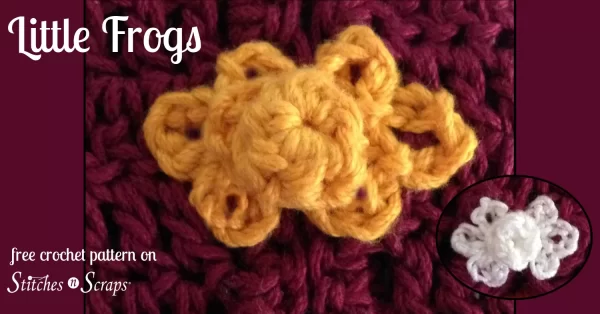
Little Frogs crochet pattern - Large worsted weight frog and tiny thread frog
These little crochet frog closures are fast and fun to make, and can be added to almost anything! Put them on ...More
Anemone Security Blanket - a free pattern on StitchesNScraps.com
After making my Seahorse Teether pattern, I had quite a bit of yarn left, so I made this blanket to ...More
Caterpillar Scrubby Set
Quick and easy mini scrubbies combine to form this cute crochet caterpillar scrubby set, perfect for gifting! Each scrubby takes only ...More
Little Frogs crochet pattern - Large worsted weight frog and tiny thread frog

Crochet Frog Closures – Little Frogs

These little crochet frog closures are fast and fun to make, and can be added to almost anything! Put them on cardigans, bags, boot cuffs, even tree skirts – anywhere you need a decorative closure. They’re a great way to use up scrap yarn too.

Little Frogs crochet pattern - Large worsted weight frog and tiny thread frog

This content is protected by copyright. See this Terms of Use / Copyright page for more information.

This post contains sponsored content and/or affiliate links. If you click an affiliate link and make a purchase, I may get a commission.


Any yarn or hook

You can make these crochet frogs any yarn or thread of your choice. Smaller threads will make tinier frogs, and larger yarn will make bigger ones. Use whatever hook you are comfortable with for your chosen yarn or thread.

Mix or Match

Match your project perfectly by using the same yarn, or use a contrasting yarn for a decorative pop. These little crochet frogs are a great use of scrap yarn too. Whip a few up with leftover scraps and you’ll soon have a fabulous froggy collection!

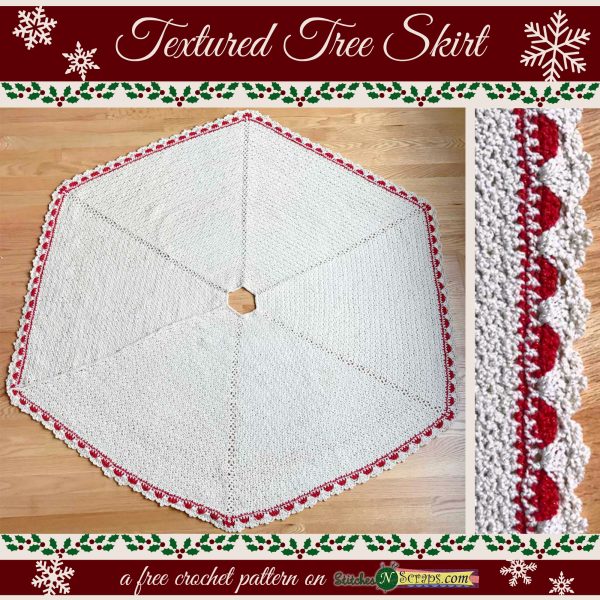
Textured Tree Skirt

I used these little crochet frog closures on my Textured Tree Skirt pattern. They made a lovely, decorative addition to this simple and elegant tree skirt.

Optional Frog Closure - Textured Tree Skirt - StitchesNScraps.com

Materials:

  • Yarn: 5-10 yds of any yarn or thread.
  • Hook: Any size hook appropriate for your yarn choice.
  • Notions: Tapestry or embroidery needle for weaving in ends.

Difficulty

Easy: Basic stitches, decreases.

Size/Gauge

Varies depending on yarn and hook used.

Choose a hook that’s slightly smaller than you would normally use for your chosen yarn

Abbreviations used

This pattern uses US terms.

  • ch = chain
  • sc = single crochet
  • sc2tog = single crochet 2 stitches together
  • sc3tog = single crochet 3 stitches together
  • sp = space
  • sl st = slip stitch
  • st(s) = stitch(es) 

Instructions

Button Side

Button

Rnd 1 (RS): Ch 2, 6 sc in 2nd ch from hook, do not join. (6 sc)

Rnd 1 of button - Little Frogs

Rnd 2: Ch 1, [sc2tog in next 2 sts] 3 times, do not join.  (3 sts)

Rnd 2 of button - Little Frogs

If desired, you can stuff the button lightly with a small scrap of the same yarn at this point. 

Rnd 3: Ch 1, sc3tog. (1 st)

If you’re using a very thick yarn and just can’t get into all three stitches to pull up a loop, it’s ok to do an sc2tog and sl st in the last st instead.

Rnd 3 of button - Little Frogs

Loops:

First Loop: Ch 6, sl st in 6th ch from hook.

Next 2 loops: [Ch 5, sl st in same ch] twice.

Male side of frog closure

Fasten off, leaving a long tail for sewing. Weave in starting tail.

Buttonhole side

Buttonhole: Ch 8, sl st in 8th ch from hook.

Buttonhole for crochet frog

Loops: [Ch 5, sl st in same ch] three times.

Buttonhole side of crochet frog

Fasten off, leaving a long tail for sewing. Weave in starting tail.

Attaching the crochet frog to a project

For best results, Pin the crochet frog closure in place first and check that it’s positioned correctly. The large buttonhole loop goes around the button. The button and buttonhole should both extend about halfway over the edge of the fabric so that the edges of the fabric will meet when it is closed.

Use long ending tails to sew closure to fabric as desired. I like to sew through the middle of each chain, using a running or back stitch.

Share this crochet frog closure pattern on Pinterest!

Here’s an image perfect for pinning.

Little Frogs crochet pattern - Large worsted weight frog and tiny thread frog

Rate this crochet frog closure pattern!


I hope you enjoy the pattern. Thanks to Kyla Marieceliaak, FiaKnit, tadpoletroll, piratemonkey, DalColloLungo, wilmaelee, and sharonf for testing it!

A downloadable pdf of this pattern is available on Ravelry for a small fee. The fee for the pdf format is to offset the advertising revenue lost when you print or download the pattern rather than viewing it online.

Do you want the best of Stitches n Scraps delivered right to your inbox? Don’t miss a stitch – Subscribe now!

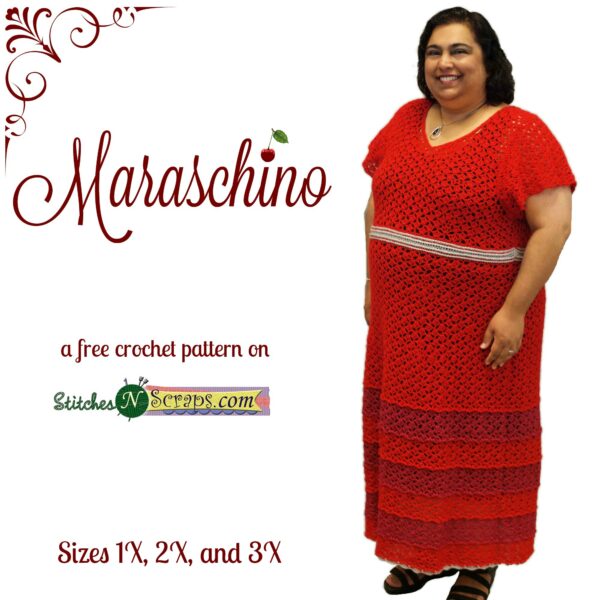
Maraschino - a free crochet pattern on StitchesNScraps.com

Free Pattern – Maraschino

Vanna’s Glamour yarn from Lion Brand gives this lacy dress a fun bit of sparkle, perfect for holiday parties. It features a figure-flattering empire waist, and subtle shaping to hug your curves in all the right places. The skirt flares out slightly, just enough for a little bit of a twirly bounce. I wore this to the CGOA Conference this past summer, and the picture is from just before the fashion show.

Maraschino - a free crochet pattern on StitchesNScraps.com

This post contains affiliate links (click for more info). If you click one of these links and then make a purchase, I may be compensated. You get the same great prices, and you will be helping to support this site!

This is a more advanced pattern, and something of a time commitment as it’s done in sport weight yarn. It also does require a slip or lining, because of the all-over lace design. I wore it over a black, full slip, which really made the lace texture pop. I have made a couple of slight adjustments to the pattern from the above photo, to raise the waist just a little bit higher and make the skirt flare out just a little bit sooner.


This pattern is protected by copyright. Please do not distribute or share this pattern in any way other than by sharing a link to this page or to the pattern page on Ravelry. Click here for copyright information.

Maraschino

2 - fine 
Add this to your Ravelry Queue

Materials:

  • Lion Brand Vanna’s Glamour Yarn
    • 1800-2000 yds / 9-10 skeins #113 Ruby Red (red)
    • 500-600 yds / 3 skeins #114 Red Stone (dark red)
    • 150-200 yd / 1 skein #100 Diamond (silver)
  • Size G / 6 (4 mm) hook or size needed to obtain gauge
  • Yarn or Tapestry needle
  • Stitch markers

Difficulty:

Experienced – Most of the dress is an easy, repetitive stitch pattern. However, where there are increases and decreases, they are worked in pattern and are more complex. The bodice is the hard part – particularly the few rows in the front where you are decreasing for armhole shaping and bust shaping at the same time. Once you get to the skirt though, there are only a couple of increases and the rest is smooth sailing. Also uses post stitches, and a join-as-you-go technique for the shoulder seams.

Sizes:

Instructions are for size 1X, with changes for 2X & 3X in [ ]. Sizing is based on the Craft Yarn Council Size Chart. Please note, this chart shows actual body measurements, not the finished measurements of the garment. The bust shaping works out to approximately a C cup. Sizes 2X & 3X include an extra pattern repeat across the back, so the back is slightly wider than the front. This is to allow for a little more wiggle room in the shoulders.

Gauge:

17 dc x 10 rows = 4 inches. Measure gauge after washing and blocking swatch. This was measured without weighting / stretching the swatch. Correct gauge is important for a good fit, take time to check your gauge.

Abbreviations used:

  • ch = chain
  • sc = single crochet
  • fsc = foundation single crochet
  • hdc = half double crochet
  • dc = double crochet
  • sl st = slip stitch
  • st(s) = stitch(es)
  • sp(s) = space(s)
  • rnd = round
  • yo = yarn over
  • WS = wrong side
  • RS = right side


Recommended Resources:


Special Stitch:

  • Fan: (2 dc, ch 1, 2 dc) in same st. Note: When the instructions say to work into the center of a fan, work into the ch sp at the center. 


Instructions:

Back:

Waistband:

Row 1 (RS): With silver, work 89 [97, 103] fsc

OR Alternate Row 1: With silver, ch 90 [98, 104], sc in back bump of 2nd ch from hook and each ch across. (89 [97, 103] sc)

Row 2: Ch 2 (counts as fpdc), turn, fpdc around next st and each st across, change to red, fasten off silver.

Row 3: With red, ch 2 (counts as bpdc), turn, bpdc around next st and each st across.

Lower Back:

Row 4: Ch 1, turn, 2 hdc in first st, sk next 1 [2, 2] sts, (fan in next st, sk next 2 sts, hdc in next st, sk next 2 sts) 14 [15, 16] times, fan in next st, sk next 1 [2, 2] sts, 2 hdc in last st. (15 [16, 17] fans)

Size 1X only:

Row 5: Ch 1, turn, hdc in first st, ch 1, 2 dc in next st, (hdc in center of next fan, fan in next hdc) 14 times, hdc in center of next fan, 2 dc in next hdc, ch 1, hdc in last st. (14 fans).

Row 6: Ch 1, turn, hdc in first st, hdc in next ch sp, sk next 2 dc, (fan in next hdc, hdc in center of next fan) 14 times, fan in next hdc, sk next 2 dc, hdc in ch sp, hdc in last st. (15 fans)

Rows 7-8: Repeat rows 5-6

Size 2X only:

Note: an increase of 1 pattern repeat is worked over the next 3 rows

Row 5: Ch 1, turn, hdc in first st, ch 1, 2 dc in next hdc, (hdc in center of next fan, fan in next hdc) 7 times, hdc in center of next fan, (2 dc, ch 1, dc, ch 1, dc, ch 1, 2 dc) in next hdc, (hdc in center of next fan, fan in next hdc) 7 times, hdc in center of next fan, 2 dc in next hdc, ch 1, hdc in last st. (14 fans).

Row 6: Ch 1, turn, hdc in first st, hdc in ch sp, sk next 2 dc, (fan in next hdc, hdc in center of next fan) 7 times, fan in next hdc, sk next 2 dc, hdc in next ch sp, (sk next dc, hdc in next ch sp) twice, sk next 2 dc, (fan in next hdc, hdc in center of next fan) 7 times, fan in next hdc, sk next 2 dc, hdc in ch sp, hdc in last st. (16 fans)

Row 7: Ch 1, turn, hdc in first st, ch 1, 2 dc in next hdc, (hdc in center of next fan, fan in next hdc) 8 times, hdc in next hdc, (fan in next hdc, hdc in center of next fan) 8 times, 2 dc in next hdc, ch 1, hdc in last st. (16 fans)

Note: Increase completed. 

Row 8: Ch 1, turn, hdc in first st, hdc in next ch sp, sk next 2 dc, (fan in next hdc, hdc in center of next fan) 16 times, fan in next hdc, sk next 2 dc, hdc in ch sp, hdc in last st. (17 fans)

Size 3X only:

Row 5: Ch 1, turn, hdc in first st, ch 1, 2 dc in next st, (hdc in center of next fan, fan in next hdc) 16 times, hdc in center of next fan, 2 dc in next hdc, ch 1, hdc in last st. (16 fans).

Note: an increase of 1 pattern repeat is worked over the next 3 rows

Row 6: Ch 1, turn, hdc in first st, hdc in ch sp, sk next 2 dc, (fan in next hdc, hdc in center of next fan) 8 times, (2 dc, ch 1, dc, ch 1, dc, ch 1, 2 dc) in next hdc, (hdc in center of next fan, fan in next hdc) 8 times, sk next 2 dc, hdc in ch sp, hdc in last st. (16 fans).

Row 7: Ch 1, turn, hdc in first st, ch 1, 2 dc in next st, (hdc in center of next fan, fan in next hdc) 8 times, sk next 2 dc, hdc in next ch sp, (sk next dc, hdc in next ch sp) twice, sk next 2 dc, (fan in next hdc, hdc in center of next fan) 8 times, 2 dc in next hdc, ch 1, hdc in last st. (16 fans).

Row 8: Ch 1, turn hdc in first st, hdc in next ch sp, sk next 2 dc, (fan in next hdc, hdc in center of next fan) 8 times, fan in next hdc, hdc in next dc, (fan in  next hdc, hdc in center of next fan) 8 times, fan in next hdc, sk next 2 sts, hdc in ch sp, hdc in last st. (18 fans).

Note: Increase completed. 

All sizes:

Row 9: Ch 1, turn, hdc in first st, ch 1, 2 dc in next st, (hdc in center of next fan, fan in next hdc) 15 [16, 17] times, hdc in center of next fan, 2 dc in next hdc, ch 1, hdc in last st. (14 [16, 17] fans).

Row 10: Ch 1, turn, hdc in first st, hdc in next ch sp, sk next 2 dc, (fan in next hdc, hdc in center of next fan) 15 [16, 17] times, fan in next hdc, sk next 2 dc, hdc in ch sp, hdc in last st. (15 [17, 18] fans)

Row 11: Repeat Row 9

Armhole shaping:

Size 1X only:

Row 12: Turn, sl st in first st, sl st in next ch sp, sl st in next 2 dc, ch 3 (counts as dc), dc in next hdc, (hdc in center of next fan, fan in next hdc) across to last fan, hdc in center of last fan, dc in next hdc, dc in next dc, leave remaining sts unworked. (13 fans)

Row 13: Ch 3, turn, sk next dc, dc in next hdc, (hdc in center of next fan, fan in next hdc) across to last fan, hdc in center of last fan, dc in next hdc, dc in last st. (12 fans)

Row 14: Repeat Row 13. (11 fans).

Row 15: Ch 1, turn, hdc in first 2 sts, (fan in next hdc, hdc in center of next fan) 11 times, fan in next hdc, hdc in each of last 2 sts (12 fans).

Size 2X only:

Row 12: Turn, sl st in first st, sl st in next ch sp, sl st in next 2 dc, sl st in next hdc, sl st in first 2 dc of next fan, sl st in center of next fan, ch 3 (counts as dc), dc in center of same fan, 2 dc in next hdc, (hdc in center of next fan, fan in next hdc) across to last 2 fans, hdc in center of next fan, 2 dc in next hdc, 2 dc in center of last fan, leave remaining sts unworked. (13 fans).

Row 13: Ch 3 (counts as dc), turn, dc in next st, sk next 2 dc, 2 dc in next hdc, (hdc in center of next fan, fan in next hdc) across to last fan, hdc in center of last fan, 2dc in next hdc, sk next 2 dc, dc in each of last 2 dc. (12 fans).

Row 14: Ch 3 (counts as dc), turn, dc in next st, sk next 2 dc, (fan in next hdc, hdc in center of next fan) across to last 5 sts, fan in last hdc, sk next 2 dc, dc in last 2 sts. (13 fans)

Row 15: Ch 1, turn, hdc in first st, ch 1, 2 dc in next st, (hdc in center of next fan, fan in next hdc) 12 times, hdc in center of next fan, 2 dc in next dc, ch 1, hdc in last st. (12 fans).

Row 16: Ch 1, turn, hdc in first st, hdc in next ch sp, sk next 2 dc, (fan in next hdc, hdc in center of next fan) 12 times, fan in next hdc, sk next 2 dc, hdc in ch sp, hdc in last st. (13 fans)

Size 3X only:

Row 12: Work as for row 12 of size 2X. (14 fans).

Row 13: Work as for row 13 of size 2X. (13 fans).

Row 14: Repeat row 13. (12 fans)

Rows 15-17: Work as for row 14-16 of size 2X. (13 fans on row 17)

Upper back

All sizes:

Row 16 [17, 18]: Ch 1, turn, hdc in first st, ch 1, 2 dc in next st, (hdc in center of next fan, fan in next hdc) 12 times, hdc in center of next fan, 2 dc in next hdc, ch 1, hdc in last st. (11 [12, 12] fans).

Row 17 [18, 19]: Ch 1, turn, hdc in first st, hdc in next ch sp, sk next 2 dc, (fan in next hdc, hdc in center of next fan) 12 times, fan in next hdc, sk next 2 dc, hdc in ch sp, hdc in last st. (12 [13, 13] fans)

Rows 18-27 [19-28, 20-27]: Repeat last two rows 5 [5, 4] more times

Row 28 [29, 28]: Repeat row 16 [17, 18] once more.

Right [Left, Right] Shoulder:

Row 29 [30, 29] (RS [WS, RS]): Ch 1, turn, hdc in first st, hdc in next ch sp, sk next 2 dc, (fan in next hdc, hdc in center of next fan) three times, leave remaining stitches unworked. Mark the side of the last st on this row for later joining. (3 fans)

Row 30 [31, 30]: Turn, sl st in first 2 dc of next fan, sl st in center of next fan, ch 1, 2 hdc in center of same fan, (fan in next hdc, hdc in center of next fan) twice, 2 dc in next hdc, ch 1, hdc in last st. (2 fans).

Row 31 [32, 31]: Ch 1, turn, hdc in first st, hdc in next ch sp, sk next 2 dc, (fan in next hdc, hdc in center of next fan) twice, fan in next hdc, sk next 2 dc, hdc in next sp, hdc in last st. (3 fans).

Size 3X only – Row 32: Ch 1, turn, hdc in first st, ch 1, 2 dc in next st, (hdc in center of next fan, fan in next hdc) twice, hdc in center of next fan, 2 dc in next hdc, ch 1, hdc in last st.  (2 fans).

All sizes – Fasten off.

Left [Right, Left] Shoulder:

Turn work so that WS [RS, WS] is facing. Join red with sl st in first st (at armhole edge). Work as for other shoulder. Fasten off.

NOTE: Back will appear too short – this is OK. It will stretch significantly with the weight of the skirt once the dress is finished. Once the skirt is finished, you can come back and make adjustments to the shoulders if needed, by adding or subtracting 1-2 rows on each side (front and back). 

Back- Maraschino - a free crochet pattern on StitchesNScraps.com

Front:

Waistband:

Rows 1-3: Repeat rows 1-3 of back.

Increases below bust:

Size 1X & 3X only:

Row 4: Ch 1, turn, 2 hdc in first st, sk next 1 [2, 2] sts, (fan in next st, sk next 2 sts, hdc in next st, sk next 2 sts) 14 [16] times, fan in next st, sk next 1 [2, 2] sts, 2 hdc in last st. (15 [16, 17] fans)

Note: An increase of 2 pattern repeats is worked over the next 3 rows

Row 5: Ch 1, turn, hdc in first st, ch 1, 2 dc in next hdc, (hdc in center of next fan, fan in next hdc) 3 [4] times, hdc in center of next fan, (2 dc, ch 1, dc, ch 1, dc, ch 1, 2 dc) in next hdc, (hdc in center of next fan, fan in next hdc) 6 times, hdc in center of next fan, (2 dc, ch 1, dc, ch 1, dc, ch 1, 2 dc) in next hdc, (hdc in center of next fan, fan in next hdc) 3 [4] times, hdc in center of next fan, 2 dc in next hdc, ch 1, hdc in last st. (12 [14] fans).

Row 6: Ch 1, turn, hdc in first st, hdc in ch sp, sk next 2 dc, (fan in next hdc, hdc in center of next fan) 3 [4] times, fan in next hdc, sk next 2 dc, hdc in next ch sp, (sk next dc, hdc in next ch sp) twice, sk next 2 dc, (fan in next hdc, hdc in center of next fan) 6 times, fan in next hdc, sk next 2 dc, hdc in next ch sp, (sk next dc, hdc in next ch sp) twice, sk next 2 dc, (fan in next hdc, hdc in center of next fan) 3 [4] times, fan in next hdc, sk next 2 dc, hdc in ch sp, hdc in last st. (15 [17] fans)

Row 7: Ch 1, turn, hdc in first st, ch 1, 2 dc in next hdc, (hdc in center of next fan, fan in next hdc) 4 [5] times, hdc in next hdc, fan in next hdc, (hdc in center of next fan, fan in next hdc) 7 times, hdc in next hdc, fan in next hdc, (hdc in center of next fan, fan in next hdc) 3 [4] times, hdc in center of next fan, 2 dc in next hdc, ch 1, hdc in last st. (16 [18] fans)

Note: Increase completed. 

Size 2X only:

Note: an increase of 2 pattern repeats is worked over the next 3 rows

Row 4: Ch 1, turn, 2 hdc in first st, sk next 2 sts, (fan in next st, sk next 2 sts, hdc in next st, sk next 2 sts) 4 times, (2 dc, ch 1, dc, ch 1, dc, ch 1, 2 dc) in next st, sk next 2 sts, hdc in next st, sk next 2 sts, (fan in next st, sk next 2 sts, hdc in next st, sk next 2 sts) 6 times, (2 dc, ch 1, dc, ch 1, dc, ch 1, 2 dc) in next st, sk next 2 sts, (hdc in next st, sk next 2 sts, fan in next st, sk next 2 sts) 4 times, 2 hdc in last st. (14 fans)

Row 5: Ch 1, turn, hdc in first st, ch 1, 2 dc in next st, (hdc in center of next fan, fan in next hdc) 4 times, sk next 2 dc, hdc in next ch sp, (sk next dc, hdc in next ch sp) twice, sk next 2 dc, fan in next hdc, (hdc in center of next fan, fan in next hdc) 6 times, sk next 2 dc, hdc in next ch sp, (sk next dc, hdc in next ch sp) twice, sk next 2 dc, (fan in next hdc, hdc in center of next fan) 4 times, 2 dc in next hdc, ch 1, hdc in last st. (15 fans)

Row 6: Ch 1, turn, hdc in first st, hdc in ch sp, sk next 2 dc, (fan in next hdc, hdc in center of next fan) 4 times, fan in next hdc, hdc in next hdc, (fan in next hdc, hdc in center of next can) 7 times, fan in next hdc, hdc in next hdc, fan in next hdc, (hdc in center of next fan, fan in next hdc) 4 times, sk next 2 dc, hdc in ch sp, hdc in last st. (18 fans).

Note: Increase completed. 

Row 7: Ch 1, turn, hdc in first st, ch 1, 2 dc in next st, (hdc in center of next fan, fan in next hdc) 17 times, hdc in center of next fan, 2 dc in next hdc, ch 1, hdc in last st. (17 fans)

All sizes:

Row 8: Ch 1, turn, hdc in first st, hdc in next ch sp, sk next 2 dc, (fan in next hdc, hdc in center of next fan) 16 [17, 18] times, fan in next hdc, sk next 2 dc, hdc in ch sp, hdc in last st. (17 [18, 19] fans)

Row 9: Ch 1, turn, hdc in first st, ch 1, 2 dc in next st, (hdc in center of next fan, fan in next hdc) 16 [17, 18] times, hdc in center of next fan, 2 dc in next hdc, ch 1, hdc in last st. (16 [17, 18] fans).

Rows 10-11: Repeat rows 8-9.

Armhole shaping & decreases above bust:

Size 1X only:

Rows 12-14: Repeat rows 12-14 of back armhole shaping. You will have 2 more fans than is specified for each row. (13 fans on row 14).

Note: a decrease of 2 pattern repeats is worked over the next 3 rows

Row 15: Ch 1, turn, hdc in first 2 sts, (fan in next hdc, hdc in center of next fan) twice, *(dc, ch 1, dc) in next hdc, hdc in center of next fan, (dc, ch 1, dc) in next hdc**, (hdc in center of next fan, fan in next hdc) 6 times, hdc in center of next fan, repeat from * to **, (hdc in center of next fan, fan in next hdc) twice, hdc in last 2 st. (10 fans)

Size 2X only:

Rows 12-13: Repeat rows 12-13 of back armhole shaping. You will have 1 more fan than is specified for each row. (13 fans on row 13).

Note: a decrease of 2 pattern repeats is worked over the next 3 rows

Row 14:Ch 3 (counts as dc), turn, dc in next st, sk next 2 dc, (fan in next hdc, hdc in center of next fan) twice, *(dc, ch 1, dc) in next hdc, hdc in center of next fan, (dc, ch 1, dc) in next hdc**, (hdc in center of next fan, fan in next hdc) 6 times, hdc in center of next fan, repeat from * to **, (hdc in center of next fan, fan in next hdc) twice, sk next 2 dc, dc in last 2 sts. (10 fans)

Size 3X only:

Rows 12-14: Repeat rows 12-14 of back armhole shaping. You will have 1 more fan than is specified for each row. (13 fans on row 14).

Note: a decrease of 2 pattern repeats is worked over the next 3 rows

Row 15: Ch 1, turn, hdc in first 2 sts, (fan in next hdc, hdc in center of next fan) twice, *(dc, ch 1, dc) in next hdc, hdc in center of next fan, (dc, ch 1, dc) in next hdc**, (hdc in center of next fan, fan in next hdc) 6 times, hdc in center of next fan, repeat from * to **, (hdc in center of next fan, fan in next hdc) twice, hdc in last 2 st. (10 fans)

All sizes:

Row 16 [15, 16]: Ch 1, turn, hdc in first st, ch 1, 2 dc in next st (hdc in center of next fan, fan in next hdc) twice, *sk next dc, hdc in next ch sp, sk next dc, hdc in next hdc, sk next dc, hdc in next ch sp, sk next dc**, (fan in next hdc, hdc in center of next fan) 6 times, fan in next hdc, repeat from * to **, (fan in next hdc, hdc in center of next fan) twice, 2 dc in next hdc, ch 1, hdc in last st. (11 fans)

Row 17 [16, 17]: Ch 1, turn, hdc in first st, hdc in ch sp, sk next 2 dc, (fan in next hdc, hdc in center of next fan) twice, *sk next hdc, fan in next hdc, sk next hdc**, (hdc in center of next fan, fan in next hdc) 6 times, hdc in center of next fan, repeat from * to **, (hdc in center of next fan, fan in next hdc) twice, sk next 2 dc, hdc in ch sp, hdc in last st. (12 fans)

Note: Decreases completed. 

Row 18: Ch 1, turn, hdc in first st, ch 1, 2 dc in next st, (hdc in center of next fan, fan in next hdc) 11 times, hdc in center of next fan, 2 dc in next hdc, ch 1, hdc in last st. (11 fans)

Row 19: Ch 1, turn, hdc in first st, hdc in next sp, sk next 2 dc, (fan in next hdc, hdc in center of next fan) 11 times, fan in next hdc, sk next 2 dc, hdc in next sp, hdc in last st.  (12 fans)

Right Shoulder:

Row 20 (WS): Ch 1, turn, hdc in first st, ch 1, 2 dc in next st, (hdc in center of next fan, fan in next hdc) 5 times, hdc in center of next fan, 2 dc in next hdc (this should be the center stitch of the previous row), leave remaining sts unworked. (5 fans)

Row 21: Ch 3 (counts as dc), turn, dc in next dc, ch 1, 2 dc in next hdc, (hdc in center of next fan, fan in next hdc) 5 times, sk next 2 dc, hdc in next sp, hdc in last st. (5 fans)

Row 22: Ch 1, turn, hdc in first st, ch 1, 2 dc in next st, (hdc in center of next fan, fan in next hdc) 4 times, hdc in center of next fan, 2 dc in next hdc, ch 1, sk next 2 dc, dc in each of last 2 sts. (4 fans)

Row 23: Ch 3 (counts as dc), turn, dc in next dc, ch 1, sk next 2 dc, 2 dc in next hdc, (hdc in center of next fan, fan in next hdc) 4 times, sk next 2 dc, hdc in next sp, hdc in last st. (4 fans)

Row 24: Ch 1, turn, hdc in first st, ch 1, 2 dc in next st, (hdc in center of next fan, fan in next hdc) 3 times, hdc in center of next fan, 2 dc in next hdc, ch 1, sk next 2 dc, dc in each of last 2 sts. (3 fans)

Row 25: Ch 3 (counts as dc), turn, dc in next dc, ch 1, sk next 2 dc, 2 dc in next hdc, (hdc in center of next fan, fan in next hdc) 3 times, sk next 2 dc, hdc in next sp, hdc in last st. (3 fans)

Row 26: Ch 1, turn, hdc in first st, ch 1, 2 dc in next st, (hdc in center of next fan, fan in next hdc) twice, hdc in center of next fan, 2 dc in next hdc, ch 1, sk next 2 dc, dc in each of last 2 sts. (2 fans)

Row 27: Ch 3 (counts as dc), turn, hdc in next dc, ch 1, sk next 2 dc, fan in next hdc, (hdc in center of next fan, fan in next hdc) twice, sk next 2 dc, hdc in next sp, hdc in last st. (3 fans)

Row 28: Ch 1, turn, hdc in first st, ch 1, 2 dc in next st, (hdc in center of next fan, fan in next hdc) twice, hdc in center of next fan, 2 dc in next hdc, ch 1, hdc in last st.  (2 fans)

Row 29: Ch 1, turn, hdc in first st, hdc in next ch sp, sk next 2 dc, (fan in next hdc, hdc in center of next fan) twice, fan in next hdc, sk next 2 dc, hdc in next sp, hdc in last st. (3 fans)

Rows 30-31: Repeat rows 28 & 29

Size 1X & 2X only

Turn so wrong side is facing. Line up with right shoulder of back piece, so WS is facing on both pieces and stitches match up. The next row will be worked across the front, with slip stitches connecting it to the back as you go. This joins the two pieces together so that the seam is almost invisible.

Row 32 (WS): Ch 1, hdc in first st on front, sl st in first st on back, sl st in next st on back, 2 dc in next st on front, (hdc in center of next fan on front, sl st in center of next fan on back, 2 dc in next hdc on front, sl st in next hdc on back**, 2 dc in same st on front) three times, ending at ** on last repeat, hdc in last st on front, sl st in last st on back. Fasten off.

Size 3X only

Row 32: Repeat row 28 once more.

Rotate work so it’s upside down, but do not turn – WS should still be facing. Line up with right shoulder of back piece, so WS is facing on both pieces and the stitches match up. The next row will be worked across the back, with slip stitches connecting it to the front as you go. This joins the two pieces together so that the seam is almost invisible.

Row 33: ch 1, hdc in first st on back, sl st in first st on front, hdc in next sp on back, sl st in next sp on front, sk next 2 dc on both pieces, (2 dc in next hdc on back, sl st in next hdc on back, 2 dc in same st on front**, hdc in center of next fan on back, sl st in center of next fan on front) three times, ending at ** on last repeat, sk next 2 dc on both pieces, hdc in next sp on back, sl st in next sp on front, hdc in last st on back, sl st in last st on front. Fasten off.

Left Shoulder:

Turn work so that WS [RS, WS] is facing. Join red with sl st in first st (at armhole edge).

Row 20: Ch 1, turn, hdc in first st, ch 1, 2 dc in next st, (hdc in center of next fan, fan in next hdc) 5 times, hdc in center of next fan, 2 dc in next hdc – this should be the same, center front stitch that the last st of row 20 from the right shoulder was worked into. (5 fans)

Rows 21-32 [32, 33] Work as for right shoulder. Fasten off.

Front and Back- Maraschino - a free crochet pattern on StitchesNScraps.com

With right sides together, sew side seams. Avoid sewing right to the bottom edge of the waistband, as you will be working into those stitches to start the skirt.

NOTE: Top will appear too short – this is OK. It will stretch significantly with the weight of the skirt once the dress is finished. Once the skirt is finished, you can come back and make adjustments to the shoulders if needed, by adding or subtracting 1-2 rows on each side (front and back). 

Skirt:

Waistband:

With right side facing, join silver with sl st at either seam on waistband.

Rnd 1 (RS): With silver, sc in each st around, join. (178 [194, 206] sc)

Rnd 2: Ch 2 (counts as fpdc), turn, fpdc around next st and each st around, change to red, fasten off silver.

Rnd 3: With red, ch 2 (counts as bpdc), turn, bpdc around next st and each st across.

Top of skirt:

Note: 2 dc at the start of a round combined with 2 dc, ch 1 in the same st at the end of the round counts as 1 fan.

Round 4 (set up round): Ch 3 (counts as dc) turn, dc in first st, sk next 1 [3, 3] sts, *(hdc in next st, sk next 2 sts, fan in next st, sk next 2 sts,) 14 [15, 16] times, hdc in next st, sk next 2 sts**, fan in next st, sk next 1 [3, 3]sts, repeat from * to **, 2 dc in first st, ch 1, join. (30 [32, 34] fans)

Rnd 5: Ch 1, turn, hdc in first sp, fan in next hdc, (hdc in center of next fan, fan in next hdc) around, join. (30 [32, 34] fans).

Note: an increase of 4 pattern repeats is worked over the next 3 rows

Rnd 6: Ch 3 (counts as dc), turn, dc in first st, hdc in center of next fan, (fan in next hdc, hdc in center of next fan) 3 [4, 4] times, *(2 dc, ch 1, dc, ch 1, dc, ch 1, 2 dc) in next hdc, hdc in center of next fan, (fan in next hdc, hdc in center of next fan) 6 [5, 6] times, (2 dc, ch 1, dc, ch 1, dc, ch 1, 2 dc) in next hdc, hdc in center of next fan**, (fan in next hdc, hdc in center of next fan) 7 [9, 9] times, repeat from * to **, (fan in next hdc, hdc in center of next fan) 3 [4, 4] times, 2 dc in first st, ch 1, join. (26 [28, 30] fans)

Rnd 7: Ch 1, turn, hdc in first sp, (fan in next hdc, hdc in center of next fan) 3 [4, 4] times, *fan in next hdc, sk next 2 dc, hdc in next ch sp, (sk next dc, hdc in next ch sp) twice, sk next 2 dc, (fan in next hdc, hdc in center of next fan 6 [5, 6] times, fan in next hdc, sk next 2 dc, hdc in next ch sp, (sk next dc, hdc in next ch sp) twice, sk next 2 dc**, (fan in next hdc, hdc in center of next fan) 7 [9, 9] times, repeat from * to **, (fan in next hdc, hdc in center of next fan) 3 [4, 4] times, fan in last hdc, join. (30 [32, 34] fans)

Rnd 8: Ch 3 (counts as dc), turn, dc in first st, (hdc in center of next fan, fan in next hdc) 4 [5, 5] times, *hdc in next hdc, (fan in next hdc, hdc in center of next fan) 7 [6, 7] times, fan in next hdc, hdc in next hdc**, (fan in next hdc, hdc in center of next fan) 8 [10, 10] times, fan in next hdc, repeat from * to **, (fan in next hdc, hdc in center of next fan) 4 [5, 5] times, 2 dc in first st, ch 1, join. (34 [36, 38] fans)

Note: Increase completed. Another increase of 4 pattern repeats is worked over the next 3 rows

Rnd 9: Ch 1, turn, hdc in first sp, (fan in next hdc, hdc in center of next fan) 4 [5, 5] times, *(2 dc, ch 1, dc, ch 1, dc, ch 1, 2 dc) in next hdc, hdc in center of next fan, (fan in next hdc, hdc in center of next fan) 7 [6, 7] times, (2 dc, ch 1, dc, ch 1, dc, ch 1, 2 dc) in next hdc, hdc in center of next fan**, (fan in next hdc, hdc in center of next fan) 8 [10, 10] times, repeat from * to **, (fan in next hdc, hdc in center of next fan) 3 [4, 4] times, fan in last hdc, join. (30 [32, 34] fans)

Rnd 10: Ch 3 (counts as dc), turn, dc in first st, (hdc in center of next fan, fan in next hdc) 4 [5, 5] times, *sk next 2 dc, hdc in next ch sp, (sk next dc, hdc in next ch sp) twice, sk next 2 dc, (fan in next hdc, hdc in center of next fan 7 [6, 7] times, fan in next hdc, sk next 2 dc, hdc in next ch sp, (sk next dc, hdc in next ch sp) twice, sk next 2 dc**, (fan in next hdc, hdc in center of next fan) 8 [10, 10] times, fan in next hdc, repeat from * to **, (fan in next hdc, hdc in center of next fan) 4 [5, 5] times, 2 dc in first st, ch 1, join. (34 [36, 38] fans)

Rnd 11: Ch 1, turn, hdc in first sp, (fan in next hdc, hdc in center of next fan) 4 [5, 5] times, *fan in next hdc, hdc in next hdc (fan in next hdc, hdc in center of next fan) 8 [7, 8] times, fan in next hdc, hdc in next hdc**, (fan in next hdc, hdc in center of next fan) 9 [11, 11] times, repeat from * to **, (fan in next hdc, hdc in center of next fan) 4 [5, 5] times, fan in last hdc, join. (38 [40, 44] fans)

Note: Increase completed. Another increase of 4 pattern repeats is worked over the next 3 rows

Rnd 12: Ch 3 (counts as dc), turn, dc in first st, hdc in center of next fan, (fan in next hdc, hdc in center of next fan) 4 [5, 5] times, *(2 dc, ch 1, dc, ch 1, dc, ch 1, 2 dc) in next hdc, hdc in center of next fan, (fan in next hdc, hdc in center of next fan) 8 [7, 8] times, (2 dc, ch 1, dc, ch 1, dc, ch 1, 2 dc) in next hdc, hdc in center of next fan**, (fan in next hdc, hdc in center of next fan) 9 [10, 10] times, repeat from * to **, (fan in next hdc, hdc in center of next fan) 4 [5, 5] times, 2 dc in first st, ch 1, join. (34 [36, 38] fans)

Rnd 13: Ch 1, turn, hdc in first sp, (fan in next hdc, hdc in center of next fan) 4 [5, 5] times, *fan in next hdc, sk next 2 dc, hdc in next ch sp, (sk next dc, hdc in next ch sp) twice, sk next 2 dc, (fan in next hdc, hdc in center of next fan 8 [7, 8] times, fan in next hdc, sk next 2 dc, hdc in next ch sp, (sk next dc, hdc in next ch sp) twice, sk next 2 dc**, (fan in next hdc, hdc in center of next fan) 9 [10, 10] times, repeat from * to **, (fan in next hdc, hdc in center of next fan) 4 [5, 5] times, fan in last hdc, join. (38 [40, 42] fans)

Rnd 14: Ch 3 (counts as dc), turn, dc in first st, (hdc in center of next fan, fan in next hdc) 5 [6, 6] times, *hdc in next hdc, (fan in next hdc, hdc in center of next fan) 9 [8, 9] times, fan in next hdc, hdc in next hdc**, (fan in next hdc, hdc in center of next fan) 10 [12, 12] times, fan in next hdc, repeat from * to **, (fan in next hdc, hdc in center of next fan) 5 [6, 6] times, 2 dc in first st, ch 1, join. (42 [44, 48] fans)

Rnd 15: Ch 1, turn, hdc in first sp, fan in next hdc, (hdc in center of next fan, fan in next hdc) around, join. (38 [40, 44] fans).

Rnd 16: Ch 3 (counts as dc), turn, dc in first st, hdc in center of next fan, (fan in next hdc, hdc in center of next fan) around, 2 dc in first st, ch 1, join. (34 [36, 38] fans).

Rnds 17-36: Repeat rnds 15-16 ten times.

Bottom of skirt (stripes):

Note: 2 dc at the start of a round combined with 2 dc, ch 1 in the same st at the end of the round counts as 1 fan.

Rnd 36b (decorative ridge) (RS): Ch 1, turn, fphdc around each of next 2 dc, ch 1, (fphdc around next hdc, ch 1, fphdc around each of the first 2 dc of next fan, ch 1, fphdc around each of the last 2 dc of next fan, ch 1, ) around to last 2 dc, fphdc around each of last 2 dc, ch 1, join, changing to dark red.

Note: In the next round, all fans are worked behind the stitches of the last (b) round, creating the decorative ridge. All hdc stitches are worked through both of the last 2 rounds together, to lock the decorative ridge in place. 

Rnd 37 (RS): Ch 1, do NOT turn, working through last 2 rounds together, hdc in first sp, (working behind the stitches from last rnd, fan in next hdc from previous rnd; working through last 2 rnds together, hdc in center of next fan) around to last hdc, working behind the stitches from last rnd, fan in last hdc from previous rnd, join. (34 [36, 38] fans).

Rnds 38-42: Repeat rnd 16, then repeat rnds 15-16 twice

Rnd 42b: Repeat rnd 36b, changing to light red at the end of the round.

Rnds 43-48: Repeat rnds 37-42

Rnds 48b-60: Repeat rnds 36b – 48

Rnd 60b: Repeat rnd 35b, changing to silver at the end of the round.

Rnd 61: Repeat rnd 37, fasten off.

Wash, block, and try on the dress. If you need to make any adjustments to the bodice / shoulders, do it now, before starting the sleeves.

Sleeves:

With RS facing, join red with a slip stitch at either shoulder seam.

Rnd 1 (Armhole edging – RS): With red, work 78 [84, 90] sc evenly spaced around sleeve opening, join. Sl st in first 8 sts

Row 2: Turn, sk first 2 sts, (fan in next st, sk next 2 sts, hdc in next st, sk next 2 sts) twice, fan in next st, sk next 2 sts, sl st in next 3 sts, leaving remaining sts unworked. (3 fans)

Row 3: Turn, sk first 2 sts, fan in next st, (hdc in center of next fan, fan in next hdc) twice, hdc in center of next fan, fan in next unworked st from rnd 1, sk next 2 sts, sl st in next 3 sts, leaving remaining sts unworked. (4 fans)

Row 4: Turn, sk first 2 sts, fan in next st, (hdc in center of next fan, fan in next hdc) across to last fan, hdc in center of last fan, fan in next unworked st from rnd 1, sk next 2 sts, sl st in next 3 sts, leaving remaining sts unworked. (5 fans).

Rows 5-9 [10, 11]: Repeat last row 5 [6, 7] times. (10 [11, 12] fans on last row).

Row 10 [11, 12]: Turn, sk first 2 sts, fan in next st, (hdc in center of next fan, fan in next hdc) 10 [11, 12] times, hdc in center of last fan, fan in next unworked st from rnd 1, sk next 2 sts, sl st in next 7 sts, leaving remaining 6 sts unworked. (12 [13, 14] fans)

Note: Last row should end in line with the underarm seam.

Rnd 11 [12, 13]: Ch 3 (counts as dc), turn, dc in same st, sk next 2 sts, hdc in next st, sk next 2 sts, fan in next st, (hdc in center of next fan, fan in next hdc) 10 [11, 12] times, hdc in center of last fan, fan in next unworked st from rnd 1, sk next 2 sts, hdc in next st, sk last 2 sts, 2 dc in first st, ch 1, join. (13 [14, 15] fans).

Note: A decrease of 2 pattern repeats is worked over the next 3 rows

Rnd 12 [13, 14]: Ch 1, turn, hdc in first sp, *(dc, ch 1, dc) in next hdc, hdc in center of next fan, (dc, ch 1, dc) in next hdc** (hdc in center of next fan, fan in next hdc) 9 [10, 11] times, hdc in center of next fan, repeat from * to **, join. (9 [10, 11] fans)

Rnd 13 [14, 15]: Ch 3 (counts as dc), turn, dc in first st, *sk next dc, hdc in next sp, sk next dc, hdc in next hdc, sk next dc, hdc in next sp, sk next dc**, (fan in next hdc, hdc in center of next fan) 9 [10, 11] times, fan in next hdc, repeat from * to **, 2 dc in first st, ch 1, join. (11 [12, 13] fans)

Rnd 14 [15, 16]: Ch 1, turn, hdc in first sp, *sk next hdc, fan in next hdc, sk next hdc**, (hdc in center of next fan, fan in next hdc) 9 [10, 11] times, hdc in center of next fan, repeat from * to **, join. (11 [12, 13] fans)

Note: Decrease complete. 

Rnd 15 [16, 17]: Ch 3 (counts as dc), turn, dc in first st, (hdc in center of next fan, fan in next hdc) 10 [11, 12] times, hdc in center of last fan, 2 dc in first st, ch 1, join. Fasten off. (11 [12, 13] fans)

Finishing:
  • Front neckline edging: With right side facing, join red with slip stitch at marked st on back shoulder (where the neckline shaping starts). Ch 1, work 65 [69, 69] sc evenly spaced across sides of rows up to shoulder, around front neckline, and across sides of rows down to marker on other shoulder, sl st in first unworked st from back neckline, fasten off.
  • Weave in all ends.
 

I hope you enjoy the pattern. Thanks to Lion Brand for providing the beautiful Vanna’s Glamour yarn. Also thank you to happypeacock for tech editing the pattern!

A downloadable pdf of this pattern is also available on Ravelry, for a fee. The fee for the pdf format is to offset the advertising revenue lost when you print or download the pattern rather than viewing it online.

Contours - a free crochet pattern on StitchesNScraps.com

Free Pattern – Contours Square

There’s very little that’s square about this unique square! It’s made in 4 separate, half-circle pieces that are then joined with an edging and sewn together in the middle. It looks complicated, but the actual crochet is very easy. This square is shown here in 3 colors, but can be made all in 1 color, or in as many as 5 or even 6 (see Notes section for details).

Contours 12 inch square - a free crochet pattern on StitchesNScraps.comThis pattern was designed for the Moogly 2016 afghan CAL. If this is the first you’ve heard about it, go check it out! The CAL is nearing the end, but there’s still time to catch up. Also be sure to take a look at the block 22 post to see how Moogly’s version of this square turned out. I love her color combination! All the squares so far this year have been fun and interesting, and I can’t wait to see the last few.

Télécharger la traduction française par Véronique HoRaive ici


This pattern is protected by copyright. Please do not distribute or share this pattern in any way other than by sharing a link to this page or to the pattern page on Ravelry. Click here for copyright information.

This pattern contains affiliate links (click for more info). If you click one of these links and then make a purchase, I may be compensated. You get the same great prices, and you will be helping to support this site!

Contours Square

4-medium
Add this to your Ravelry Queue

Materials:

Affiliate Advertisements

Difficulty:

Intermediate – The crochet part is easy, mostly double crochet. However the assembly requires some embroidery/sewing and can be a bit trickier, so I’m calling it Intermediate.

Sizes:

12 inches square

Gauge:

12.5 dc x 6.5 rows = 4 inches square.

Abbreviations used:

  • ch = chain
  • sc = single crochet
  • dc = double crochet
  • csdc = chainless starting double crochet (optional)
  • sl st = slip stitch
  • st(s) = stitch(es)
  • sp(s) = space(s)
  • rnd = round
  • RS = right side
  • WS = wrong side

Notes:

  • Chainless starting double crochet stitches are recommended because it results in a cleaner looking edge. However, if you prefer, you can replace “turn, csdc” with “ch 3 (counts as first dc), turn” anywhere it appears in the pattern.
  • The pattern indicates the colors I used in my 3-color version; however there are lots of options for color. There are 5 distinct sections of this square – the 4 semi-circles, and a 2-row border. The whole square can be worked all in one color, or each section can be worked in a different color. You can even do each row of the border in a separate color to incorporate as many as 6 colors!

Recommended Resources:

Instructions:

Semi-circle 1:

(yellow)

Row 1 (RS): Make magic circle, ch 3 (counts as dc), 5 dc in circle, pull circle closed. Do not join. (6 dc)

OR

Alternative Row 1 (RS): Ch 4 (counts as dc and ch 1), 5 dc in 4th ch from hook. Do not join. (6 dc)

Row 2: Turn, csdc, dc in same st, 2 dc in each st across. (12 dc)

Row 3: Turn, csdc, dc in same st, (dc in next st, 2 dc in next st) 5 times, dc in last st. (18 dc)

Row 4: Turn, csdc, dc in same st, (dc in next 2 sts, 2 dc in next st) 5 times, dc in last 2 sts (24 dc)

Row 5: Turn, csdc, dc in same st, (dc in next 3 sts, 2 dc in next st) 5 times, dc in last 3 sts (30 dc)

Row 6: Turn, csdc, dc in same st, (dc in next 4 sts, 2 dc in next st) 5 times, dc in last 4 sts (36 dc)

Row 7: Turn, csdc, dc in same st, (dc in next 5 sts, 2 dc in next st) 5 times, dc in last 5 sts (42 dc)

Row 8: Turn, csdc, dc in same st, (dc in next 6 sts, 2 dc in next st) 5 times, dc in last 6 sts (48 dc)

Row 9: Turn, csdc, dc in same st, dc in next 7 sts, (2 dc in next st, dc in next 7 sts) twice, ch 1, (2 dc in next st, dc in next 7 sts) 3 times.(54 dc)

Edging: Do not turn, ch 1, working across straight edge at bottom of semi-circle, 2 sc in side of each row across, fasten off. (36 sc)

Note: Your semi-circle should measure 11 inches wide across the bottom, and 5.5 inches tall. 

Semicircle 1 - Contours square - a free pattern on StitchesNScraps.com

Semi-circle 2:

(yellow)

Rows 1-8: Repeat as for rows 1-8 of semi-circle 1.

Row 9: Turn, csdc, dc in same st, dc in next 7 sts, (2 dc in next st, dc in next 7 sts) twice. With right side facing, sl st in ch 1 sp from semi-circle 1. Now continuing on semi-circle 2, (2 dc in next st, dc in next 7 sts) 3 times.(54 dc, 1 sl st)

Note: The pictures here show this in 2 different colors just so you could see the join more clearly. In the finished piece, I actually used yellow for both semi-circles. 

Joining 2nd semicircle - Contours square - a free pattern on StitchesNScraps.com

Edging: Repeat as for edging on semi-circle 1.

2 semicircles - Contours square - a free pattern on StitchesNScraps.com

Semi-circles 3 & 4:

(blue)

Repeat instructions for Semi-circles 1 & 2. On the 4th semi-circle, do not fasten off after the edging. Instead, change to the color you want to use for the border.

Border:

(grey)

Rnd 1 (WS):

1st edge: Ch 1, turn, sl st in first st, sc in each st across straight side to last edging row st.

1st Corner: You’re going to join semi-cirlce 4 to semicircle 1. To do this and make sure everything is all lined up, first lay semi-circles 3 & 4, RS up (so your current working rnd will be upside down) on a table. Now place semi-circles 1 & 2 on top, with RS up as shown here.

1st side of border - Contours square - a free pattern on StitchesNScraps.com

Now, holding both pieces together, fold up the corner where your working yarn is, so you are again working on the wrong side of the fabric.  Working through last st from edging row on semi-circle 4, and first stitch on the edging row from semi-circle 1, (sc, ch 1, sc) to join the two pieces together.

1st corner of border - Contours square - a free pattern on StitchesNScraps.com

2nd edge: Continuing on semi-circle 1, sc in each st across to last st.

2nd Corner: Lay the piece flat on the table again, RS up. Pull up the edge of the next semi-circle so that it lies on top of the current one as shown. I like to think of this like the way you fold the flaps of a cardboard box to keep it closed.

2nd corner of border - Contours square - a free pattern on StitchesNScraps.com

Fold up working corner as before, and again working through both pieces, (sc, ch 1, sc) in corner st.

2nd corner of border - Contours square - a free pattern on StitchesNScraps.com

3rd edge: Continuing on next semi-circle, sc in each st across to last st.

3rd corner: Repeat as for 2nd corner

4th edge: Repeat as for 3rd edge

4th corner: Repeat as for 2nd corner, join with sl st to first st. (152 sc [38 on each side], 4 corner ch sps)

Rnd 2: Turn, sl st in ch sp, ch 1, {(sc, ch 1, sc) in sp, sc in each st across to next sp} 4 times, join with sl st to first st, fasten off.

Seaming:

Stretch your square out, RS up, so it’s nice and square and flat. make sure you like how the edges of the semicircles are laying. Pin the edges in place as shown.

pinned in place - Contours square - a free pattern on StitchesNScraps.com

You’re going to sew along the visible edge of each semicircle to hold it in place, using a backstitch just under the top edge of the stitches. To make this seam invisible on the opposite side, use whatever color is below the section you’re doing. So for instance, when I sew down the first yellow edge, I am using blue.

Cut a piece of yarn about 1 yd long (or as long as you can manage without knotting), and thread it on your yarn needle. Sew the end in on the wrong side of the work to secure it, just like you would when weaving in a tail. Now pull the needle up through the corner of the piece, just inside the edging, as shown.

backstitch seam - Contours square - a free pattern on StitchesNScraps.com

Working just underneath the top “V” edge of your stitches, insert needle in the first st, and bring it back out again where you started. Be sure to work through both pieces to sew them together.

backstitch seam - Contours square - a free pattern on StitchesNScraps.com

Now insert the needle in the 2nd st and pull it out again in the first stitch (the same spot you went into last time).

backstitch seam - Contours square - a free pattern on StitchesNScraps.com

As you work, be sure to keep the working yarn on the same side of the needle each time. It doesn’t matter which side you choose, as long as you are consistent. I chose to always keep my working yarn towards the edge, and my needle towards the middle.

backstitch seam - Contours square - a free pattern on StitchesNScraps.com

For the next stitch, you insert your needle into the 3rd stitch and pull it back out of the 2nd. You’re always going forward another stitch and then back out through the stitch you went into last time. Continue stitching in this manner to create a nice rope like effect around the edge:

backstitch seam - Contours square - a free pattern on StitchesNScraps.com

Now because I used only 2 colors, I have the same color combination on the diagonal end, so rather than break the yarn, I just went across the center and continued on the other side. I went under the center stitch, back over the top, and under again, to create a decorative little line in the center, then I continued the seam on the other side.

center - Contours square - a free pattern on StitchesNScraps.com

If you were using different colors, you might need to break the yarn for each section instead, leaving an end to weave in. In this case, just leave the center unworked. Remember to always use whatever color is on the bottom of the work, to keep the seam invisible on that side.

Continue to work each of the 4 sections in the same manner. When finished, your piece should look like the main pattern image, but will be floppy on the back.

Flip it over, and sew down the edges on the wrong side in exactly the same manner. You may find you don’t need the pins this time.

Weave in all ends. You can also add a decorative flower or applique in the center of the square if desired.


I hope you enjoy the pattern. Big thanks to Karen Walker (check out her square) and Tamara Kelly for testing the pattern, and to Véronique HoRaive for translating it into French:

A downloadable pdf of this pattern is also available on Ravelry, for a fee. The fee for the pdf format is to offset the advertising revenue lost when you print or download the pattern rather than viewing it online.

If you would like to receive notifications of new posts and patterns as they become available, please follow this blog. You can follow by e-mail (look at the sidebar on the right for the follow by email option), or via RSS feed, or via your WordPress.com reader: Follow Stitches ‘N’ Scraps on WordPress.com

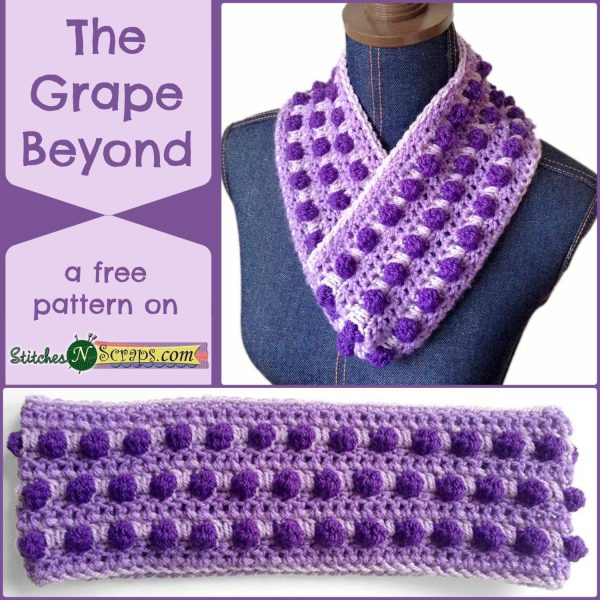
The Grape Beyond - A free pattern on StitchesNScraps.com

Free Pattern – The Grape Beyond

Get your grape on with this bold, puffy cowl! Cluster stitches “grapes” pop out of a lighter, two-toned background. It’s fast and fun to make, and the size can easily be adjusted. Since it’s worked in the round, the colors can easily be carried from one section to the next, meaning fewer ends to weave in. Try other colors too, and make one for everyone on your gift list!

The Grape Beyond - A free pattern on StitchesNScraps.com

I’m breaking through // I’m bending spoons // I’m keeping flowers in full bloom // I’m looking for answers from the great beyond. (R.E.M. – The Great Beyond)


This pattern is protected by copyright. Please do not distribute or share this pattern in any way other than by sharing a link to this page or to the pattern page on Ravelry. Click here for copyright information.

This pattern contains affiliate links (click for more info). If you click one of these links and then make a purchase, I may be compensated. You get the same great prices, and you will be helping to support this site!

The Grape Beyond

4-medium 
Add this to your Ravelry Queue

Materials:

  • Worsted weight yarn
    • 65 yds light purple (A)
    • 45 yds medium purple (B)
    • 50 yds dark purple (C)
  • Size J / 10 (6 mm) hook or size needed to obtain gauge
  • Yarn or Tapestry needle

Difficulty:

Easy – Worked in the round, cluster stitches, color changes.

Sizes:

Adult – one size fits most.

Gauge:

12 dc x 6 rows = 4 inches. Exact gauge is not critical.

Abbreviations used:

  • ch = chain
  • sc = single crochet
  • fsc = foundation single crochet (optional)
  • dc = double crochet
  • yo = yarn over
  • cl = cluster (see special stitches)
  • sl st = slip stitch
  • st(s) = stitch(es)
  • sp(s) = space(s)
  • rnd = round

Recommended Resources:

 Special Stitch:

Cluster (cl): (Yo, insert hook into specified st and pull up a loop, yo and draw through 2 loops on hook) 4 times, yo and draw through all 5 loops on hook, ch 1 to close.

Notes:

  • Joining after the first round, rather than joining the foundation chain, makes it easier to join without twisting your round. This will leave a slight gap at the bottom of your cowl, but you can sew that closed when weaving in your tails.
  • You can make the cowl longer or shorter by adjusting the number of stitches on rnd 1, so long as you have a multiple of 3 sts.
  • You can make the cowl taller or shorter by repeating repeating rnds 2-5 more or fewer times.

Instructions:

Note: When joining the first round, be careful not to twist your work. 

Rnd 1 (RS): With A, work 84 fsc, join, changing to B. (84 fsc).

OR

Alternate Row 1 (RS): With A, ch 85 loosely, turn, sc in 2nd ch from hook and in each ch across, join, changing to B. (84 sc).

Rnd 2: With B, ch 3 (counts as dc), turn, dc in next st and in each st around, join, changing to A.

Rnd 3: With A, ch 1, turn, sc in each st around, join, changing to C.

Rnd 4: With C, ch 2 (does not count as a st), (cl in next st, ch 2, sk next 2 sts) around, join to top of first cl, changing to A. (28 cls)

Note: In next round, be sure to work over the chains in round 4 (not in front of or behind them), so that they get hidden inside the stitches. Front and back of stitch detail - Grape Cowl - SttichesNScraps.com

Rnd 5: With A, ch 1, turn, (working around the chs from the previous rnd, dc in 2 skipped sts below next sp; sc in top of next cl) around, join to first dc, changing to B. (84 sts).

Rnds 6 – 14: Repeat rnds 2 – 5 twice, then repeat rnd 2 once more.

Rnd 15: Repeat rnd 3, but do not change colors at the end of the rnd. Fasten off.

Weave in all ends.


I hope you enjoy the pattern. Thanks to rebejones for testing the pattern, and to Erin Morrison for coming up with the awesome name!

A downloadable pdf of this pattern is also available on Ravelry, for a fee. The fee for the pdf format is to offset the advertising revenue lost when you print or download the pattern rather than viewing it online.

If you would like to receive notifications of new posts and patterns as they become available, please follow this blog. You can follow by e-mail (look at the sidebar on the right for the follow by email option), or via RSS feed, or via your WordPress.com reader: Follow Stitches ‘N’ Scraps on WordPress.com-

Mitered Mitts - a free pattern on StitchesNScraps.com

Free Pattern – Mitered Mitts

These fun mitts are reversible – wear them one way for a mitered pattern on top, or switch hands for simple stripes. If you make them in a solid color yarn, you won’t get the colorful stripes, but will still see the different designs. They’re so much easier than they look, and work up quickly. This may become one of your go-to patterns for gifting or craft fairs!

Mitered Mitts - a free pattern on StitchesNScraps.com


This pattern is protected by copyright. Please do not distribute or share this pattern in any way other than by sharing a link to this page or to the pattern page on Ravelry. Click here for copyright information.

This pattern contains affiliate links (click for more info). If you click one of these links and then make a purchase, I may be compensated. You get the same great prices, and you will be helping to support this site!

Mitered Mitts

 
Add this to your Ravelry Queue

Materials:

  • 125 yds DK weight, self striping yarn – you can use solid color yarn, but you won’t get the same striping effect.
  • Size H / 8 (5 mm) hook or size needed to obtain gauge
  • Size G / 6 (4 mm) hook or one size smaller than the other hook. This is for the ribbing. If you have a 4.5 mm hook that’s good too.
  • Yarn or Tapestry needle

Difficulty:

Intermediate – Unique construction, some working in sides of rows, front post / back post ribbing.

Sizes:

Adult – one size fits most.

Gauge:

18 dc x 9 rows = 4 inches. You can use the first few rows as a swatch – after row 3, work should measure approximately 3.25 x 1.25 inches.

Abbreviations used:

  • ch = chain
  • dc = double crochet
  • fpdc = front post double crochet
  • bpdc = back post double crochet
  • sl st = slip stitch
  • st(s) = stitch(es)
  • sp(s) = space(s)

Recommended Resources:

 Instructions:

First Mitt:

Note: Ch 3 at the beginning of a row counts as a dc.

Hand:  

Ch 12 loosely.

Row 1 (RS): Dc in 4th ch from hook and each ch across. (10 dc).

Row 2: Ch 3, turn, dc in next 8 sts, (2 dc, ch 1, 2 dc) in next st, dc in side of row 1. (14 dc)

Row 3: Ch 3, turn, dc in next 2 sts, (2 dc, ch 1, 2 dc) in next sp, dc in next 11 sts. (18 dc)

Row 4: Ch 3, turn, dc in next 12 sts, (2 dc, ch 1, 2 dc) in next sp, dc in next 5 sts. (22 dc)

Row 5: Ch 3, turn, dc in next 6 sts, (2 dc, ch 1, 2 dc) in next sp, 3 dc in next st, dc in next 14 sts. (28 dc)

Row 6: Ch 3, turn, dc in next 13 sts, 2 dc in next st, dc in next st, 2 dc in next st, dc in next 2 sts, (2 dc, ch 1, 2 dc) in next sp, dc in next 9 sts. (34 dc)

Row 7: Ch 3, turn, dc in next 10 sts, (2 dc, ch 1, 2 dc) in next sp, dc in next 5 sts, 2 dc in next st, dc in next st, 2 dc in next st, dc in next 15 sts. (40 dc)

Row 8: Ch 3, turn, dc in next 13 sts, ch 3, sk next 7 sts (thumb), dc in next 6 sts, (2 dc, ch 1, 2 dc) in next sp, dc in next 13 sts. (37 dc)

Row 9: Ch 3, turn, dc in next 14 sts, (2 dc, ch 1, 2 dc) in next sp, dc in next 8 sts, 2 dc in next sp (above thumb), dc in next 14 sts. (43 dc)

Row 10: Ch 3, turn, dc in next 25 sts, (2 dc, ch 1, 2 dc) in next sp, dc in next 17 sts. (47 dc)

Row 11: Ch 3, turn, dc in next 18 sts, (2 dc, ch 1, 2 dc) in next sp, dc in next 28 sts. Do not fasten off. (51 dc)

Seam:

Seaming diagram for Mitered Mitts pattern

Row 1: Do not turn. Rotate work so that you are working into the sides of the rows. Work 22 sc evenly spaced along sides of rows.

Row 2: Fold work in half with right sides together. The stitches from the short edge of row 11 of hand should line up with the stitches you just made. Working through the wrong side loop only on both pieces (front loop on front piece, back loop on back piece), slip stitch loosely in each st across. Your last sl st will be in a corner ch sp on one side. Do not fasten off.

Wrong side loops - StitchesNScraps.com

Note: For more help in identifying the wrong side loops, see this tutorial: Tutorial – Whipstitch seam through wrong side loops only

Finger ribbing:

Turn the mitt right side out and make sure your working yarn isn’t caught inside. Rotate so you are working along the top edge of the mitt.

Row 1 (RS): With smaller hook – Ch 2 (does not count as a st), fpdc around first st, (bpdc around next st, fpdc around next st) 14 times, bpdc around last st, join with sl st to first fpdc.

Rows 2-4: Do not turn. Repeat row 1 three times more. Fasten off.

Cuff ribbing:

With right side facing, join yarn at seam on bottom of mitt.

Row 1 (RS): With smaller hook – Ch 3 (counts as dc), work 29 dc evenly around, join with sl st to first st. (30 dc total – 10 dc in bottom of stitches from row 1, 20 dc in sides of rows).

Row 2: Do not turn. Ch 2 (does not count as a st), fpdc around first st, (bpdc around next st, fpdc around next st) 14 times, bpdc around last st, join with sl st to first fpdc.

Rows 3-4: Repeat row 2.

Second Mitt:

Hand:  

Repeat as for first hand, but row 1 is now a wrong side row instead of a right side row.

Seam:

Repeat as for first seam – remember, row 1 is now the wrong side row so you will be folding the work in the opposite direction – this is what makes one right handed the other left handed. When seamed, you should be able to arrange the mitts as shown in the main picture, with thumbs pointing in opposite directions when matching sides are showing.

Finger ribbing & Cuff ribbing:

Repeat as for first hand.


I hope you enjoy the pattern. Thanks to hillsjlg, Carbon14, amielokijasper, craftyvic & wilmaelee for testing the pattern!

A downloadable pdf of this pattern is also available in my Craftsy store or on Ravelry, for a fee. The fee for the pdf format is to offset the advertising revenue lost when you print or download the pattern rather than viewing it online.

If you would like to receive notifications of new posts and patterns as they become available, please follow this blog. You can follow by e-mail (look at the sidebar on the right for the follow by email option), or via RSS feed, or via your WordPress.com reader: Follow Stitches ‘N’ Scraps on WordPress.com-

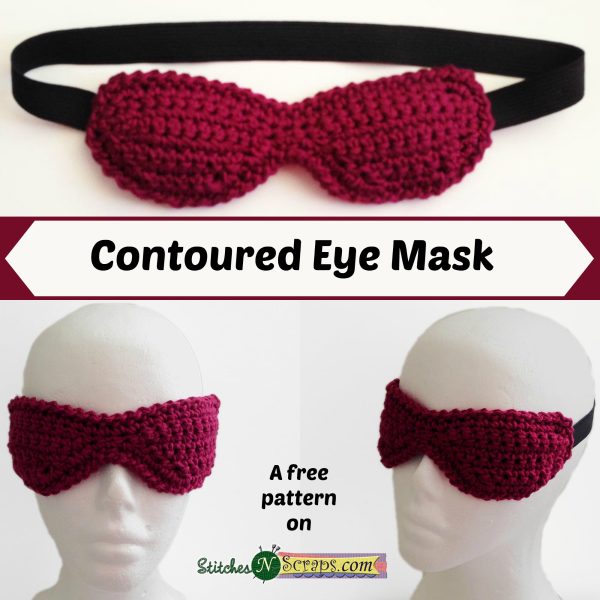
Contoured Eye Mask - a free crochet pattern on StitchesNScraps.com

Free Pattern – Contoured Eye Mask

The Spa Basket Crochet Along is in full swing, and this is the 5th pattern! Visit the Spa Basket CAL main page for more details, and be sure to join in the fun on Facebook and Ravelry! (Note: You need to join or be a member of the Crochet Playground group on Facebook in order to get to the Facebook event).

This week’s featured sponsor is Red Turtle and the Plant Spirits. This wonderful Etsy store carries all sorts of things you may want to add to your basket! They have balms and salves, herbal sleep pillows, and a wide variety of herbal tinctures for every occasion. One lucky winner will be winning a Restful Sleep prize package from Red Turtle, containing an herbal sleep pillow and Restful Slumber tincture. The winner will even get to choose the fabric for their pillow. My favorite is the green polka dots – what’s your favorite?  Be sure to enter the giveaway for your chance to win!

Red Turtle Plant Spirit - #SpaBasketCAL - StitchesNScraps.com


And now, for the pattern!

Settle in for a relaxing nap with this contoured eye mask. It’s made with 2 layers of single crochet in a tight gauge, to minimize gaps and block out light. For a more comfortable fit, short rows are used to create curved pockets over each eye. The instructions include options for either an elastic strap, or crocheted ties.

Contoured Eye Mask - a free crochet pattern on StitchesNScraps.com


This pattern is protected by copyright. Please do not distribute or share this pattern in any way other than by sharing a link to this page or to the pattern page on Ravelry. Click here for copyright information.

This pattern contains affiliate links (click for more info). If you click one of these links and then make a purchase, I may be compensated. You get the same great prices, and you will be helping to support this site!

Contoured Eye Mask

4-medium 
Add this to your Ravelry Queue

Materials:

Difficulty:

Intermediate – short rows, some working into sides of stitches for edging.

Sizes:

Adult – one size fits most.

Gauge:

13 sc x 14 rows = 4 inches. Mask works up quickly, so you can just use the first mask piece as a swatch – it should measure about 7.5 x 3.25 inches.

Abbreviations used:

  • ch = chain
  • sc = single crochet
  • sc2tog = single crochet 2 stitches together
  • sl st = slip stitch
  • st(s) = stitch(es)
  • sp(s) = space(s)

Recommended Resources:

Instructions:

Mask (make 2):

Ch 24 loosely.

Row 1 (RS): 2 sc in 2nd ch from hook, sc in next 21 chs, 2 sc in last ch (25 sc). Mark the first st of this row for later joining.

First Eye:

Row 2a: Ch 1, turn, sc in first 10 sts, sl st in next st, leaving 14 sts unworked (10 sc)

Row 3a: Ch 1, turn, sc in sl st, sc in next 8 sts, sl st in next st, leaving last st unworked.  (9 sc)

Row 4a: Ch 1, turn, sc in sl st, sc in next 8 sts, sc2tog in next st and next unworked st from row 2a. (10 sc)

Row 5a: Ch 1, turn, sc2tog, sc in next 7 sts, sc2tog in next st and unworked st from row 3a. (9 sc)

Row 6a: Ch 1, turn, sc2tog, sc in next 5 sts, sc2tog. (7 sc)

Row 7a: Ch 1, turn, sc2tog, sc in next 3 sts, sc2tog. (5 sc)

Fasten off.

Second Eye:

Join yarn in 1st st from row 1 (marked st).

Row 2b: Ch 1, turn, sc in first 10 sts, sl st in next st, leaving 2 sts unworked (10 sc)

Rows 3b – 7b: Repeat as for rows 3a – 7a. Do not fasten off.

Edging (RS):

  • Working in sides of rows along outside edge of second eye: ch 1, work 7 sc evenly spaced to top corner. (7 sc)
  • Working in bottom of foundation chain: Ch 1, sc in each st across. (23 sc)
  • Working in sides of rows along outside edge of first eye: ch 1, work 7 sc evenly spaced to corner. (7 sc)
  • Working in stitches from row 7a: Do not chain, sc in each st across. (5 sc).
  • Working in sides of rows along inside edge of first eye: Do not chain, work 7 sc evenly spaced along edge. (7 sc)
  • Sc in unworked stitch from the middle of row 1 (1 sc)
  • Working in sides of rows along inside edge of second eye: Do not chain, work 7 sc evenly spaced along edge. (7 sc)
  • Working in stitches from row 7b: Do not chain, sc in each st across. Join with sl st to first st of edging. Fasten off. (5 sc).

Note: Mask piece should measure approximately 7.5 x 3.25 inches at this point. 

Mask Pieces - Contoured Eye Mask - a free crochet pattern on StitchesNScraps.com

Assembly:
  • Optional elastic band: If using an elastic band, sew this into place before joining the mask pieces. Overlap the edge of the mask by a half inch on each side. Sew down securely on the wrong side of the mask, matching the thread color to the mask so it doesn’t show. Try to avoid sewing into the very edge of the stitches, as you will use those for the joining round.  Do not knot/finish off your thread – leave enough to tack down the 2nd piece over the top of the elastic after joining.

Sewing on band - Contoured Eye Mask - a free crochet pattern on StitchesNScraps.com

  • Joining: Hold masks with WS together so that the edges line up. Join yarn with sl st in any corner. Working through both thicknesses, (sl st, ch 1, sl st) in each st around. If you used elastic, when you get to that section, work through the front mask piece only across the elastic band. Continue working through both pieces after you pass the band.

Working around band - Contoured Eye Mask - a free crochet pattern on StitchesNScraps.com

  • If you used the elastic band, with your remaining thread, sew top layer down over the elastic band to secure. This time, sew close to the edge. Fasten off thread and sew in end.
  • Optional ties: If you didn’t use the elastic band, join yarn with a sl st in ch sp at outside edge (where you want the tie to be). Ch 60, sl st in back bump of 2nd ch from hook and in each ch across, sl st in next ch sp at outside edge of mask, fasten off. Repeat for other side of mask.

Ties - Contoured Eye Mask - a free crochet pattern on StitchesNScraps.com


I hope you enjoy the pattern. Thanks to MixedKreations, chickfromleeds, Kristinlovesyarn & Kairyna for testing the pattern!

A downloadable pdf of this pattern is also available on Ravelry, for a fee. The fee for the pdf format is to offset the advertising revenue lost when you print or download the pattern rather than viewing it online.

If you would like to receive notifications of new posts and patterns as they become available, please follow this blog. You can follow by e-mail (look at the sidebar on the right for the follow by email option), or via RSS feed, or via your WordPress.com reader: Follow Stitches ‘N’ Scraps on WordPress.com-

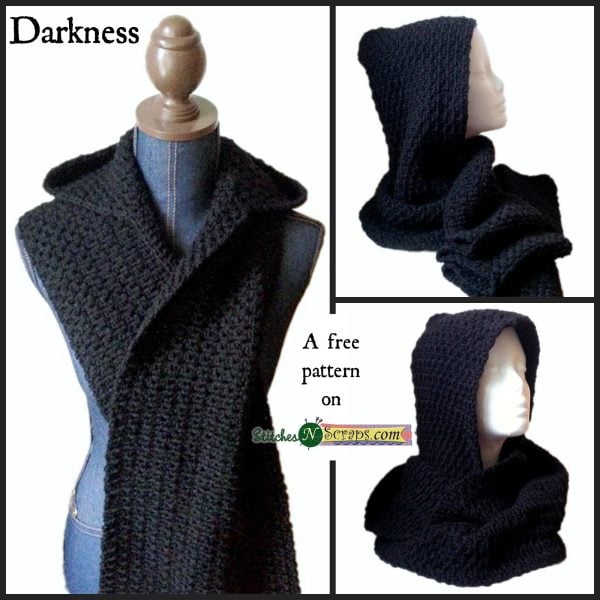
Darkness - A free pattern on StitchesNScraps.com

Free Pattern – Darkness

Sometimes you just want to wrap yourself up in darkness. Unfortunately, black or dark colored yarns can be difficult to work with, because it’s hard to see the stitches. The softer and fuzzier the black yarn is, the harder it is to see.  Well now you can get your softest, snuggliest, blackest yarns out, because this hooded scarf pattern was designed just for them!

Darkness - A free pattern on StitchesNScraps.com

Why does this pattern work well for black yarn? First, the construction is different from most hooded scarves. With this design, there’s no need to work into the edge of the scarf to create the hood. Second, except for the foundation row and the edge stitches, you’ll always be working into chain spaces. This makes it much easier to find where to put your hook. Even with all the chain spaces, it’s not an open and lacy design. The stitch pattern creates a soft, squishy fabric with an interesting texture, and the spaces are hardly visible once finished. It would of course work up easily in other colors too. 


This pattern is protected by copyright. Please do not distribute or share this pattern in any way other than by sharing a link to this page or to the pattern page on Ravelry. Click here for copyright information.

This pattern contains affiliate links (click for more info). If you click one of these links and then make a purchase, I may be compensated. You get the same great prices, and you will be helping to support this site!

Darkness

4-medium 
Add this to your Ravelry Queue

Materials:

  • 720 yds worsted weight, black yarn (see Size for more info)
  • Size J / 10 (6 mm) hook or size needed to obtain gauge
  • Yarn or Tapestry needle
  • 2 Locking stitch markers
  • Small scrap of white or light colored yarn or thread
  • Optional – 4-5 yds of light colored scrap yarn or dental floss to use as a running stitch marker.


Difficulty:

Easy – almost all single crochet and chains, and almost all worked into chain spaces instead of stitches.

Sizes:

Adult – one size fits most. Hood is approximately 12 inches tall (top to bottom) and 9 inches deep (front to back). Scarf can be made to any length desired. Yardage listed made a scarf of 157 rows on each side (including the hood), for a total length of about 86 inches.

Gauge:

13 sc x 14 rows = 4 inches. You can use the first few rows as a swatch – after row 14, work should measure approximately 20.5 x 4 inches.

Abbreviations used:

  • ch = chain
  • sc = single crochet
  • hdc = half double crochet
  • sl st = slip stitch
  • st(s) = stitch(es)
  • sp(s) = space(s)


Recommended Resources:


 Notes:

  • To avoid having to work into the sides of rows, which can be hard to see on black yarn, this scarf has a unique construction. It starts in the middle, at the back of the hood. First you work in one direction all the way to the end of the scarf, then come back to the middle again and work in the other direction.
  • Weaving a scrap piece of yarn back and forth as a running stitch marker can be helpful for counting the rows. See the tutorial here: Tutorial – Continuous rounds and running stitch markers
  • The pattern is provided in both written and charted formats. These are the same pattern, you only need to work one or the other.
  • Until you actually sew the hood together, there is no right or wrong side.


 Instructions:

(Jump to Chart)

First Half:

Note: Be sure to count your rows, so you can make the other side of the scarf the same length. Weaving a scrap piece of yarn back and forth as a running stitch marker can be helpful for counting the rows. See the tutorial here: Tutorial – Continuous rounds and running stitch markers

Hood:

Ch 70 loosely.

Row 1 (RS): Sc in 2nd ch from hook, (ch 1, sk next ch, sc in next 2 chs) across to last 2 chains, ch 1, sk next ch, sc in last ch. Place marker in the last ch you worked into, for later joining. (46 sts, 23 sps).

Row 2: Ch 1, turn, sc in first st, sc in next sp, (ch 1, sk next 2 sts, 2 sc in next sp) across to last st, ch 1, hdc in last st. (47 sts, 23 sps)

Row 3: Ch 1, turn, sc in first st, ch 1, 2 sc in next sp, (ch 1, sk next 2 sts, 2 sc in next sp) across to last 2 sts, ch 1, sk next st, sc in last st. (48 sts, 24 sps)

Row 4: Repeat row 2 (49 sts, 24 sps)

Row 5: Repeat Row 3 (50 sts, 25 sps)

Row 6: Repeat row 2 (51 sts, 25 sps)

Row 7: Ch 1, turn, sc in first st, sc in next sp, (ch 1, sk next 2 sts, 2 sc in next sp) across to last 2 sts, ch 1, sk next st, sc in last st (51 sts, 25 sps)

Rows 8-31: Repeat Row 7.

Row 32: Ch 1, turn, sc in first st, sc in next sp, (ch 1, sk next 2 sts, 2 sc in next sp) 10 times, place marker in last sp made, (ch 1, sk next 2 sts, 2 sc in next sp) across to last 2 sts, ch 1, sk next st, sc in last st (51 sts, 25 sps).

Fasten off.

Work should now measure about 20″ x 9″

Scarf:

Join yarn with sl st in marked sp from Row 32, remove this marker.

Row 33: Ch 1, 2 sc in same sp, (ch 1, sk next 2 sts, 2 sc in next sp) 9 times, ch 1, sk next st, sc in last st. (21 sts, 10 sps)

Row 34: Repeat row 7 of hood. (21 sts, 10 sps).

Repeat row 34 until desired length is achieved. Fasten off. Make a note of how many rows you worked.

Second Half:

Hood:

Turn work upside down so you are working into the foundation chain / bottom of row 1. Join yarn with sl st in marked chain. This should be the first chain of the foundation, at the bottom of the hood. If you haven’t woven your tails in yet, this should also be where your starting tail is.

Joining for 2nd half - Darkness, a free pattern on StitchesNScraps.com

Note: The skipped chains from the foundation chain form chain spaces. These are the spaces you will be working into on row 1. 

Row 1 (RS): Sc in first st, sc in next sp, (ch 1, sk next 2 sts, 2 sc in next sp) 22 times, ch 1, hdc in last st. (47 sts, 23 sps)

Row 2: Ch 1, sc in first st, ch 1, 2 sc in next sp, (ch 1, sk next 2 sts, 2 sc in next sp) across to last 2 sts, ch 1, sk next st, sc in last st. (48 sts, 24 sps)

Row 3: Ch 1, turn, sc in first st, sc in next sp, (ch 1, sk next 2 sts, 2sc in next sp) across to last st, ch 1, hdc in last st. (49 sts, 24 sps)

Row 4: Repeat row 2 (50 sts, 25 sps)

Row 5: Repeat Row 3 (51 sts, 25 sps)

Row 6: Ch 1, turn, sc in first st, sc in next sp, (ch 1, sk next 2 sts, 2 sc in next sp) across to last 2 sts, ch 1, sk next st, sc in last st (51 sts, 25 sps)

Rows 7-32: Repeat Row 6. Do not fasten off.

Scarf:

Row 33: Ch 1, turn, sc in first st, sc in next spc, (ch 1, sk next 2 sts, 2 sc in next sp) 9 times, ch 1, sk next st, sc in last st. (21 sts, 10 sps)

Row 34: Repeat row 6 of hood. (21 sts, 10 sps).

Repeat row 34 for the same number of rows as you worked on the first half.

Fasten off.

Chart:

(Back to Written Instructions)

Darkness - A free crochet pattern on StitchesNScraps.com
Click image to enlarge

Finishing:

(for both written and charted versions)

  • Fold in half along foundation chain, and sew the top of the hood together.
  • Weave in all ends.
  • Take the scrap of light colored yarn and weave it into the seam on the inside of the hood, so you can’t see it from the outside. Why? Because in every darkness, there is a little light if you only know where to look.


fold and seam - Darkness - A free pattern on StitchesNScraps.com


Darkness - A free pattern on StitchesNScraps.comI hope you enjoy the pattern. Big thanks to wilmaelee for tech editing it!

A downloadable pdf of this pattern is also available in my Craftsy store or on Ravelry, for a fee. The fee for the pdf format is to offset the advertising revenue lost when you print or download the pattern rather than viewing it online.

If you would like to receive notifications of new posts and patterns as they become available, please follow this blog. You can follow by e-mail (look at the sidebar on the right for the follow by email option), or via RSS feed, or via your WordPress.com reader: Follow Stitches ‘N’ Scraps on WordPress.com-

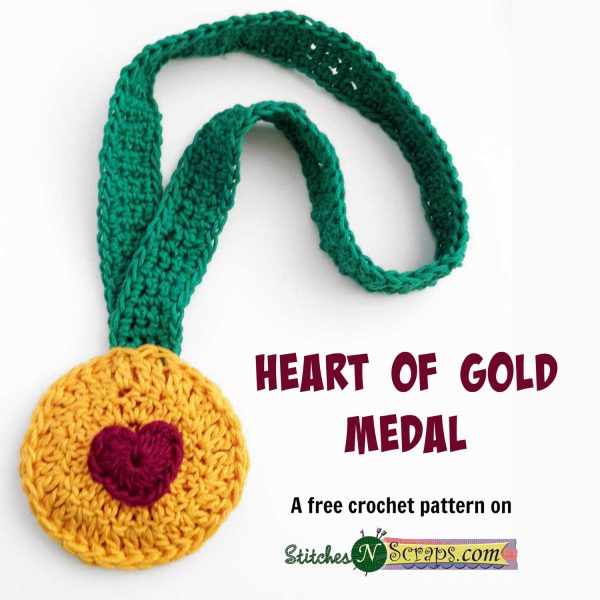
Heart of Gold Medal - a free pattern on StitchesNScraps.com

Free Pattern – Heart of Gold Medal

This pattern came about from a conversation about the cyber-bullying that Gabby Douglas had to deal with during this year’s Olympics. No matter what critics (or even fans) might say, you know what really matters is what’s in your heart. If you know someone who has a heart of gold, show them you see it with this special gold medal.

Heart of Gold Medal - a free pattern on StitchesNScraps.com


This pattern is protected by copyright. Please do not distribute or share this pattern in any way other than by sharing a link to this page or to the pattern page on Ravelry. Click here for copyright information.

This pattern contains affiliate links (click for more info). If you click one of these links and then make a purchase, I may be compensated. You get the same great prices, and you will be helping to support this site!

Heart of Gold Medal

4-medium 
Add this to your Ravelry Queue

Materials:

  • Worsted weight yarn:
    • 50 yds green
    • 25 yds gold
    • 5-10 yds red
  • Size I / 9 (5.5 mm) hook or size needed to obtain gauge
  • Yarn or Tapestry needle

Difficulty:

Easy – Basic stitches, each piece worked separately and then seamed.

Size:

Medal is about 3.75 inches in diameter, cord is about 28 inches long.

Gauge:

Use first medal piece as gauge swatch – should be about 3.75 inches in diameter. Gauge is not critical for this pattern.

Abbreviations used:

  • ch = chain
  • sc = single crochet
  • hdc = half double crochet
  • dc = double crochet
  • sl st = slip stitch
  • st(s) = stitch(es)
  • sp(s) = space(s)
  • rnd = round
  • WS = wrong side
  • RS = right side

Recommended Resources:

Notes:

  • Join rounds where indicated, with a slip stitch into the first stitch of the round.
  • Ch 3 at the beginning of a round counts as first dc.

 Instructions:

Medal:

First half:

Rnd 1 (RS): With gold, work 12 dc inside a magic circle, join. (12 sts)

OR Alternate Rnd 1: With gold, ch 4, 11 dc in 4th ch from hook, join. (12 sts)

Rnd 2: Ch 3, turn, dc in first st, 2 dc in each st around, join. (24 sts)

Rnd 3: Ch 3, turn, dc in first 2 sts, (2 dc in next st, dc in next st) 11 times, join. Fasten off (36 sts).

Weave in tails

Second half:

Repeat instructions for first half. When fastening off, leave a long tail (about 24-36 inches) for sewing. Only weave in the starting tail.

Heart (make 2):

With red, inside a magic circle work (ch 2, 4 dc, 3 hdc, dc, 3 hdc, 4 dc, ch 2, sl st), do not join. Fasten off, leaving a 12-18 inch tail for sewing. Pull magic circle closed tightly.

OR Alternate Version: Ch 4, join to make a circle. Inside the circle, work (4 dc, 3 hdc, dc, 4 hdc, dc, 3 hdc, 4 dc, ch 2, sl st), do not join. Fasten off, leaving a 12-18 inch tail for sewing.

Weave in starting tail

Medal Pieces - Heart of Gold Medal - a free pattern on StitchesNScraps.com

Cord:

Row 1: With green, ch 4, sc in 2nd ch from hook and in each ch across. (3 sc)

Rows 2-95: Ch 1, turn, sc in each st across (3 sc).

Note: To adjust the length, work more or fewer rows as desired.

Edging:

  • Ch 1, do not turn, working in sides of rows, sc in each row.
  • Ch 1, working across short end, sc in each st across (3 sc)
  • Ch 1, working in sides of rows, sc in each row
  • Ch 1, working across short end, sc in each st across (3 sc)
  • Ch 1, join, fasten off.

Gold Tab: Hold the cord ends together, with a half twist in the cord so that it lays flat when worn.  The easiest way to do this is to actually put it around your neck so it’s nice and flat, hold or pin the ends together, and take it off.  Working through both thicknesses, join gold in corner chain space, ch 3, dc in next 3 sts, dc in corner ch sp, fasten off.

  Joining Gold - Heart of Gold Medal - a free pattern on StitchesNScraps.com    Cord - Heart of Gold Medal - a free pattern on StitchesNScraps.com

Weave in tails.

Assembly:

  • With right sides up, place a heart on center of a medal piece. Using the red tail, sew heart into place with a running stitch around the entire edge (just under the tops of the stitches). Repeat for the other heart and medal piece.

medal with heart

  • Hold medal pieces with wrong sides together, making sure the hearts are oriented the same way on both sides. Using yellow tail, sew medal pieces together with a running stitch around the edge, stopping 2 stitches away from the center top.
  • Insert  gold tab of ribbon between the two medal pieces as shown below. Now sewing through all pieces, continue to sew around.

insert tab

  • Optional: For extra stability, once you have sewn all the way around, turn and sew around again in the other direction.
  • Weave in any remaining tails.

I hope you enjoy the pattern. Thanks to Wilmaelee and Reshanda for testing it!

A downloadable pdf of this pattern is also available on Ravelry, for a fee. The fee for the pdf format is to offset the advertising revenue lost when you print or download the pattern rather than viewing it online.

If you would like to receive notifications of new posts and patterns as they become available, please follow this blog. You can follow by e-mail (look at the sidebar on the right for the follow by email option), or via RSS feed, or via your WordPress.com reader: Follow Stitches ‘N’ Scraps on WordPress.com-

Anemone Security Blanket - a free pattern on StitchesNScraps.com

Free Pattern – Anemone

This pattern contains Sponsored content and affiliate links (click for more info). If you click one of these links and then make a purchase, I may be compensated. You get the same great prices, and you will be helping to support this site!

After making my Seahorse Teether pattern, I had quite a bit of yarn left, so I made this blanket to go with it. The design is reversible, and was inspired by pictures of “flower” anemones.

Anemone Security Blanket - a free pattern on StitchesNScraps.com

This pattern is made in Red Heart Baby Hugs yarn, which I received free from Red Heart. Baby Hugs yarn is tested to be free from harmful levels of over 300 substances!


This pattern is protected by copyright. Please do not distribute or share this pattern in any way other than by sharing a link to this page or to the pattern page on Ravelry. Click here for copyright information.

Anemone

4-medium 3-light_3L
Add this to your Ravelry Queue

Materials:

  • 175-180 yds Red Heart Baby Hugs Medium – Aloe
  • 300 yds Red Heart Baby Hugs Light – Peachie
  • Size I / 9 (5.5 mm) hook or size needed to obtain gauge
  • Yarn or Tapestry needle

Difficulty:

Intermediate – Basic stitches worked in the round. While the stitches themselves aren’t difficult, keeping track of the stitch counts and repeats requires some attention, particularly in the later rounds.

Size:

About 28 inches in diameter

Gauge:

With lighter weight yarn, 15 dc x 6.5 rows = 4 inches. After rnd 4, your circle should measure about 4 inches in diameter. Exact gauge is not critical, except that you may run out of yarn if your gauge is looser.

Abbreviations used:

  • ch = chain
  • sc = single crochet
  • hdc = half double crochet
  • dc = double crochet
  • sl st = slip stitch
  • st(s) = stitch(es)
  • sp(s) = space(s)
  • rnd = round
  • WS = wrong side
  • RS = right side

Recommended Resources:

Notes:

  • This pattern works because one yarn is thicker than the other. If you try to do this pattern all in one weight of yarn, it will pucker.
  • Join rounds where indicated, with a slip stitch into the first stitch of the round.
  • Ch 3 at the beginning of a round counts as first dc.
  • If you run out of yarn early, you can stop after rnd 36 without changing colors. Work rnd 37 in Aloe, and then skip to rnd 41 to finish the ruffle.
  • Carrying yarn / changing colors:
    • Do not cut Peachie yarn when changing colors. Instead, carry it up for the next round.
    • For the Aloe yarn, you can either cut it and weave in the end each time, or try to carry it up neatly, weaving it into your chains as you chain up for each round. Remember the blanket is two sided though, so only carry the Aloe yarn if you can make it look neat on both sides.

 Instructions:

Rnd 1 (RS): With Peachie, work 12 dc inside a magic circle, join. (12 sts)

OR Alternate Rnd 1: With Peachie, ch 4, 11 dc in 4th ch from hook, join. (12 sts)

Rnd 2: Ch 3, turn, dc in first st, 2 dc in each st around, join, changing to Aloe. (24 sts)

Rnd 3: With Aloe, ch 1, turn, (sc, ch 1, sk next st) around, join, changing to Peachie. (12 sts, 12 sps).

Rnd 4: With Peachie, ch 1, turn, 3 sc in each sp around. (36 sts)

Rnd 5: Ch 3, turn, dc in first 3 sts, (2 dc in next st, dc in next 2 sts) 11 times, join, changing to Aloe. (48 sts)

Rnd 6: Repeat Rnd 3. (24 sts, 24 sps)

Rnd 7: With Peachie, ch 1, turn, (2 sc in next sp, 3 sc in next sp) 12 times, join. (60 sts)

Rnd 8: Ch 3, turn, dc in first 5 sts, (2 dc in next st, dc in next 4 sts) 11 times, join, changing to Aloe. (72 sts)

Rnd 9: Repeat Rnd 3. (36 sts, 36 sps)

Rnd 10: With Peachie, ch 1, turn, (2 sc in next sp, 3 sc in next sp, 2 sc in next sp) 12 times, join. (84 sts)

Rnd 11: Ch 3, turn, dc in first 7 sts, (2 dc in next st, dc in next 6 sts) 11 times, join, changing to Aloe. (96 sts)

Rnd 12: Repeat Rnd 3. (48 sts, 48 sps)

Rnd 13: With Peachie, ch 1, turn, (2 sc in each of next 2 sps, 3 sc in next sp, 2 sc in next sp) 12 times, join. (108 sts)

Rnd 14: Ch 3, turn, dc in first 9 sts, (2 dc in next st, dc in next 8 sts) 11 times, join, changing to Aloe. (120 sts)

Rnd 15: Repeat Rnd 3. (60 sts, 60 sps)

Rnd 16: With Peachie, ch 1, turn, (2 sc in each of next 2 sps, 3 sc in next sp, 2 sc in each of next 2 sps) 12 times, join. (132 sts)

Rnd 17: Ch 3, turn, dc in first 11 sts, (2 dc in next st, dc in next 10 sts) 11 times, join, changing to Aloe. (144 sts)

Rnd 18: Repeat Rnd 3. (72 sts, 72 sps)

Rnd 19: With Peachie, ch 1, turn, (2 sc in each of next 3 sps, 3 sc in next sp, 2 sc in each of next 2 sps) 12 times, join. (156 sts)

Rnd 20: Ch 3, turn, dc in first 13 sts, (2 dc in next st, dc in next 12 sts) 11 times, join, changing to Aloe. (168 sts)

Rnd 21: Repeat Rnd 3. (84 sts, 84 sps)

Rnd 22: With Peachie, ch 1, turn, (2 sc in each of next 3 sps, 3 sc in next sp, 2 sc in each of next 3 sps) 12 times, join. (180 sts)

Rnd 23: Ch 3, turn, dc in first 15 sts, (2 dc in next st, dc in next 14 sts) 11 times, join, changing to Aloe. (192 sts)

Rnd 24: Repeat Rnd 3. (96 sts, 96 sps)

Rnd 25: With Peachie, ch 1, turn, (2 sc in each of next 4 sps, 3 sc in next sp, 2 sc in each of next 3 sps) 12 times, join. (204 sts)

Rnd 26: Ch 3, turn, dc in first 17 sts, (2 dc in next st, dc in next 16 sts) 11 times, join, changing to Aloe. (216 sts)

Rnd 27: Repeat Rnd 3. (108 sts, 108 sps)

Rnd 28: With Peachie, ch 1, turn, (2 sc in each of next 4 sps, 3 sc in next sp, 2 sc in each of next 4 sps) 12 times, join. (228 sts)

Rnd 29: Ch 3, turn, dc in first 19 sts, (2 dc in next st, dc in next 18 sts) 11 times, join, changing to Aloe. (240 sts)

Rnd 30: Repeat Rnd 3. (120 sts, 120 sps)

Rnd 31: With Peachie, ch 1, turn, (2 sc in each of next 5 sps, 3 sc in next sp, 2 sc in each of next 4 sps) 12 times, join. (252 sts)

Rnd 32: Ch 3, turn, dc in first 21 sts, (2 dc in next st, dc in next 20 sts) 11 times, join, changing to Aloe. (264 sts)

Rnd 33: Repeat Rnd 3. (132 sts, 132 sps)

Rnd 34: With Peachie, ch 1, turn, (2 sc in each of next 5 sps, 3 sc in next sp, 2 sc in each of next 5 sps) 12 times, join. (276 sts)

Rnd 35: Ch 3, turn, dc in first 23 sts, (2 dc in next st, dc in next 22 sts) 11 times, join, changing to Aloe. (288 sts)

Rnd 36: Repeat Rnd 3. (144 sts, 144 sps)

Rnd 37: With Peachie, ch 1, turn, (2 sc in each of next 6 sps, 3 sc in next sp, 2 sc in each of next 5 sps) 12 times, join. (300 sts)

Rnd 38: Ch 3, turn, dc in first 27 sts, (2 dc in next st, dc in next 24 sts) 11 times, join, changing to Aloe. Fasten off Peachie. (312 sts)

Rnd 39: With Aloe, ch 1, turn, (sc, ch 1, sk next st) around, join. (156 sts, 156 sps)

Rnd 40: Ch 1, turn, (2 sc in each of next 6 sps, 3 sc in next sp, 2 sc in each of next 6 sps) 12 times, join. (324 sts)

Rnd 41: Ch 3, turn, 2 dc in each st around. Fasten off.  (648 sts)

Sew in all tails.


I hope you enjoy the pattern. Special thanks to Red Heart for providing the beautiful yarn, and to Roe Russell, OnceUponAYarn, & Kristinlovesyarn for testing the pattern!

A downloadable pdf of this pattern is also available on Ravelry, for a fee. The fee for the pdf format is to offset the advertising revenue lost when you print or download the pattern rather than viewing it online.

If you would like to receive notifications of new posts and patterns as they become available, please follow this blog. You can follow by e-mail (look at the sidebar on the right for the follow by email option), or via RSS feed, or via your WordPress.com reader: Follow Stitches ‘N’ Scraps on WordPress.com-

Caterpillar Scrubby Set

Caterpillar Crochet Scrubby Set

Quick and easy mini scrubbies combine to form this cute caterpillar crochet scrubby set, perfect for gifting! Each scrubby takes only a few minutes to make and has a convenient finger strap. These little pads have loads of scrubbing power, and dry quickly too!

Caterpillar Crochet Scrubby Set

This content is protected by copyright. See this Terms of Use / Copyright page for more information.

This post contains sponsored content and/or affiliate links. If you click an affiliate link and make a purchase, I may get a commission.


Red Heart Scrubby Yarn

These scrubbies are made with two types of Red Heart Scrubby yarns, which I received free from Red Heart for this design. I used Scrubby Sparkle in Lemon, and regular Scrubby in Green Tea. There are so many fun color combinations to try!

The regular scrubby yarn is great in the kitchen or as an exfoliating bath scrubber. The sparkle version is shiny and fun – I feel like it’s a little rougher and would be great for those really tough scouring jobs.


Caterpillar Scrubby Set

4-medium
Project level Intermediate

Yarn weight and project level images source: Craft Yarn Council

Add this to your Ravelry Queue

Materials

  • 100 yds Red Heart Scrubby and/or Red Heart Scrubby Sparkle – 100% Polyester yarn (174 yds / 3 oz / 85 g per skein)
  • Size 9 / 5.5 mm crochet hook or size needed to obtain desired texture
  • 2 -3 pipe cleaners
  • Yarn or Tapestry needle

Project Level

Intermediate: Instructions are easy, but textured yarn makes it more difficult to see stitches.

Size

About 6-8 inches long when complete. Size will vary depending on your gauge and how many scrubber pads you make.

Gauge

14 sc x 13 rows = 4 inches. Gauge is not particularly important for this pattern. Use a hook that gives you a texture / stiffness that you like for the scrubbies. If you’re using both Scrubby and Scrubby Sparkle, you may even want to use different hooks for each.

Abbreviations used

This pattern uses US terms.

  • ch = chain
  • sc = single crochet
  • hdc = half double crochet
  • dc = double crochet
  • dc2tog = double crochet next 2 stitches together
  • sl st = slip stitch
  • st(s) = stitch(es)
  • sp(s) = space(s)
  • rnd = round
  • RS = right side

Recommended Resources

Instructions

Scrubby (Make 6-8 as desired)

Rnd 1 (WS): Ch 4, 11 dc in 4th ch from hook (3 skipped chs count as first dc), join with sl st in first st. (12 dc)

Rnd 2: Ch 3 (counts as dc throughout), dc in first st, 2 dc in each st around. (24 dc)

Rnd 3: Ch 1, sc in first 12 sts, ch 10 (strap), flip work over so strap lays across RS of work, sl st in first st of round,

Caterpillar Crochet Scrubby Set

ch 1, turn, hdc in each of 10 chs just made (strap made), flip work over to continue on WS,

Caterpillar Crochet Scrubby Set

flip work back over to continue on the WS, sc in remaining 12 sts from rnd 2, sl st in side of strap,

Caterpillar Crochet Scrubby Set

join with sl st to first sc of round. (24 sc around, 10 hdc on strap)

Caterpillar Crochet Scrubby Set
Round 3, RS - Caterpillar Scrubby Set - A free crochet pattern on StitchesNScraps.com

Weave in starting tail (it will become inaccessible later)

Rnd 4: Ch 1 (does not count as a stitch), ignoring strap, sk first st, dc in next st, dc2tog 11 times, join. (12 sts)

Rnd 5: Ch 2, sk first st, dc in next st, dc2tog 5 times, fasten off. (6 sts)

Use tails to sew holes closed, then weave in ends.

Assembly

Slide scrubbies onto a pipe cleaner in desired order, making sure that the scrubbies on the ends have their straps facing the scrubby next to them (you shouldn’t see any straps). Leave about 2 inches of pipe cleaner unused at the back end.

String scrubbies onto pipe cleaner - Caterpillar Scrubby Set - A free crochet pattern on StitchesNScraps.com

Fold over one end of pipe cleaner (back of caterpillar) and tuck it inside to secure.

Fold over end - Caterpillar Scrubby Set - A free crochet pattern on StitchesNScraps.com

Trim other end of pipe cleaner to about 2 inches, and fold it over in the same way. Try to get it as tight as possible, but don’t worry if there’s a little give – That will allow for more shaping.

Cut a 5 inch piece of pipe cleaner. Insert it through top of front scrubby and curl ends around a pencil to form antennae.

Cut two 2-inch pieces of pipe cleaner for the eyes. On each piece, roll one end around an embroidery needle as shown, leaving a small, uncurled bit at the end. Attach eyes to front scrubby by inserting the straight end.

Making eyes - Caterpillar Scrubby Set - A free crochet pattern on StitchesNScraps.com

Optional: Cut 3-inch pieces of pipe cleaner for legs, thread them through the bottoms of the scrubbies, and shape into feet. Be sure to fold over any sharp ends.

Making legs - Caterpillar Scrubby Set - A free crochet pattern on StitchesNScraps.com

 To remove scrubbies for use, pull out back end of pipe cleaner, and slide them off from the back. Remove any pipe cleaner pieces before using scrubby. 

Share this caterpillar crochet scrubby set pattern on Pinterest!

Here’s an image perfect for pinning.

Caterpillar Crochet Scrubby Set

Rate this caterpillar crochet scrubby set pattern!


I hope you enjoyed this pattern! A downloadable pdf of is available on Ravelry for a small fee.

Do you want the best of Stitches n Scraps delivered right to your inbox? Don’t miss a stitch – Subscribe now!