Free Crochet Patterns
Find the perfect, free crochet pattern for your next project! Browse them all, or select a category from the dropdown menu. Where will your creativity take you today?

It’s Fall Y’all Shawl Crochet Pattern
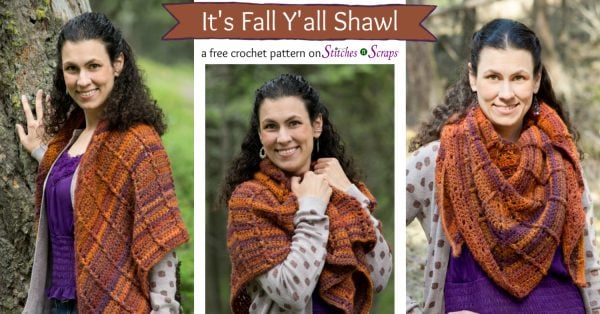
It’s fall, y’all! Wrap yourself in this fall shawl, with self-striping yarn in the colors of the season. Or opt for a solid color to highlight the lacy, cabled texture. Either way, the It’s Fall Y’all Shawl will take you into autumn in style.

Big thanks to Kirsten Holloway for the stunning photography and modeling!
This content is protected by copyright. See this Terms of Use / Copyright page for more information.
This post contains sponsored content and/or affiliate links. If you click an affiliate link and make a purchase, I may get a commission.
Universal Yarns Classic Shades
The sample is shown in Universal Yarns Classic Shades yarn, in Sundown (#706). This lovely, worsted weight yarn is a combination of 70% acrylic and 30% wool. Unfortunately, it now seems to be discontinued.
Other Yarn Options
Any worsted-weight yarn should work for this pattern. I recommend wool or a wool blend. Subtle striping like the sample yarn gives a nice effect. Anything busier, like a variegated yarn or a yarn with more dramatic color changes, may obscure the cable pattern.
In the Universal Yarns line, Delux Worsted Superwash (solid or tweed) would be a great option. For a more luxurious feel, try Cassatt – a blend of alpaca, wool, nylon and viscose.
Starting Circle
There are a few different ways to make a starting ring or circle. For this pattern, I chose a circle of chains. I prefer this method over the magic loop in this case, because it allows the stitches to spread out more easily into the triangle shape. If you prefer to start with a magic loop, that will work as well. You may end up with a slight bump at the center top, but not enough to be noticeable.
Materials
- Yarn: 800 yds worsted weight yarn – Shown in Universal Yarns Classic Shades #706 – Sundown
- Hook: Size J / 6 mm hook, or size needed to match gauge
- Notions:
- Scissors
- Tapestry needle
Project Level
Intermediate: Post stitches, increasing in pattern, longer pattern repeat.
Size
32 inches tall from center top to bottom point; 70 inches wide across top. Size can be adjusted by working more/fewer rows.
Gauge
12 hdc x 10 rows = 4 inches after blocking.
Use pattern as gauge swatch – after row 8 your work should measure approximately 4 inches tall at center and 11 inches wide across top. Exact gauge is not critical but will affect yarn usage.
Abbreviations used
This pattern uses US terms.
- bpdc = back post double crochet
- ch = chain
- dc = double crochet
- fpdc = front post double crochet
- hdc = half double crochet
- RS = right side
- sc = single crochet
- sk = skip
- sp = space
- st(s) = stitch(es)
- WS = wrong side
Recommended Resources:
- 3 Ways to Start a Crochet Circle
- Front and Back Post Stitch Crochet on Jessie at Home
- Edging – Working Evenly Across/Around
Special Stitches
Cable (cable):
On RS rows: Ch 1, sk next st or sp, fpdc around next st, ch 1, sk next st or sp. (counts as 1 fpdc and 2 ch-1 sps in st counts at end of row)
On WS rows: Ch 1, sk next st or sp, bpdc around next st, ch 1, sk next st or sp. (counts as 1 bpdc and 2 ch-1 sps in st counts at end of row)
Center Cable (center cable):
On RS rows: Ch 2, fpdc around next (center) st, ch 2. (counts as 1 fpdc and 2 ch-2 sps in st counts at end of row)
On WS rows: Ch 2, bpdc around next (center) st, ch 2. (counts as 1 bpdc and 2 ch-2 sps in st counts at end of row)
Instructions:
Ch 4, sl st in 4th ch from hook to form a circle.
Top Center
Row 1 (WS): Ch 3 (counts as first dc throughout), (3 dc, ch 2, dc, ch 2, 4 dc) in circle. (9 dc, 2 ch-2 sps)
Row 2 (RS): Ch 3, turn, 2 hdc in first st, hdc in next 3 sts, hdc in next ch-2 sp, center cable (see Special Stitches) hdc in next ch-2 sp, hdc in next 3 sts, (2 hdc, dc) in last st. (2 dc, 12 hdc, 1 fpdc, 2 ch-2 sps)
Row 3: Ch 3, turn, 2 hdc in first st, hdc in next 6 sts, hdc in next ch-2 sp, center cable, hdc in next ch-2 sp, hdc in next 6 sts, (2 hdc, dc) in last st. (2 dc, 18 hdc, 1 bpdc, 2 ch-2 sps)
Row 4 (adding cables at edges): Ch 3, turn, 2 hdc in first st, cable, hdc in next 6 sts, hdc in next ch-2 sp, center cable, hdc in next ch-2 sp, hdc in next 6 sts, cable, (2 hdc, dc) in last st. (2 dc, 18 hdc, 3 fpdc, 4 ch-1 sps, 2 ch-2 sps)

Repeating Section 1
Rows 5 & 6: Ch 3, turn, 2 hdc in first st, hdc across to next ch-1 sp, [cable, hdc across to next ch-sp] to first ch-2 sp, hdc in ch-2 sp, center cable, hdc in next ch-2 sp, [hdc across to next ch-1 sp, cable] until you have skipped the last ch-1 sp, hdc across to last st, (2 hdc, dc) in last st. (2 dc, 30 hdc, 3 fpdc, 4 ch-1 sps, 2 ch-2 sps)
Row 7 (adding cables at center): Ch 3, turn, 2 hdc in first st, [hdc across to next ch-1 sp, cable] until you have skipped the last ch-1 sp before center st, hdc in next 6 sts, cable, hdc in next ch-2 sp, center cable, hdc in next ch-2 sp, cable, [hdc across to next ch-1 sp, cable] until you have skipped the last ch-1 sp, hdc across to last st, (2 hdc, dc) in last st (2 dc, 30 hdc, 5 bpdc, 8 ch-1 sps, 2 ch-2 sps)
Row 8 (adding cables at edges): Ch 3, turn, hdc in first st, ch 1, fpdc around next st, ch 1, sk next st, [hdc across to next ch-1 sp, cable] until you have skipped the last ch-1 sp before center, hdc in next st, hdc in next ch-2 sp, center cable, hdc in next ch-2 sp, [hdc across to next ch-1 sp, cable] until you have skipped the last ch-1 sp, hdc in next 6 sts, ch 1, sk next st, fpdc around next st, ch 1, (hdc, dc) in last st. (2 dc, 30 hdc, 7 fpdc, 12 ch-1 sps, 2 ch-2 sps)
Rows 9-11: Repeat Row 5. (2 dc, 48 hdc, 7 bpdc, 12 ch-1 sps, 2 ch-2 sps)
Repeating Section 2
Row 12 (adding cables at edges): Ch 4 (counts as first dc and ch-1) turn, fpdc around first st, ch 1, hdc across to next ch-1 sp, [cable, hdc across to next ch-sp] to first ch-2 sp, hdc in ch-2 sp, center cable, hdc in next ch-2 sp, [hdc across to next ch-1 sp, cable] until you have skipped the last ch-1 sp, hdc in next 6 sts, ch 1, sk next st fpdc around last st, ch 1, dc in same st. (2 dc, 48 hdc, 9 fpdc, 16 ch-1 sps, 2 ch-2 sps)
Row 13: Ch 3, turn, 2 hdc in first st, cable, hdc across to next ch-1 sp, [cable, hdc across to next ch-sp] to first ch-2 sp, hdc in ch-2 sp, center cable, hdc in next ch-2 sp, [hdc across to next ch-1 sp, cable] until you have skipped the last ch-1 sp, (2 hdc, dc) in last st. (2 dc, 54 hdc, 9 bpdc, 16 ch-1 sps, 2 ch-2 sps)
Rows 14-15: Repeat row 5. (2 dc, 66 hdc, 9 bpdc, 16 ch-1 sps, 2 ch-2 sps)

Repeating Section 3
Row 16 (adding cables at center): Repeat Row 7. (2 dc, 66 hdc, 11 fpdc, 20 ch-1 sps, 2 ch-2 sps)
Row 17 (adding cables at edges): Ch 3, turn, hdc in first st, ch 1, bpdc around next st, ch 1, sk next st, [hdc across to next ch-1 sp, [cable, hdc across to next ch-sp] to first ch-2 sp, hdc in ch-2 sp, center cable, hdc in next ch-2 sp, [hdc across to next ch-1 sp, cable] until you have skipped the last ch-1 sp, hdc in next 6 sts, ch 1, sk next st, bpdc around next st, ch 1, (hdc, dc) in last st. (2 dc, 66 hdc, 13 bpdc, 24 ch-1 sps, 2 ch-2 sps)
Rows 18-20: Repeat row 5. (2 dc, 84 hdc, 13 fpdc, 24 ch-1 sps, 2 ch-2 sps)
Row 21 (adding cables at edges): Ch 4 (counts as dc and ch-1) turn, bpdc around first st, ch 1, hdc across to next ch-1 sp, [cable, hdc across to next sp] to first ch-2 sp, hdc in ch-2 sp, center cable, hdc in next ch-2 sp, [hdc across to next ch-1 sp, cable] until you have skipped the last ch-1 sp, hdc in next 6 sts, ch 1, sk next st, bpdc around last st, ch 1, dc in same st. (2 dc, 84 hdc, 15 bpdc, 28 ch-1 sps, 2 ch-2 sps)
Row 22: Repeat Row 13. (2 dc, 90 hdc, 15 bpdc, 28 ch-1 sps, 2 ch-2 sps)
Repeats
Rows 23-47: Repeat rows 5-22, then repeat rows 5-11 once more. (2 dc, 192 hdc, 31 bpdc, 60 ch-1 sps, 2 ch-2 sps)
Note: To make your shawl larger, repeat rows 5-22 to desired length, stopping after any odd numbered (WS) row. This will change the number of stitches in the edging and the amount of yarn needed.
Edging:
- Ch 1, turn, 3 sc in first st, sc in each st and each sp across. (289 sc)
- Do not turn. Ch 1, working in sides of rows along top edge, 2 sc in each row across to center, 2 sc in center circle, 2 sc in each row across to end, join with sl st to first st of edging. (96 sc)
Finishing
Fasten off, weave in all ends. For best results, wash and block.
Share this Fall Shawl Crochet Pattern on Pinterest!
Here’s an image perfect for pinning.

Rate this Fall Shawl Crochet Pattern!
I hope you enjoy this fall shawl crochet pattern. A downloadable pdf of this pattern is available on Ravelry for a small fee. The fee for the pdf format offsets the advertising revenue lost when you print or download the pattern rather than viewing it online.
Do you want the best of Stitches n Scraps delivered right to your inbox? The Stitches n Scraps email newsletter includes highlights from the blog as well as special features not available elsewhere. Don’t miss a stitch – Subscribe now!

Free Pattern – Jazzberry Baby Blanket
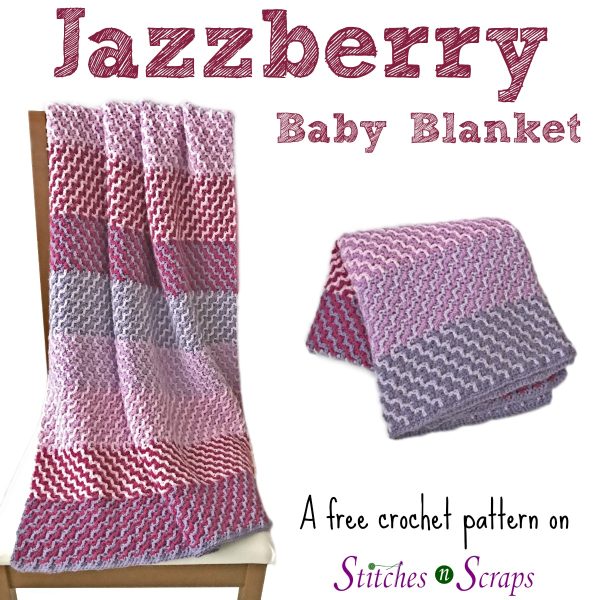
Jazz up baby’s room with the fun and squishy Jazzberry Baby Blanket! Intermeshing crochet, using 2 strands at once, creates a plush feel and eye catching, zig-zag texture. The colors shift through a spectrum of pinks and purples, and each time a color changes, the zig-zag pattern changes direction as well.
This pattern was originally released as a crochet along. See the main Jazzberry CAL post for more information and tips!

This is an experienced skill level pattern because of the intermeshing crochet. If you’ve never tried intermeshing crochet before, this would be a great project to learn on. My Intermeshing Crochet Basics tutorial will help you get started!
The sample is shown in Paintbox Simply DK yarn, which I received for free from Love Crafts for this design. I used the Bella Coco Ombre Pack in Raspberry. This 5 skein pack contains the colors Candyfloss Pink (149), Dusty Rose (141), Tea Rose (142), Dusty Lilac (146) and Raspberry Pink (143)
This pattern contains affiliate advertisements (click for more info). If you click one of these advertisements and then make a purchase, I may be compensated. You get the same great prices, and you will be helping to support this site!
This pattern is protected by copyright. Please do not distribute or share this pattern in any way other than by sharing a link to this page or to the pattern page on Ravelry. Click here for copyright information.
Materials:
- Paintbox Simply DK yarn – 1 skein (302 yds) each:
- 146 Dusty Lilac (A)
- 141 Dusty Rose (B)
- 142 Tea Rose (C)
- 149 Candyfloss Pink (D)
- 143 Raspberry Pink (E)
- Size 7 / 4.5 mm hook, or size needed to obtain gauge
- Yarn needle
Skill Level:
Experienced – intermeshing crochet, with color changes.
Size:
30 inches x 40 inches.
To change the width, add or remove stitches in groups of 4. To change the length, add or remove rows from each section, in groups of 2.
Gauge:
Swatch worked as follows should measure 4.75 inches x 4.5 inches:
Row 1: Ch 22, sc in 2nd ch from hook and each ch across (21 sc)
Rows 2-3: Work as for rows 2-3 of pattern. (11 sc, 10 ch-1 sps on 1st part of each row. 10 sc, 9 ch-1 sps on 2nd part of each row).
Rows 4-9: Repeat rows 2 & 3 three times
Row 10: Turn, pick up outside color, csdc in first st, (sc in next inside st, dcf in next outside st, sc in next inside st, dcb in next outside st) across. (21 sts)
Row 11: Ch 1, turn, sc in each st across.
Note: Exact gauge / size isn’t critical, however if your gauge is looser (bigger), you will need more yarn.
Abbreviations used:
(Pattern is written in US terms)
- ch = chain
- sc = single crochet
- fsc = foundation single crochet (optional)
- dc = double crochet
- csdc = chainless starting double crochet (optional)
- dcf = double crochet in front of next ch-sp (see Special Stitches)
- dcb = double crochet behind next ch-sp (see Special Stitches)
- sp = space
- ch sp = chain space
- st(s) = stitch(es)
- RS = right side
Recommended Resources:
- Tutorial – Intermeshing Crochet Basics
- Changing Colors
- Foundation Single Crochet (fsc) on Moogly – optional technique
- Chainless Starting Double Crochet (csdc) on Moogly – optional technique
Optional Techniques:
Foundation Single Crochet (fsc): Using foundation single crochet instead of a starting chain creates a stretchier starting edge. An alternative row 1 with a starting chain is also provided.
Chainless Starting Double Crochet (csdc): Chainless starting double crochets create cleaner looking side edges. This technique is also optional and you can instead substitute “ch 3 (counts as first dc)” wherever you see it.
Special Stitches:
Double Crochet in Front (dcf): Working in front of the chain space, double crochet in the indicated stitch.

Double Crochet Behind (dcb): Working behind the chain space, double crochet in the indicated stitch.

Instructions:
Bottom edge:
Row 1 (RS): With A, work 133 fsc. (133 sts – multiple of 4 + 1)
OR
Alternate Row 1 (WS): With A, ch 134 (multiple of 4 + 2), sc in back bump of 2nd ch from hook and each ch across. (133 sts)
Note: For sections 1-10, each row is worked in two parts. The “outside” is the first part, and the “inside” is the 2nd part. Starting with row 3, outside stitches are only worked into outside stitches and inside stitches are only worked into inside stitches. Skip any stitches of the opposite color.
Section 1:
Outside color: A
Inside color: B
Row 2:
1: Ch 1, turn, sc in first st, (ch 1, sk next st, sc in next st) across, drop working loop. (67 sc, 66 ch-1 sps)
2: Do not turn. Go back to the start of the row to begin working in the skipped sts below the ch-1 sps from 2.1. Working behind the first ch-1 sp, join B with a sl st in first skipped st, ch 4 (counts as dc and ch-1), sk next st, dcf, (ch 1, sk next st, dcb, ch 1, sk next st, dcf) across to last st, skip last st, drop working loop at back of work. (66 sts, 65 ch-1 sps)
Note: When dropping a working loop, if a side of the work is specified, both the loop and the working yarn should be dropped to that side.
Row 3:
1: Turn, pick up A, csdc in first st, ch 1, dcf, ch 1, (dcb, ch 1, dcf, ch 1) across to last st, dc in last st, drop working loop. (67 sts, 66 ch-1 sps)
2: Do not turn. Pick up B, working in front of the ch-1 sp, csdc in first st, ch 1, dcb, (ch 1, dcf, ch 1, dcb) across, drop working loop at front of work. (66 sts, 65 ch-1 sps)
Row 4:
1: Repeat row 3.1
2: Do not turn. Pick up B, working behind the ch-1 sp, csdc in first st, ch 1, dcf, (ch 1, dcb, ch 1, dcf) across to last st, drop working loop at back of work. (66 sts, 65 ch-1 sps)
Rows 5-8: Repeat rows 3-4 twice
Row 9 (color change):
1: Repeat row 3.1, changing to color C in the last stitch. Fasten off A.
2: Repeat row 3.2.
Section 2:
Outside color: C
Inside color: B
Row 10 (pattern shift):
1: Turn, pick up C, csdc in first st, ch 1, dcb, ch 1, (dcf, ch 1, dcb, ch 1) across to last st, dc in last st, drop working loop. (67 sts, 66 ch-1 sps)
2: Do not turn. Pick up B, working behind the ch-1 sp, csdc in first st , ch 1, dcf, (ch 1, dcb, ch 1, dcf) across to last st, drop working loop at back of work. (66 sts, 65 ch-1 sps)
Row 11:
1: Repeat row 10.1
2: Do not turn. Pick up B, working in front of ch-1 sp, csdc in first st, ch 1, dcb, (ch 1, dcf, ch 1, dcb) across to last st, drop working loop at front of work. (66 sts, 65 ch-1 sps)
Rows 12-16: Repeat rows 10-11 twice, then repeat row 10 once more.
Row 17 (color change row):
1: Repeat row 10.1
2: Repeat row 11.2, changing to color D in the last stitch, drop loop at back of work. Fasten off B.

Section 3:
Outside color: C
Inside color: D
Row 18 (pattern shift):
1: Turn, pick up C, csdc in first st, ch 1, dcb, ch 1, (dcf, ch 1, dcb, ch 1) across to last st, dc in last st, drop working loop. (67 sts, 66 ch-1 sps)
2: Do not turn. Pick up D, working in front of ch-1 sp, csdc in first st, ch 1, dcb, (ch 1, dcf, ch 1, dcb) across to last st, drop working loop at front of work. (66 sts, 65 ch-1 sps)
Row 19:
1: Repeat row 18.1
2: Do not turn. Pick up D, working behind the ch-1 sp, csdc in first st, ch 1, dcf, (ch 1, dcb, ch 1, dcf) across to last st, drop working loop at back of work. (66 sts, 65 ch-1 sps)
Rows 20-24: Repeat rows 18-19 twice, then repeat row 18 once more.
Row 25 (color change row):
1: Repeat row 18.1, changing to color E in the last stitch. Fasten off C.
2: Repeat row 19.2.

Section 4:
Outside color: E
Inside color: D
Row 26 (pattern shift):
1: Turn, pick up E, csdc in first st, ch 1, dcf, ch 1, (dcb, ch 1, dcf, ch 1) across to last st, dc in last st, drop working loop. (67 sts, 66 ch-1 sps)
2: Do not turn. Pick up D, working in front of ch-1 sp, csdc in first st, ch 1, dcb, (ch 1, dcf, ch 1, dcb) across to last st, drop working loop at front of work. (66 sts, 65 ch-1 sps)
Row 27:
1: Repeat row 26.1
2: Do not turn. Pick up D, working behind the ch-1 sp, csdc in first st, ch 1, dcf, (ch 1, dcb, ch 1, dcf) across to last st, drop working loop at back of work. (66 sts, 65 ch-1 sps)
Rows 28-32: Repeat rows 26-27 twice, then repeat row 26 once more.
Row 33 (color change row):
1: Repeat row 26.1
2: Repeat row 27.2, changing to color A in the last stitch, drop loop to front of work. Fasten off D.

Section 5:
Outside color: E
Inside color: A
Row 34 (pattern shift):
1: Turn, pick up E, csdc in first st, ch 1, dcf, ch 1, (dcb, ch 1, dcf, ch 1) across to last st, dc in last st, drop working loop. (67 sts, 66 ch-1 sps)
2: Do not turn. Pick up A, working behind the ch-1 sp, csdc in same st, ch 1, dcf, (ch 1, dcb, ch 1, dcf) across to last st, drop working loop at back of work. (66 sts, 65 ch-1 sps)
Row 35:
1: Repeat row 34.1
2: Do not turn. Pick up A, working in front of ch-1 sp, csdc in first A st, ch 1, dcb, (ch 1, dcf, ch 1, dcb) across to last st, drop working loop at front of work. (66 sts, 65 ch-1 sps)
Rows 36-40: Repeat rows 34-35 twice, then repeat row 34 once more.
Row 41 (color change row):
1: Repeat row 34.1, changing to color B in the last stitch. Fasten off E.
2: Repeat row 35.2

Section 6:
Outside color: B
Inside color: A
Row 42 (pattern shift):
1: Turn, pick up B, csdc in first st, ch 1, dcb, ch 1, (dcf, ch 1, dcb, ch 1) across to last st, dc in last st, drop working loop. (67 sts, 66 ch-1 sps)
2: Do not turn. Pick up A, working behind the ch-1 sp, csdc in first st , ch 1, dcf, (ch 1, dcb, ch 1, dcf) across to last st, drop working loop at back of work. (66 sts, 65 ch-1 sps)
Row 43:
1: Repeat row 42.1
2: Do not turn. Pick up A, working in front of ch-1 sp, csdc in first st, ch 1, dcb, (ch 1, dcf, ch 1, dcb) across to last st, drop working loop at front of work. (66 sts, 65 ch-1 sps)
Rows 44-48: Repeat rows 42-43 twice, then repeat row 42 once more.
Row 49 (color change row):
1: Repeat row 42.1
2: Repeat row 43.2, changing to color C in the last stitch, drop loop at back of work. Fasten off A.

Section 7:
Outside color: B
Inside color: C
Row 50 (pattern shift):
1: Turn, pick up B, csdc in first st, ch 1, dcb, ch 1, (dcf, ch 1, dcb, ch 1) across to last st, dc in last st, drop working loop. (67 sts, 66 ch-1 sps)
2: Do not turn. Pick up C, working in front of ch-1 sp, csdc in first st, ch 1, dcb, (ch 1, dcf, ch 1, dcb) across to last st, drop working loop at front of work. (66 sts, 65 ch-1 sps)
Row 51:
1: Repeat row 50.1
2: Do not turn. Pick up C, working behind the ch-1 sp, csdc in first st, ch 1, dcf, (ch 1, dcb, ch 1, dcf) across to last st, drop working loop at back of work. (66 sts, 65 ch-1 sps)
Rows 52-56: Repeat rows 50-51 twice, then repeat row 50 once more.
Row 57 (color change row):
1: Repeat row 50.1, changing to color D in the last stitch. Fasten off B.
2: Repeat row 51.2.

Section 8:
Outside color: D
Inside color: C
Row 58 (pattern shift):
1: Turn, pick up D, csdc in first st, ch 1, dcf, ch 1, (dcb, ch 1, dcf, ch 1) across to last st, dc in last st, drop working loop. (67 sts, 66 ch-1 sps)
2: Do not turn. Pick up C, working in front of ch-1 sp, csdc in first st, ch 1, dcb, (ch 1, dcf, ch 1, dcb) across to last st, drop working loop at front of work. (66 sts, 65 ch-1 sps)
Row 59:
1: Repeat row 58.1
2: Do not turn. Pick up C, working behind the ch-1 sp, csdc in first st, ch 1, dcf, (ch 1, dcb, ch 1, dcf) across to last st, drop working loop at back of work. (66 sts, 65 ch-1 sps)
Rows 60-64: Repeat rows 58-59 twice, then repeat row 58 once more.
Row 65 (color change row):
1: Repeat row 58.1
2: Repeat row 59.2, changing to color E in the last stitch, drop loop to front of work. Fasten off C.

Section 9:
Outside color: D
Inside color: E
Row 66 (pattern shift):
1: Turn, pick up D, csdc in first st, ch 1, dcf, ch 1, (dcb, ch 1, dcf, ch 1) across to last st, dc in last st, drop working loop. (67 sts, 66 ch-1 sps)
2: Do not turn. Pick up E, working behind the ch-1 sp, csdc in same st, ch 1, dcf, (ch 1, dcb, ch 1, dcf) across to last st, drop working loop at back of work. (66 sts, 65 ch-1 sps)
Row 67:
1: Repeat row 66.1
2: Do not turn. Pick up E, working in front of ch-1 sp, csdc in first st, ch 1, dcb, (ch 1, dcf, ch 1, dcb) across to last st, drop working loop at front of work. (66 sts, 65 ch-1 sps)
Rows 68-72: Repeat rows 66-67 twice, then repeat row 66 once more.
Row 73 (color change row):
1: Repeat row 66.1, changing to color A in the last stitch. Fasten off D.
2: Repeat row 67.2

Section 10:
Outside color: A
Inside color: E
Row 74 (pattern shift):
1: Turn, pick up A, csdc in first st, ch 1, dcb, ch 1, (dcf, ch 1, dcb, ch 1) across to last st, dc in last st, drop working loop. (67 sts, 66 ch-1 sps)
2: Do not turn. Pick up E, working behind the ch-1 sp, csdc in first st , ch 1, dcf, (ch 1, dcb, ch 1, dcf) across to last st, drop working loop at back of work. (66 sts, 65 ch-1 sps)
Row 75:
1: Repeat row 74.1
2: Do not turn. Pick up E, working in front of ch-1 sp, csdc in first st, ch 1, dcb, (ch 1, dcf, ch 1, dcb) across to last st, drop working loop at front of work. (66 sts, 65 ch-1 sps)
Rows 76-81: Repeat rows 74-75 three times. Fasten off E, do not fasten off A.

Top Edge:
Note: On row 82, you will be working into stitches from both the inside and outside layers to join them together.
Row 82: Turn, pick up A, csdc in first st, (sc in next inside st, dcb in next outside st, sc in next inside st, dcf in next outside st) across. (133 sts)

Row 83: Turn, ch 1, sc in each st across, fasten off.
Weave in all ends.
I hope you enjoy making this pattern!
A downloadable pdf of this pattern is also available in my Craftsy store or on Ravelry, for a small fee. The fee for the pdf format is to offset the advertising revenue lost when you print or download the pattern rather than viewing it online.
Do you want the best of Stitches n Scraps delivered right to your inbox? The Stitches n Scraps email newsletter includes highlights from the blog as well as special features not available elsewhere. Don’t miss a stitch – Subscribe now!

Free Pattern – A Simple Twist Beaded Necklace and Bracelet
Add a bit of sparkle to any outfit with A Simple Twist Beaded Necklace and Bracelet set. Long chains of beads twist together to form a beaded rope. The simple design is fast and easy to make, and can be adjusted to any size. Make them in all your favorite colors!

The sample is shown in Aunt Lydia’s Metallic Crochet Thread, Size 10, in silver/silver. The beads are the Green Iris color in the Summer Greens Kit from Bead Biz.
This pattern contains affiliate advertisements (click for more info). If you click one of these advertisements and then make a purchase, I may be compensated. You get the same great prices, and you will be helping to support this site!
This pattern is protected by copyright. Please do not distribute or share this pattern in any way other than by sharing a link to this page or to the pattern page on Ravelry. Click here for copyright information.
A Simple Twist: Beaded Necklace & Bracelet

Add this to your Ravelry Queue
Materials:
- 60 [20] yds, size 10 crochet thread
- Size 5 (1.9 mm) steel crochet hook
- Beads, size 6/0
- 270-300 for necklace
- 90-100 for bracelet
- Beading needle
- Tapestry needle
Skill Level:
Easy – Basic stitches, but working with thread and beads.
Sizes:
Pattern is written for necklace, with changes for bracelet in [ ]. Finished size: 27 [9] inches circumference (13.5 [4.5] inches long when joined).
Gauge:
Use pattern as gauge swatch – Row 1 of bracelet should measure approximately 9.5 inches. Exact gauge is not critical, and will depend on bead size. Pattern can be easily adjusted for size.
Abbreviations used:
(Pattern is written in US terms)
- ch = chain
- sc = single crochet
- sb = set bead (see special technique)
- st(s) = stitch(es)
- sl st = slip stitch
Recommended Resources:
Special Technique:
Set Bead (sb) – Slide the next bead down, next to the hook, so that it gets worked into the next chain.

Instructions:
Scroll down for video tutorial
String at least 270 (90) beads onto your thread. I like to string about 10-12 extra, just in case I make a mistake or want to make adjustments later.
Row 1: Ch 2, sc in 2nd ch from hook, ch 1, (sb, ch 2) 90 [30] times. (90 [30] beads)
Note: You can adjust the length as needed by doing more or fewer repeats. Keep in mind that your necklace or bracelet will get a little shorter when twisted. If you make an adjustment, do the same on the following rows – you should use the same number of beads for each row. Be sure you have enough beads on your thread!
Row 2: Ch 2, turn, sc in 2nd ch from hook, ch 1, (sb, ch 2) 90 [30] times, sl st in sc from row 1. (90 [30] beads)
Row 3: Turn, ch 1, (sb, ch 2) 90 [30] times, sl st in sc from row 2, fasten off. (90 [30] beads).
Hold the work at both ends and twist, so that the three strands twist around each other. Once you have the level of twist you want, use one of the tails to sew the two ends together.
If your join looks too obvious, string a bead onto each tail before weaving it in, this will help to camouflage the join. Weave in both tails, sliding the beads into place as you do.
Soak the finished necklace or bracelet in water for a few minutes, then hang to dry. This will help to relax the thread and even out the twist. I like to add a drop of fiber conditioner to the water for extra softness.

Video Tutorial:
I hope you enjoy making this pattern. Big thanks to Katie Clary of Salty Pearl Crochet for testing it!
A downloadable pdf of this pattern is available on Ravelry for a small fee. The fee for the pdf format offsets the advertising revenue lost when you print or download the pattern rather than viewing it online.
Do you want the best of Stitches n Scraps delivered right to your inbox? Don’t miss a stitch – Subscribe now!

Free Pattern – Modular Mitered Pillow
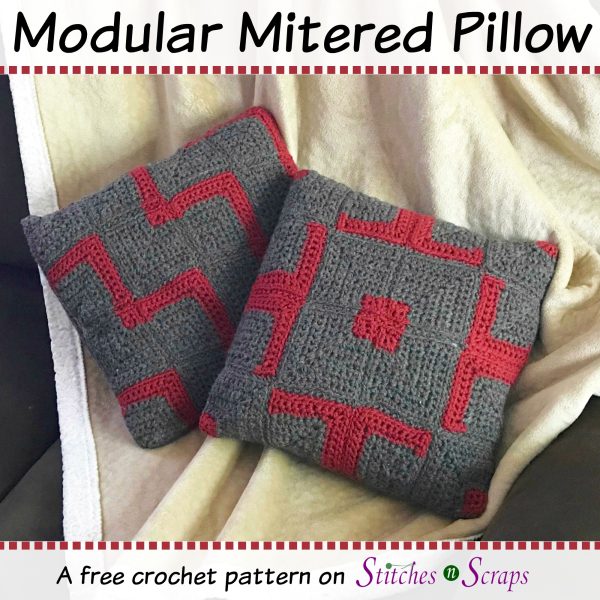
It’s time to get creative – mix them up, or make a matched set! Mitered squares in 2 different color patterns offer a kaleidoscope of possible combinations. Use one of the provided layouts, or make up your own. What will your Modular Mitered Pillow look like? A video tutorial for making the squares is included below!
The Modular Mitered Pillow pattern is part of the Christmas in July Crochet-Along. Check out the main Christmas in July CAL post for more information on the event, links to the patterns, and instructions for entering the giveaway!
The sample is shown in Plymouth Homestead yarn (worsted weight, 100% wool), in colors #9 Brick and #3 Brown Heather.
This pattern contains affiliate advertisements (click for more info). If you click one of these advertisements and then make a purchase, I may be compensated. You get the same great prices, and you will be helping to support this site!
This pattern is protected by copyright. Please do not distribute or share this pattern in any way other than by sharing a link to this page or to the pattern page on Ravelry. Click here for copyright information.
Materials:
- Worsted weight yarn
- 100 yds Red (A)
- 300 yds Grey/Brown (B)
- Size J / 6 mm hook, or size needed to obtain gauge
- Yarn needle
- 14 inch square pillow form
Skill Level:
Intermediate – The stitches are easy, but the yarn management makes it a little more difficult.
Size:
14 inches square.
Gauge:
12 sc x 12 rows = 4 inches. Use pattern as gauge swatch: each small square should measure 3.5 inches after blocking.
Abbreviations used:
(Pattern is written in US terms)
- ch = chain
- sc = single crochet
- sp = space
- ch sp = chain space
- st(s) = stitch(es)
- RS = right side
Recommended Resources:
Instructions:
(Scroll down for video tutorial on making the squares)
Note: All the instructions about leaving long tails and working over tails are only so that you can use those tails when doing the edging, rather than joining new bits of yarn (fewer ends). If you find these instructions confusing, ignore them and just join new yarns on the edging where needed.
Square 1 (Make 8):
With A, ch 2
Row 1 (WS): (Sc, ch 2, sc) in 2nd ch from hook. (2 sc)
Row 2: Ch 1, turn, sc in first st, (sc, ch 2, sc) in ch-2 sp, sc in last st, changing to B (4 sc)
Leave a 32 inch starting B tail. Cut A, leaving a 32 inch tail.
Row 3: Work over starting B tail on this row only, to carry it to the other side. With B, ch 1, sc in each st across to ch-2 sp, (sc, ch 2, sc) in ch-2 sp, sc in each st across. (6 sc)
Rows 4-9: Repeat row 3, but without working over tail. (18 sc)
Edging Rnd (RS):
- Ch 1, turn, sc in each st across to ch-2 sp, 3 sc in ch-2 sp, sc in each st across to last st, ch 3 in last st. (23 B sc)
- Working in sides of rows, work 7 sc evenly spaced in B rows, changing to the long tail of A, cut B. (7 B sc)
- With A, sc in side of next row, 3 sc corner, sc in side of next row, changing to the long tail of B in the last st. (5 A sc)
- With B, work 7 sc evenly spaced in sides of B rows, 2 sc in same st as start of rnd, join with sl st to first st, fasten off. (9 B sc)

Square 2 (Make 8):
With B, ch 2, leaving a 48 inch starting tail. For the first 7 rounds of this square you will be carrying this tail up one side.
Row 1 (WS): (sc, ch 2, sc) in 2nd ch from hook. (2 sc)
Row 2: Ch 1, turn, sc in each st across to ch-2 sp, (sc, ch 2, sc) in ch-2 sp, sc in each st across, carrying the long tail of B up in the last st. (4 sc)
Row 3: Ch 1 carrying the long tail of B up with the chain, turn, sc in each st across to ch-2 sp, (sc, ch 2, sc) in ch-2 sp, sc in each st across. (6 sc)
Rows 4-7: Repeat rows 2-3 twice more, changing to A at end of row 7. Fasten off B (14 sc)
Leave an 18 inch starting tail of A.
Rows 8-9: With A, ch 1, sc in each st across to ch-2 sp, (sc, ch 2, sc) in ch-2 sp, sc in each st across. (18 sc)
Edging Rnd (RS):
- Ch 1, turn, sc in each st across to ch-2 sp, 3 sc in ch-2 sp, sc in each st across to last st, ch 3 in last st. (23 A sc)
- Working in sides of rows, sc in side of next row, changing to the long tail of B, cut A. (1 A sc)
- With B, work 7 sc evenly spaced to corner, 3 sc in corner, work 7 sc evenly spaced in sides of B rows, changing to the long tail of A in the last st. (17 B sc)
- With A, sc in side of next row, 2 sc in same st as start of rnd, join with sl st to first st, fasten off. (3 A sc)

Back (Make 2):
With B, ch 12
Row 1 (WS): (Sc, ch 2, sc) in 2nd ch from hook, sc in next 10 chs. (12 sc)
Rows 2-29: Ch 1, turn, sc in each st across to ch-2 sp, (sc, ch 2, sc) in ch-2 sp, sc in each st across. (68 sc)
Edging Rnd (RS):
- Ch 1, turn, sc in each st across to ch-2 sp, 3 sc in ch-2 sp, sc in each st across to last st, ch 3 in last st. (73 sc)
- Working in sides of rows, work 38 sc evenly spaced to corner, 3 sc in corner, work 28 sc evenly in sides of rows to corner, 2 sc in same st as start of rnd, join with sl st to first st, fasten off. (71 sc)

Assembly:
Front:
Arrange squares as desired. Here are some possible arrangements.
With right sides facing, sew squares together using a whipstitch through the wrong side loops only as follows:
- Wherever two A edges meet, use A for the seam
- In all other cases (A & B, or 2 B edges), use B for the seam.
Weave in all ends on front.
Back:
With right sides together, place back pieces and front piece together, lining up the outside edges. Back pieces should overlap in the middle by 20 edge stitches. On both the front and the back, you should have 40 stitches along each outside edge, plus 1 stitch in each corner. Use stitch markers or scraps of yarn to secure pieces in place temporarily if desired.

Using B, with a whipstitch seam through wrong side loops only, sew through all layers around outside edge of pillow only.

Weave in all ends, turn pillow right side out. Insert pillow form through the opening in the back.
Video Tutorial:
This tutorial shows how to make both types of squares for the front of the pillow.
I hope you enjoy making this pattern. A downloadable pdf of this pattern is also available in my Craftsy store or on Ravelry, for a small fee. The fee for the pdf format is to offset the advertising revenue lost when you print or download the pattern rather than viewing it online.
Do you want the best of Stitches n Scraps delivered right to your inbox? The Stitches n Scraps email newsletter includes highlights from the blog as well as special features not available elsewhere. Don’t miss a stitch – Subscribe now!

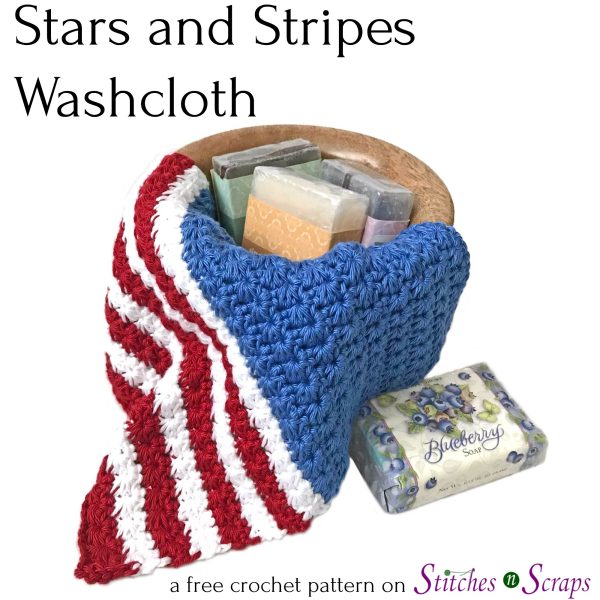
Free Pattern – Stars and Stripes Washcloth
Celebrate this summer with the Stars & Stripes Washcloth! This design works well for team or school colors too. The star stitch pattern is fast and fun to make, and gives the washcloth its fabulous, scrubby texture. A photo and video tutorial for the crochet star stitch is also available.

This pattern contains sponsored content and affiliate advertisements (click for more info). If you click one of these advertisements and then make a purchase, I may be compensated. You get the same great prices, and you will be helping to support this site!
The Stars & Stripes Washcloth was designed for the CAL Central 2018 Washcloth Crochet-Along. Join in the fun on the CAL Central Facebook group or Ravelry group! Also be sure to visit the main Washcloth CAL post for more information on the event, links to the patterns, and instructions for entering the giveaway. There are some wonderful prizes!
Cascade Yarns has generously provided all the designers with their Ultra Pima yarn for free, to use for our designs. It’s a soft and luxurious, 100% cotton yarn, with a lovely shine.

This pattern is protected by copyright. Please do not distribute or share this pattern in any way other than by sharing a link to this page or to the pattern page on Ravelry. Click here for copyright information.
Stars and Stripes Washcloth
Add this to your Ravelry Queue
Materials:
- Cascade Ultra Pima cotton, DK weight yarn
- 30 yds #3713 Wine (A)
- 30 yds #3728 White (B)
- 65 yds #3800 Blueberry (C)
- Size H / 5 mm hook, or size needed to obtain gauge
- Yarn needle
Skill Level:
Intermediate – Star stitch.
Size:
9 inches square.
Gauge:
21 sc x 23 rows = 4 inches. Use pattern as gauge swatch: After Row 7, your work should measure about 9 inches x 2 inches.
Abbreviations used:
(Pattern is written in US terms)
- ch = chain
- sc = single crochet
- hdc = half double crochet
- star = star stitch (see Special Stitch)
- st(s) = stitch(es)
- yo = yarn over
- RS = right side
Recommended Resources:
Special Stitch – Star Stitch:
See this Crochet Star Stitch Tutorial for a more detailed look.
Anatomy of a Star – Each star stitch is a cluster of 6 loops. The chain at the end forms the eye, the 6 loops form the legs, and the last chain worked into is the base.

Star Stitch (star) – Working into the previous star, pick up one loop in the eye, one loop in the last leg, and one loop at the base, pick up a loop in each of next 2 chs, yo and draw through all 6 loops on hook, ch 1.

Instructions:
With A, ch 50 (multiple of 2 + 6).
First Red (A) Stripe:
Row 1 (RS): Sk first ch, pick up a loop in each of next 5 chs, yo and draw through all 6 loops on hook, ch 1 (first star made); work star stitch across (see Special Stitch), hdc in base of last star (this should be the last ch). (23 stars)
Row 2: Ch 1, turn, sc in first hdc, sc in eye of next star, 2 sc in eye of each star across, sc in corner (top of turning ch from previous row), changing to B. Fasten off A. (47 sc)

White (B) Stripe:
Row 3: With B, turn, ch 2, sk first ch, pick up a loop in front loop of next ch, pick up a loop in back loop of same ch, pick up a loop in each of next 3 sts, yo and draw through all 6 loops on hook, ch 1 (first star made); work star stitch across, hdc in base of last star. (23 stars)
Row 4: With B, repeat row 2, changing to A at end of row. Fasten off B.
Red (A) Stripe:
Row 5: With A, repeat row 3.
Row 6: Repeat row 2.
Rows 7-15: Repeat rows 3-6 twice, then repeat row 3 once more.
Row 16: Repeat row 4, changing to C at end of row. Fasten off B.
You should now have a total of 4 red stripes and 4 white stripes.
Rows 17-34: With C, and without changing colors, repeat rows 3-4 nine times.
Fasten off, weave in all ends.

I hope you enjoy making this pattern. A downloadable pdf of this pattern is also available in my Craftsy store or on Ravelry, for a small fee. The fee for the pdf format is to offset the advertising revenue lost when you print or download the pattern rather than viewing it online.
Do you want the best of Stitches n Scraps delivered right to your inbox? The Stitches n Scraps email newsletter includes highlights from the blog as well as special features not available elsewhere. Don’t miss a stitch – Subscribe now!

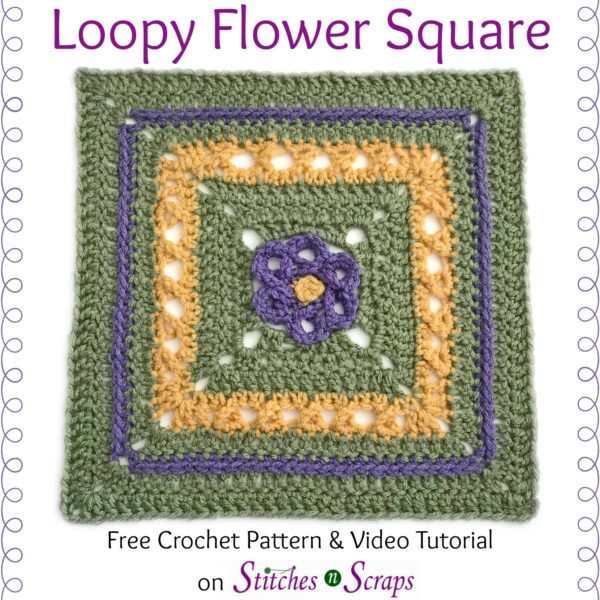
Free Pattern – Loopy Flower Square
Brighten up your day with this fun, Loopy Flower Square. Use it as a blanket square, trivet, or just for decoration. Twisted loops give the center flower a 3-dimensional pop, and add a textural border element as well. In addition to the written pattern, scroll down for a full video tutorial that takes you step by step through the entire square!

This pattern was designed for the Moogly 2018 afghan CAL. If this is the first you’ve heard about it, go check it out! Also be sure to take a look at the block 11 post to see how Moogly’s version of this square turned out.
This pattern is protected by copyright. Please do not distribute or share this pattern in any way other than by sharing a link to this page or to the pattern page on Ravelry. Click here for copyright information.
This pattern contains affiliate advertisements (click for more info). If you click one of these advertisements and then make a purchase, I may be compensated. You get the same great prices, and you will be helping to support this site!
Loopy Flower Square
Add this to your Ravelry Queue
Materials:
- Red Heart With Love yarn:
- 25-30 yds #1207 Cornsilk (A)
- 25-30 yds #1538 Lilac (B)
- 125 yds #1601 Lettuce (C)
- Size J / 6 mm hook, or size needed to obtain gauge
- Yarn needle
Skill Level:
Intermediate – Working into twisted chain loops, back bumps of chains, and third loops of hdc stitches. Worked in the round.
Size:
12 inches square.
Gauge:
Use pattern as gauge swatch. After Rnd 7, your work should measure about 5.5 inches square.
Abbreviations used:
(Pattern is written in US terms)
- ch = chain
- sc = single crochet
- hdc = half double crochet
- dc = double crochet
- st(s) = stitch(es)
- sp = space
- ch sp = chain space
- rnd = round
- RS = right side
- WS = wrong side
Recommended Resources:
- Working into the back bump
- Improved Chainless Starting Double Crochet on Moogly
- Standing Double Crochet on Moogly
- Front Loop Only or Back Loop Only
Instructions:
Flower:
With A, ch 2
Rnd 1 (WS): 6 sc in 2nd ch from hook. Join with sl st to first sc, fasten off. (6 sts)
Rnd 2 (RS): Working in back loops only: Turn, join B with sc in any stitch, (ch 9, sc in next st) 5 times, ch 9, join with sl st to first st. (6 sc, 6 ch-9 loops)
Rnd 3 (RS): Do not turn. Ch 1, *twist next loop 1/2 turn towards hook, (3 sc, ch 1, 3sc) in loop, repeat from * around, join with sl st to starting ch 1, fasten off. (6 petals with a total of 36 sc, 6 chs)
Square:
Note: Ch 3 at the start of a round counts as a dc throughout
Rnd 4 (WS): Working in back bump of chs, join C with sl st in center ch of any petal, (ch 4, sl st in center ch of next petal) 5 times, ch 4, join with sl st in same ch as start of rnd. (6 ch-4 sps)

Note: This will create a hexagon of chain spaces that sit behind the flower. It may make everything cinch in and look weird for now, but it should flatten out after the next round.
Rnd 5 (RS): Turn, sl st in first ch-4 sp, ch 3, (dc, hdc, sc, hdc) in same sp, *(2 dc, ch 2, 2 dc) in next sp, (hdc, sc, hdc, 2 dc) in next sp, ch 2, **(2 dc, hdc, sc, hdc) in next sp, repeat from * to **, join with sl st to first st. (16 dc, 8 hdc, 4 sc, 4 corner ch-2 sps)
Rnd 6 (WS): Turn, sl st in first ch-2 sp, ch 3, dc in same sp, dc in each st across to next ch-2 sp, *(2 dc, ch 2, 2 dc) in next ch-2 sp, dc in each st across to next ch-2 sp, repeat from * twice more, 2 dc in same ch-2 sp as beginning, ch 2, join with sl st to first st. (44 dc, 4 ch-2 corner sps)
Rnd 7 (RS): Repeat Rnd 6. Fasten off C. (60 dc, 4 corner ch-2 sps)
You should now have a 5.5 inch square.

Rnd 8 (WS): Turn, join A with sc in any corner ch-2 sp, sc in next st, (ch 7, sc in next 3 sts) 4 times, ch 7, sc in next 2 sts, *(sc, ch 2, sc) in next ch-2 sp, sc in next st, (ch 7, sc in next 3 sts) 4 times, ch 7, sc in next 2 sts, repeat from * twice more, sc in same ch-2 sp as beginning, ch 2, join with sl st to first st. (68 sc, 20 ch-7 loops, 4 corner ch-2 sps)
Rnd 9 (RS): Turn, sl st in first corner ch-2 sp, ch 3, dc in same sp, *dc in next st, sk next 2 sts, (twist next loop 1/2 turn towards hook, 3 sc in loop, sk next 3 sts) 4 times, twist next loop 1/2 turn towards hook, 3 sc in loop, sk next st, dc in next st,** (2 dc, ch 2, 2 dc) in next corner ch sp, repeat from * 3 times more, ending at ** on last repeat, 2 dc in same ch-2 sp as beginning, ch 2, join with sl st to first st, fasten off. (24 dc, 60 sc, 4 corner ch-2 sps)
Rnd 10 (WS): Turn, join C with sl st in any corner ch-2 sp, ch 3, dc in same sp, dc in each st across to next corner ch-2 sp, (2 dc, ch 2, 2dc) in next ch-2 sp, dc in each st across to next corner ch-2 sp, repeat from * twice more, dc in each st across, 2 dc in same ch-2 sp as beginning, ch 2, join with sl st to first st. (100 dc, 4 corner ch-2 sps)
Rnd 11 (RS): Turn, sl st in first corner ch-2 sp, changing to B. With B, ch 1, hdc in same sp, hdc in each st across to next ch-2 sp, *(hdc, ch 2, hdc) in next ch-2 sp, hdc in each st across to next ch-2 sp, repeat from * twice more, hdc in same ch-2 sp as beginning, ch 2, join with sl st to first st, fasten off. (108 hdc, 4 corner ch-2 sps)
Rnd 12 (WS): Turn, pick up a loop of C in first corner ch-2 sp, ch 3, dc in same sp, dc in third loop only (below front loop) of each hdc across to next ch-2 sp, *(2 dc, ch 2, 2 dc) in next ch-2 sp, dc in third loop only of each hdc across to next ch-2 sp, repeat from * twice more, 2 dc in same ch-2 sp as beginning, ch 2, join with sl st to first st. (124 dc, 4 corner ch-2 sps)

Your work should now measure about 10.5 – 10.75 inches. If it does not, see Optional Size Adjustments below before working next rnd.

Rnd 13 (RS): Repeat rnd 6. (140 dc, 4 corner ch-2 sps)
Fasten off, weave in all ends, wash and block.
Optional Size Adjustments:
Rnd 13 listed above is a dc rnd. Here are some alternate, plain rounds:
Sc rnd: Turn, sl st in first corner ch-2 sp, ch 1, sc in same sp, sc in each st across to next ch-2 sp, *(sc, ch 2, sc) in next ch-2 sp, sc in each st across to next ch-2 sp, repeat from * twice more, sc in beginning ch-2 sp, ch 2, join with sl st to first st.
Hdc rnd: Turn, sl st in first corner ch-2 sp, ch 1, hdc in same sp, hdc in each st across to next ch-2 sp, *(hdc, ch 2, sc) in next ch-2 sp, hdc in each st across to next ch-2 sp, repeat from * twice more, hdc in beginning ch-2 sp, ch 2, join with sl st to first st.
If your square is too big or too small, replace rnd 13 with any combination of sc, hdc, and dc rnds needed to get to 12 inches, just be sure to work an odd number of rnds, so you end after a RS rnd. For example, if your square is just a little too small, you could work 3 sc rnds instead of rnd 13.
Video Tutorial:
I hope you enjoy making this pattern. A downloadable pdf of this pattern is also available in my Craftsy store or on Ravelry, for a small fee. The fee for the pdf format is to offset the advertising revenue lost when you print or download the pattern rather than viewing it online.
Do you want the best of Stitches n Scraps delivered right to your inbox? The Stitches n Scraps email newsletter includes highlights from the blog as well as special features not available elsewhere. Don’t miss a stitch – Subscribe now!

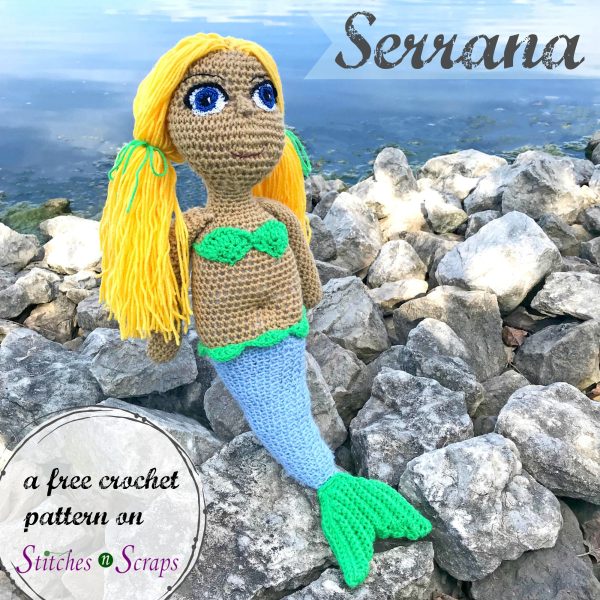
Free Pattern – Serrana the Mermaid
Meet my new friend Serrana! This sweet, 19-inch doll is sure to delight mermaid fans and amigurumi enthusiasts alike. She’s a little bit sassy, completely adorable, and a whole lot of fun to make.

Serrana got her name from a 6-year-old buddy of mine. I’ve been told her full name is Serrana Charlotte Christian. She was designed for the CAL Central Softie Crochet Along. If you’re new to the CAL, check out some of the other patterns, and join in all the softie fun on our Facebook group!
Fairfield generously sent me a bag of Original Poly-Fil and a bag of Poly-Fil Royal Silk for free to use in this design. They are also providing a great grand prize for the giveaway! See the main CAL post for more information about the giveaway and how to enter.
This pattern is protected by copyright. Please do not distribute or share this pattern in any way other than by sharing a link to this page or to the pattern page on Ravelry. Click here for copyright information.
This pattern contains sponsored content and affiliate advertisements (click for more info). If you click one of these advertisements and then make a purchase, I may be compensated. You get the same great prices, and you will be helping to support this site!
Serrana the Mermaid
Add this to your Ravelry Queue
Materials:
- DK weight yarn:
- 100 yds Skin color
- 50 yds Tail color (blue)
- 40 yds Fin color (green)
- 60 -75 yds Hair color
- Size 10 crochet thread – less than 5 yds each:
- Black
- Eye color (blue)
- White
- Mouth color (Red – just 10-12 inches).
- Size F / 3.75 mm hook, or size needed to obtain gauge
- Size C / 2.75mm hook (for eyes)
- 2-4 oz Original Poly-Fil or Poly-Fil Royal Silk fiber fill.
- Yarn needle
- Scrap of yarn or thread to use as a running stitch marker (optional)
Skill Level:
Experienced – Working in front loops, back loops, and in 3rd loop of hdc, continuous rounds, short rows, and several pieces to assemble.
Size:
About 19″ tall.
Gauge:
After Rnd 6 of head, work should measure about 2.5 inches in diameter.
Exact gauge is not critical, but stitches should be fairly tight with no big gaps. Use head as a gauge swatch. If your head comes out to a size and texture you like, your gauge is fine.
For the eyes, if you want them smaller or bigger, adjust your hook accordingly. The eyes can seem too big on their own, so pin them in place on the head before deciding.
Abbreviations used:
(Pattern is written in US terms)
- ch = chain
- sc = single crochet
- dc = double crochet
- inc = invisible increase (see special stitches)
- dec = invisible decrease (see special stitch)
- blo = back loop only
- flo = front loop only
- st(s) = stitch(es)
- rnd = round
- RS = right side
Recommended Resources:
- Continuous rounds and running stitch markers
- Why Continuous Rounds Shift
- Invisible Single Crochet Decrease on Nicki’s Homemade Crafts
- Needle Sculpting an Amigurumi Doll Face
- Half Double Crochet in the Third Loop on Moogly
- Adding Hair to an Amigurumi Doll
- Edging – Crab Stitch & Twisted SC
Special Stitches:
Invisible increase (inc): Sc in back loop only of indicated st, then sc in both loops of same stitch.
Invisible decrease (dec): Insert hook into front loop only of both of next 2 stitches, yarn over and draw up a loop, yarn over and draw through both loops on hook.

This is an alternative to a single crochet 2 together (sc2tog) stitch. If you prefer, you can use the standard sc2tog instead.
Notes:
Most of the pattern is worked in continuous rounds. Do not join rounds or turn unless indicated. Use a stitch marker or scrap of yarn to mark the first stitch of each round. I highly recommend a running stitch marker. This is a piece of scrap yarn that you move back and forth across your work before the first stitch of each round. See this running stitch marker tutorial.
In the pictures, I have used running stitch markers, and have also used regular stitch markers to mark increase and decrease sections.
Instructions:
Head:
Before starting, cut a 24-36 inch piece of skin color yarn and set aside to use for face shaping later.
With skin color, ch 2
Rnd 1 (RS): 6 sc in 2nd ch from hook. (6 sts)
Rnd 2: Inc in each st around. (12 sts)
Rnd 3: (Inc in next st, sc in next st) 6 times. (18 sts)
Rnd 4: (Sc in next st, inc in next st, sc in next st) 6 times. (24 sts)
Rnd 5: (Inc in next st, sc in next 3 st) 6 times. (30 sts)
Rnd 6: (Sc in next 2 sts, inc in next st, sc in next 2 sts) 6 times. (36 sts)
You should now have a circle of about 2.5 inches in diameter.
Rnds 7-11: Sc in each st around.
Rnd 12: Sc in first 13 sts, inc in next st, sc in next st, mark next st on row 11 for eye placement, inc in next (marked) st, (sc in next st, inc in next st) 3 times, sc in next st, mark next st on rnd 11 for eye placement, inc in next (marked) st, sc in last 12 sts. (42 sts)
Rnd 13: Sc in first 13 sts, (inc in next st, sc in next 2 sts) 6 times, sc in last 11 sts. (48 sts)
Rnds 14-18: Sc in each st around.
Rnd 19: (sc in next 3 sts, dec, sc in next 3 sts) 6 times. (42 sts)
Begin stuffing head as you go.
Rnd 20: (Dec, sc in next 5 sts) 6 times. (36 sts)
Rnd 21: (Sc in next 2 sts, dec, sc in next 2 sts) 6 times. (30 sts)
Rnd 22: (Dec, sc in next 3 sts) 6 times. (24 sts)
Rnd 23: (Sc in next st, dec, sc in next st) 6 times. (18 sts)
Rnd 24: (Dec, sc in next st) 6 times. (12 sts)
Pull working loop up and secure it with a stitch marker so it doesn’t come undone. Stuff head firmly (but not overstuffed).
Eye (Make 2):
Rnd 1: With black, ch 2, 8 hdc in 2nd ch from hook, join with a sl st to first st, fasten off. (8 sts)
Rnd 2 (RS): Turn, join eye color in any st from rnd 1. Ch 1, 2 hdc in each st around, join with sl st to first st, fasten off. (16 sts)
Rnd 3: Turn, working in third loops only, join white in any st from row 2. Ch 1, 2 sc in same st, *hdc in next st, 3 dc in next st, hdc in next st, 2 sc in next st, sc in next 3 sts,** 2 sc in next st, repeat from * to **, join with sl st to first st, fasten off leaving a 12-15 inch end for sewing. (24 sts)

Rnd 4:
Right eye only: Turn, join black with sc in 2nd dc at one side of eye, sc in next 11 sts, 3 sc in next st, sc in next st, sl st in next st, fasten off, leaving a 10-12 inch tail for sewing eyebrow. ( 16 sts not counting sl st)

Left eye only: Join black with sl st in the hdc before the 3 dc at one side of eye, sc in next st, 3 sc in next st, sc in next 11 sts, (sc, sl st) in next st, fasten off, leaving a 10-12 inch tail for sewing eyebrow. (16 sts not counting sl sts)
Weave in all ends except for the long white end and long black end (for sewing with later).
Face:
(see Needle Sculpting tutorial)
Between the two eye markers, use pins to mark a triangle for the nose.

Eye sockets:
Thread the 24-36 inch piece of skin colored yarn you set aside earlier onto a yarn needle. Sew in through the top of the head and bring it out the front at one of the eye markers. Leave a tail at the back to weave in later.
Sew over one stitch and bring the needle back out at the other eye marker.
Sew over one stitch and bring the needle out at the back of the head.
Pull firmly on working yarn and starting tail at the same time to form indentations for the eye sockets.
Optional: Bring yarn up and down again at each eye socket to further secure the indentation.
Nose:
Bring needle up at one side of nose, near the top where the pins cross.
Sew back and forth across the nose 2-3 times, working from top to bottom and following the lines of the pins. Pull slightly with each stitch to pinch nose up. When you reach the bottom, remove the pins.
Bring needle in from the side of the nose and out through the bottom of the nose, just to one side of the center.
Sewing over one stitch, go back up through the bottom of the nose, and out through the opposite side of the nose, near the top. Pull gently to curve bottom of nose.
Bring needle back down to the bottom of the nose, just to the other side of the center. Sewing over one stitch, go back up through the bottom of the nose and out through the opposite side near the top. Pull gently.
Add more stitches if necessary to adjust shaping. When satisfied, bring needle down and out through the back of the head. Weave in both tails.

Attach eyes:
(scroll down for video tutorial)
Using long white tail, make 2 small stitches at one side of the eye, where round 1 meets rnd 2, for a highlight.
Place eye onto eye socket so that inner edge is close to the nose. Sew eye onto head. Make your stitches in the white section, just under the edge of rnd 3.
Weave in tail, sew through to back of head and trim end.
Repeat for 2nd eye.
Eyebrows
Sew black tail down through eye, being careful not to deform any of the eye stitches. Bring it back up above the eye at one end of the eyebrow.
Make a horizontal stitch across to the other end of the eyebrow, and bring yarn back up in the middle, at the top of the eyebrow arch.

Sewing over the eyebrow, bring the needle back down in the same spot. This tiny stitch locks the eyebrow in place at the top of the arch. Sew one additional locking stitch on each side of center to shape eyebrow into a curve.
Sew through to back of head, weave in tail, and trim.
Repeat for 2nd eyebrow.
Mouth
The mouth is done the same way as the eyebrow, just arching down instead of up.
Secure mouth color thread by weaving in a tail at the back of the head. Bring needle up at one corner of the mouth.
Make a horizontal stitch to the other corner of the mouth.
Come out at the center bottom and make a small stitch to lock mouth in place at bottom. Make additional locking stitches at either side of center to shape mouth into a curve.

Sew through to back of head, weave in tail, and trim.
Torso:
Pick up working loop from head to continue crocheting torso.
Rnd 25: Inc in next 4 sts, sc in next 6 sts, inc in next 2 sts. (18 sts)
Note: This places all the increases for rnd 25 at the back of the head.
Rnd 26 – 27: Sc in each st around.
Rnd 28: (Sc in next 2 sts, inc in next st) 6 times. (24 sts)
Rnds 29-30: Sc in each st around.
Rnd 31: (Sc in next 3 sts, inc in next st) 6 times. (30 sts)
Rnds 32-33: Sc in each st around.
Rnd 34: (Sc in next 4 sts, inc in next st) 6 times. (36 sts)
Rnds 35-36: Sc in each st around.
Rnd 37: (Sc in next 5 sts, inc in next st) 6 times. (42 sts)
Rnds 38-50: Sc in each st around, fasten off skin color, leaving a 12-15 inch tail to make belly button.
Tail:
Ruffle: Working in front loops only, join fin color with sl st in any stitch at the back,*Sk next 2 sts, (dc, ch 1) 4 times in next st, dc in same st (fan made), sk next 2 sts, sl st in next st, repeat from * around – last sl st should be in same st as joining. Fasten off fin color. (7 fans)
Finish stuffing torso firmly. Continue stuffing tail as you go.
Rnd 51: Working in unused back loops from rnd 51, and continuing where you left off from torso, join tail color with sl st in next st. Ch 1, sc in same st and in each st around.

Rnd 52-54: (Sc in blo of next st, sc in flo of next st) around.
Rnd 55: *Dec, (sc in blo of next st, sc in flo of next st) twice, sc in blo of next st, repeat from * 6 times. (36 sts)
Rnds 56 – 59: (Sc in blo of next st, sc in flo of next st) around.
Rnd 60: *Dec, (sc in blo of next st, sc in flo of next st) twice, repeat from * 6 times. (30 sts)
Rnds 61 – 64: (Sc in blo of next st, sc in flo of next st) around.
Rnd 65: (Dec, sc in blo of next st, sc in flo of next st, sc in blo of next st) 6 times. (24 sts)
Rnds 66 – 69: (Sc in blo of next st, sc in flo of next st) around.
Rnd 70: (Dec, sc in blo of next st, sc in flo of next st) 6 times. (18 sts)
Rnds 71 – 74: (Sc in blo of next st, sc in flo of next st) around.
Rnd 75: (Dec, sc in blo of next st) 6 times. (12 sts)
Finish stuffing tail firmly.
Row 76: Pinch rnd 71 together so that it is flat at the front and back. You should have 6 pairs of stitches. If needed, slip stitch around to get to one side. Working through both loops of both layers, sc in each pair of sts across to close tail. (6 sc)
Weave in all ends on torso and tail.

Arm (Make 2):
With skin color, ch 2
Rnd 1 (RS): 6 sc in 2nd ch from hook. (6 sts)
Rnd 2: Inc in each st around. (12 sts)
Rnds 3 – 27: Sc in each st around. Fasten off, leaving a 12-18 inch tail for sewing.
Stuff arm.
Tail Fin:
(Scroll down for video tutorial)
1st fin piece:
With fin color, ch 21 (Foundation)
Row 1 (RS): Working into the back bump of the chains, sc in 2nd ch from hook and in next 12 chs, sl st in next ch, leaving remaining 6 chs unworked (13 sc)
For remainder of tail fin, when working into sc stitches, work into the back loop only.
Row 2: Ch 1, turn, sk sl st, sc in next 11 sts, sl st in next st, leaving remaining sc unworked (11 sc)
Row 3: Ch 1, turn,sk sl st, sc in next 11 sc, sc in turning ch-1 sp (above the skipped sl st from the previous row), sc in back bump of next skipped ch from foundation, sl st in back bump of next ch. (13 sc, 4 remaining unworked chs)
Row 4: Repeat row 2
Row 5: Repeat row 3 (13 sc, 2 remaining unworked chs)
Row 6: Repeat row 2
Row 7: Repeat row 3 (13 sc, no remaining unworked chs)
Row 8: Ch 1, turn, sk sl st, sc in next 11 sc, leaving remaining 2 sc unworked. (11 sc)
Row 9: Ch 3, turn, sc in 2nd ch from hook and in next ch, sc in next 9 sc, sl st in next sc, leaving remaining sc unworked. (11 sc)
Row 10: Ch 1, turn, sk sl st, sc in next 11 sc. (11 sc)
Rows 11-14: Repeat rows 9-10 twice.
Row 15: Ch 3, turn, sc in 2nd ch from hook and in next ch, sc in next 11 sc, (sc in next turning ch-1 sp, sc in next unworked st from previous row) 3 times, sc in last sl turning ch-1 sp. 20 sc. Fasten off.
2nd fin piece: Repeat as for first fin piece, but do not fasten off.
Joining:
Hold fin pieces with right sides together and lining up edges.
Working through wrong side (outside) loops only of both pieces together, ch 1, sc in each st across side.
Working through both pieces across bottom of tail, ch 1, work 23 sc evenly spaced across bottom.
Working through wrong side loops only of both pieces together, ch 1, sc in each st across side.
Turn tail fin right-side out. Stuff lightly if desired (I did not stuff mine).
Top edging: With right side facing and working through only one fin piece at a time, ch 1, work 8 sc evenly spaced around, join with a sl st into first st, fasten off, leaving a 10 – 12 inch tail for sewing. (8 sc).
Bikini Top:
Shell 1:
Row 1: With fin color, ch 4 (counts as dc and foundation ch), 4 dc in 4th ch from hook. (5 sts)
Row 2: Ch 3 (counts as dc), turn, dc in first st, 2 dc in each remaining st across. (10 sts)
Crab Stitch Edging: Ch 1, do not turn, (sc in previous st) across. This is called “crab stitch” or “reverse sc”. See crab stitch tutorial. (10 sts) .
Fasten off, leaving a 24 inch tail for sewing.
Shell 2: Repeat as for Shell 1, but do not fasten off.
Strap: Ch 23, with RS facing, join with sl st to top left corner of shell 1. Fasten off, leaving a 24 inch tail for sewing.
Weave in all ends except for the long tails for sewing.

Assembly:
(Scroll down for video tutorial)
Note: If this is going to be given to a child, be especially careful to sew everything down very securely.
Using remaining tails for sewing, and using pictures as a guide:
Flatten ends of arms and sew them to torso at neckline. You may find it helpful to mark the placement of each arm with stitch markers first, to be sure they are positioned correctly.

Sew bikini top in place, being careful not to twist the strap. Be sure to sew all the way around each shell, and across the entire chain around the back.

Slide tail fin onto bottom of tail so that it is flat at the front and the back. Sew through all layers to attach.

Hair:
Guideline: Using a scrap piece of contrasting yarn, sew a guideline to mark the hairline. Sew across the front (forehead), down the sides, and across the back. Finally, sew a part line up the middle.

Make hair:
Wrap hair colored yarn 200 times around a hardcover book that’s at least 11 inches (or desired length). If you don’t have a book, you can use any stiff surface of appropriate length.

Cut through all wraps at one end only. You should end up with 200 strands of “hair” about 22 inches long.
How to attach a strand of hair: (see next step for where to attach). Fold a strand of hair in half, forming a loop. Insert hook into desired stitch and pull up that loop. Yarn over with both ends of the hair strand and pull all the way through.

Attach hair:
Hold head sideways with part line on top. Working along the side of the part closest to you, add hair evenly along part line. Add only 2 or 3 rows of hair for now, starting about a half inch from the front guideline and going down to the bottom guideline. (About 40 strands of hair)
Turn head around and work across the other side of the part in the same way. (About 40 strands of hair)

Turn head so that back of head is facing you and front guideline is on top. Add hairs along center of part line. Be sure not to snag or split your guideline or you will have trouble removing it later. (About 15 strands of hair)

Working along guideline around front (forehead), fill in a few rows of hair along the forehead. (about 40 strands of hair).
Rotate head to add a line of hair along the remainder of the guideline (sides and bottom). As you work, rotate the head so that the guideline is always on top. (about 40 strands of hair)

Shake out hair and pull it into two rough ponytails (just to look at – don’t tie them yet). Use remaining strands of hair to fill in any bare spots.
Trim hair:
Stand mermaid up or lay face down and comb through hair with your fingers until it is all smooth and straight.
Trim ends to make them even. Don’t worry about shorter strands near the top, this will add a layered effect.
Style hair:
Cut two 12-in pieces of fin color for hair ties.
Pull hair into 2 somewhat loose ponytails and tie with hair ties. I used a double knot to make sure my ties were secure.

Finishing:
Belly Button:
Weave in ending tail from body for a few stitches, then bring it out the back.
Bring needle up through the belly button, being careful not to pucker the fabric at the back.
Sew a small stitch at the belly button, coming back out the back, and pull tightly to make the fabric dimple.
Repeat this with a second stitch to secure if desired, then weave in end.
Remove all guidelines and stitch markers.
Weave in all ends.
Give your mermaid a name!
Video Tutorials:
Tail Fin Tutorial – This tutorial covers making the tail fin.
Assembly Tutorial – This tutorial covers attaching the eyes, sewing the eyebrows and mouth, attaching the arms and tail fin, and making the belly button.
I hope you enjoy making this pattern. Big thanks to MixedKreations for tech editing it!
A downloadable pdf of this pattern is also available in my Craftsy store or on Ravelry, for a small fee. The fee for the pdf format is to offset the advertising revenue lost when you print or download the pattern rather than viewing it online.
Do you want the best of Stitches ‘N’ Scraps delivered right to your inbox? The Stitches ‘N’ Scraps email newsletter includes highlights from the blog as well as special features not available elsewhere. Don’t miss a stitch – Subscribe now!

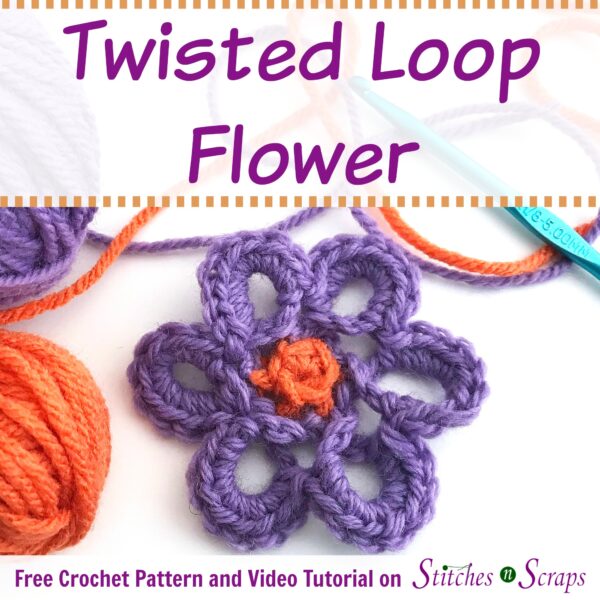
Free Pattern – Twisted Loop Flower
Nothing says Spring like brightly colored flowers. Use them to dress up headbands, bags, or just about anything. These twisted loop flowers take just a few minutes to make, and are so much fun you’ll want to make them by the dozen! I’ve included a video tutorial as well, to show you how.

I used some scraps of worsted weight yarn for my flowers, so the gauge, size and yardage listed in the pattern is for worsted weight yarn. You can make these flowers in any weight of yarn or thread you like, but the finished size and yardage will vary.
This pattern is protected by copyright. Please do not distribute or share this pattern in any way other than by sharing a link to this page or to the pattern page on Ravelry. Click here for copyright information.
This pattern contains affiliate advertisements (click for more info). If you click one of these advertisements and then make a purchase, I may be compensated. You get the same great prices, and you will be helping to support this site!
Twisted Loop Flowers
Add this to your Ravelry Queue
Materials:
- Worsted weight yarn
- 1-2 yds center color (A)
- 10 yds petal color (B)
- Size H / 5 mm hook, or size needed to obtain gauge
- Yarn needle
Skill Level:
Easy – chain loops and single crochet worked in the round.
Size:
2-2.5 inches in diameter.
Gauge:
Exact gauge is not critical. Use flower pattern as a gauge swatch. If your flower comes out to a size and texture you like, your gauge is fine.
Abbreviations used:
(Pattern is written in US terms)
- ch = chain
- sc = single crochet
- st(s) = stitch(es)
- rnd = round
- RS = right side
- WS = wrong side
Instructions:
With A, ch 2
Rnd 1 (WS): 6 sc in 2nd ch from hook. Fasten off. Turn. (6 sts)
Rnd 2 (RS): With RS facing, and working in back loops only, join B by pulling up a loop in any stitch. Ch 9, (sl st in next st, ch 9) around, sl st in same st as joining. Do not turn. (6 ch-9 loops).

Rnd 3: (Twist next ch-9 loop half a turn towards your hook – this is to the right for right handed crocheters and to the left for left handed crocheters. 9 sc in loop) around, join with sl st in first sc, fasten off.

Weave in all ends.
Video Tutorial:
I hope you enjoy making this pattern. A downloadable pdf of this pattern is also available in my Craftsy store or on Ravelry, for a small fee. The fee for the pdf format is to offset the advertising revenue lost when you print or download the pattern rather than viewing it online.
Do you want the best of Stitches n Scraps delivered right to your inbox? The Stitches n Scraps email newsletter includes highlights from the blog as well as special features not available elsewhere. Don’t miss a stitch – Subscribe now!

Free Pattern – Chocolate Chip Cookie
Let’s make some cookies! The other day, I wanted some cookies for a photo prop, and there were no actual cookies in my house. So I decided to make some – chocolate chip of course. This is one kind of “baking” I can actually manage. Scroll down for a video link!

I used some scraps of worsted weight yarn for my cookies, so the gauge, size and yardage listed in the pattern is for worsted weight yarn. You can make these cookies in any weight of yarn or thread you like, but the finished size and yardage will vary.
This pattern is protected by copyright. Please do not distribute or share this pattern in any way other than by sharing a link to this page or to the pattern page on Ravelry. Click here for copyright information.
This pattern contains affiliate advertisements (click for more info). If you click one of these advertisements and then make a purchase, I may be compensated. You get the same great prices, and you will be helping to support this site!
Chocolate Chip Cookie
Add this to your Ravelry Queue
Materials:
- Worsted weight yarn
- 10-15 yards light brown (cookie color)
- 1 yd dark brown (chocolate chip color)
- Size H / 5 mm hook, or size needed to obtain gauge
- Yarn needle
- Scrap of yarn or thread to use as a running stitch marker (optional)
Skill Level:
Easy – single crochet worked in the round with regular increases and decreases.
Size:
2-2.5 inches in diameter.
Gauge:
Exact gauge is not critical, but stitches should be fairly tight with no gaps showing. Use cookie pattern as a gauge swatch. If your cookie comes out to a size and texture you like, your gauge is fine.
Abbreviations used:
(Pattern is written in US terms)
- ch = chain
- sc = single crochet
- dec = invisible decrease (see special stitch)
- st(s) = stitch(es)
- rnd = round
- RS = right side
Recommended Resources:
- Continuous rounds and running stitch markers
- Why Continuous Rounds Shift
- Invisible Single Crochet Decrease on Nicki’s Homemade Crafts
- Chocolate Chip Cookie Tutorial on the Stitches n Scraps Facebook page
Special Stitch:
Invisible decrease (dec): Insert hook into front loop only of both of next 2 stitches, yarn over and draw up a loop, yarn over and draw through both loops on hook.

I learned this stitch recently from a video tutorial on Nicki’s Homemade Crafts. It’s an alternative to a single crochet 2 together (sc2tog) stitch. If you prefer, you can use the standard sc2tog instead.
Instructions:
Cookie:
Note: Pattern is worked in continuous rounds, without joining or turning. You may find it helpful to mark the first stitch of each round.
With lighter yarn, ch 2
Rnd 1 (RS): 6 sc in 2nd ch from hook. (6 sts)
Rnd 2: 2 sc in each st around. (12 sts)
Rnd 3: (2 sc in first st, sc in next st) 6 times. (18 sts)
Rnd 4: (2 sc in first st, sc in next 2 sts) 6 times. (24 sts)
Rnd 5: (2 sc in first st, sc in next 3 st) 6 times. (30 sts)
Rnd 6: (Dec, sc in next 3 sts) 6 times. (24 sts)
Pause here to attach darker yarn and sew in starting tail:
- Pull your working loop up really big or secure it with a stitch marker so it doesn’t come undone.
- Thread starting tail onto needle and sew in on wrong side of work. There is no need to trim the tail when you’re done, leave it long as a bit of “stuffing” for the cookie.

- Thread darker yarn onto yarn needle, and sew a small tail in on the wrong side of your work to secure it. Again there is no need to trim the tail.
- Bring your needle out to the right side, somewhere near the middle, and set it aside.
- Put your working loop of lighter yarn back on your hook, and continue crocheting.

Rnd 7: (Dec, sc in next 2 sts) 6 times. (18 sts)
Rnd 8: (Dec, sc in next st) 6 times. (12 sts)
Rnd 9: Dec 6 times, fasten off. (6 sts)
Making sure all the other tails are tucked away inside the cookie, sew ending tail through the 6 sts from rnd 9, and pull tightly to close. Weave in ending tail and trim.

Chocolate Chips:
Using yarn needle, sew small stitches with darker yarn in a random fashion. Work evenly over both sides of the cookie.
When finished, weave in tail, being careful not to let it show through on the front, and trim.
Just on the off chance this needs saying….please don’t try to eat your cookies. These are not edible. (They’re great for tossing though!)
Video Tutorial:
I demonstrated this pattern in a Facebook Live video on the StitchesnScraps facebook page. Watch the video and follow along!
I hope you enjoy making this pattern. A downloadable pdf of this pattern is also available in my Craftsy store or on Ravelry, for a small fee. The fee for the pdf format is to offset the advertising revenue lost when you print or download the pattern rather than viewing it online.
Do you want the best of Stitches ‘N’ Scraps delivered right to your inbox? The Stitches ‘N’ Scraps email newsletter includes highlights from the blog as well as special features not available elsewhere. Don’t miss a stitch – Subscribe now!

Free Pattern – Tesseract
Blocks of alternating textures twist around this fun to make hat, capped off with a spiral design. Available in 6 sizes, so you can make one for the whole family. The entire hat is made in only half double crochets, for extra squishiness. Varying textures, created by working the stitches in different loops, keep it interesting and fun. Change colors as you go to create your own unique look and to use up scraps!

I designed Tesseract for the 2018 CGOA Chapter Challenge. Chapters around the country are competing to make sets of chemo hats to donate. The solid design and soft feel of this hat make it a great choice for charity projects!
This pattern is protected by copyright. Please do not distribute or share this pattern in any way other than by sharing a link to this page or to the pattern page on Ravelry. Click here for copyright information.
This pattern contains affiliate advertisements (click for more info). If you click one of these advertisements and then make a purchase, I may be compensated. You get the same great prices, and you will be helping to support this site!
Tesseract
Add this to your Ravelry Queue
Materials:
- 40 – 125 yds worsted weight yarn
- Size H / 5 mm hook, or size needed to obtain gauge
- Yarn needle
- Stitch markers (optional)
Skill Level:
Easy- all hdc stitches worked in various loops. Hdc2tog decrease.
Size:
Preemie [0-6mo, 6-12 mo, child, adult small, adult large]. Circumference: 11.5 [14, 16, 18.5, 21, 23] inches. Height: 5 [6, 7, 7.75, 8.5, 9] inches.
Gauge:
14 hdc x 11.5 rows = 4″
Abbreviations used:
(Pattern is written in US terms)
- ch = chain
- hdc = half double crochet
- hdc2tog = half double croceht 2 stitches together
- sl st = slip stitch
- st(s) = stitch(es)
- rnd = round
- RS = right side
- WS = wrong side
Recommended Resources:
- Edging – Working Evenly Across/Around
- Why Continuous Rounds Shift
- Continuous rounds and running stitch markers
- Half Double Crochet in the Third Loop – by Moogly
- Alternative hdc2tog (Half Double Crochet 2 Together)
Instructions:
Note: Feel free to change colors as desired throughout the pattern. For the most seamless color changes, change colors when you are working into a back loop or third loop.

Ribbing
Ch 5 [6, 7, 7, 8, 8]
Row 1 (RS): Hdc in 2nd ch from hook and in each ch across. (4 [5, 6, 6, 7, 7] hdc)
Rows 2-26 [30, 34, 40, 44, 50]: Ch 1, turn, hdc in back loop only of each st across.
Joining Row (WS): Fold work in half so that short ends meet, with right sides together. Working through last row and bottom of first row together, sl st in each st across.
Hat
Turn work so that right side is facing.
Note: This section is worked in continuous rounds. Do not join, turn, or chain at the start of rounds. Stitches will naturally shift slightly with every round. You may find it helpful to mark the first stitch of each round.
Rnd 1: Working in sides of rows, work 40 [48, 56, 64, 72, 80] hdc evenly around.
Rnds 2-6 [8, 9, 10, 10, 11]: (Hdc in third loop of next 5 [6, 7, 8, 9, 10] sts, hdc (normally) in next 5 [6, 7, 8, 9, 10] sts) 8 times.
Crown
Start crown at Rnd 6 [5, 4, 3, 2, 1]
Rnd 1: (Hdc2tog, hdc in next 8 sts) 8 times. (72 sts)
Rnd 2: (Hdc2tog, hdc in next 7 sts) 8 times. (64 sts)
Rnd 3: (Hdc2tog, hdc in next 6 sts) 8 times. (56 sts)
Rnd 4: (Hdc2tog, hdc in next 5 sts) 8 times. (48 sts)
Rnd 5: (Hdc2tog, hdc in next 4 sts) 8 times. (40 sts)
Rnd 6: (Hdc2tog, hdc in next 3 sts) 8 times. (32 sts)
Rnd 7: (Hdc2tog, hdc in next 2 sts) 8 times. (24 sts)
Rnd 8: (Hdc2tog, hdc in next st) 8 times. (16 sts)
Rnd 9: Hdc2tog around, fasten off, leaving a 6-8 inch tail. (8 sts)
Sew ending tail through last 8 stitches and pull tightly to close top. Weave in all ends.
I hope you enjoy making this pattern. A downloadable pdf of this pattern is also available in my Craftsy store or on Ravelry, for a small fee. The fee for the pdf format is to offset the advertising revenue lost when you print or download the pattern rather than viewing it online.
Do you want the best of Stitches ‘N’ Scraps delivered right to your inbox? The Stitches ‘N’ Scraps email newsletter includes highlights from the blog as well as special features not available elsewhere. Don’t miss a stitch – Subscribe now!